

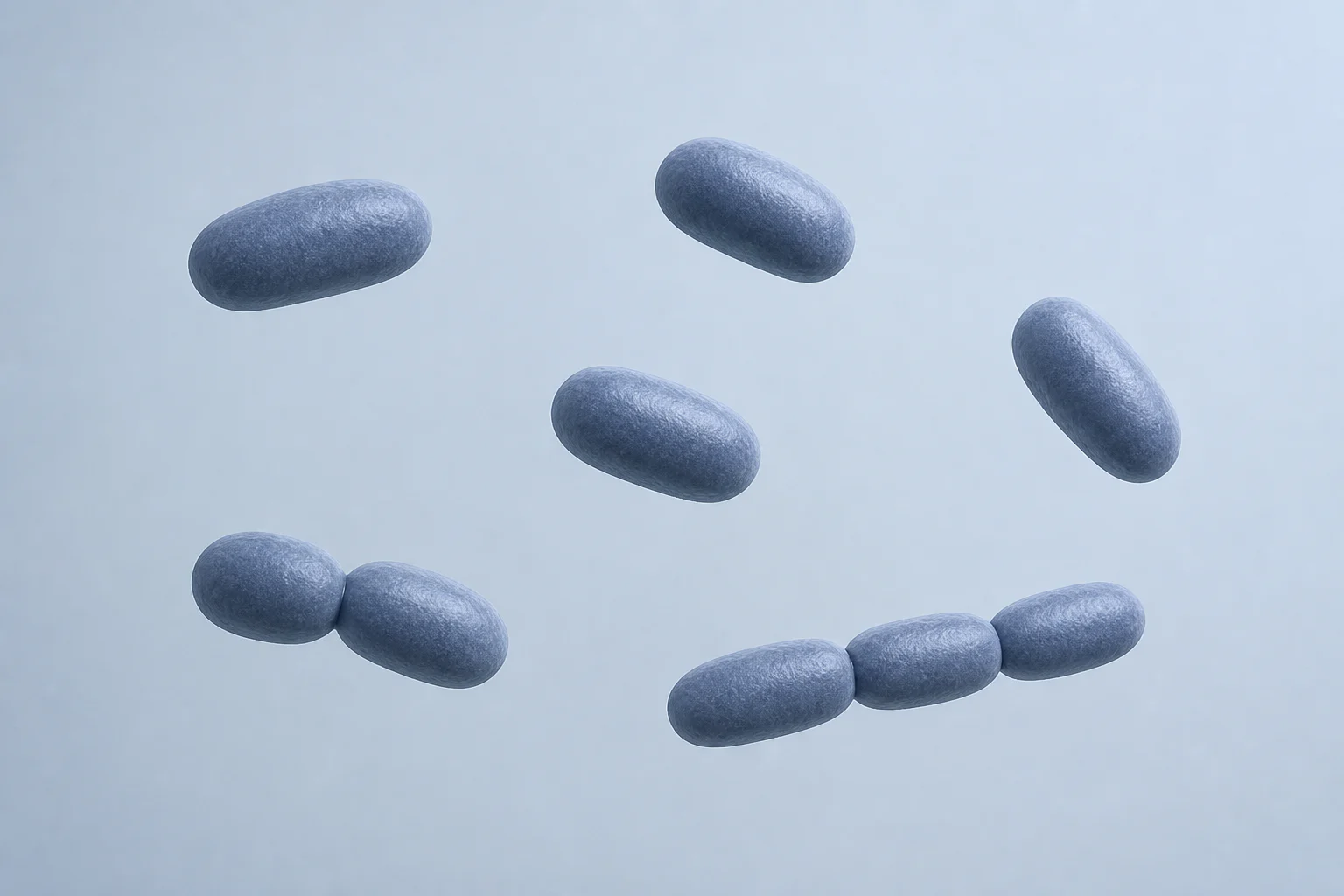
Representative morphology for the current Atopobium genus, centered on A. minutum-like elliptical to short rods. Species now assigned to Lancefieldella or Fannyhessea are outside this image's scope; it is not diagnostic.
Scientific media record1 verified identifier
- Subject
- Atopobiumtaxon · genus
- Identifiers
- NCBITaxon:1380
- Review
- Editorial review completeIdentifiers authority-verified · Accessibility validated · · atopobium|atopobium-morphology-v1.webp
- Digital source
- Trained-algorithmic mediaCreated with a trained generative algorithm and reviewed by WikiBiome for subject identity, scientific framing, identifiers, provenance, and accessibility.
- Scientific basis
- Atopobium — NCBI TaxonomyAtopobium minutum — NCBI TaxonomyAtopobium gen. nov.Atopobium minutum type strain
- License
- CC BY-SA 4.0Created
Atopobium is a genus of obligate anaerobic, Gram-positive bacteria in the phylum Actinobacteria. The primary species of clinical relevance is A. vaginae (recently reclassified as Fannyhessea vaginae), which is one of the hallmark organisms of bacterial vaginosis (BV) and a key partner in Gardnerella biofilms.
Atopobium appears in 20+ files across the WikiBiome vault, predominantly in the context of vaginal and reproductive tract microbiome studies.
Evidence map9 cited passagesInspect provenance +
A. vaginae embeds within Gardnerella-initiated biofilms, where it is protected from antimicrobial agents—this explains the high BV recurrence rate after metronidazole treatment (Gardnerella is susceptible, but Atopobium within the biofilm is resistant).
Produces sialidase—an enzyme that degrades mucin glycans on the vaginal epithelium, compromising the mucosal barrier and facilitating ascending infection.
Enriched in HPV16-positive cervical microbiomes alongside Sneathia, Megasphaera, and Prevotella. The sialidase-mediated mucosal degradation may facilitate HPV access to basal epithelial cells.
Elevated vaginal Atopobium is associated with preterm birth risk, likely through mucosal barrier degradation and ascending inflammation.
Part of the dysbiotic vaginal-peritoneal microbiome signature in ovarian cancer.
Like megasphaera and gardnerella, Atopobium is depleted in cervical samples of endometriosis patients. This is significant because endometriosis is not simply "vaginal dysbiosis"—the cervical community shifts away from the BV consortium toward Enterobacteriaceae enrichment, representing a distinct ecological state.
Genital tract studies in endometriosis consistently show reduced Atopobium.
Atopobium is part of the altered genital-intestinal microbiota in adenomyosis with associated infertility.
Mucosal lactoferrin levels modulate Atopobium colonization in the genital tract—lactoferrin's iron-sequestering function creates selective pressure favoring organisms with iron acquisition strategies. Chlamydia co-infection contexts further alter Atopobium dynamics.
Contents
1. Vaginal Microbiome Role2. Endometriosis—Depletion Pattern3. Adenomyosis and Infertility4. Iron and Lactoferrin Context5. Cross-ReferencesVaginal Microbiome Role#
BV Biofilm Partnership#
A. vaginae is the second most important organism in BV after Gardnerella, forming a polymicrobial biofilm on the vaginal epithelium.
A. vaginae embeds within Gardnerella-initiated biofilms, where it is protected from antimicrobial agents—this explains the high BV recurrence rate after metronidazole treatment (Gardnerella is susceptible, but Atopobium within the biofilm is resistant).[1]Abdelmaksoud 2017 — Association between Statin Use, the Vaginal Microbiome, and Gardnerella vaginalis Vaginolysin-Mediated CytotoxicityAbdelmaksoud AA, Girerd PH, Garcia EM et al. · 2017Open reference 1 ↓
Produces sialidase—an enzyme that degrades mucin glycans on the vaginal epithelium, compromising the mucosal barrier and facilitating ascending infection.[2]Roberts 2019 — Mucosal Lactoferrin Response to Genital Tract Infections Is Associated with Iron and Nutritional BiomarkersS. A. Roberts, L. Brabin, S. Diallo et al. · 2019Open reference 2 ↓
cobalt (Co)-enriched with Megasphaera, Sneathia, and Prevotella in Community State Type IV vaginal microbiomes.
HPV and Cervical Cancer#
Enriched in HPV16-positive cervical microbiomes alongside Sneathia, Megasphaera, and Prevotella.[3]Yang 2020 — Vaginal Microbiome Alterations in HPV16 Infection by Shotgun MetagenomicsQian Yang, Yaping Wang, Xinyi Wei et al. · 2020Open reference 3 ↓ The sialidase-mediated mucosal degradation may facilitate HPV access to basal epithelial cells.
Preterm Birth#
Elevated vaginal Atopobium is associated with preterm birth risk, likely through mucosal barrier degradation and ascending Metal-Driven Inflammation.[4]Pruski & Correia 2021 — Direct On-Swab Metabolic Profiling of Vaginal Microbiome Host Interactions During Pregnancy and Preterm BirthPamela Pruski, Gonçalo D. S. Correia, Holly V. Lewis et al. · 2021Open reference 4 ↓
Ovarian Cancer#
Part of the dysbiotic vaginal-peritoneal microbiome signature in ovarian cancer.[5]Asangba 2023 — Diagnostic and prognostic potential of the microbiome in ovarian cancer treatment responseAsangba AE, Chen J, Goergen KM et al. · 2023Open reference 5 ↓
Endometriosis—Depletion Pattern#
Like Megasphaera and Gardnerella, Atopobium is depleted in cervical samples of endometriosis patients.[6]Ata 2019 — The Endobiota Study: Comparison of Vaginal, Cervical and Gut Microbiota Between Women with Stage 3/4 Endometriosis and Healthy ControlsBaris Ata, Sule Yildiz, Engin Turkgeldi et al. · 2019Open reference 6 ↓[7]Hicks et al. 2025 — Oral, Vaginal, and Stool Microbial Signatures in Patients With Endometriosis as Potential Diagnostic Non-Invasive BiomarkersChloe Hicks, Mathew Leonardi, Xin-Yi Chua et al. · 2025Open reference 7 ↓[8]Ser 2023 — Current Updates on the Role of Microbiome in Endometriosis: A Narrative ReviewHooi-Leng Ser, Siu-Jung Au Yong, Mohamad Nasir Shafiee et al. · 2023Open reference 8 ↓[9]Shen 2022 — Vaginal Microecological Characteristics of Women in Different Physiological and Pathological PeriodsLiping Shen, Wei Zhang, Yi Yuan et al. · 2022Open reference 9 ↓
This is significant because endometriosis is not simply "vaginal Dysbiosis"—the cervical community shifts away from the BV consortium toward Enterobacteriaceae enrichment, representing a distinct ecological state.
Genital tract studies in endometriosis consistently show reduced Atopobium.[10]Hernandes 2020 — Microbiome Profile of Deep Endometriosis Patients: Comparison of Vaginal Fluid, Endometrium and LesionCamila Hernandes, Paola Silveira, Aline Fernanda Rodrigues Sereia et al. · 2020Open reference 10 ↓[11]Miyashira 2022 — The Microbiome and EndometriosisCarlos H Miyashira, Fernanda Reali Oliveira, Marina Paula Andres et al. · 2022Open reference 11 ↓[12]Microbiome of the lower genital tract in Chinese women with endometriosis by 16s-rRNA sequencing technique: a pilot studyChen S, Gu Z, Zhang W et al. · 2020Open reference 12 ↓
Adenomyosis and Infertility#
Atopobium is part of the altered genital-intestinal microbiota in adenomyosis with associated infertility.[13]Ponomaryova 2022 — Changes in microbiota of genital tract and intestines in patients with adenomyosis and infertilityPonomaryova IG, Lisyana TO, Trokhimovych OV et al. · 2022Open reference 13 ↓
Iron and Lactoferrin Context#
Mucosal Lactoferrin levels modulate Atopobium colonization in the genital tract—lactoferrin's iron-sequestering function creates selective pressure favoring organisms with iron acquisition strategies.[2]Roberts 2019 — Mucosal Lactoferrin Response to Genital Tract Infections Is Associated with Iron and Nutritional BiomarkersS. A. Roberts, L. Brabin, S. Diallo et al. · 2019Open reference 2 ↓ Chlamydia co-infection contexts further alter Atopobium dynamics.[14]Chen 2021 — Alterations of vaginal microbiota in women with infertility and Chlamydia trachomatis infectionChen H, Wang L, Zhao L et al. · 2021Open reference 14 ↓
Cross-References#
- Gardnerella—primary BV biofilm partner
- Megasphaera—BV consortium member; co-depleted in endometriosis
- Sneathia—BV consortium member
- Prevotella—BV consortium member
- Endometriosis—depleted in cervical samples
- Lactoferrin—mucosal iron sequestration affects colonization
- Bacterial Vaginosis—hallmark BV organism
- Chlamydia trachomatis—co-infection context alters dynamics
References 14
Numbered by first appearance in the article, then reconciled with its declared source list.
- 1
Abdelmaksoud AA, Girerd PH, Garcia EM et al. (2017). Abdelmaksoud 2017 — Association between Statin Use, the Vaginal Microbiome, and Gardnerella vaginalis Vaginolysin-Mediated Cytotoxicity. PLOS ONE.
- 2
S. A. Roberts, L. Brabin, S. Diallo et al. (2019). Roberts 2019 — Mucosal Lactoferrin Response to Genital Tract Infections Is Associated with Iron and Nutritional Biomarkers. European Journal of Clinical Nutrition.
- 3
Qian Yang, Yaping Wang, Xinyi Wei et al. (2020). Yang 2020 — Vaginal Microbiome Alterations in HPV16 Infection by Shotgun Metagenomics. Frontiers in Cellular and Infection Microbiology.
- 4
Pamela Pruski, Gonçalo D. S. Correia, Holly V. Lewis et al. (2021). Pruski & Correia 2021 — Direct On-Swab Metabolic Profiling of Vaginal Microbiome Host Interactions During Pregnancy and Preterm Birth. Nature Communications.
- 5
Asangba AE, Chen J, Goergen KM et al. (2023). Asangba 2023 — Diagnostic and prognostic potential of the microbiome in ovarian cancer treatment response. Scientific Reports.
- 6
Baris Ata, Sule Yildiz, Engin Turkgeldi et al. (2019). Ata 2019 — The Endobiota Study: Comparison of Vaginal, Cervical and Gut Microbiota Between Women with Stage 3/4 Endometriosis and Healthy Controls. Scientific Reports.
- 7
Chloe Hicks, Mathew Leonardi, Xin-Yi Chua et al. (2025). Hicks et al. 2025 — Oral, Vaginal, and Stool Microbial Signatures in Patients With Endometriosis as Potential Diagnostic Non-Invasive Biomarkers. BJOG: An International Journal of Obstetrics and Gynaecology.
- 8
Hooi-Leng Ser, Siu-Jung Au Yong, Mohamad Nasir Shafiee et al. (2023). Ser 2023 — Current Updates on the Role of Microbiome in Endometriosis: A Narrative Review. Microorganisms.
- 9
Liping Shen, Wei Zhang, Yi Yuan et al. (2022). Shen 2022 — Vaginal Microecological Characteristics of Women in Different Physiological and Pathological Periods. Frontiers in Cellular and Infection Microbiology.
- 10
Camila Hernandes, Paola Silveira, Aline Fernanda Rodrigues Sereia et al. (2020). Hernandes 2020 — Microbiome Profile of Deep Endometriosis Patients: Comparison of Vaginal Fluid, Endometrium and Lesion. Diagnostics.
- 11
Carlos H Miyashira, Fernanda Reali Oliveira, Marina Paula Andres et al. (2022). Miyashira 2022 — The Microbiome and Endometriosis. Reproduction and Fertility.
- 12
Chen S, Gu Z, Zhang W et al. (2020). Microbiome of the lower genital tract in Chinese women with endometriosis by 16s-rRNA sequencing technique: a pilot study. Annals of Translational Medicine.
- 13
Ponomaryova IG, Lisyana TO, Trokhimovych OV et al. (2022). Ponomaryova 2022 — Changes in microbiota of genital tract and intestines in patients with adenomyosis and infertility. Medical Research Journal.
- 14
Chen H, Wang L, Zhao L et al. (2021). Chen 2021 — Alterations of vaginal microbiota in women with infertility and Chlamydia trachomatis infection. Frontiers in Cellular and Infection Microbiology.
Article network
Connect the evidence
Publicly readable discussion by ORCID-authenticated researchers. Questions, interpretation, methods, corrections, and new evidence stay attached to this record.
No discussion yet. Start with a precise question or a source-backed observation.
Published page changes
This record shows only material changes published on this page, including changes to its content, evidence, conclusions, or author context. Internal processes and discussion activity are excluded. Pending, declined, and withdrawn proposals remain private.
- published revision
Created “Atopobium”: Atopobium is a genus of obligate anaerobic, Gram-positive bacteria in the phylum Actinobacteria. The primary species of clinical relevance is A. vaginae (recently reclassified as Fannyhessea vaginae),…
Created “Atopobium”: Atopobium is a genus of obligate anaerobic, Gram-positive bacteria in the phylum Actinobacteria. The primary species of clinical relevance is A. vaginae (recently reclassified as Fannyhessea vaginae),… Published sections: Atopobium; BV Biofilm Partnership; HPV and Cervical Cancer; Preterm Birth; Ovarian Cancer; Endometriosis — Depletion Pattern; Adenomyosis and Infertility; Iron and Lactoferrin Context; Cross-References. · WikiBiome Deploy Bot · +86 −0
Inspect exact Git diff ↗