

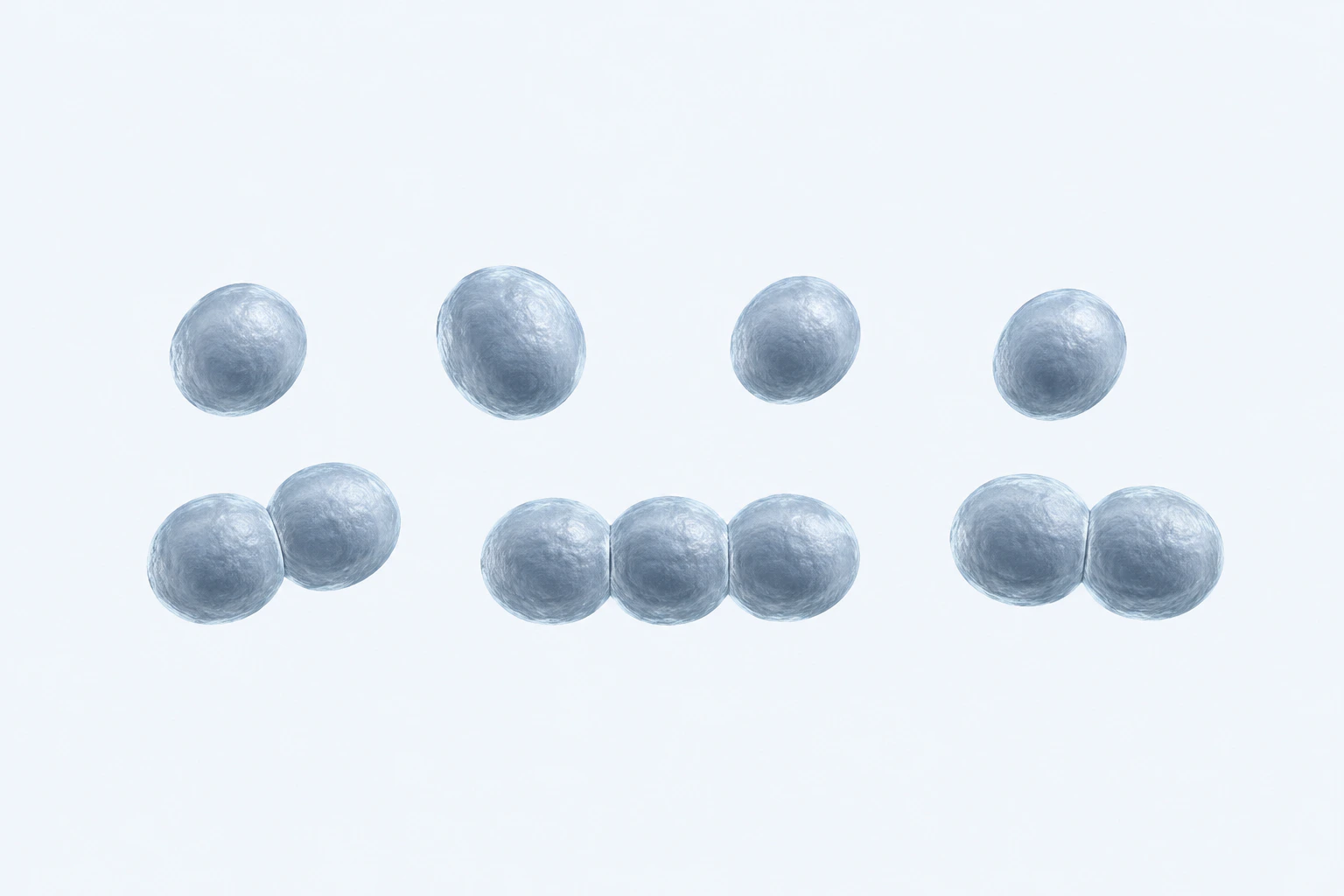
Type-species-anchored Megasphaera spherical-to-slightly-ovoid cells, shown as eleven bodies in four single, two paired, and one short-chain grouping. This scientific reconstruction is representative, non-universal, non-diagnostic, and not a micrograph.
Scientific media record1 verified identifier
- Subject
- Megasphaerataxon · genus
- Identifiers
- NCBITaxon:906
- Review
- Editorial review completeIdentifiers authority-verified · Accessibility validated · · megasphaera|megasphaera-morphology-v1.webp
- Digital source
- Trained-algorithmic mediaCreated with a trained generative algorithm and reviewed by WikiBiome for subject identity, scientific framing, identifiers, provenance, and accessibility.
- Scientific basis
- Megasphaera — NCBI TaxonomyMegasphaera — LPSNMegasphaera genus transferMegasphaera elsdenii morphologyMegasphaera indica description
- License
- CC BY-SA 4.0Created
Megasphaera is a genus of obligate anaerobic, Gram-negative bacteria in the family Veillonellaceae (class Negativicutes, phylum Firmicutes). The genus occupies two distinct ecological niches—the vaginal microbiome (where it is a hallmark of bacterial vaginosis) and the Gut Microbiome (where it functions as a beneficial SCFA producer).
This dual role makes Megasphaera one of the most context-dependent organisms in the WikiBiome knowledge graph.
Evidence map8 cited passagesInspect provenance +
Enriched in HPV16-positive cervical microbiomes alongside Sneathia, Prevotella, and Atopobium.
Associated with preterm birth risk when elevated in vaginal samples.
Counterintuitively, Megasphaera is depleted (not enriched) in cervical samples from endometriosis patients, alongside Gardnerella, Atopobium, and Prevotella, while Escherichia/Shigella and Dialister increased. This suggests the endometriosis cervical microbiome is not simply "more dysbiotic" but represents a distinct ecological shift away from the BV-associa
Vaginal microecological characteristics in endometriosis show reduced Megasphaera compared to controls.
Enriched in ASD gut microbiota in some studies.
Altered in premenstrual disorders.
Depleted in Graves' disease gut microbiota.
Altered in postpartum depression.
Contents
1. Vaginal Microbiome—BV Association2. Gut Microbiome—SCFA Producer3. The Context-Dependence Problem4. Cross-ReferencesVaginal Microbiome—BV Association#
Megasphaera is one of the BV-associated bacteria (BVAB) consistently enriched when Lactobacillus-dominant vaginal communities shift toward Dysbiosis.
Part of the Gardnerella-Atopobium-Megasphaera-Prevotella-Sneathia consortium that characterizes bacterial vaginosis and Community State Type IV (CST-IV) vaginal microbiomes. Enriched in HPV16-positive cervical microbiomes alongside Sneathia, Prevotella, and Atopobium.[1]Yang 2020 — Vaginal Microbiome Alterations in HPV16 Infection by Shotgun MetagenomicsQian Yang, Yaping Wang, Xinyi Wei et al. · 2020Open reference 1 ↓
Associated with preterm birth risk when elevated in vaginal samples.[2]Pruski & Correia 2021 — Direct On-Swab Metabolic Profiling of Vaginal Microbiome Host Interactions During Pregnancy and Preterm BirthPamela Pruski, Gonçalo D. S. Correia, Holly V. Lewis et al. · 2021Open reference 2 ↓
Endometriosis—Cervical Depletion#
Counterintuitively, Megasphaera is depleted (not enriched) in cervical samples from endometriosis patients, alongside Gardnerella, Atopobium, and Prevotella, while Escherichia/Shigella and Dialister increased.[3]Ata 2019 — The Endobiota Study: Comparison of Vaginal, Cervical and Gut Microbiota Between Women with Stage 3/4 Endometriosis and Healthy ControlsBaris Ata, Sule Yildiz, Engin Turkgeldi et al. · 2019Open reference 3 ↓[4]Hicks et al. 2025 — Oral, Vaginal, and Stool Microbial Signatures in Patients With Endometriosis as Potential Diagnostic Non-Invasive BiomarkersChloe Hicks, Mathew Leonardi, Xin-Yi Chua et al. · 2025Open reference 4 ↓[5]Ser 2023 — Current Updates on the Role of Microbiome in Endometriosis: A Narrative ReviewHooi-Leng Ser, Siu-Jung Au Yong, Mohamad Nasir Shafiee et al. · 2023Open reference 5 ↓
This suggests the endometriosis cervical microbiome is not simply "more dysbiotic" but represents a distinct ecological shift away from the BV-associated community.
- Vaginal microecological characteristics in endometriosis show reduced Megasphaera compared to controls.[6]Shen 2022 — Vaginal Microecological Characteristics of Women in Different Physiological and Pathological PeriodsLiping Shen, Wei Zhang, Yi Yuan et al. · 2022Open reference 6 ↓[7]Miyashira 2022 — The Microbiome and EndometriosisCarlos H Miyashira, Fernanda Reali Oliveira, Marina Paula Andres et al. · 2022Open reference 7 ↓
Gut Microbiome—SCFA Producer#
In the gut, Megasphaera plays a different role as a Butyrate and propionate producer.
M. elsdenii is one of the most efficient lactate-utilizing organisms in the gut, converting lactate to butyrate and propionate via the acrylate pathway. Enriched in ASD gut microbiota in some studies.[8]Liu 2019 — Altered Gut Microbiota and Short Chain Fatty Acids in Chinese Children with Autism Spectrum DisorderSimeng Liu, Enyao Li, Zhenyu Sun et al. · 2019Open reference 8 ↓ Altered in premenstrual disorders.[9]Takeda 2022 — Gut Microbiota in Women with Premenstrual SymptomsTakashi Takeda, Kana Yoshimi, Sayaka Kai et al. · 2022Open reference 9 ↓
Depleted in Graves' disease gut microbiota.[10]Alteration in gut microbiota is associated with immune imbalance in Graves' diseaseSu X, Yin X, Liu Y et al. · 2020Open reference 10 ↓ Altered in postpartum depression.[11]Zhou 2020 — Fecal Microbiota Changes in Patients With Postpartum Depressive DisorderYumei Zhou, Chen Chen, Haibo Yu et al. · 2020Open reference 11 ↓
The Context-Dependence Problem#
Megasphaera illustrates why genus-level classification as "beneficial" or "pathogenic" fails:
| Niche | Role | Implication |
|---|---|---|
| Vagina (Lactobacillus-depleted) | BV-associated pathobiont | Drives inflammatory cascade, preterm birth risk |
| Vagina (endometriosis) | Depleted | Loss is part of endometriosis-specific cervical shift |
| Gut (healthy) | Lactate-utilizing butyrate producer | Contributes to SCFA pool and barrier integrity |
| Gut (ASD) | Enriched | Possibly compensatory overgrowth; unclear if cause or effect |
Site-specific and disease-specific context determines whether Megasphaera presence is protective, pathological, or incidental.
Cross-References#
- Gardnerella—co-enriched in BV; co-depleted in endometriosis cervical samples
- Atopobium—BV consortium partner
- Sneathia—BV consortium partner
- Prevotella—BV consortium partner; also context-dependent
- Lactobacillus crispatus—Megasphaera expansion inversely correlated with L. crispatus dominance
- butyrate—gut Megasphaera contributes to butyrate production via lactate utilization
- Endometriosis—cervical depletion pattern
- Bacterial Vaginosis—hallmark BV-associated genus
References 13
Numbered by first appearance in the article, then reconciled with its declared source list.
- 1
Qian Yang, Yaping Wang, Xinyi Wei et al. (2020). Yang 2020 — Vaginal Microbiome Alterations in HPV16 Infection by Shotgun Metagenomics. Frontiers in Cellular and Infection Microbiology.
- 2
Pamela Pruski, Gonçalo D. S. Correia, Holly V. Lewis et al. (2021). Pruski & Correia 2021 — Direct On-Swab Metabolic Profiling of Vaginal Microbiome Host Interactions During Pregnancy and Preterm Birth. Nature Communications.
- 3
Baris Ata, Sule Yildiz, Engin Turkgeldi et al. (2019). Ata 2019 — The Endobiota Study: Comparison of Vaginal, Cervical and Gut Microbiota Between Women with Stage 3/4 Endometriosis and Healthy Controls. Scientific Reports.
- 4
Chloe Hicks, Mathew Leonardi, Xin-Yi Chua et al. (2025). Hicks et al. 2025 — Oral, Vaginal, and Stool Microbial Signatures in Patients With Endometriosis as Potential Diagnostic Non-Invasive Biomarkers. BJOG: An International Journal of Obstetrics and Gynaecology.
- 5
Hooi-Leng Ser, Siu-Jung Au Yong, Mohamad Nasir Shafiee et al. (2023). Ser 2023 — Current Updates on the Role of Microbiome in Endometriosis: A Narrative Review. Microorganisms.
- 6
Liping Shen, Wei Zhang, Yi Yuan et al. (2022). Shen 2022 — Vaginal Microecological Characteristics of Women in Different Physiological and Pathological Periods. Frontiers in Cellular and Infection Microbiology.
- 7
Carlos H Miyashira, Fernanda Reali Oliveira, Marina Paula Andres et al. (2022). Miyashira 2022 — The Microbiome and Endometriosis. Reproduction and Fertility.
- 8
Simeng Liu, Enyao Li, Zhenyu Sun et al. (2019). Liu 2019 — Altered Gut Microbiota and Short Chain Fatty Acids in Chinese Children with Autism Spectrum Disorder. Scientific Reports.
- 9
Takashi Takeda, Kana Yoshimi, Sayaka Kai et al. (2022). Takeda 2022 — Gut Microbiota in Women with Premenstrual Symptoms. PLOS ONE.
- 10
Su X, Yin X, Liu Y et al. (2020). Alteration in gut microbiota is associated with immune imbalance in Graves' disease. EBioMedicine.
- 11
Yumei Zhou, Chen Chen, Haibo Yu et al. (2020). Zhou 2020 — Fecal Microbiota Changes in Patients With Postpartum Depressive Disorder. Frontiers in Cellular and Infection Microbiology.
- 12
Chen H, Wang L, Zhao L et al. (2021). Chen 2021 — Alterations of vaginal microbiota in women with infertility and Chlamydia trachomatis infection. Frontiers in Cellular and Infection Microbiology.
- 13
Si Xian Ho, Jia-Hao Law, Chin-Wen Png et al. (2024). Alterations in colorectal cancer virome and its persistence after surgery. Scientific Reports.
Article network
Connect the evidence
Publicly readable discussion by ORCID-authenticated researchers. Questions, interpretation, methods, corrections, and new evidence stay attached to this record.
No discussion yet. Start with a precise question or a source-backed observation.
Published page changes
This record shows only material changes published on this page, including changes to its content, evidence, conclusions, or author context. Internal processes and discussion activity are excluded. Pending, declined, and withdrawn proposals remain private.
- published revision
Added “Megasphaera”: Megasphaera is a genus of obligate anaerobic, Gram-negative bacteria in the family Veillonellaceae (class Negativicutes, phylum Firmicutes). The genus occupies two distinct ecological niches — the…
Added “Megasphaera”: Megasphaera is a genus of obligate anaerobic, Gram-negative bacteria in the family Veillonellaceae (class Negativicutes, phylum Firmicutes). The genus occupies two distinct ecological niches — the… Added “Vaginal Microbiome — BV Association”: Megasphaera is one of the BV-associated bacteria (BVAB) consistently enriched when Lactobacillus-dominant vaginal communities shift toward dysbiosis: - Part of the… Added “Endometriosis — Cervical Depletion”: Counterintuitively, Megasphaera is depleted (not enriched) in cervical samples from endometriosis patients, alongside Gardnerella, Atopobium, and Prevotella, while Escherichia/Shigella and Dialister… Added “Gut Microbiome — SCFA Producer”: In the gut, Megasphaera plays a different role as a butyrate and propionate producer: - M. elsdenii is one of the most efficient lactate-utilizing organisms in the gut, converting lactate to butyrate… Added “The Context-Dependence Problem”: Megasphaera illustrates why genus-level classification as "beneficial" or "pathogenic" fails: | Niche | Role | Implication | |-------|------|-------------| | Vagina (Lactobacillus-depleted) |… Added “Cross-References”: - gardnerella — co-enriched in BV; co-depleted in endometriosis cervical samples - atopobium — BV consortium partner - sneathia — BV consortium partner - prevotella — BV consortium partner; also… Added citations to “Vaginal Microbiome — BV Association”: yang 2020 vaginal microbiome hpv16 shotgun metagenomics; pruski 2021 desi ms vaginal microbiome preterm birth. Added citations to “Endometriosis — Cervical Depletion”: ata 2019 endobiota study vaginal cervical gut microbiota endometriosis; hicks 2025 oral vaginal stool microbial signatures endometriosis; ser 2023 current updates microbiome endometriosis review; shen 2022 vaginal microecological characteristics endometriosis; miyashira 2022 microbiome and endometriosis. Added citations to “Gut Microbiome — SCFA Producer”: liu 2019 altered gut microbiota scfa chinese children asd; takeda 2022 gut microbiota premenstrual symptoms; su 2020 gut microbiota immune imbalance graves; zhou 2020 fecal microbiota ppd. Added references: ata-2019-endobiota-study-vaginal-cervical-gut-microbiota-endometriosis; hicks-2025-oral-vaginal-stool-microbial-signatures-endometriosis; ser-2023-current-updates-microbiome-endometriosis-review; shen-2022-vaginal-microecological-characteristics-endometriosis; miyashira-2022-microbiome-and-endometriosis; yang-2020-vaginal-microbiome-hpv16-shotgun-metagenomics; pruski-2021-desi-ms-vaginal-microbiome-preterm-birth; chen-2021-chlamydia-vaginal-microbiota-tubal-infertility; liu-2019-altered-gut-microbiota-scfa-chinese-children-asd; takeda-2022-gut-microbiota-premenstrual-symptoms; su-2020-gut-microbiota-immune-imbalance-graves; ho-2024-colorectal-cancer-virome-alterations-persistence-surgery; zhou-2020-fecal-microbiota-ppd. Added key enzymes: butyrate-kinase; butyryl-CoA-transferase. Added metal dependencies: iron. · WikiBiome Deploy Bot · +77 −12
Inspect exact Git diff ↗ - published revision
Created “Megasphaera”:
Created “Megasphaera”: · WikiBiome Deploy Bot · +21 −0
Inspect exact Git diff ↗