

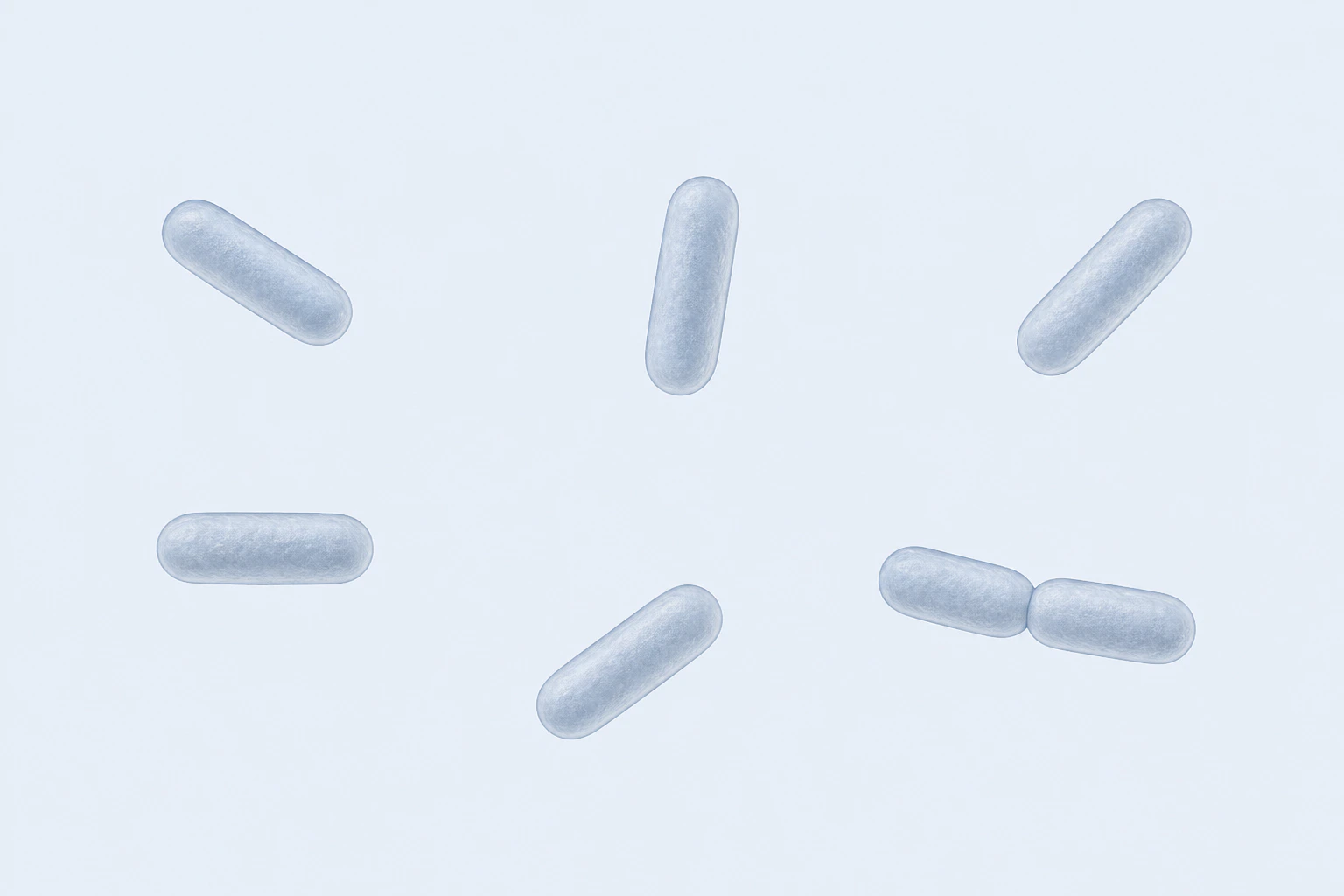
Representative Citrobacter short-rod morphology, shown as seven bodies in six single or paired groupings. This genus-level reconstruction is non-diagnostic and is not a micrograph.
Scientific media record1 verified identifier
- Subject
- Citrobactertaxon · genus
- Identifiers
- NCBITaxon:544
- Review
- Editorial review completeIdentifiers authority-verified · Accessibility validated · · citrobacter|citrobacter-morphology-v1.webp
- Digital source
- Trained-algorithmic mediaCreated with a trained generative algorithm and reviewed by WikiBiome for subject identity, scientific framing, identifiers, provenance, and accessibility.
- Scientific basis
- Citrobacter — NCBI TaxonomyCitrobacter — LPSNCitrobacter freundii type strain — BacDiveCitrobacter freundii type-strain genome report
- License
- CC BY-SA 4.0Created
Citrobacter is a genus of Gram-negative, facultatively anaerobic bacteria in the Enterobacteriaceae family, named for its ability to utilize citrate as a sole carbon source. Species include C. freundii, C. koseri, and C. rodentium (a mouse model for EHEC infection).
In the WikiBiome context, Citrobacter is notable as an opportunistic pathogen enriched in multiple disease signatures—particularly necrotizing enterocolitis, colorectal cancer, and CKD—and as an organism with significant arsenic biotransformation capacity.
Evidence map9 cited passagesInspect provenance +
Like other Enterobacteriaceae, Citrobacter produces enterobactin and other siderophores for iron acquisition. Iron availability in the inflamed gut favors Citrobacter expansion alongside E. coli and Klebsiella, contributing to the characteristic Enterobacteriaceae bloom in dysbiosis.
C. freundii harbors NiFe hydrogenase for anaerobic hydrogen oxidation, linking it to the nickel-dependent pathogen network in this wiki.
Citrobacter species possess arsenic reductase and methyltransferase enzymes that convert inorganic arsenic to organic forms. This biotransformation capacity means Citrobacter abundance directly affects arsenic speciation and toxicity in the gut.
Citrobacter is enriched in the preterm infant gut prior to NEC onset, as part of the Enterobacteriaceae bloom that precedes intestinal necrosis. Iron and nickel availability in preterm formula may fuel this expansion.
Enriched in CRC microbiome alongside other Enterobacteriaceae. C. rodentium is the standard mouse model for studying colonic epithelial attachment and effacement—the mechanism by which EHEC causes colitis and promotes tumorigenesis.
Citrobacter enrichment correlates with CKD severity and uremic toxin accumulation.
Part of the dysbiotic gut microbiota in endometriosis mouse models.
Enriched in pancreatic cancer-associated microbiome.
Metallomics relevance in critical care infections.
Metal Dependencies#
Iron#
Like other Enterobacteriaceae, Citrobacter produces enterobactin and other siderophores for iron acquisition. Iron availability in the inflamed gut favors Citrobacter expansion alongside E. coli and Klebsiella, contributing to the characteristic Enterobacteriaceae bloom in Dysbiosis.[1]Khorsand 2022 — Overrepresentation of Enterobacteriaceae and Escherichia coli is the major gut microbiome signature in Crohn's and UC: comprehensive metagenomic analysis of IBDMDB datasetsBabak Khorsand, Hamid Asadzadeh Aghdaei, Ehsan Nazemalhosseini-Mojarad et al. · 2022Open reference 1 ↓
Nickel#
C. freundii harbors NiFe Hydrogenase for anaerobic hydrogen oxidation, linking it to the nickel-dependent pathogen network in this wiki.[2]Nickel as a Catalytic Driver of Necrotizing Enterocolitis: Dietary Nickel, Microbial Metallomics, and the Activation of Nickel-Dependent Virulence Pathways in the Preterm GutKaren Pendergrass · 2026Open reference 2 ↓
Arsenic Biotransformation#
Citrobacter species possess arsenic reductase and methyltransferase enzymes that convert inorganic arsenic to organic forms. This biotransformation capacity means Citrobacter abundance directly affects arsenic speciation and toxicity in the gut.[3]Arsenic and the gastrointestinal tract microbiomeMcDermott TR, Stolz JF, Oremland RS · 2020Open reference 3 ↓
Conditions Associated#
Necrotizing Enterocolitis (NEC)#
Citrobacter is enriched in the preterm infant gut prior to NEC onset, as part of the Enterobacteriaceae bloom that precedes intestinal necrosis.[2]Nickel as a Catalytic Driver of Necrotizing Enterocolitis: Dietary Nickel, Microbial Metallomics, and the Activation of Nickel-Dependent Virulence Pathways in the Preterm GutKaren Pendergrass · 2026Open reference 2 ↓[4]Lin 2025 — Integrated serum metabolomics and fecal microbiome in NEC infantsZhi-ying Lin, Shan-shan He, Zi-tong Mo et al. · 2025Open reference 4 ↓ Iron and nickel availability in preterm formula may fuel this expansion.
Colorectal Cancer#
Enriched in CRC microbiome alongside other Enterobacteriaceae.[5]Towards the Human Colorectal Cancer MicrobiomeMarchesi JR, Dutilh BE, Hall N et al. · 2011Open reference 5 ↓[6]Identification of colorectal cancer progression-associated intestinal microbiome and predictive signature constructionJungang Liu, Xiaoliang Huang, Chuanbin Chen et al. · 2023Open reference 6 ↓ C. rodentium is the standard mouse model for studying colonic epithelial attachment and effacement—the mechanism by which EHEC causes colitis and promotes tumorigenesis.
Chronic Kidney Disease#
Citrobacter enrichment correlates with CKD severity and uremic toxin accumulation.[7]Wang 2023 — Perturbed Gut Microbiome and Metabolomes Across CKD SeverityWang, Li, Zhang et al. · 2023Open reference 7 ↓[8]Gut Microbiota Composition and Frailty in Elderly Patients with Chronic Kidney DiseaseElisabetta Margiotta, Francesco Miragoli, Maria Luisa Callegari et al. · 2020Open reference 8 ↓
Other#
Part of the dysbiotic gut microbiota in endometriosis mouse models.[9]Ni 2020 — Fecal Metabolomics and Gut Microbiota Correlation in Endometriosis MiceZhexin Ni, Shuai Sun, Yanli Bi et al. · 2020Open reference 9 ↓ Enriched in pancreatic cancer-associated microbiome.[10]Microbiome as a biomarker and therapeutic target in pancreatic cancerGhazaleh Pourali, Danial Kazemi, Amir Shayan Chadeganipour et al. · 2024Open reference 10 ↓ Metallomics relevance in critical care infections.[11]Infection metallomics for critical care in the post-COVID eraPatil RH, Luptakova D, Havlicek V · 2021Open reference 11 ↓
Cross-References#
- Enterobacteriaceae—family-level bloom in dysbiosis
- Iron—siderophore-dependent; iron availability drives expansion
- Nickel—NiFe-hydrogenase for anaerobic hydrogen oxidation
- Arsenic—biotransformation capacity affects gut arsenic speciation
- Siderophores—enterobactin production
- Necrotizing Enterocolitis—preterm gut enrichment
- Colorectal Cancer—enriched in CRC microbiome
- Chronic Kidney Disease—correlates with disease severity
References 12
Numbered by first appearance in the article, then reconciled with its declared source list.
- 1
Babak Khorsand, Hamid Asadzadeh Aghdaei, Ehsan Nazemalhosseini-Mojarad et al. (2022). Khorsand 2022 — Overrepresentation of Enterobacteriaceae and Escherichia coli is the major gut microbiome signature in Crohn's and UC: comprehensive metagenomic analysis of IBDMDB datasets. Frontiers in Cellular and Infection Microbiology.
- 2
Karen Pendergrass (2026). Nickel as a Catalytic Driver of Necrotizing Enterocolitis: Dietary Nickel, Microbial Metallomics, and the Activation of Nickel-Dependent Virulence Pathways in the Preterm Gut. Zenodo Preprint.
- 3
McDermott TR, Stolz JF, Oremland RS (2020). Arsenic and the gastrointestinal tract microbiome. Environmental Microbiology Reports.
- 4
Zhi-ying Lin, Shan-shan He, Zi-tong Mo et al. (2025). Lin 2025 — Integrated serum metabolomics and fecal microbiome in NEC infants. Frontiers in Microbiology.
- 5
Marchesi JR, Dutilh BE, Hall N et al. (2011). Towards the Human Colorectal Cancer Microbiome. PLOS ONE.
- 6
Jungang Liu, Xiaoliang Huang, Chuanbin Chen et al. (2023). Identification of colorectal cancer progression-associated intestinal microbiome and predictive signature construction. Journal of Translational Medicine.
- 7
Wang, Li, Zhang et al. (2023). Wang 2023 — Perturbed Gut Microbiome and Metabolomes Across CKD Severity. Microbiome.
- 8
Elisabetta Margiotta, Francesco Miragoli, Maria Luisa Callegari et al. (2020). Gut Microbiota Composition and Frailty in Elderly Patients with Chronic Kidney Disease. PLOS ONE.
- 9
Zhexin Ni, Shuai Sun, Yanli Bi et al. (2020). Ni 2020 — Fecal Metabolomics and Gut Microbiota Correlation in Endometriosis Mice. American Journal of Reproductive Immunology.
- 10
Ghazaleh Pourali, Danial Kazemi, Amir Shayan Chadeganipour et al. (2024). Microbiome as a biomarker and therapeutic target in pancreatic cancer. BMC Microbiology.
- 11
★Patil RH, Luptakova D, Havlicek V (2021). Infection metallomics for critical care in the post-COVID era. Mass Spectrometry Reviews.
- 12
Khan F, Rizvi M, Shukla I et al. (2011). A Novel Approach for Identification of Members of Enterobacteriaceae Isolated from Clinical Samples. Biology and Medicine.
Article network
Connect the evidence
Publicly readable discussion by ORCID-authenticated researchers. Questions, interpretation, methods, corrections, and new evidence stay attached to this record.
No discussion yet. Start with a precise question or a source-backed observation.
Published page changes
This record shows only material changes published on this page, including changes to its content, evidence, conclusions, or author context. Internal processes and discussion activity are excluded. Pending, declined, and withdrawn proposals remain private.
- published revision
Revised “Nickel”: now reads “C. freundii harbors NiFe hydrogenase for anaerobic hydrogen oxidation, linking it”.
Revised “Nickel”: changed “C. freundii harbors NiFe-hydrogenase for anaerobic hydrogen oxidation, linking it” to “C. freundii harbors NiFe hydrogenase for anaerobic hydrogen oxidation, linking it”. · Karen Pendergrass · +1 −1
Inspect exact Git diff ↗ - published revision
Added “Citrobacter”: Citrobacter is a genus of Gram-negative, facultatively anaerobic bacteria in the Enterobacteriaceae family, named for its ability to utilize citrate as a sole carbon source. Species include C.…
Added “Citrobacter”: Citrobacter is a genus of Gram-negative, facultatively anaerobic bacteria in the Enterobacteriaceae family, named for its ability to utilize citrate as a sole carbon source. Species include C.… Added “Iron”: Like other Enterobacteriaceae, Citrobacter produces enterobactin and other siderophores for iron acquisition. Iron availability in the inflamed gut favors Citrobacter expansion alongside E. coli and… Added “Nickel”: C. freundii harbors NiFe-hydrogenase for anaerobic hydrogen oxidation, linking it to the nickel-dependent pathogen network in this wiki. Added “Arsenic Biotransformation”: Citrobacter species possess arsenic reductase and methyltransferase enzymes that convert inorganic arsenic to organic forms. This biotransformation capacity means Citrobacter abundance directly… Added “Necrotizing Enterocolitis (NEC)”: Citrobacter is enriched in the preterm infant gut prior to NEC onset, as part of the Enterobacteriaceae bloom that precedes intestinal necrosis. Iron and nickel availability in preterm formula may… Added “Colorectal Cancer”: Enriched in CRC microbiome alongside other Enterobacteriaceae. C. rodentium is the standard mouse model for studying colonic epithelial attachment and effacement — the mechanism by which EHEC causes… Added “Chronic Kidney Disease”: Citrobacter enrichment correlates with CKD severity and uremic toxin accumulation. Added “Other”: - Part of the dysbiotic gut microbiota in endometriosis mouse models. - Enriched in pancreatic cancer-associated microbiome. - Metallomics relevance in critical care infections. Added “Cross-References”: - enterobacteriaceae — family-level bloom in dysbiosis - iron — siderophore-dependent; iron availability drives expansion - nickel — NiFe-hydrogenase for anaerobic hydrogen oxidation - arsenic —… Added citations to “Iron”: khorsand 2022 enterobacteriaceae ecoli ibd ibdmdb metagenomics. Added citations to “Nickel”: pendergrass 2026 nickel nec preterm gut. Added citations to “Arsenic Biotransformation”: mcdermott 2020 arsenic gastrointestinal tract microbiome. Added citations to “Necrotizing Enterocolitis (NEC)”: pendergrass 2026 nickel nec preterm gut; lin 2025 nec serum metabolomics fecal microbiome. Added citations to “Colorectal Cancer”: marchesi 2011 towards human crc microbiome; liu 2023 colorectal cancer progression microbiome signature. Added citations to “Chronic Kidney Disease”: wang 2023 perturbed microbiome metabolomes ckd severity; margiotta 2020 gut microbiota frailty elderly ckd. Added citations to “Other”: ni 2020 fecal metabolomics gut microbiota endometriosis mice; pourali 2024 microbiome biomarker therapeutic target pancreatic cancer; patil 2021 infection metallomics critical care. Added references: khorsand-2022-enterobacteriaceae-ecoli-ibd-ibdmdb-metagenomics; pendergrass-2026-nickel-nec-preterm-gut; lin-2025-nec-serum-metabolomics-fecal-microbiome; marchesi-2011-towards-human-crc-microbiome; liu-2023-colorectal-cancer-progression-microbiome-signature; wang-2023-perturbed-microbiome-metabolomes-ckd-severity; margiotta-2020-gut-microbiota-frailty-elderly-ckd; mcdermott-2020-arsenic-gastrointestinal-tract-microbiome; patil-2021-infection-metallomics-critical-care; khan-2011-novel-approach-enterobacteriaceae-identification-clinical; ni-2020-fecal-metabolomics-gut-microbiota-endometriosis-mice; pourali-2024-microbiome-biomarker-therapeutic-target-pancreatic-cancer. Added key enzymes: enterobactin; citrate-lyase; NiFe-hydrogenase. Added metal dependencies: iron; nickel. · WikiBiome Deploy Bot · +73 −12
Inspect exact Git diff ↗ - published revision
Created “Citrobacter”:
Created “Citrobacter”: · WikiBiome Deploy Bot · +21 −0
Inspect exact Git diff ↗