
 metals · microbes · host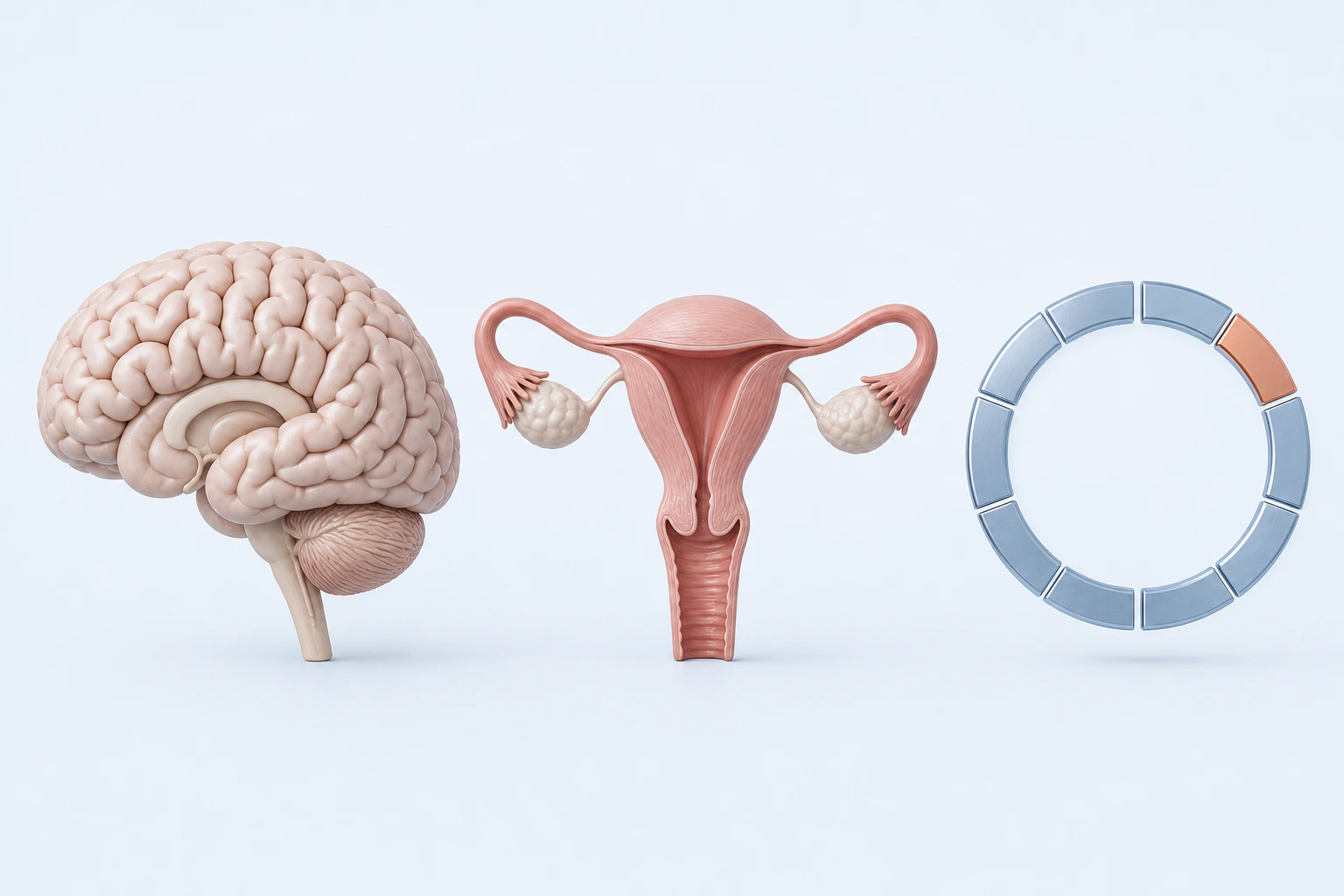
PMDD orientation without symptom caricature, hormone-level, mechanism, fixed-timing, severity, prognosis, or diagnostic claims.
Scientific media record1 verified identifier
- Subject
- Premenstrual Dysphoric Disordercondition
- Identifiers
- MeSH:D065446
- Review
- Editorial review completeIdentifiers authority-verified · Accessibility validated · · pmdd|pmdd-pathology-v1.webp
- Digital source
- Trained-algorithmic mediaCreated with a trained generative algorithm and reviewed by WikiBiome for subject identity, scientific framing, identifiers, provenance, and accessibility.
- License
- CC BY-SA 4.0Created
Premenstrual Dysphoric Disorder (PMDD) affects 3-8% of menstruating individuals Epperson et al. 2012, causing severe mood disturbances, irritability, anxiety, and physical symptoms during the luteal phase of the menstrual cycle.
Distinguished from premenstrual syndrome (PMS) by the severity of affective symptoms, PMDD is increasingly recognized as a neuroimmune disorder in which Gut Microbiome composition modulates hormonal sensitivity, tryptophan metabolism, and GABAergic neurotransmission.
Evidence map9 cited passagesInspect provenance +
Reduced melatonin AUC in the luteal phase—supported by 4 of 8 studies in a systematic review (, systematic review, 25 studies); earlier melatonin offset time also observed
Elevated nocturnal core body temperature throughout the entire menstrual cycle (not confined to the luteal phase)—suggests a persistent circadian state alteration rather than purely a hormonal-phase phenomenon ()
Sleep architecture disruption: increased slow-wave sleep (SWS), reduced Stage 1 sleep, longer REM sleep latency, and significantly worse subjective sleep quality in the late luteal phase ()
Higher prolactin peak throughout the menstrual cycle in PMDD; earlier TSH acrophase—suggesting broader neuroendocrine circadian disruption ()
BRIAN scale assessment: PMDD patients scored higher in all four biological rhythm disruption domains—sleep, social rhythms, activity, and eating—compared to healthy controls ()
Diabetes mellitus increases PMS/PMDD incidence via shared disruption of estrogen, progesterone, serotonin, and GABA—the same neuroendocrine mediators implicated in PMDD pathophysiology (, narrative review). The shared mechanism runs through:
Gut dysbiosis as bridge: DM disrupts gut microbiota, reducing SCFAs and serotonin that guard against PMDD severity ()
Bidirectional hormonal dysregulation: estrogen/progesterone fluctuations can impair glucose control in diabetic women, while chronic hyperglycemia disrupts hormonal balance ()
Insulin resistance as a common downstream pathway—present in both DM and PMDD independently ()
One disease. Five evidence layers.
A generated systems view of the metals, organisms, host sequestration signals, ecological conditions, and microbial functions indexed for Premenstrual Dysphoric Disorder.
Evidence layer
Taxonomic signature
Organisms reported as enriched or depleted, with their indexed functional context kept beside the name.Enriched in PMDD — functional significance under investigation
MR-validated causal association (OR=1.004); LPS production drives inflammatory signaling during luteal phase
Butyrate producer — loss reduces colonocyte health and anti-inflammatory signaling
Valerate and SCFA producer — abundance inversely predicts symptom severity
Depleted; abundance inversely predicts symptom severity (R2=0.29 combined with Megasphaera)
MR-validated protective taxon (OR=0.994); acetate/propionate producer; loss reduces anti-inflammatory signaling
Presumed depleted based on shared signature with depression; butyrate producer
Evidence layer
Nutritional immunity
Host metal-withholding, inflammatory, antioxidant, and microbial-metabolite signals indexed in the signature.Elevated host signals
4Depleted protective signals
5Evidence layer
Ecological state
The environmental conditions that connect the organism-level observations into a system.Evidence layer
Virulence functions
Microbial structures, enzymes, and acquisition systems implicated by the linked evidence.The disease record, in full.
The original WikiBiome disease narrative remains intact beneath the generated signature atlas.
Microbiome Associations#
Taxonomic Shifts#
The gut microbiome of PMDD patients shows a distinctive pattern of depletion in taxa that regulate short-chain fatty acid production and immune tolerance. Bacteroidetes—phylum-level depletion correlates with symptom severity (P = 0.015) Takeda et al. 2022, suggesting a dose-response relationship between microbial diversity loss and mood disruption.
Parabacteroides—depleted; its abundance inversely predicts symptom severity (R2 = 0.29 combined with Megasphaera) Takeda et al. 2022, making it a candidate biomarker.
Megasphaera—depleted; produces valerate and other SCFAs that support barrier integrity Takeda et al. 2022. Blautia—MR-validated protective taxon (OR = 0.994) Yao et al. 2024; produces acetate and propionate, supports anti-inflammatory signaling. Butyricicoccus—depleted; Butyrate producer whose loss reduces colonocyte health.
Enriched taxa include. Anaerotaenia—enriched in PMDD, correlated with severity (r = 0.292) Takeda et al. 2022; functional significance under investigation. Escherichia/Shigella—MR-validated causal association (OR = 1.004) Yao et al.
2024; LPS production drives inflammatory signaling.
Estrobolome and Beta-Glucuronidase#
The Estrobolome—the collection of gut microbial genes capable of metabolizing estrogens—is directly relevant to PMDD. Bacterial beta-glucuronidase deconjugates estrogens in the gut, increasing their reabsorption into systemic circulation.
Dysbiotic communities with altered beta-glucuronidase activity may amplify estrogen fluctuations during the luteal phase, exacerbating the hormonal sensitivity that characterizes PMDD.
Tryptophan-Kynurenine Shunting#
During the luteal phase, pro-inflammatory cytokines (IL-8, TNF-alpha—both elevated in PMDD, Etyemez et al. 2025) upregulate indoleamine 2,3-dioxygenase (IDO) Cheng et al. 2025, shunting tryptophan from serotonin synthesis toward the kynurenine pathway. This creates a dual deficit.
Reduced serotonin—explaining the mood disturbance that SSRIs partially address. Elevated kynurenine metabolites—including quinolinic acid (NMDA receptor agonist, neurotoxic) and 3-hydroxykynurenine (Oxidative Stress generator).
The gut microbiome modulates this shunt: dysbiotic communities produce less indole (an AhR ligand that suppresses IDO), permitting greater tryptophan diversion toward kynurenine.
Neuroinflammation and GABA-A Modulation#
Inflammatory cytokines from gut Dysbiosis alter GABA-A receptor sensitivity to allopregnanolone, the neurosteroid metabolite of progesterone that normally produces calming effects during the luteal phase. In PMDD, cytokine-mediated changes in GABA-A receptor subunit expression reduce allopregnanolone sensitivity, converting a normally anxiolytic signal into an insufficient or paradoxically anxiogenic one.
Dietary Factors#
Dietary fiber intake shows a protective association: women consuming >10 g/day of dietary fiber have reduced PMDD symptom severity (OR = 0.483) lithium (Li) et al. 2020, consistent with the role of fiber in supporting SCFA-producing taxa (Bacteroidetes, Parabacteroides, Megasphaera) that are depleted in PMDD.
Metal Associations#
Direct metallomic data for PMDD is limited. However, magnesium depletion is documented in premenstrual disorders broadly, and magnesium's role as an NMDA receptor antagonist and cofactor for serotonin synthesis makes it mechanistically relevant. Copper-zinc ratio fluctuations across the menstrual cycle may also modulate PMDD symptom expression, though this remains preliminary.
Circadian and Biological Rhythm Disruption#
PMDD involves widespread biological rhythm disruption beyond the luteal phase alone. Reduced melatonin AUC in the luteal phase—supported by 4 of 8 studies in a systematic review (,[1]Nexha 2024 — Biological Rhythms in PMS/PMDD (Systematic Review)Adile Nexha, Luisa Caropreso, Taiane de Azevedo Cardoso et al. · 2024Open reference 1 ↓ systematic review, 25 studies); earlier melatonin offset time also observed.
Elevated nocturnal core body temperature throughout the entire menstrual cycle (not confined to the luteal phase)—suggests a persistent circadian state alteration rather than purely a hormonal-phase phenomenon ([1]Nexha 2024 — Biological Rhythms in PMS/PMDD (Systematic Review)Adile Nexha, Luisa Caropreso, Taiane de Azevedo Cardoso et al. · 2024Open reference 1 ↓).
Sleep architecture disruption: increased slow-wave sleep (SWS), reduced Stage 1 sleep, longer REM sleep latency, and significantly worse subjective sleep quality in the late luteal phase ([1]Nexha 2024 — Biological Rhythms in PMS/PMDD (Systematic Review)Adile Nexha, Luisa Caropreso, Taiane de Azevedo Cardoso et al. · 2024Open reference 1 ↓).
Higher prolactin peak throughout the menstrual cycle in PMDD; earlier TSH acrophase—suggesting broader neuroendocrine circadian disruption ([1]Nexha 2024 — Biological Rhythms in PMS/PMDD (Systematic Review)Adile Nexha, Luisa Caropreso, Taiane de Azevedo Cardoso et al. · 2024Open reference 1 ↓).
BRIAN scale assessment: PMDD patients scored higher in all four biological rhythm disruption domains—sleep, social rhythms, activity, and eating—compared to healthy controls ([1]Nexha 2024 — Biological Rhythms in PMS/PMDD (Systematic Review)Adile Nexha, Luisa Caropreso, Taiane de Azevedo Cardoso et al. · 2024Open reference 1 ↓).
The gut microbiome is subject to circadian entrainment via the host's SCN-driven clock; disrupted melatonin signaling may alter gut epithelial permeability and microbiota composition, providing a mechanistic bridge from circadian disruption to the dysbiosis pattern observed in PMDD.
Comorbidity with Diabetes and Metabolic Conditions#
Diabetes mellitus increases PMS/PMDD incidence via shared disruption of estrogen, progesterone, serotonin, and GABA—the same neuroendocrine mediators implicated in PMDD pathophysiology (,[2]Nabeh 2024 — Diabetes Mellitus, Anti-Diabetic Drugs, and Premenstrual Syndrome (Narrative Review)Omnia Azmy Nabeh, Alaa Amr, Aml Medhat Faoosa et al. · 2024Open reference 2 ↓ narrative review). The shared mechanism runs through.
Gut dysbiosis as bridge: DM disrupts gut microbiota, reducing SCFAs and serotonin that guard against PMDD severity ([2]Nabeh 2024 — Diabetes Mellitus, Anti-Diabetic Drugs, and Premenstrual Syndrome (Narrative Review)Omnia Azmy Nabeh, Alaa Amr, Aml Medhat Faoosa et al. · 2024Open reference 2 ↓).
Bidirectional hormonal dysregulation: estrogen/progesterone fluctuations can impair glucose control in diabetic women, while chronic hyperglycemia disrupts hormonal balance ([2]Nabeh 2024 — Diabetes Mellitus, Anti-Diabetic Drugs, and Premenstrual Syndrome (Narrative Review)Omnia Azmy Nabeh, Alaa Amr, Aml Medhat Faoosa et al. · 2024Open reference 2 ↓).
Insulin resistance as a common downstream pathway—present in both DM and PMDD independently ([2]Nabeh 2024 — Diabetes Mellitus, Anti-Diabetic Drugs, and Premenstrual Syndrome (Narrative Review)Omnia Azmy Nabeh, Alaa Amr, Aml Medhat Faoosa et al. · 2024Open reference 2 ↓).
Open Questions#
Unresolved questions identified by the current evidence record.
01Does estrobolome composition predict PMDD severity independently of hormonal levels?+
The current WikiBiome record identifies this as an unresolved evidence gap.
02Can targeted probiotic supplementation (Parabacteroides, Blautia) reduce PMDD symptoms?+
The current WikiBiome record identifies this as an unresolved evidence gap.
03What is the causal direction: does luteal-phase Metal-Driven Inflammation drive dysbiosis, or does pre-existing dysbiosis amplify luteal-phase inflammation?+
The current WikiBiome record identifies this as an unresolved evidence gap.
04Is the IDO-mediated tryptophan shunt a therapeutic target distinct from SSRIs?+
The current WikiBiome record identifies this as an unresolved evidence gap.
Cross-References#
- Depression—shared tryptophan-kynurenine pathway dysfunction, Blautia depletion
- Female Infertility—overlapping hormonal and microbiome mechanisms
- Estrobolome—beta-glucuronidase activity modulates estrogen recirculation
- Beta-Glucuronidase—key enzyme linking gut microbiome to hormone metabolism
- Endometriosis—shared estrogen-dependent mechanisms and estrobolome involvement
- Estrogen Recirculation—bacterial beta-glucuronidase drives estrogen reabsorption amplifying luteal-phase sensitivity
- Tryptophan Metabolism—IDO-mediated tryptophan-kynurenine shunting reduces serotonin in luteal phase
References 6
Numbered by first appearance in the article, then reconciled with its declared source list.
- 1
Adile Nexha, Luisa Caropreso, Taiane de Azevedo Cardoso et al. (2024). Nexha 2024 — Biological Rhythms in PMS/PMDD (Systematic Review). BMC Women's Health.
- 2
Omnia Azmy Nabeh, Alaa Amr, Aml Medhat Faoosa et al. (2024). Nabeh 2024 — Diabetes Mellitus, Anti-Diabetic Drugs, and Premenstrual Syndrome (Narrative Review). Diabetes Therapy.
- 3
Yihui Yang, Tong Gong, Carlos A. Camargo Jr et al. (2023). Yang 2023 — Childhood Asthma, Allergies and Risk of Premenstrual Disorders (Prospective Cohort). Nature Mental Health.
- 4
Md Fakruddin, Moftiful Islam, Mahi Rubayia Islam et al. (2025). Fakruddin 2025 — Probiotics as a Therapeutic Modulator of Menstrual Health (Systematic Review). Microbial Bioactives.
- 5
Edilberto A Rocha Filho, José C Lima, João S Pinho Neto et al. (2011). Rocha Filho 2011 — Essential Fatty Acids for Premenstrual Syndrome: Effect on Prolactin and Cholesterol (RCT). Reproductive Health.
- 6
Khalida Itriyeva (2022). Itriyeva 2022 — PMS and PMDD in Adolescents (Review). Current Problems in Pediatric and Adolescent Health Care.
Article network
Connect the evidence
Publicly readable discussion by ORCID-authenticated researchers. Questions, interpretation, methods, corrections, and new evidence stay attached to this record.
No discussion yet. Start with a precise question or a source-backed observation.
Activity and accepted changes
Accepted researcher context, editorial status, public discussion, and upstream Git revisions are shown together. Pending, declined, and withdrawn proposals remain private.
- published revision
Backfill oxidative stress concept links
Karen Pendergrass · +1 −1
Inspect exact Git diff ↗ - published revision
Backfill gut microbiome concept links
Karen Pendergrass · +1 −1
Inspect exact Git diff ↗ - published revision
Backfill inflammation concept links
Karen Pendergrass · +1 −1
Inspect exact Git diff ↗ - published revision
Complete corpus-wide Dysbiosis linking
Karen Pendergrass · +1 −1
Inspect exact Git diff ↗ - published revision
massive wiki expansion: 149 stubs fixed, 100+ new pages, Rule 15 scan, keystone papers
WikiBiome Deploy Bot · +21 −21
Inspect exact Git diff ↗ - published revision
update: pmdd entity and signature — source density threshold crossed
WikiBiome Deploy Bot · +3 −4
Inspect exact Git diff ↗ - published revision
ingest: nexha-2024-biological-rhythms-pmdd-systematic-review
WikiBiome Deploy Bot · +26 −6
Inspect exact Git diff ↗ - published revision
ingest: 87 papers (17 endometriosis, 67 erectile dysfunction, 3 cross-condition)
WikiBiome Deploy Bot · +63 −46
Inspect exact Git diff ↗ - published revision
nightly maintenance: 94 stub demotions, 181 source_count fixes, 22 auto-discovered stubs, 5 adversarial audits, 3 boundary fixes, 3 evidence-level corrections
WikiBiome Deploy Bot · +2 −0
Inspect exact Git diff ↗ - published revision
cycle 1: health check + lint fixes + 8 ingests + 2 stubs + gestational-diabetes signature
WikiBiome Deploy Bot · +1 −0
Inspect exact Git diff ↗ - published revision
Deepen metal/concept entities + 8 new sources for T1D/schizophrenia
WikiBiome Deploy Bot · +145 −0
Inspect exact Git diff ↗ - published revision
Citation integrity pass: 38 citations added, 24 parenthesized citations fixed
WikiBiome Deploy Bot · +9 −9
Inspect exact Git diff ↗ - published revision
Health check fixes: 40 intervention pages + 14 entity Connections sections
WikiBiome Deploy Bot · +3 −0
Inspect exact Git diff ↗ - published revision
Final 5 condition signatures + chelation library (Primitive 4/8)
WikiBiome Deploy Bot · +76 −0
Inspect exact Git diff ↗