

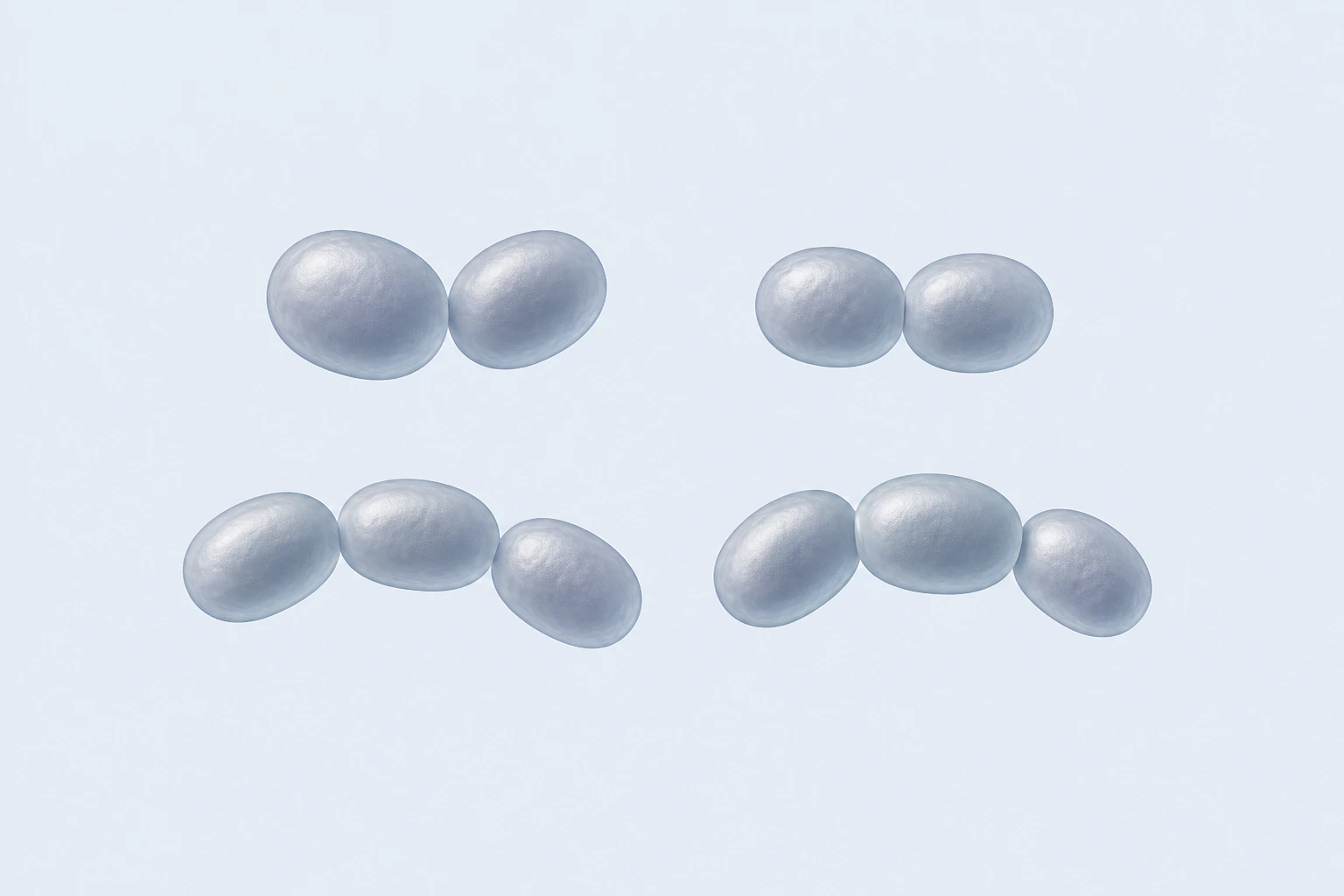
Selected Blautia ovoid and short-coccoid forms, shown as ten bodies in four paired or short-chain groupings. This genus-level reconstruction is non-diagnostic and is not a micrograph.
Scientific media record1 verified identifier
- Subject
- Blautiataxon · genus
- Identifiers
- NCBITaxon:572511
- Review
- Editorial review completeIdentifiers authority-verified · Accessibility validated · · blautia|blautia-morphology-v1.webp
- Digital source
- Trained-algorithmic mediaCreated with a trained generative algorithm and reviewed by WikiBiome for subject identity, scientific framing, identifiers, provenance, and accessibility.
- Scientific basis
- Blautia — NCBI TaxonomyReclassification and description of the genus BlautiaEmended description of the genus Blautia
- License
- CC BY-SA 4.0Created
A genus of Gram-positive, obligate anaerobic bacteria within the Lachnospiraceae family that produces Short-Chain Fatty Acids (SCFAs) and plays a significant role in bile acid metabolism. Key species include B. obeum, B. wexlerae, B. hydrogenotrophica, and B. producta.
While primarily a beneficial commensal, Blautia shows context-dependent behavior with some species enriched in specific disease states.
Evidence map3 cited passagesInspect provenance +
Carotid atherosclerosis: part of the depleted SCFA-producing network in subclinical CVD.
Multiple sclerosis: some Blautia species are paradoxically increased in MS patients, potentially reflecting a compensatory shift or pro-inflammatory capacity in the neuroinflammatory context.
Endometriosis: Blautia abundance altered by hormonal treatment in endometriosis patients, suggesting sensitivity to estrogen-modulating therapies.
Contents
1. SCFA Production and Bile Acid Metabolism2. Disease Associations3. Role in Gut Ecosystem4. Metal Sensitivity5. Key Metabolites6. ConnectionsSCFA Production and Bile Acid Metabolism#
Produces acetate as its primary fermentation end-product, with some species also generating Butyrate and propionate.
B. hydrogenotrophica is a unique acetogen that converts H2 and CO2 into acetate via the Wood-Ljungdahl pathway, providing a critical hydrogen sink in the gut ecosystem.
Active in bile acid transformation: deconjugation via bile salt hydrolase (BSH) activity and downstream secondary bile acid modifications. This places Blautia at the intersection of lipid metabolism and gut-liver axis signaling.
Bile acid metabolism by Blautia affects FXR and TGR5 receptor signaling, influencing cholesterol homeostasis, glucose metabolism, and Metal-Driven Inflammation.
Disease Associations#
Depleted in Disease#
IBD: B. obeum depleted in Crohn's disease and ulcerative colitis; its loss reduces SCFA-mediated mucosal protection. Colorectal cancer: reduced in CRC patients alongside other Lachnospiraceae members. Carotid atherosclerosis: part of the depleted SCFA-producing network in subclinical CVD.[1]Network of Interactions Between Gut Microbiome, Host Biomarkers, and Urine Metabolome in Carotid AtherosclerosisRui-Jun Li, Zhu-Ye Jie, Qiang Feng et al. · 2021Open reference 1 ↓
Enriched in Disease (Context-Dependent)#
Multiple sclerosis: some Blautia species are paradoxically increased in MS patients, potentially reflecting a compensatory shift or pro-inflammatory capacity in the neuroinflammatory context.[2]Feeding the gut microbiome: impact on multiple sclerosisMatteo Bronzini, Alessandro Maglione, Rachele Rosso et al. · 2023Open reference 2 ↓
Endometriosis: Blautia abundance altered by hormonal treatment in endometriosis patients, suggesting sensitivity to estrogen-modulating therapies.[3]Associations Between Endometriosis and Gut MicrobiotaSvensson A, Brunkwall L, Roth B et al. · 2021Open reference 3 ↓
Role in Gut Ecosystem#
Functions as a metabolic hub connecting fiber fermentation, bile acid cycling, and gas metabolism. Hydrogen consumption by B. hydrogenotrophica prevents H2 accumulation that would thermodynamically inhibit fiber fermentation by other bacteria.
Cross-feeds with butyrate producers: acetate from Blautia serves as a substrate for butyryl-CoA:acetate CoA-transferase in Roseburia and Faecalibacterium prausnitzii, enabling butyrate production. The genus occupies a middle trophic level in the colonic food web, connecting primary fiber degraders (Ruminococcus R. bromii) to terminal butyrate producers.
Metal Sensitivity#
As a Lachnospiraceae member, Blautia shares the family-wide sensitivity to heavy metal stress. Iron-sulfur cluster enzymes in the Wood-Ljungdahl pathway of acetogenic species are particularly vulnerable to metal disruption. Cadmium and Lead exposure depletes Blautia alongside other SCFA producers in the Gut-Metal-Microbiome Interactions framework.
Key Metabolites#
Acetate—primary fermentation product; substrate for butyrate producers. Bile acid derivatives—BSH-mediated deconjugation and secondary bile acid production. Hydrogen consumption—acetogenic species convert H2/CO2 to acetate, regulating gut gas homeostasis.
Connections#
- Lachnospiraceae—parent family; Blautia is a core member genus
- Roseburia—metabolic cross-feeding: Blautia acetate feeds Roseburia butyrate production
- Faecalibacterium prausnitzii—complementary SCFA producer; co-depleted in disease
- Multiple Sclerosis—paradoxically enriched in some MS studies; context-dependent effects
- Endometriosis—altered by hormonal treatment in endometriosis
- Cardiovascular Disease—depleted in subclinical atherosclerosis; bile acid metabolism relevant to CVD
- Colorectal Cancer—depleted alongside other Lachnospiraceae in CRC
- Iron—iron (Fe)-S clusters in acetogenic pathway vulnerable to metal competition
- Dysbiosis—depletion accompanies loss of other SCFA producers
- inflammation—bile acid metabolism modulates FXR/NF-kB inflammatory signaling
- Gut-Metal-Microbiome Interactions—sensitive to heavy metal perturbation as Lachnospiraceae member
References 5
Numbered by first appearance in the article, then reconciled with its declared source list.
- 1
Rui-Jun Li, Zhu-Ye Jie, Qiang Feng et al. (2021). Network of Interactions Between Gut Microbiome, Host Biomarkers, and Urine Metabolome in Carotid Atherosclerosis. Frontiers in Cellular and Infection Microbiology.
- 2
Matteo Bronzini, Alessandro Maglione, Rachele Rosso et al. (2023). Feeding the gut microbiome: impact on multiple sclerosis. Frontiers in Immunology.
- 3
Svensson A, Brunkwall L, Roth B et al. (2021). Associations Between Endometriosis and Gut Microbiota. Reproductive Sciences.
- 4
Ziyu Huang, Ailing Wei, Hai Yuan et al. (2025). Huang 2025 -- Gut Microbiota and Urine Metabolomics Signature in Autism Spectrum Disorder Children from Southern China. BMC Pediatrics.
- 5
Junwen Zhu, Jin Lyu, Ruochi Zhao et al. (2023). Gut macrobiotic and its metabolic pathways modulate cardiovascular disease. Frontiers in Microbiology.
Article network
Mentioned here 16
Pages linking here 35
Connect the evidence
Publicly readable discussion by ORCID-authenticated researchers. Questions, interpretation, methods, corrections, and new evidence stay attached to this record.
No discussion yet. Start with a precise question or a source-backed observation.
Activity and accepted changes
Accepted researcher context, editorial status, public discussion, and upstream Git revisions are shown together. Pending, declined, and withdrawn proposals remain private.
- published revision
Backfill inflammation concept links
Karen Pendergrass · +1 −1
Inspect exact Git diff ↗ - published revision
massive wiki expansion: 149 stubs fixed, 100+ new pages, Rule 15 scan, keystone papers
WikiBiome Deploy Bot · +9 −9
Inspect exact Git diff ↗ - published revision
nightly maintenance: 94 stub demotions, 181 source_count fixes, 22 auto-discovered stubs, 5 adversarial audits, 3 boundary fixes, 3 evidence-level corrections
WikiBiome Deploy Bot · +1 −0
Inspect exact Git diff ↗ - published revision
WikiBiome update — 2026-04-15 17:23
WikiBiome Deploy Bot · +0 −1
Inspect exact Git diff ↗ - published revision
wiki: bulk entity upgrades, new article pages, and site regeneration
WikiBiome Deploy Bot · +6 −0
Inspect exact Git diff ↗ - published revision
WikiBiome update — integrity fixes, metallomic diet pages, cross-condition analyses
WikiBiome Deploy Bot · +12 −4
Inspect exact Git diff ↗ - published revision
WikiBiome update — 2026-04-10 13:49
WikiBiome Deploy Bot · +65 −0
Inspect exact Git diff ↗