

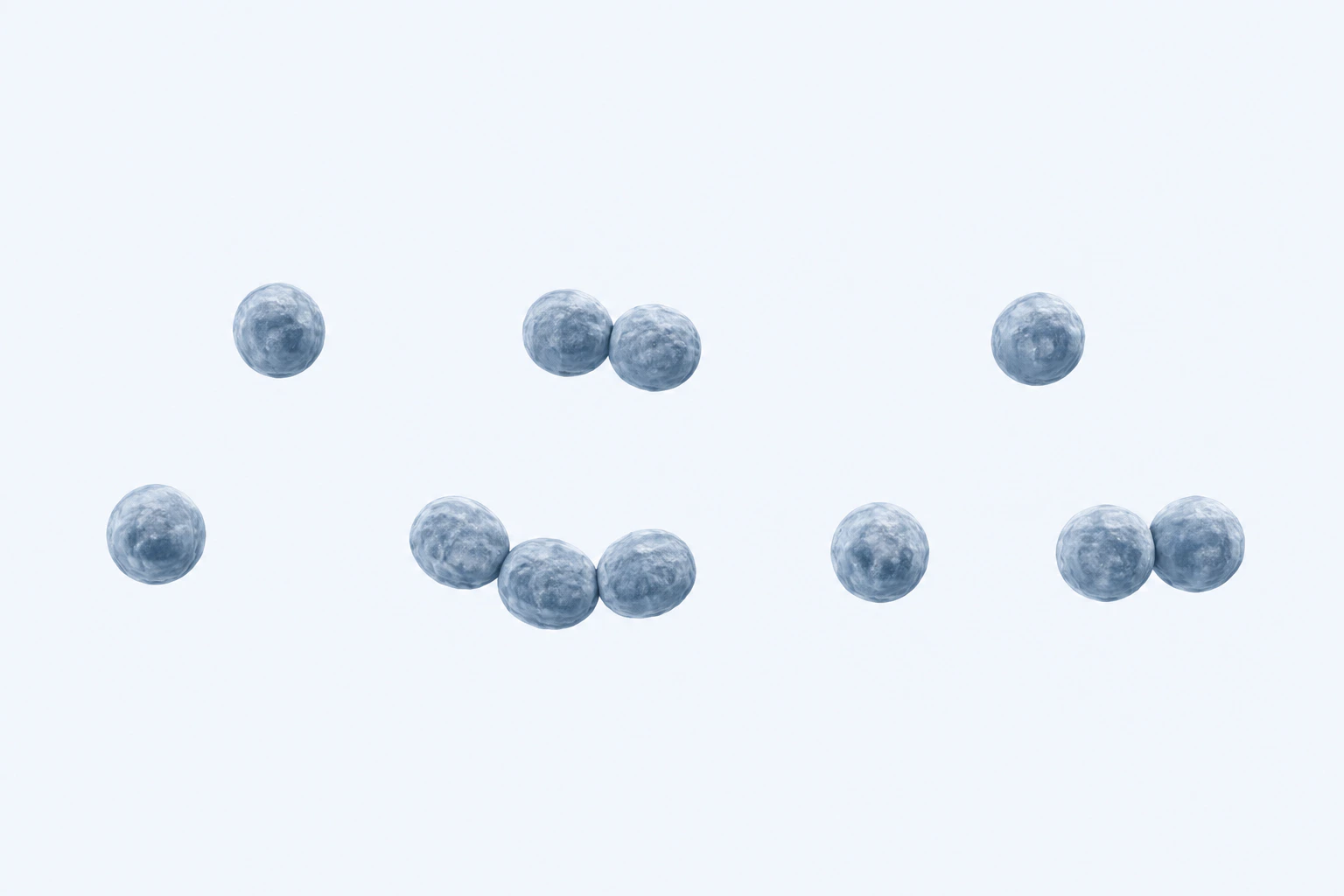
Type-species/current-circumscription-anchored Ruminococcus reconstruction with eleven coccoid bodies in seven groupings. This genus plate is representative, non-universal, non-diagnostic, and not a micrograph; omitted appendages make no motility claim.
Scientific media record1 verified identifier
- Subject
- Ruminococcustaxon · genus
- Identifiers
- NCBITaxon:1263
- Review
- Editorial review completeIdentifiers authority-verified · Accessibility validated · · ruminococcus|ruminococcus-morphology-v1.webp
- Digital source
- Trained-algorithmic mediaCreated with a trained generative algorithm and reviewed by WikiBiome for subject identity, scientific framing, identifiers, provenance, and accessibility.
- Scientific basis
- Ruminococcus — NCBI TaxonomyRuminococcus — LPSNSequence-based analysis of the genus RuminococcusRuminococcus flavefaciens type strain — BacDive
- License
- CC BY-SA 4.0Created
A genus of Gram-positive, obligate anaerobic cocci within the Firmicutes phylum that exemplifies dual-nature microbiology—containing both keystone beneficial species and disease-associated pathobionts within the same genus.
The genus spans multiple former taxonomic groupings (Clostridium clusters IV and XIVa) and has been reorganized multiple times, meaning that "Ruminococcus" findings in older literature may refer to species now classified elsewhere. Proper species-level resolution is critical when interpreting any Ruminococcus finding.
Evidence map12 cited passagesInspect provenance +
Lower R. gauvreauii discriminates coronary artery disease (CAD) from healthy controls, suggesting a cardioprotective role for this species.
Atherosclerotic cardiovascular disease: Enriched in ACVD in the landmark Jie et al. (2017) metagenome-wide study (n=218), where it was part of the ACVD-enriched taxa associated with increased pathobiont load.
Coronary artery disease: Higher R. gnavus significantly associated with CAD after adjustment for diabetes and dyslipidemia. The CAD-associated microbiome shows progressive changes from Bacteroides to Ruminococcus to Prevotella as disease severity worsens.
Graves' disease: Enriched in untreated Graves' disease patients; correlates positively with TRAb (thyroid receptor antibody) levels, and decreases following methimazole treatment and thyroid function normalization,.
ASD: Enriched in ASD children in Chinese cohorts with GI symptoms; negatively correlated with CARS severity score (higher Ruminococcus1 = lower autism severity), suggesting species-level heterogeneity even in the pathobiont-enriched context.
Anti-correlated with constipation in ASD cohorts.
Lead exposure depletes R. gnavus in prenatal cohort data—R. gnavus was reproducibly depleted with maternal blood Pb in the PROGRESS birth cohort (both trimesters, ≥80% holdout threshold),. This is counter-intuitive given R. gnavus's pathobiont status; however, Pb may disrupt the mucin-degrading niche or compete with Fe-S cluster assembly.
| Condition | Direction | Species | Evidence | |---|---|---|---| | Crohn's disease | Enriched | R. gnavus | Prospective, multiple cohorts | | Cardiovascular disease (ACVD) | Enriched | R. gnavus | Metagenome-wide association | | Coronary artery disease | Enriched (gnavus) / Depleted (gauvreauii) | R. gnavus / R. gauvreauii | | | Endometriosis | Enriched (cal
—R. gnavus enrichment in ACVD
—R. gnavus/gauvreauii in CAD
—R. gnavus, TRAb correlation in Graves'
—Pb depletion of R. gnavus
Contents
1. Classification and Taxonomic Complexity2. Beneficial Species3. Pathobiont Species4. Metal Dependencies5. Disease Associations Summary6. Key Metabolites7. Ecological Role8. Interkingdom and Community Interactions9. What Wikipedia Doesn't Cover10. Cross-ReferencesClassification and Taxonomic Complexity#
The genus Ruminococcus originally encompassed a broader group of fiber-degrading anaerobes. Modern phylogenomics has split this into multiple genera: Ruminococcus sensu stricto (retaining R. bromii, R. champanellensis), Blautia (formerly R. obeum, R. hydrogenotrophicus), and Mediterraneibacter.
R. gnavus and R. torques—the most clinically relevant pathobionts—were reclassified into a separate genus (Gemmiger or Ruminococcus gnavus group) in some databases, though they continue to be reported as Ruminococcus in most clinical microbiome studies. This taxonomy instability creates significant confusion in cross-study comparisons.
Beneficial Species#
R. bromii—Keystone Starch Degrader#
The primary degrader of resistant starch in the human colon, often designated a "keystone species" because other bacteria depend on its initial breakdown of complex starches into oligosaccharides.
Initiates the trophic cascade: resistant starch → R. bromii degradation → oligosaccharides → cross-feeding to Butyrate producers Roseburia, Faecalibacterium prausnitzii, and Anaerostipes. Uses amylase and glucanase enzymes that are among the most specialized starch-degrading systems in the human Gut Microbiome.
Its absence significantly reduces the community's capacity to ferment dietary fiber into Short-Chain Fatty Acids (SCFAs), with downstream effects on gut barrier function and immune modulation.
Depleted by low-fiber Western diets that eliminate its primary substrate.
R. faecis / R. gauvreauii—Cardioprotective Commensal#
Lower R. gauvreauii discriminates coronary artery disease (CAD) from healthy controls,[1]Coronary artery disease is associated with an altered gut microbiome compositionTakumi Toya, Michel T. Corban, Eric Marrietta et al. · 2020Open reference 1 ↓ suggesting a cardioprotective role for this species.
Involved in butyrate production through Clostridium cluster IV fermentation pathways.
Pathobiont Species#
R. torques—ASD-Associated Mucin Degrader#
Enriched in children with Autism Spectrum Disorder, particularly those with GI symptoms. Also a mucin degrader, though less inflammatory than R. gnavus. Anti-correlated with constipation in ASD cohorts.[7]Strati 2017 — New Evidences on the Altered Gut Microbiota in Autism Spectrum DisordersFrancesco Strati, Duccio Cavalieri, Davide Albanese et al. · 2017Open reference 7 ↓
Metal Dependencies#
Ruminococcus species rely on iron-sulfur cluster enzymes for core anaerobic metabolism. Iron-sulfur (iron (Fe)-S) clusters in ferredoxins are essential for electron transfer in the strict anaerobic fermentation pathways used across the genus. R. bromii's starch-degrading enzymatic cascade includes enzymes requiring iron cofactors for redox reactions.
Lead exposure depletes R. gnavus in prenatal cohort data—R. gnavus was reproducibly depleted with maternal blood lead (Pb) in the PROGRESS birth cohort (both trimesters, ≥80% holdout threshold).[8]Prenatal Lead Exposure is Negatively Associated with the Gut Microbiome in ChildhoodEggers S, Midya V, Bixby M et al. · 2023Open reference 8 ↓[9]Eggers 2023 — Prenatal lead exposure is negatively associated with gut microbiome in childhood (PROGRESS cohort)Shoshannah Eggers, Vishal Midya, Moira Bixby et al. · 2023Open reference 9 ↓
This is counter-intuitive given R. gnavus's pathobiont status; however, lead may disrupt the mucin-degrading niche or compete with iron-S cluster assembly.
Metal stress from Cadmium and Lead may differentially affect species—potentially sparing the most resilient strains while depleting sensitive beneficial ones.
Disease Associations Summary#
| Condition | Direction | Species | Evidence |
|---|---|---|---|
| Crohn's disease | Enriched | R. gnavus | Prospective, multiple cohorts |
| Cardiovascular disease (ACVD) | Enriched | R. gnavus | Metagenome-wide association[2]The gut microbiome in atherosclerotic cardiovascular diseaseZhuye Jie, Huihua Xia, Shi-Long Zhong et al. · 2017Open reference 2 ↓ |
| Coronary artery disease | Enriched (gnavus) / Depleted (gauvreauii) | R. gnavus / R. gauvreauii | [1]Coronary artery disease is associated with an altered gut microbiome compositionTakumi Toya, Michel T. Corban, Eric Marrietta et al. · 2020Open reference 1 ↓ |
| Endometriosis | Enriched (calprotectin correlated) | Ruminococcus sp. CAG:177 depleted | [10]Associations Between Endometriosis and Gut MicrobiotaSvensson A, Brunkwall L, Roth B et al. · 2021Open reference 10 ↓[11]Gut microbiome in endometriosis: a cohort study on 1000 individualsPerez-Prieto I, Vargas E, Salas-Espejo E et al. · 2024Open reference 11 ↓ |
| Graves' disease | Enriched (untreated) | Ruminococcus_2, gnavus group | [4]Preliminary Observation of the Changes in the Intestinal Flora of Patients With Graves' Disease Before and After Methimazole TreatmentYang M, Zheng X, Wu Y et al. · 2022Open reference 4 ↓ |
| ASD | Enriched | Ruminococcus_1 (but severity-inverse) | [6]Wang 2023 — Gut Microbiota Signature in Children with ASD Who Suffered from Chronic Gastrointestinal SymptomsHui Wang, Shu Liu, Liqing Xie et al. · 2023Open reference 6 ↓ |
| ASD | Enriched | R. torques | [7]Strati 2017 — New Evidences on the Altered Gut Microbiota in Autism Spectrum DisordersFrancesco Strati, Duccio Cavalieri, Davide Albanese et al. · 2017Open reference 7 ↓ |
Key Metabolites#
Short-chain fatty acids—beneficial species produce butyrate and acetate from starch fermentation; net contribution to colonocyte health. Inflammatory glucorhamnan polysaccharide—R. gnavus-specific; activates TNF-alpha via TLR4 on dendritic cells; a direct inflammatory driver.
Hydrogen gas—R. bromii produces H₂ during starch fermentation, feeding hydrogenotrophic methanogens and Desulfovibrio in the acetogenic/sulfidogenic fermentation network. Mucin-degradation products—R. gnavus and R. torques generate mucin fragments that may serve as substrates for downstream pathobionts.
Ecological Role#
In healthy gut ecology, Ruminococcus (primarily R. bromii) functions as a primary degrader that unlocks dietary fiber for the wider microbial community. Without its starch-degrading capacity, the cross-feeding network that sustains Faecalibacterium prausnitzii, Roseburia, and Anaerostipes is impaired.
In Dysbiosis, R. gnavus exploits mucin as a substrate when fermentable fiber is reduced—meaning a fiber-depleted gut shifts Ruminococcus from starch-to-butyrate contribution toward mucin degradation and inflammatory polysaccharide production. This substrate-driven behavioral switch is a key insight for understanding how diet modulates inflammatory potential.
Interkingdom and Community Interactions#
R. bromii enables cross-feeding to butyrate producers—its absence is felt across the entire SCFA-producing consortium.
R. gnavus-mediated mucin degradation creates conditions that favor other mucin-degrading opportunists, including Akkermansia muciniphila (though via different mechanisms) and potentially Candida in conditions with compromised mucus barriers.
The R. gnavus glucorhamnan polysaccharide may function as a signaling molecule in interkingdom communication, modulating host immune responses in ways that benefit the mucin-degrading niche.
What Wikipedia Doesn't Cover#
Wikipedia's Ruminococcus entry focuses on starch degradation and general fiber fermentation.
This page adds: species-level separation of beneficial (R. bromii) from pathobiont (R. gnavus) functions, the glucorhamnan polysaccharide as a specific TNF-alpha driver, enrichment in Graves' disease with correlation to autoantibody titers, lead-induced depletion data, and the substrate-switching model from starch degradation to mucin degradation under fiber-depleted conditions.
Cross-References#
- Crohn's Disease—R. gnavus is a hallmark Crohn's-enriched pathobiont
- Cardiovascular Disease—R. gnavus enriched in ACVD; R. gauvreauii depleted in CAD
- Autism Spectrum Disorder—R. torques and R. gnavus group enriched in ASD with GI symptoms
- Endometriosis—fecal calprotectin correlates with Ruminococcus abundance
- Graves' Disease—Ruminococcus enriched in untreated GD; decreases with methimazole treatment
- Faecalibacterium prausnitzii—cross-feeding partner for R. bromii starch degradation products
- Roseburia—receives oligosaccharides from R. bromii keystone degradation
- Anaerostipes—downstream beneficiary of R. bromii's starch degradation cascade
- Lachnospiraceae—taxonomic overlap; former Clostridium cluster XIV members
- dysbiosis—species-level shifts within Ruminococcus signal disease-specific dysbiosis patterns
- inflammation—R. gnavus polysaccharides directly activate TNF-alpha/TLR4
- Iron—iron (Fe)-S clusters essential for anaerobic metabolism across the genus
- Lead—prenatal lead (Pb) depletes R. gnavus and R. bromii-associated community members
References 11
Numbered by first appearance in the article, then reconciled with its declared source list.
- 1
Takumi Toya, Michel T. Corban, Eric Marrietta et al. (2020). Coronary artery disease is associated with an altered gut microbiome composition. PLOS ONE.
- 2
Zhuye Jie, Huihua Xia, Shi-Long Zhong et al. (2017). The gut microbiome in atherosclerotic cardiovascular disease. Nature Communications.
- 3
Sebastien Fromentin, Sofia K. Forslund, Kanta Chechi et al. (2022). Microbiome and metabolome features of the cardiometabolic disease spectrum. Nature Medicine.
- 4
Yang M, Zheng X, Wu Y et al. (2022). Preliminary Observation of the Changes in the Intestinal Flora of Patients With Graves' Disease Before and After Methimazole Treatment. Frontiers in Cellular and Infection Microbiology.
- 5
Zhao H, Yuan L, Zhu D et al. (2022). Alterations and Mechanism of Gut Microbiota in Graves' Disease and Hashimoto's Thyroiditis. Polish Journal of Microbiology.
- 6
Hui Wang, Shu Liu, Liqing Xie et al. (2023). Wang 2023 — Gut Microbiota Signature in Children with ASD Who Suffered from Chronic Gastrointestinal Symptoms. BMC Pediatrics.
- 7
Francesco Strati, Duccio Cavalieri, Davide Albanese et al. (2017). Strati 2017 — New Evidences on the Altered Gut Microbiota in Autism Spectrum Disorders. Microbiome.
- 8
Eggers S, Midya V, Bixby M et al. (2023). Prenatal Lead Exposure is Negatively Associated with the Gut Microbiome in Childhood. Frontiers in Microbiology.
- 9
Shoshannah Eggers, Vishal Midya, Moira Bixby et al. (2023). Eggers 2023 — Prenatal lead exposure is negatively associated with gut microbiome in childhood (PROGRESS cohort). Frontiers in Microbiology.
- 10
Svensson A, Brunkwall L, Roth B et al. (2021). Associations Between Endometriosis and Gut Microbiota. Reproductive Sciences.
- 11
Perez-Prieto I, Vargas E, Salas-Espejo E et al. (2024). Gut microbiome in endometriosis: a cohort study on 1000 individuals. BMC Medicine.
Article network
Mentioned here 18
Pages linking here 17
Connect the evidence
Publicly readable discussion by ORCID-authenticated researchers. Questions, interpretation, methods, corrections, and new evidence stay attached to this record.
No discussion yet. Start with a precise question or a source-backed observation.
Activity and accepted changes
Accepted researcher context, editorial status, public discussion, and upstream Git revisions are shown together. Pending, declined, and withdrawn proposals remain private.
- published revision
Backfill gut microbiome concept links
Karen Pendergrass · +1 −1
Inspect exact Git diff ↗ - published revision
Backfill inflammation concept links
Karen Pendergrass · +1 −1
Inspect exact Git diff ↗ - published revision
Complete corpus-wide Dysbiosis linking
Karen Pendergrass · +2 −2
Inspect exact Git diff ↗ - published revision
massive wiki expansion: 149 stubs fixed, 100+ new pages, Rule 15 scan, keystone papers
WikiBiome Deploy Bot · +15 −15
Inspect exact Git diff ↗ - published revision
Deepen schizophrenia/CKD entities + 8 microbe entities; add 6 source pages
WikiBiome Deploy Bot · +98 −44
Inspect exact Git diff ↗ - published revision
Citation integrity pass: 38 citations added, 24 parenthesized citations fixed
WikiBiome Deploy Bot · +1 −1
Inspect exact Git diff ↗ - published revision
v2 migration Priority 3: 17 metal + 82 microbe entities upgraded with seo_target, wikipedia_differentiation, conditions data
WikiBiome Deploy Bot · +6 −0
Inspect exact Git diff ↗ - published revision
WikiBiome update — integrity fixes, metallomic diet pages, cross-condition analyses
WikiBiome Deploy Bot · +6 −4
Inspect exact Git diff ↗ - published revision
WikiBiome update — 2026-04-10 13:49
WikiBiome Deploy Bot · +66 −0
Inspect exact Git diff ↗