

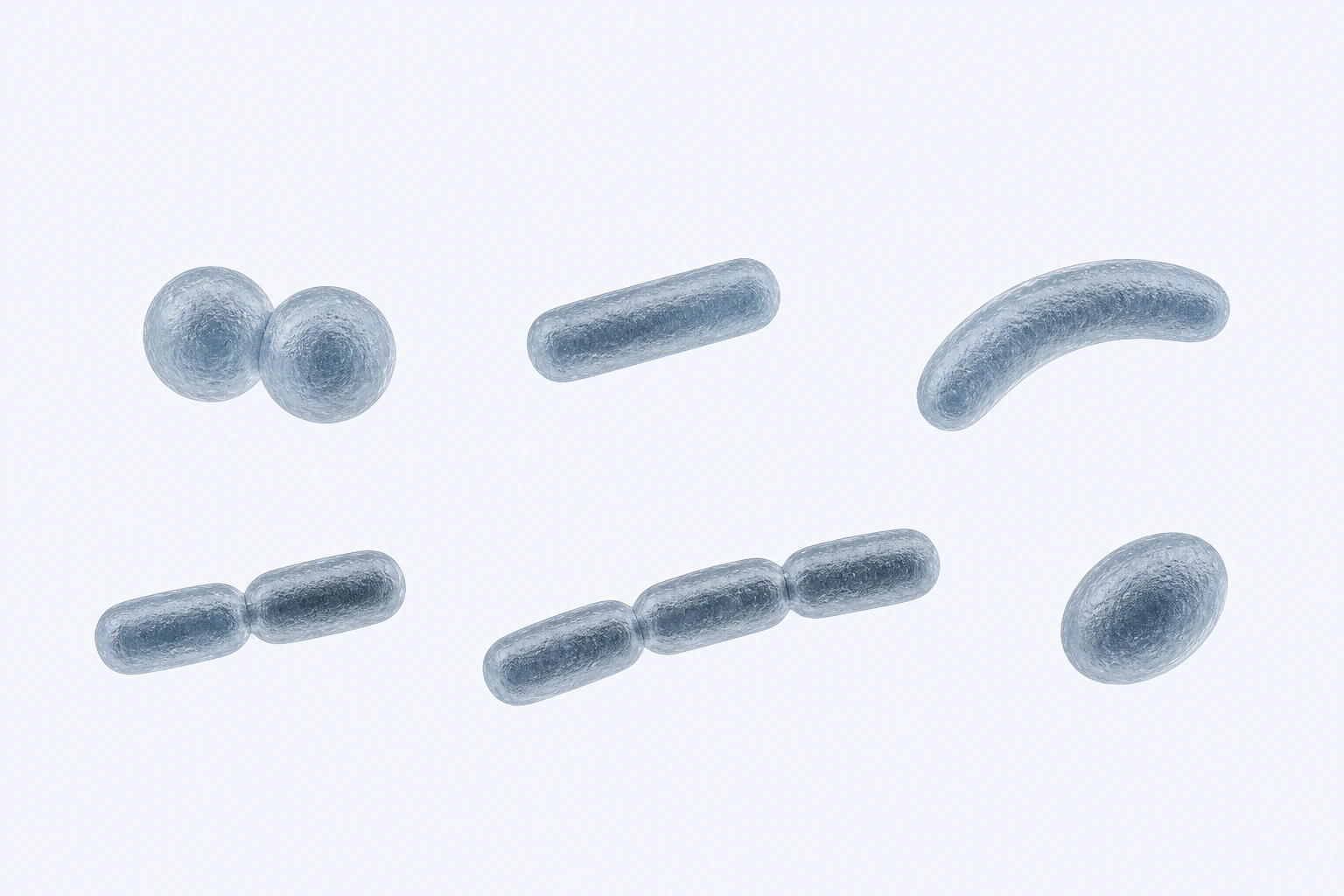
Selected current-descendant morphology diversity within Lachnospiraceae, shown as ten coccoid, ovoid, straight, and curved bodies in six groupings. This family-level reconstruction is representative, non-exhaustive, non-universal, non-diagnostic, and not a micrograph.
Scientific media record1 verified identifier
- Subject
- Lachnospiraceaetaxon · family
- Identifiers
- NCBITaxon:186803
- Review
- Editorial review completeIdentifiers authority-verified · Accessibility validated · · lachnospiraceae|lachnospiraceae-microbial-community-v1.webp
- Digital source
- Trained-algorithmic mediaCreated with a trained generative algorithm and reviewed by WikiBiome for subject identity, scientific framing, identifiers, provenance, and accessibility.
- Scientific basis
- Lachnospiraceae — NCBI TaxonomyLachnospiraceae — LPSNLachnospiraceae taxonomic and physiological diversityThe family Lachnospiraceae and its use as a probiotic
- License
- CC BY-SA 4.0Created
A family within the Firmicutes phylum (order Clostridiales, formerly Clostridium cluster XIVa) that serves as a sentinel indicator of gut health—its depletion is the single most consistent microbiome signature across nearly every disease represented in this wiki.
The family includes major SCFA-producing genera: Roseburia, Blautia, Coprococcus, Dorea, Anaerostipes, and Butyrivibrio.
Evidence map3 cited passagesInspect provenance +
Parkinson's disease: consistently reduced alongside Prevotellaceae; their loss increases gut permeability and facilitates alpha-synuclein propagation.
Colorectal cancer: depleted in CRC patients, with lifestyle factors (smoking, alcohol) further reducing abundance. Ketogenic diet intervention restores Lachnospiraceae NK4A136.
Cardiovascular disease: 12 of 23 differentially abundant taxa in CAD belonged to Lachnospiraceae, including Anaerosporobacter and NK4B4 group. butyrate-producing members depleted in ACVD.
Contents
1. Role as a Dysbiosis Sentinel2. SCFA Production3. Metal Sensitivity4. Key Member Genera5. ConnectionsRole as a Dysbiosis Sentinel#
Lachnospiraceae depletion recurs across an extraordinary range of diseases, making it a universal marker of Dysbiosis.
Multiple sclerosis: depleted in MS patients; loss reduces anti-inflammatory SCFA signaling to the CNS via the Gut-Brain Axis. Parkinson's disease: consistently reduced alongside Prevotellaceae; their loss increases gut permeability and facilitates alpha-synuclein propagation.[1]Microbial Metallomics and Parkinson's Disease: A Unified Metal-Driven Framework Linking Ferroptosis, Dysbiosis, and alpha-Synuclein PathologyKaren Pendergrass · 2025Open reference 1 ↓
Inflammatory bowel disease: depleted in both Crohn's disease and ulcerative colitis; inversely correlated with disease activity.
Colorectal cancer: depleted in CRC patients, with lifestyle factors (smoking, alcohol) further reducing abundance.[2]Dysbiotic microbiome variation in colorectal cancer patients is linked to lifestyles and metabolic diseasesTung Hoang, Minjung Kim, Ji Won Park et al. · 2023Open reference 2 ↓ Ketogenic diet intervention restores Lachnospiraceae NK4A136.[3]Ketogenic diet suppresses colorectal cancer through reshaping gut microbiota and modulating the intestinal FXR/NF-kB signaling pathwayQinhan Gao, Yuwen Liu, Fayu Su et al. · 2026Open reference 3 ↓
Cardiovascular disease: 12 of 23 differentially abundant taxa in CAD belonged to Lachnospiraceae, including Anaerosporobacter and NK4B4 group.[4]Coronary artery disease is associated with an altered gut microbiome compositionTakumi Toya, Michel T. Corban, Eric Marrietta et al. · 2020Open reference 4 ↓ Butyrate-producing members depleted in ACVD.[5]The gut microbiome in atherosclerotic cardiovascular diseaseZhuye Jie, Huihua Xia, Shi-Long Zhong et al. · 2017Open reference 5 ↓
Autism spectrum disorder: depleted in ASD children, correlating with reduced SCFA levels. Type 2 diabetes: reduced in T2D; inversely correlated with HbA1c.
SCFA Production#
The family collectively produces butyrate, acetate, and propionate from dietary fiber fermentation. Butyrate production via the butyryl-CoA:acetate CoA-transferase pathway is the dominant route. Butyrate from Lachnospiraceae members acts as.
The primary energy source for colonocytes (70% of energy). An HDAC inhibitor promoting Treg differentiation and anti-inflammatory cytokine production. A maintainer of epithelial hypoxia that preserves the anaerobic niche for beneficial obligate anaerobes.
Loss of Lachnospiraceae SCFA output triggers a vicious cycle: reduced butyrate -> impaired barrier -> oxygen leak into lumen -> expansion of facultative anaerobic Enterobacteriaceae -> further displacement of obligate anaerobes.
Metal Sensitivity#
Lachnospiraceae members are sensitive to heavy metal stress. Cadmium, Lead, and Mercury exposure depletes the family disproportionately compared to metal-tolerant taxa. Iron-sulfur cluster enzymes required for butyrate production are vulnerable to disruption by toxic metals that compete for iron binding sites.
Siderophore-producing Enterobacteriaceae outcompete Lachnospiraceae for Iron under metal-stressed conditions, compounding the depletion. This metal sensitivity positions Lachnospiraceae as a biomarker for metal-induced dysbiosis within the Gut-Metal-Microbiome Interactions framework.
Key Member Genera#
| Genus | Key Function |
|---|---|
| Roseburia | Major butyrate producer; R. intestinalis, R. hominis |
| Blautia | SCFA producer; bile acid metabolism |
| Coprococcus | Butyrate producer; depleted in depression |
| Dorea | SCFA producer; some species enriched in disease |
| Anaerostipes | Lactate-to-butyrate converter; metabolic cross-feeder |
| Butyrivibrio | Fiber fermenter; bile acid transformer |
Connections#
- Roseburia—key butyrate-producing member genus; depleted across diseases
- Blautia—SCFA and bile acid metabolizing member genus
- Faecalibacterium prausnitzii—complementary butyrate producer; co-depleted in disease
- Clostridium—former Clostridium cluster XIVa members now classified here
- Enterobacteriaceae—inversely correlated; Enterobacteriaceae bloom when Lachnospiraceae deplete
- Multiple Sclerosis—depletion impairs SCFA-mediated immune tolerance
- Parkinson's Disease—loss linked to gut permeability and alpha-synuclein propagation
- Colorectal Cancer—depletion reduces anti-tumorigenic butyrate; lifestyle factors compound loss
- Cardiovascular Disease—12/23 differentially abundant CAD taxa from this family
- Iron—iron (Fe)-S cluster enzymes vulnerable to metal competition
- dysbiosis—the most universally depleted family across disease states
- Gut-Metal-Microbiome Interactions—metal sensitivity makes Lachnospiraceae a sentinel for environmental exposure
- Metal-Driven Inflammation—butyrate loss removes HDAC-mediated anti-inflammatory brake
References 5
Numbered by first appearance in the article, then reconciled with its declared source list.
- 1
★Karen Pendergrass (2025). Microbial Metallomics and Parkinson's Disease: A Unified Metal-Driven Framework Linking Ferroptosis, Dysbiosis, and alpha-Synuclein Pathology. Conference Presentation.
- 2
Tung Hoang, Minjung Kim, Ji Won Park et al. (2023). Dysbiotic microbiome variation in colorectal cancer patients is linked to lifestyles and metabolic diseases. BMC Microbiology.
- 3
Qinhan Gao, Yuwen Liu, Fayu Su et al. (2026). Ketogenic diet suppresses colorectal cancer through reshaping gut microbiota and modulating the intestinal FXR/NF-kB signaling pathway. Food Science and Human Wellness.
- 4
Takumi Toya, Michel T. Corban, Eric Marrietta et al. (2020). Coronary artery disease is associated with an altered gut microbiome composition. PLOS ONE.
- 5
Zhuye Jie, Huihua Xia, Shi-Long Zhong et al. (2017). The gut microbiome in atherosclerotic cardiovascular disease. Nature Communications.
Article network
Mentioned here 18
Pages linking here 85
Connect the evidence
Publicly readable discussion by ORCID-authenticated researchers. Questions, interpretation, methods, corrections, and new evidence stay attached to this record.
No discussion yet. Start with a precise question or a source-backed observation.
Activity and accepted changes
Accepted researcher context, editorial status, public discussion, and upstream Git revisions are shown together. Pending, declined, and withdrawn proposals remain private.
- published revision
Complete corpus-wide Dysbiosis linking
Karen Pendergrass · +2 −2
Inspect exact Git diff ↗ - published revision
massive wiki expansion: 149 stubs fixed, 100+ new pages, Rule 15 scan, keystone papers
WikiBiome Deploy Bot · +9 −9
Inspect exact Git diff ↗ - published revision
nightly maintenance: 94 stub demotions, 181 source_count fixes, 22 auto-discovered stubs, 5 adversarial audits, 3 boundary fixes, 3 evidence-level corrections
WikiBiome Deploy Bot · +1 −0
Inspect exact Git diff ↗ - published revision
WikiBiome update — 2026-04-15 17:23
WikiBiome Deploy Bot · +3 −3
Inspect exact Git diff ↗ - published revision
wiki: bulk entity upgrades, new article pages, and site regeneration
WikiBiome Deploy Bot · +6 −0
Inspect exact Git diff ↗ - published revision
WikiBiome update — integrity fixes, metallomic diet pages, cross-condition analyses
WikiBiome Deploy Bot · +6 −4
Inspect exact Git diff ↗ - published revision
WikiBiome update — 2026-04-10 13:49
WikiBiome Deploy Bot · +70 −0
Inspect exact Git diff ↗