

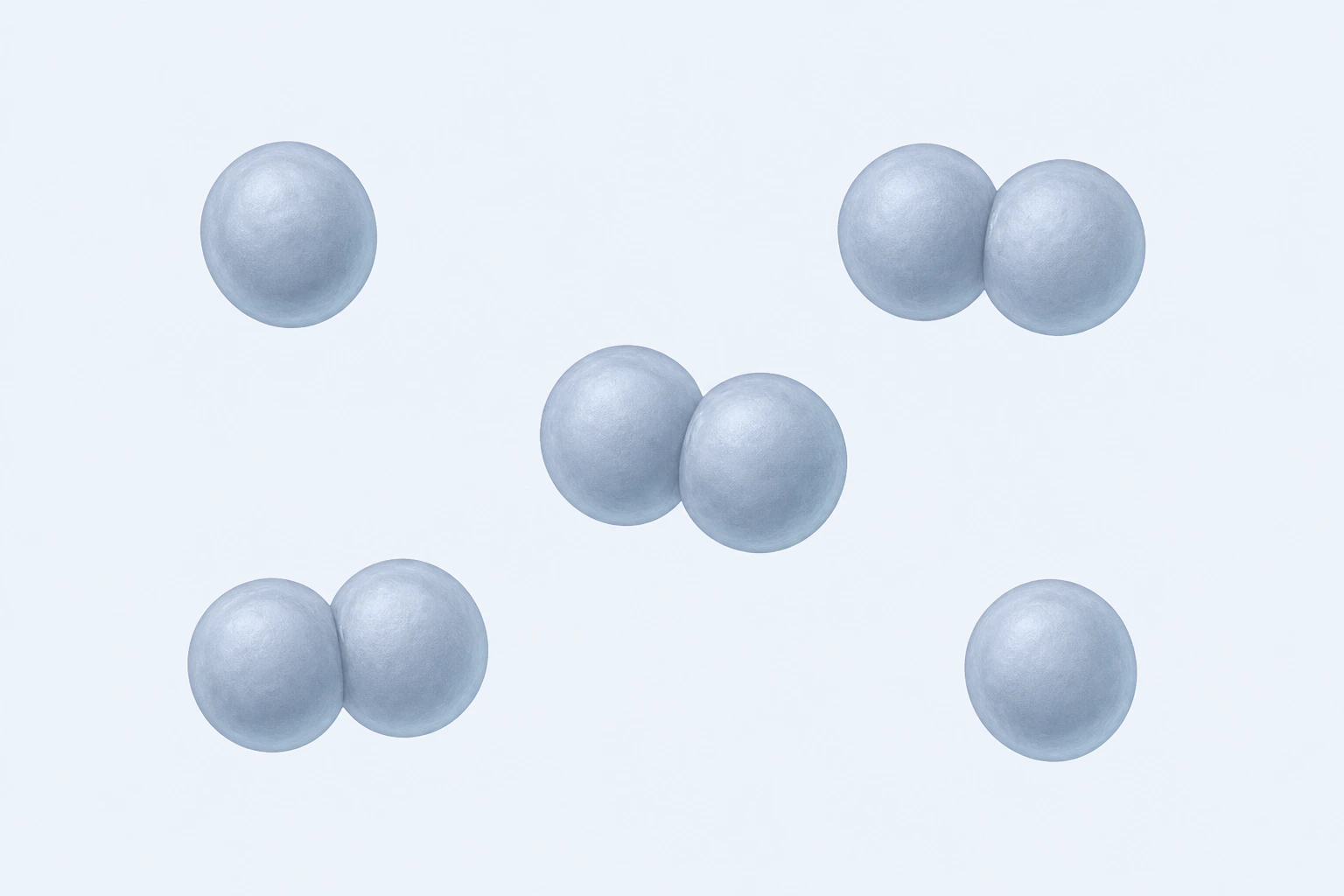
Representative Butyricicoccus coccoid morphology, shown as eight bodies in five single or paired groupings. This genus-level reconstruction is non-diagnostic and is not a micrograph.
Scientific media record1 verified identifier
- Subject
- Butyricicoccustaxon · genus
- Identifiers
- NCBITaxon:580596
- Review
- Editorial review completeIdentifiers authority-verified · Accessibility validated · · butyricicoccus|butyricicoccus-morphology-v1.webp
- Digital source
- Trained-algorithmic mediaCreated with a trained generative algorithm and reviewed by WikiBiome for subject identity, scientific framing, identifiers, provenance, and accessibility.
- Scientific basis
- Butyricicoccus — NCBI TaxonomyButyricicoccus pullicaecorum gen. nov., sp. nov.Butyricicoccus pullicaecorum type strain — BacDive
- License
- CC BY-SA 4.0Created
A genus of Gram-positive, strictly anaerobic, Butyrate-producing bacteria in the order Clostridiales (phylum Firmicutes). The type species, Butyricicoccus pullicaecorum, was originally isolated from chicken caecal content but has since been identified as a significant member of the healthy human Gut Microbiome.
Butyricicoccus has attracted attention as a candidate next-generation probiotic because of its consistent depletion in colorectal cancer, multiple sclerosis, and inflammatory bowel disease—conditions characterized by impaired butyrate production and compromised gut barrier integrity.
Evidence map6 cited passagesInspect provenance +
Butyricicoccus has been detected in oral microbiome studies, suggesting it may participate in the oral-gut axis. In multiple sclerosis, it is among the taxa altered in the oral microbiome alongside other Gram-positive early colonizers (, case-control, n=100).
Colorectal cancer—Depleted in CRC patients across multiple studies. In a systematic review of microbial markers for colorectal neoplasia, butyrate-producing taxa including Butyricicoccus are consistently reduced in tumor-bearing patients (, systematic-review-meta-analysis). Multi-omic profiling confirms depletion of butyrate producers in CRC with correspo
Multiple sclerosis—Altered in the oral microbiome of relapsing-remitting MS patients, with MS showing a broad shift away from Gram-positive early colonizers toward Gram-negative pathobionts (, case-control, n=100).
(systematic-review-meta-analysis)—Comprehensive review identifying butyrate-producing taxa including Butyricicoccus as consistently depleted CRC biomarkers across 45 observational and 30 prediction studies.
(cross-sectional, n=41)—Multi-omic study confirming depletion of butyrate producers in CRC; identifies metabolic pathway enrichments in tumor microenvironment.
(case-control, n=100)—Documents oral microbiome alterations in MS including shifts in Butyricicoccus and related taxa.
Contents
1. Metal Dependencies2. Key Enzymes and Virulence Factors3. Ecological Role4. Conditions Associated5. Key Studies6. Cross-ReferencesMetal Dependencies#
As a strictly anaerobic Firmicute, Butyricicoccus requires Iron for iron-sulfur cluster enzymes involved in its anaerobic metabolic pathways, including the butyrate production pathway. The genus has not been characterized at the detailed metallomic level.
Key Enzymes and Virulence Factors#
Butyricicoccus is not pathogenic. Its significance is entirely beneficial. Butyryl-CoA dehydrogenase—Key enzyme in the butyrate biosynthesis pathway via the acetyl-CoA route.
Butyrate kinase—Terminal enzyme in the butyrate kinase pathway for butyrate production.
Short-chain fatty acid production—Butyrate is the primary metabolic output, serving as the preferred energy source for colonocytes and a potent anti-inflammatory signaling molecule.
Ecological Role#
Butyrate Production and Barrier Integrity#
Butyricicoccus contributes to the pool of gut butyrate producers alongside Faecalibacterium prausnitzii, Roseburia, and other Clostridiales. Butyrate serves multiple protective functions: fueling colonocyte metabolism, maintaining tight junction integrity, suppressing NF-kB-mediated Metal-Driven Inflammation, and promoting regulatory T cell differentiation.
The loss of Butyricicoccus and other butyrate producers is a recurring feature of conditions marked by barrier breakdown and chronic inflammation.
Oral-Gut Presence#
Butyricicoccus has been detected in oral microbiome studies, suggesting it may participate in the oral-gut axis. In multiple sclerosis, it is among the taxa altered in the oral microbiome alongside other Gram-positive early colonizers (,[1]Multiple Sclerosis Patients Exhibit Oral Dysbiosis with Decreased Early Colonizers and Lower Hypotaurine LevelRachel L. Fitzjerrells, Leeann Aguilar Meza, Meeta Yadav et al. · 2025Open reference 1 ↓ case-control, n=100).
Conditions Associated#
Colorectal cancer—Depleted in CRC patients across multiple studies. In a systematic review of microbial markers for colorectal neoplasia, butyrate-producing taxa including Butyricicoccus are consistently reduced in tumor-bearing patients (,[2]A Systematic Review of Microbial Markers for Risk Prediction of Colorectal NeoplasiaYu L, Zhao G, Wang L et al. · 2022Open reference 2 ↓ systematic-review-meta-analysis).
Multi-omic profiling confirms depletion of butyrate producers in CRC with corresponding enrichment of pathogenic taxa like Fusobacterium nucleatum and Bacteroides fragilis (,[3]Multi-omic profiling reveals associations between the gut microbiome, host genome and transcriptome in patients with colorectal cancerShaomin Zou, Chao Yang, Jieping Zhang et al. · 2024Open reference 3 ↓ cross-sectional, n=41).
Multiple sclerosis—Altered in the oral microbiome of relapsing-remitting MS patients, with MS showing a broad shift away from Gram-positive early colonizers toward Gram-negative pathobionts (,[1]Multiple Sclerosis Patients Exhibit Oral Dysbiosis with Decreased Early Colonizers and Lower Hypotaurine LevelRachel L. Fitzjerrells, Leeann Aguilar Meza, Meeta Yadav et al. · 2025Open reference 1 ↓ case-control, n=100).
Inflammatory bowel disease—Reduced as part of the general loss of butyrate-producing Firmicutes in IBD.
Key Studies#
[2]A Systematic Review of Microbial Markers for Risk Prediction of Colorectal NeoplasiaYu L, Zhao G, Wang L et al. · 2022Open reference 2 ↓ (systematic-review-meta-analysis)—Comprehensive review identifying butyrate-producing taxa including Butyricicoccus as consistently depleted CRC biomarkers across 45 observational and 30 prediction studies.
[3]Multi-omic profiling reveals associations between the gut microbiome, host genome and transcriptome in patients with colorectal cancerShaomin Zou, Chao Yang, Jieping Zhang et al. · 2024Open reference 3 ↓ (cross-sectional, n=41)—Multi-omic study confirming depletion of butyrate producers in CRC; identifies metabolic pathway enrichments in tumor microenvironment.
[1]Multiple Sclerosis Patients Exhibit Oral Dysbiosis with Decreased Early Colonizers and Lower Hypotaurine LevelRachel L. Fitzjerrells, Leeann Aguilar Meza, Meeta Yadav et al. · 2025Open reference 1 ↓ (case-control, n=100)—Documents oral microbiome alterations in MS including shifts in Butyricicoccus and related taxa.
Cross-References#
- butyrate—Primary metabolic product; loss of production linked to disease progression
- Colorectal Cancer—Consistent depletion across CRC microbiome signatures
- Multiple Sclerosis—Oral microbiome alteration pattern
- Faecalibacterium prausnitzii—Fellow butyrate producer; co-depleted in multiple conditions
- Roseburia—Fellow butyrate producer in the Clostridiales order
- Dysbiosis—Butyricicoccus loss as marker of impaired butyrate ecology
- gut microbiome—Candidate next-generation probiotic for butyrate restoration
References 4
Numbered by first appearance in the article, then reconciled with its declared source list.
- 1
Rachel L. Fitzjerrells, Leeann Aguilar Meza, Meeta Yadav et al. (2025). Multiple Sclerosis Patients Exhibit Oral Dysbiosis with Decreased Early Colonizers and Lower Hypotaurine Level. npj Biofilms and Microbiomes.
- 2
Yu L, Zhao G, Wang L et al. (2022). A Systematic Review of Microbial Markers for Risk Prediction of Colorectal Neoplasia. British Journal of Cancer.
- 3
Shaomin Zou, Chao Yang, Jieping Zhang et al. (2024). Multi-omic profiling reveals associations between the gut microbiome, host genome and transcriptome in patients with colorectal cancer. Journal of Translational Medicine.
- 4
Rosemeire Arai Yoshida, Tiago Bertola Lobato, Renata Gorjão et al. (2023). Yoshida 2023 — Detection and Quantification of Pathogens in Saliva of Adolescents With Cerebral Palsy: A Cross-Sectional Study. Frontiers in Dental Medicine.
Article network
Connect the evidence
Publicly readable discussion by ORCID-authenticated researchers. Questions, interpretation, methods, corrections, and new evidence stay attached to this record.
No discussion yet. Start with a precise question or a source-backed observation.
Published page changes
This record shows only material changes published on this page, including changes to its content, evidence, conclusions, or author context. Internal processes and discussion activity are excluded. Pending, declined, and withdrawn proposals remain private.
- published revision
Created “Butyricicoccus”: A genus of Gram-positive, strictly anaerobic, butyrate-producing bacteria in the order Clostridiales (phylum Firmicutes). The type species, Butyricicoccus pullicaecorum, was originally isolated from…
Created “Butyricicoccus”: A genus of Gram-positive, strictly anaerobic, butyrate-producing bacteria in the order Clostridiales (phylum Firmicutes). The type species, Butyricicoccus pullicaecorum, was originally isolated from… Published sections: Butyricicoccus; Metal Dependencies; Key Enzymes and Virulence Factors; Butyrate Production and Barrier Integrity; Oral-Gut Presence; Conditions Associated; Key Studies; Cross-References. · WikiBiome Deploy Bot · +69 −0
Inspect exact Git diff ↗