
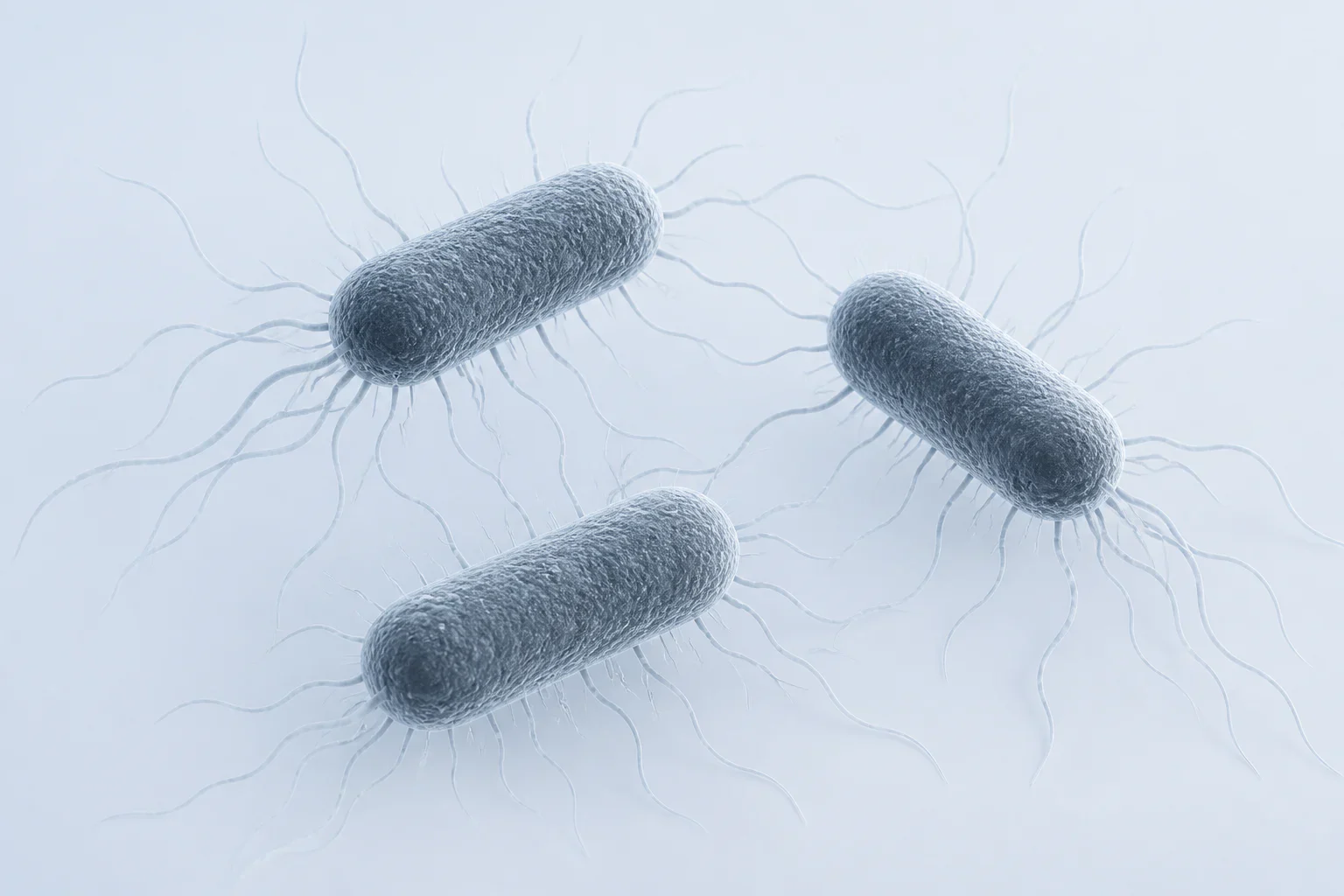
Representative E. coli bacilli with rounded ends, peritrichous flagella, and fine pili. Surface structures vary by strain and culture conditions; this is an educational reconstruction, not a micrograph.
Scientific media record1 verified identifier
- Subject
- Escherichia colitaxon · species
- Identifiers
- NCBITaxon:562
- Review
- Editorial review completeIdentifiers authority-verified · Accessibility validated · · escherichia-coli|escherichia-coli-morphology-v1.webp
- Digital source
- Trained-algorithmic mediaCreated with a trained generative algorithm and reviewed by WikiBiome for subject identity, scientific framing, identifiers, provenance, and accessibility.
- Scientific basis
- Escherichia coli — NCBI TaxonomyEscherichia, Klebsiella, Enterobacter, Serratia, Citrobacter, and Proteus
- License
- CC BY-SA 4.0Created
A Gram-negative bacterium that spans the commensal-pathogen spectrum, with pathogenic variants (UPEC, STEC, EHEC) deploying nickel-dependent enzymes as virulence factors.
E. coli is the model organism for nickel transport biology—the NikABCDE system was first characterized here—and pathogenic strains have co-opted nickel metabolism for urinary tract colonization, gut survival, and acid resistance.
Evidence map17 cited passagesInspect provenance +
E. coli encodes multiple [NiFe] hydrogenases:
STEC/EHEC strains use urease for acid survival during gastric transit.
First characterized Ni-specific ABC transporter.
Originally characterized as an iron siderophore in Yersinia pestis, but the UPEC yersiniabactin also binds extracellular nickel.
Urinary tract infections (UTI): UPEC is the 1 cause of community-acquired UTI; nickel transport upregulated during infection.
Hemolytic uremic syndrome (HUS): STEC/EHEC (O157:H7); Shiga toxin is iron-regulated.
Bacteremia/sepsis: from urinary or GI source; E. coli translocation from the gut is a major source of sepsis in severe COVID-19.
Chronic kidney disease: Enterobacteriaceae including E. coli are enriched and LPS translocation contributes to uremic inflammation.
GERD / esophageal dysbiosis: Enterobacteriaceae including E. coli are enriched in a Type II (LPS-driven) esophageal microbiome signature associated with erosive disease.
Endometriosis: Gram-negative E. coli and related Enterobacteriaceae are enriched in cervical, vaginal, and gut compartments; nickel-sensitive IBS symptoms overlap with endometriosis dysbiosis.
Colorectal cancer: colibactin-producing and mucosa-associated E. coli are enriched and drive genotoxic damage.
Necrotizing enterocolitis: Enterobacteriaceae bloom (including E. coli) precedes NEC onset in preterm infants.
Type 1 diabetes: Bacteroides dorei-like and E. coli populations with immunoinhibitory LPS structures alter early immune priming and are linked to T1D progression.
Dietary nickel excreted in urine provides substrate for UPEC nickel scavenging during UTI—higher dietary nickel may theoretically support UPEC virulence.
Gut E. coli populations are exposed to dietary metals; iron supplementation is known to promote pathogenic E. coli expansion in the gut.
Yersiniabactin's dual iron/nickel specificity means environmental iron AND nickel both feed UPEC metal acquisition.
Synergistic toxicity of copper, nickel, iron, and sulfur modulates E. coli stress and survival responses.
Contents
1. Metal-Dependent Virulence Factors2. Metal Acquisition Systems3. Nutritional Immunity Evasion4. Disease Associations5. Connection to Environmental Metal Exposure6. ConnectionsMetal-Dependent Virulence Factors#
[NiFe] Hydrogenases#
E. coli encodes multiple [NiFe] hydrogenases.[1]Role of Nickel in Microbial PathogenesisRobert J. Maier, Stéphane L. Benoit · 2019Open reference 1 ↓ Hyd-1 (HyaABC): membrane-bound, H2-uptake. Expressed under aerobic/microaerobic conditions.
Hyd-2 (HybOABC): membrane-bound, H2-uptake. Most active under anaerobic conditions with alternative electron acceptors. Hyd-3 (HycBCDEFG): cytoplasmic, H2-evolving.
Part of the formate hydrogenlyase (FHL) complex; produces H2 during mixed-acid fermentation.
Hyd-4 (HyfABCDEFGHIR): second FHL-associated complex.
In pathogenic E. coli, hydrogenases provide. Respiratory flexibility in the oxygen-variable gut environment. Acid resistance: Hyd-3/FHL consumes formate and produces H2 + CO2, removing acidic fermentation products.
Energy generation in nutrient-limited intracellular niches (for UPEC inside bladder epithelial cells).
Urease (in Shiga Toxin-Producing E. coli)#
STEC/EHEC strains use Urease for acid survival during gastric transit.[1]Role of Nickel in Microbial PathogenesisRobert J. Maier, Stéphane L. Benoit · 2019Open reference 1 ↓ Urease-mediated Ammonia production buffers pH, enabling survival through the stomach to reach the intestinal colonization site. Not all E. coli pathotypes carry urease—it is primarily found in STEC and some UPEC strains.
Ni-Acireductone Dioxygenase (ARD)#
Part of the methionine salvage pathway; the nickel (Ni)-bound form is present in E. coli and other gamma-proteobacteriaceae. Provides metabolic flexibility depending on available metal cofactors.
Fe-Dependent Virulence#
Enterobactin: the canonical high-affinity siderophore (Ka for iron(III) (Fe3+) = ~10^52). Aerobactin: found in many UPEC and invasive strains; functions at lower affinity but under a broader range of conditions. Yersiniabactin: see below—dual iron/nickel role.
ChuA/Chu system: heme uptake receptor in EHEC and UPEC. Shiga toxin expression is iron-regulated (repressed by Fur under high iron; induced under iron limitation).
Metal Acquisition Systems#
NikABCDE—The Model Nickel Transporter#
First characterized nickel (Ni)-specific ABC transporter.[1]Role of Nickel in Microbial PathogenesisRobert J. Maier, Stéphane L. Benoit · 2019Open reference 1 ↓ NikA: periplasmic nickel-binding protein. NikB/NikC: integral membrane permease subunits.
NikD/NikE: ATP-binding cassette subunits providing energy. Regulated by NikR (nickel-responsive repressor)—under high nickel, NikR represses nikABCDE to prevent toxicity.
This system is the paradigm for understanding nickel import across all bacteria; homologs found in Salmonella enterica serovar Typhimurium, Helicobacter pylori (NiuBDE), and many other pathogens.
Yersiniabactin—A Dual Iron/Nickel Metallophore#
Originally characterized as an iron siderophore in Yersinia pestis, but the UPEC yersiniabactin also binds extracellular nickel.[1]Role of Nickel in Microbial PathogenesisRobert J. Maier, Stéphane L. Benoit · 2019Open reference 1 ↓ In uropathogenic E. coli, yersiniabactin serves a dual role. Iron acquisition for growth.
Nickel import for hydrogenase/urease metalation during UTI. Nickel transport via yersiniabactin is upregulated during urinary tract infection, suggesting active nickel scavenging in the urinary environment. This dual-specificity metallophore represents a metabolically efficient strategy: one molecule, two essential metals.
Hydrogenase Maturation#
HypABCDEF: accessory proteins for [NiFe] active site assembly, shared across all four hydrogenases. HypB is a GTPase/nickel metallochaperone; HypA delivers nickel to HypB.
Nutritional Immunity Evasion#
Lipocalin-2: host protein that sequesters enterobactin-iron (Fe) complexes. UPEC strains carrying yersiniabactin or salmochelin evade lipocalin-2. Calprotectin: sequesters zinc (Zn), manganese (Mn), and nickel (Ni) at infection sites.
Lactoferrin: sequesters iron in mucosal secretions and urine.
UPEC nickel transport upregulation during UTI suggests the pathogen senses host-mediated nickel restriction and responds with increased scavenging.
Disease Associations#
Urinary tract infections (UTI): UPEC is the #1 cause of community-acquired UTI; nickel transport upregulated during infection.[1]Role of Nickel in Microbial PathogenesisRobert J. Maier, Stéphane L. Benoit · 2019Open reference 1 ↓ Hemolytic uremic syndrome (HUS): STEC/EHEC (O157:H7); Shiga toxin is iron-regulated.[1]Role of Nickel in Microbial PathogenesisRobert J. Maier, Stéphane L. Benoit · 2019Open reference 1 ↓ Neonatal meningitis: K1 capsular strains.
Traveler's diarrhea: ETEC strains. Crohn's disease-associated: adherent-invasive E. coli (AIEC) in the ileum. Bacteremia/sepsis: from urinary or GI source; E. coli translocation from the gut is a major source of sepsis in severe COVID-19.[2]Bernard-Raichon et al. 2022 — Gut microbiome dysbiosis in antibiotic-treated COVID-19 patients is associated with microbial translocation and bacteremiaLucie Bernard-Raichon, Mericien Venzon, Jon Klein et al. · 2022Open reference 2 ↓
Chronic kidney disease: Enterobacteriaceae including E. coli are enriched and LPS translocation contributes to uremic Metal-Driven Inflammation.[3]Alobaidi 2025 — The Gut-Kidney Axis in CKD: Mechanisms, Microbial Metabolites, and Microbiome-Targeted TherapeuticsSami Alobaidi · 2025Open reference 3 ↓[4]Protein-Bound Uremic Toxins from Gut Microbiota and Inflammatory Markers in CKDNatalia A. Borges, Amanda F. Barros, Lia S. Nakao et al. · 2016Open reference 4 ↓
GERD / esophageal Dysbiosis: Enterobacteriaceae including E. coli are enriched in a Type II (LPS-driven) esophageal microbiome signature associated with erosive disease.[5]Esophageal microbial dysbiosis impairs mucosal barrier integrity via toll-like receptor 2 pathway in patients with gastroesophageal reflux symptomsChen S, Jiang D, Zhuang Q et al. · 2024Open reference 5 ↓[6]Alageel 2025 — Examining the Microbiome Composition in Patients with Gastroesophageal Reflux Disease: A Systematic ReviewAlageel AA, Alomran DA, Alharbi HB et al. · 2025Open reference 6 ↓
Endometriosis: Gram-negative E. coli and related Enterobacteriaceae are enriched in cervical, vaginal, and gut compartments; nickel-sensitive IBS symptoms overlap with endometriosis dysbiosis.[7]Molecular detection of microbial colonization in cervical mucus of women with and without endometriosisAkiyama K, Nishioka K, Khan KN et al. · 2019Open reference 7 ↓[8]Irritable Bowel Syndrome-Like Disorders in Endometriosis: Prevalence of Nickel Sensitivity and Effects of a Low-Nickel Diet. An Open-Label Pilot StudyBorghini R, Porpora MG, Casale R et al. · 2020Open reference 8 ↓[9]Gut and Vaginal Microbiota in the Endometriosis: Systematic Review and Meta-AnalysisColonetti T, Saggioratto MC, Grande AJ et al. · 2023Open reference 9 ↓
Colorectal cancer: colibactin-producing and mucosa-associated E. coli are enriched and drive genotoxic damage.[10]Comparison between 16S rRNA and Shotgun Sequencing in Colorectal Cancer, Advanced Colorectal Lesions, and Healthy Human Gut MicrobiotaBars-Cortina D, Ramon E, Rius-Sansalvador B et al. · 2024Open reference 10 ↓[11]Metabolic Interactions: How Gut Microbial Metabolites Influence Colorectal CancerCao Q, Yang M, Chen M · 2025Open reference 11 ↓
Necrotizing enterocolitis: Enterobacteriaceae bloom (including E. coli) precedes NEC onset in preterm infants.[12]Torrazza 2013 — Intestinal Microbial Ecology and Environmental Factors Affecting NECTorrazza RM, Ukhanova M, Wang X et al. · 2013Open reference 12 ↓[13]Nickel as a Catalytic Driver of Necrotizing Enterocolitis: Dietary Nickel, Microbial Metallomics, and the Activation of Nickel-Dependent Virulence Pathways in the Preterm GutKaren Pendergrass · 2026Open reference 13 ↓
Type 1 diabetes: Bacteroides dorei-like and E. coli populations with immunoinhibitory LPS structures alter early immune priming and are linked to T1D progression.[14]Davis-Richardson & Triplett 2015 — Bacteroides dorei as a Model for T1D Microbiome PathogenesisAustin G. Davis-Richardson, Eric W. Triplett · 2015Open reference 14 ↓[15]Vatanen et al. 2018 — The Human Gut Microbiome in Early-Onset Type 1 Diabetes from the TEDDY StudyTommi Vatanen, Eric A. Franzosa, Randall Schwager et al. · 2018Open reference 15 ↓
Connection to Environmental Metal Exposure#
Dietary nickel excreted in urine provides substrate for UPEC nickel scavenging during UTI—higher dietary nickel may theoretically support UPEC virulence.[1]Role of Nickel in Microbial PathogenesisRobert J. Maier, Stéphane L. Benoit · 2019Open reference 1 ↓
Gut E. coli populations are exposed to dietary metals; iron supplementation is known to promote pathogenic E. coli expansion in the gut.[16]Mechanism of Iron Ion Homeostasis in Intestinal Immunity and Gut Microbiota RemodelingHonghong Bao, Yi Wang, Hanlin Xiong et al. · 2024Open reference 16 ↓
Yersiniabactin's dual iron/nickel specificity means environmental iron AND nickel both feed UPEC metal acquisition.[1]Role of Nickel in Microbial PathogenesisRobert J. Maier, Stéphane L. Benoit · 2019Open reference 1 ↓ Agricultural metal contamination selects for metal-tolerant E. coli in food-animal production.
Synergistic toxicity of copper, nickel, iron, and sulfur modulates E. coli stress and survival responses.[17]Darwiche 2025 — The Molecular Basis of the Synergistic Toxicity of Nickel and Copper, Common Environmental Co-ContaminantsLinda Darwiche, Carlos A Rodriguez-Bornot, Rebecca A Ingrassia et al. · 2025Open reference 17 ↓
Connections#
- Metal-Dependent Virulence—[NiFe] hydrogenases, STEC urease, yersiniabactin dual iron (Fe)/nickel (Ni) metallophore
- Nickel—NikABCDE is the paradigmatic nickel transporter; yersiniabactin also scavenges nickel
- Iron—enterobactin, aerobactin, yersiniabactin; Shiga toxin is iron-regulated
- Salmonella enterica serovar Typhimurium—closely related; shares NikABCDE architecture and multiple hydrogenases
- Helicobacter pylori—NiuBDE is homologous to NikABCDE
- Proteus mirabilis—both cause UTI with nickel-dependent virulence mechanisms
- Nutritional Immunity (Metal Sequestration)—lipocalin-2 and calprotectin counteract E. coli metal acquisition
- Staphylococcus aureus—yersiniabactin (nickel-binding) parallels staphylopine (nickel-binding)
- Co-Selection—metal resistance plasmids carrying ESBL and carbapenemase genes
- Antimicrobial Resistance—ESBL-producing and carbapenem-resistant E. coli are major AMR threats
References 23
Numbered by first appearance in the article, then reconciled with its declared source list.
- 1
★Robert J. Maier, Stéphane L. Benoit (2019). Role of Nickel in Microbial Pathogenesis. Inorganics.
- 2
Lucie Bernard-Raichon, Mericien Venzon, Jon Klein et al. (2022). Bernard-Raichon et al. 2022 — Gut microbiome dysbiosis in antibiotic-treated COVID-19 patients is associated with microbial translocation and bacteremia. Nature Communications.
- 3
Sami Alobaidi (2025). Alobaidi 2025 — The Gut-Kidney Axis in CKD: Mechanisms, Microbial Metabolites, and Microbiome-Targeted Therapeutics. Frontiers in Medicine.
- 4
Natalia A. Borges, Amanda F. Barros, Lia S. Nakao et al. (2016). Protein-Bound Uremic Toxins from Gut Microbiota and Inflammatory Markers in CKD. Journal of Renal Nutrition.
- 5
Chen S, Jiang D, Zhuang Q et al. (2024). Esophageal microbial dysbiosis impairs mucosal barrier integrity via toll-like receptor 2 pathway in patients with gastroesophageal reflux symptoms. Journal of Translational Medicine.
- 6
Alageel AA, Alomran DA, Alharbi HB et al. (2025). Alageel 2025 — Examining the Microbiome Composition in Patients with Gastroesophageal Reflux Disease: A Systematic Review. TPM (The Primary Care Companion for CNS Disorders).
- 7
Akiyama K, Nishioka K, Khan KN et al. (2019). Molecular detection of microbial colonization in cervical mucus of women with and without endometriosis. American Journal of Reproductive Immunology.
- 8
Borghini R, Porpora MG, Casale R et al. (2020). Irritable Bowel Syndrome-Like Disorders in Endometriosis: Prevalence of Nickel Sensitivity and Effects of a Low-Nickel Diet. An Open-Label Pilot Study. Nutrients.
- 9
Colonetti T, Saggioratto MC, Grande AJ et al. (2023). Gut and Vaginal Microbiota in the Endometriosis: Systematic Review and Meta-Analysis. BioMed Research International.
- 10
Bars-Cortina D, Ramon E, Rius-Sansalvador B et al. (2024). Comparison between 16S rRNA and Shotgun Sequencing in Colorectal Cancer, Advanced Colorectal Lesions, and Healthy Human Gut Microbiota. BMC Genomics.
- 11
Cao Q, Yang M, Chen M (2025). Metabolic Interactions: How Gut Microbial Metabolites Influence Colorectal Cancer. Frontiers in Microbiology.
- 12
Torrazza RM, Ukhanova M, Wang X et al. (2013). Torrazza 2013 — Intestinal Microbial Ecology and Environmental Factors Affecting NEC. PLoS ONE.
- 13
Karen Pendergrass (2026). Nickel as a Catalytic Driver of Necrotizing Enterocolitis: Dietary Nickel, Microbial Metallomics, and the Activation of Nickel-Dependent Virulence Pathways in the Preterm Gut. Zenodo Preprint.
- 14
Austin G. Davis-Richardson, Eric W. Triplett (2015). Davis-Richardson & Triplett 2015 — Bacteroides dorei as a Model for T1D Microbiome Pathogenesis. Diabetologia.
- 15
Tommi Vatanen, Eric A. Franzosa, Randall Schwager et al. (2018). Vatanen et al. 2018 — The Human Gut Microbiome in Early-Onset Type 1 Diabetes from the TEDDY Study. Nature.
- 16
★Honghong Bao, Yi Wang, Hanlin Xiong et al. (2024). Mechanism of Iron Ion Homeostasis in Intestinal Immunity and Gut Microbiota Remodeling. International Journal of Molecular Sciences.
- 17
Linda Darwiche, Carlos A Rodriguez-Bornot, Rebecca A Ingrassia et al. (2025). Darwiche 2025 — The Molecular Basis of the Synergistic Toxicity of Nickel and Copper, Common Environmental Co-Contaminants. Applied and Environmental Microbiology.
- 18
Babak Khorsand, Hamid Asadzadeh Aghdaei, Ehsan Nazemalhosseini-Mojarad et al. (2022). Khorsand 2022 — Overrepresentation of Enterobacteriaceae and Escherichia coli is the major gut microbiome signature in Crohn's and UC: comprehensive metagenomic analysis of IBDMDB datasets. Frontiers in Cellular and Infection Microbiology.
- 19
Cuipeng Zhu, Kaiqi Li, Xiao-Xu Peng et al. (2022). Berberine a Traditional Chinese Drug Repurposing: Its Actions in Inflammation-Associated Ulcerative Colitis and Cancer Therapy. Frontiers in Immunology.
- 20
Michael Maes, Abbas F. Almulla, Asara Vasupanrajit et al. (2026). Maes 2026 — Functional Shotgun Metagenomic Insights into Gut Microbial Pathway and Enzyme Disruptions Linking Metabolism, Affect, Cognition, and Suicidal Ideation in Major Depressive Disorder. Acta Neuropsychiatrica.
- 21
Natalia Kurhaluk, Piotr Kaminski, Halina Tkaczenko (2025). Kurhaluk 2025 — Oxidative Stress, Antioxidants, Gut Microbiota and Male Fertility. Cellular Physiology and Biochemistry.
- 22
Zachary D Wallen, Mary B Makarious, Cornelis Blauwendraat et al. (2022). Wallen 2022 -- Metagenomics of Parkinson's Disease Implicates the Gut Microbiome. Nature Communications.
- 23
Asangba AE, Chen J, Goergen KM et al. (2023). Asangba 2023 — Diagnostic and prognostic potential of the microbiome in ovarian cancer treatment response. Scientific Reports.
Article network
Mentioned here 15
Pages linking here 113
Connect the evidence
Publicly readable discussion by ORCID-authenticated researchers. Questions, interpretation, methods, corrections, and new evidence stay attached to this record.
No discussion yet. Start with a precise question or a source-backed observation.
Activity and accepted changes
Accepted researcher context, editorial status, public discussion, and upstream Git revisions are shown together. Pending, declined, and withdrawn proposals remain private.
- published revision
Backfill inflammation concept links
Karen Pendergrass · +1 −1
Inspect exact Git diff ↗ - published revision
Complete corpus-wide Dysbiosis linking
Karen Pendergrass · +1 −1
Inspect exact Git diff ↗ - published revision
Complete Ammonia contextual coverage
Karen Pendergrass · +1 −1
Inspect exact Git diff ↗ - published revision
Complete Hydrogenase contextual coverage
Karen Pendergrass · +1 −1
Inspect exact Git diff ↗ - published revision
Complete reviewed Urease contextual coverage
Karen Pendergrass · +1 −1
Inspect exact Git diff ↗ - published revision
massive wiki expansion: 149 stubs fixed, 100+ new pages, Rule 15 scan, keystone papers
WikiBiome Deploy Bot · +46 −42
Inspect exact Git diff ↗ - published revision
ingest: 87 papers (17 endometriosis, 67 erectile dysfunction, 3 cross-condition)
WikiBiome Deploy Bot · +1 −1
Inspect exact Git diff ↗ - published revision
nightly maintenance: 94 stub demotions, 181 source_count fixes, 22 auto-discovered stubs, 5 adversarial audits, 3 boundary fixes, 3 evidence-level corrections
WikiBiome Deploy Bot · +3 −0
Inspect exact Git diff ↗ - published revision
11 new sources for Hashimotos/MS/CVD + 10 microbe entity citation pass
WikiBiome Deploy Bot · +13 −6
Inspect exact Git diff ↗ - published revision
WikiBiome update — 2026-04-15 17:23
WikiBiome Deploy Bot · +5 −5
Inspect exact Git diff ↗ - published revision
wiki: bulk entity upgrades, new article pages, and site regeneration
WikiBiome Deploy Bot · +6 −0
Inspect exact Git diff ↗ - published revision
WikiBiome v2 migration: signature pages + safety fixes + gap analysis
WikiBiome Deploy Bot · +2 −0
Inspect exact Git diff ↗ - published revision
WikiBiome update — integrity fixes, metallomic diet pages, cross-condition analyses
WikiBiome Deploy Bot · +10 −5
Inspect exact Git diff ↗ - published revision
WikiBiome v7 — interactive microbiome metallomics encyclopedia
Karen Pendergrass · +99 −0
Inspect exact Git diff ↗