
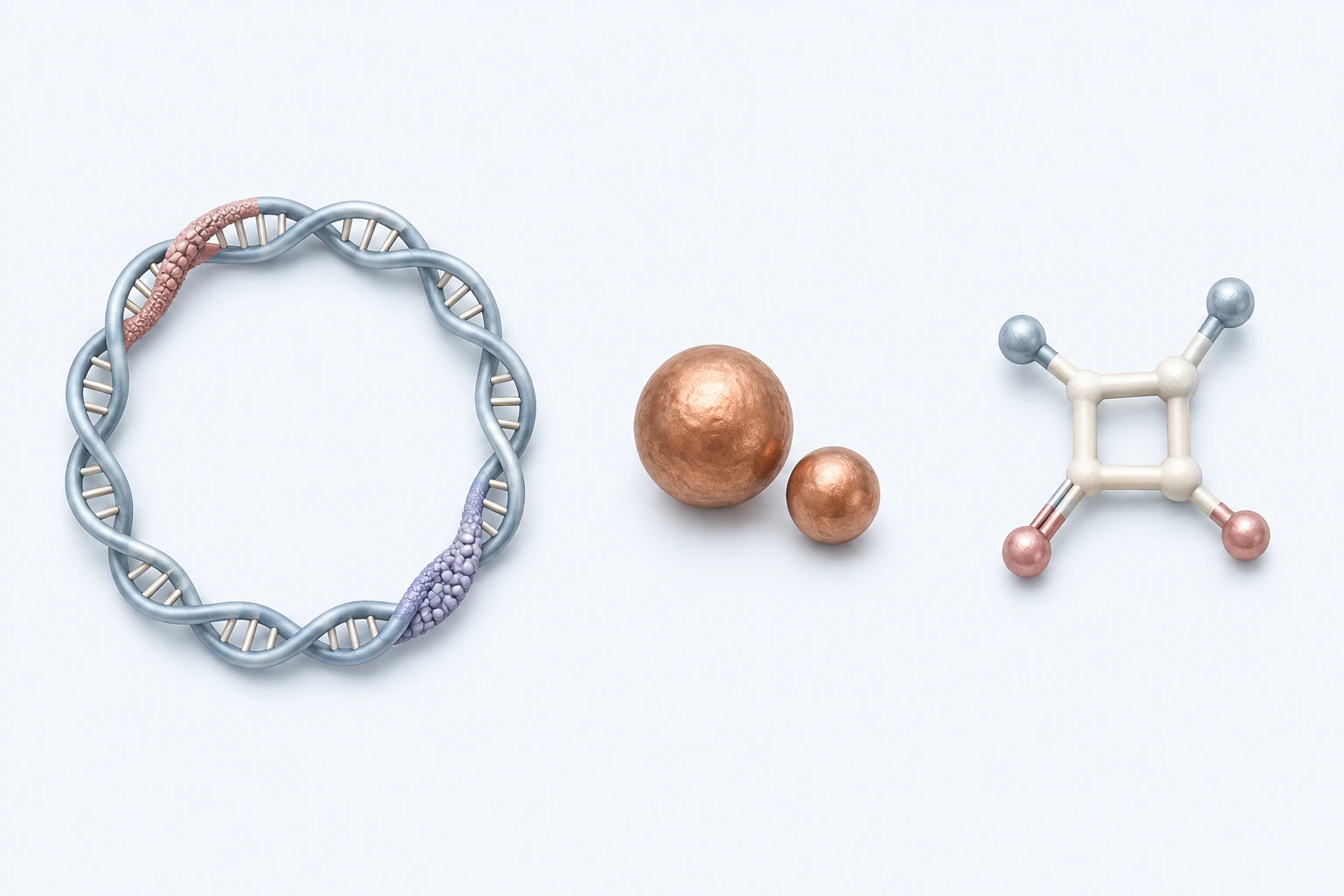
Antimicrobial-and-metal co-selection concept. Juxtaposition does not establish genetic linkage, co-resistance, cross-resistance, selection, transfer, expression, phenotype, prevalence, treatment failure, or causality.
Scientific media record2 verified identifiers
- Subject
- Co-selectionbiological-process
- Identifiers
- WikiBiome:co-selectionPMID:16537105
- Review
- Editorial review completeIdentifiers authority-verified · Accessibility validated · · co-selection|co-selection-mechanism-v1.webp
- Digital source
- Trained-algorithmic mediaCreated with a trained generative algorithm and reviewed by WikiBiome for subject identity, scientific framing, identifiers, provenance, and accessibility.
- Scientific basis
- Co-selection of antibiotic and metal resistanceCo-selection
- License
- CC BY-SA 4.0Created
The process by which selection pressure from one agent—typically a heavy metal—simultaneously selects for resistance to a structurally unrelated agent such as an antibiotic, because the resistance determinants are genetically linked on the same mobile genetic element (plasmid, transposon, integron).
cobalt (Co)-selection is one of the most clinically significant but underappreciated consequences of environmental metal pollution: heavy metal contamination in food, water, soil, and animal feed creates antibiotic-resistant bacteria without a single dose of antibiotic ever being administered.
The framework was established in,[1]Baker-Austin 2006 — Co-selection of Antibiotic and Metal ResistanceBaker-Austin C, Wright MS, Stepanauskas R et al. · 2006Open reference 1 ↓ the seminal 2006 review that defined the three molecular mechanisms and coined the vocabulary now used across this field.
The review made a critical argument: unlike antibiotics, metals do not degrade and can therefore represent a permanent selective pressure that maintains antibiotic resistance genes in environmental reservoirs indefinitely.
Evidence map16 cited passagesInspect provenance +
The framework was established in, the seminal 2006 review that defined the three molecular mechanisms and coined the vocabulary now used across this field. The review made a critical argument: unlike antibiotics, metals do not degrade and can therefore represent a permanent selective pressure that maintains antibiotic resistance genes in environmental reserv
The most straightforward mechanism: distinct resistance genes for different agents are physically co-located on the same genetic element. The element cannot be selected for without selecting for all resistance genes it carries.
In CKD gut bacteria from a Chilean mining region, cadmium resistance genes (cadA3k, cadA2k) co-occur on mobile elements with antibiotic resistance genes strB, floR, acrB, and arr2—in patients who had never been prescribed the corresponding antibiotics
A single biochemical mechanism confers resistance to both metals and antibiotics simultaneously. This requires no physical gene linkage—the same protein serves double duty.
Copper stress liberates Cu ions from the bacterial cell envelope, which activates the MarR repressor, inducing expression of the AcrAB-TolC multi-drug efflux pump—creating broad-spectrum antibiotic resistance via a metal intermediate.
Exposure to one stress agent transcriptionally activates resistance to another because they share regulatory circuits. The mex and czc operons are linked: activation of metal efflux (merE) also induces expression of multidrug transporters (mreD), connecting metal exposure to imipenem resistance.
Biofilm formation is both a metal resistance mechanism and an antibiotic resistance mechanism—making it a powerful co-selection amplifier. Under metal stress, bacteria form biofilms by secreting extracellular polymeric substances (EPS) with carboxyl, phosphoryl, and hydroxyl groups that bind metals, reducing intracellular metal burden. These same biofilms
Pseudomonas aeruginosa, for example, forms biofilms in response to cadmium at concentrations well below its planktonic MIC, and these biofilms show elevated resistance to multiple antibiotic classes—a direct co-selective effect of metal exposure.
The livestock food chain is the primary conduit for metal-selected antibiotic resistance entering the human gut:
Environmental persistence: Metals from livestock operations remain in soils for decades after supplementation ends. Agricultural topsoil metal concentrations are correlated with the abundance of antibiotic resistance genes across multiple studies.
Microplastics represent an emerging co-selection vector:
Dental amalgam mercury: Mercury released from dental amalgam is associated with elevated mercury resistance genes in oral and intestinal bacteria; these bacteria carry co-selected antibiotic resistance genes at significantly higher frequencies than in amalgam-free controls.
CKD patients in mining regions: In stage 3 CKD patients from Chile's mining-contaminated region, gut bacteria isolated under metal-selective conditions (As, Pb, Hg, Cd) showed simultaneous resistance to gentamicin, cefazolin, ceftazidime, and ciprofloxacin. The resistance pattern was stage-specific, intensifying at stage 4 and shifting at stage 5—tracking
Enterococcus as a 120-year bioindicator: A longitudinal study of 381 Enterococcus isolates spanning 1900–2019 showed that metal tolerance genes (arsA for arsenic, merA for mercury, tcrB for copper) have been present in clinical Enterococcus since at least the early 1900s, with co-occurrence with antibiotic resistance genes accelerating markedly since the 199
| Source | Evidence Level | Key Contribution | |--------|---------------|-----------------| | (2006) | Expert opinion (review) | Defined three mechanisms; established metals as permanent selection pressure | | (2019) | Expert opinion (review) | Added microplastics as co-selection hotspot; enumerated six bacterial metal resistance mechanisms | | (2015) | Expe
A critical insight from co-selection research: metal concentrations far below the minimum inhibitory concentration (MIC) are sufficient to select for co-resistance. The minimum selective concentration—the concentration at which selection for resistance measurably occurs—for metals can be 10–100× lower than concentrations needed to inhibit bacterial growt
Contents
1. Three Molecular Mechanisms2. The Biofilm Amplifier3. Agricultural and Industrial Sources4. Microplastics as Co-Selection Hotspots5. Evidence in Human Gut Bacteria6. Implications for Nutritional Immunity7. Key Studies8. Minimum Selective Concentrations: Sub-Lethal Risk9. Cross-ReferencesThree Molecular Mechanisms#
1. Co-Resistance#
The most straightforward mechanism: distinct resistance genes for different agents are physically co-located on the same genetic element. The element cannot be selected for without selecting for all resistance genes it carries.[1]Baker-Austin 2006 — Co-selection of Antibiotic and Metal ResistanceBaker-Austin C, Wright MS, Stepanauskas R et al. · 2006Open reference 1 ↓
Canonical examples. Copper resistance gene tcrB physically linked to vancomycin resistance (vanA) and macrolide resistance (ermB) on a single transferable plasmid in Enterococcus faecium—copper exposure alone co-selects for glycopeptide and macrolide resistance.
Mercury resistance transposons (Tn21-type) carry multiple antibiotic resistance gene cassettes via class 1 integrons. Tn7 transposons encode both mercury resistance and aadA1 (spectinomycin/streptomycin resistance).
In CKD gut bacteria from a Chilean mining region, cadmium resistance genes (cadA3k, cadA2k) co-occur on mobile elements with antibiotic resistance genes strB, floR, acrB, and arr2—in patients who had never been prescribed the corresponding antibiotics.[2]Miranda 2022 — Characterization of Metal(loid)s and Antibiotic Resistance in Bacteria of Human Gut Microbiota from CKD SubjectsMaría V. Miranda, Fernanda C. González, Osvaldo S. Paredes-Godoy et al. · 2022Open reference 2 ↓
2. Cross-Resistance#
A single biochemical mechanism confers resistance to both metals and antibiotics simultaneously. This requires no physical gene linkage—the same protein serves double duty.[1]Baker-Austin 2006 — Co-selection of Antibiotic and Metal ResistanceBaker-Austin C, Wright MS, Stepanauskas R et al. · 2006Open reference 1 ↓
Key examples. Efflux pumps are the dominant cross-resistance mechanism. The CzcCBA pump expels cobalt (Co), zinc (Zn), and cadmium (Cd) from the bacterial cell—but its broad substrate range also includes certain antibiotics.
Exposure to any substrate selects for its overexpression, which confers cross-resistance to all substrates.
The TetL protein can transport both tetracycline and cobalt.
Copper stress liberates copper (Cu) ions from the bacterial cell envelope, which activates the MarR repressor, inducing expression of the AcrAB-TolC multi-drug efflux pump—creating broad-spectrum antibiotic resistance via a metal intermediate.[3]Co-Selection of Resistance to Antibiotics, Biocides and Heavy Metals, and Its Relevance to Foodborne PathogensWales AD, Davies RH · 2015Open reference 3 ↓
Reduced outer membrane permeability, selected by arsenic, copper, zinc, or manganese stress, also impedes antibiotic entry.
3. Co-Regulatory Mechanisms#
Exposure to one stress agent transcriptionally activates resistance to another because they share regulatory circuits. The mex and czc operons are linked: activation of metal efflux (merE) also induces expression of multidrug transporters (mreD), connecting metal exposure to imipenem resistance.[1]Baker-Austin 2006 — Co-selection of Antibiotic and Metal ResistanceBaker-Austin C, Wright MS, Stepanauskas R et al. · 2006Open reference 1 ↓
The Biofilm Amplifier#
Biofilm formation is both a metal resistance mechanism and an antibiotic resistance mechanism—making it a powerful co-selection amplifier. Under metal stress, bacteria form biofilms by secreting extracellular polymeric substances (EPS) with carboxyl, phosphoryl, and hydroxyl groups that bind metals, reducing intracellular metal burden.
These same biofilms confer 10–1,000× elevated antibiotic MIC values by impeding diffusion and creating anaerobic microenvironments.[4]Co-selection of multi-antibiotic resistance in bacterial pathogens in metal and microplastic contaminated environments: an emerging health threatImran M, Das KR, Naik MM · 2019Open reference 4 ↓ Selecting for biofilm formation via metal exposure therefore simultaneously selects for antibiotic tolerance.
Pseudomonas aeruginosa, for example, forms biofilms in response to cadmium at concentrations well below its planktonic MIC, and these biofilms show elevated resistance to multiple antibiotic classes—a direct co-selective effect of metal exposure.[4]Co-selection of multi-antibiotic resistance in bacterial pathogens in metal and microplastic contaminated environments: an emerging health threatImran M, Das KR, Naik MM · 2019Open reference 4 ↓
Agricultural and Industrial Sources#
The livestock food chain is the primary conduit for metal-selected antibiotic resistance entering the human gut.[3]Co-Selection of Resistance to Antibiotics, Biocides and Heavy Metals, and Its Relevance to Foodborne PathogensWales AD, Davies RH · 2015Open reference 3 ↓
Zinc and copper in pig and poultry feed: Used therapeutically and as growth promoters. The EU permitted zinc inclusion at 30× basal requirements in young piglets. Approximately 90% of in-feed copper (Cu) and zinc (Zn) passes through livestock feces unchanged, contaminating manure-amended soils.
Arsenic: Used as a growth promoter in some countries.
Environmental persistence: Metals from livestock operations remain in soils for decades after supplementation ends. Agricultural topsoil metal concentrations are correlated with the abundance of antibiotic resistance genes across multiple studies.[3]Co-Selection of Resistance to Antibiotics, Biocides and Heavy Metals, and Its Relevance to Foodborne PathogensWales AD, Davies RH · 2015Open reference 3 ↓
E-waste recycling: Workers at electronic waste sites are exposed to metal-contaminated aerosols. Airborne resistomes at e-waste sites show co-enrichment of metal resistance genes (MRGs) and antibiotic resistance genes (ARGs) on the same mobile elements.
Microplastics as Co-Selection Hotspots#
Microplastics represent an emerging co-selection vector.[4]Co-selection of multi-antibiotic resistance in bacterial pathogens in metal and microplastic contaminated environments: an emerging health threatImran M, Das KR, Naik MM · 2019Open reference 4 ↓ Microplastic surfaces adsorb Heavy Metals (nickel (Ni), cadmium (Cd), lead (Pb), copper (Cu), zinc (Zn)) from surrounding water, concentrating metal loads many times above environmental background.
Bacteria colonize microplastic surfaces in high-density biofilms. The confined space, elevated metal concentration, and biofilm architecture accelerate horizontal gene transfer (HGT) between phylogenetically distant bacteria.
HGT on microplastic surfaces occurs at substantially higher rates than among free-living microbes. Pathogenic Vibrio spp. colonize marine microplastics and use them as vectors for global dispersal, carrying co-selected metal and antibiotic resistance determinants.
Evidence in Human Gut Bacteria#
cobalt (Co)-selection has been demonstrated directly in the human Gut Microbiome:
Dental amalgam mercury: Mercury released from dental amalgam is associated with elevated mercury resistance genes in oral and intestinal bacteria; these bacteria carry co-selected antibiotic resistance genes at significantly higher frequencies than in amalgam-free controls.[1]Baker-Austin 2006 — Co-selection of Antibiotic and Metal ResistanceBaker-Austin C, Wright MS, Stepanauskas R et al. · 2006Open reference 1 ↓
CKD patients in mining regions: In stage 3 CKD patients from Chile's mining-contaminated region, gut bacteria isolated under metal-selective conditions (arsenic (As), lead (Pb), mercury (Hg), cadmium (Cd)) showed simultaneous resistance to gentamicin, cefazolin, ceftazidime, and ciprofloxacin.
The resistance pattern was stage-specific, intensifying at stage 4 and shifting at stage 5—tracking the progressive change in gut microbiome composition that accompanies worsening kidney disease.[2]Miranda 2022 — Characterization of Metal(loid)s and Antibiotic Resistance in Bacteria of Human Gut Microbiota from CKD SubjectsMaría V. Miranda, Fernanda C. González, Osvaldo S. Paredes-Godoy et al. · 2022Open reference 2 ↓
Enterococcus as a 120-year bioindicator: A longitudinal study of 381 Enterococcus isolates spanning 1900–2019 showed that metal tolerance genes (arsA for arsenic, merA for mercury, tcrB for copper) have been present in clinical Enterococcus since at least the early 1900s, with co-occurrence with antibiotic resistance genes accelerating markedly since the 1990s—tracking the rise of modern antibiotic use and agricultural metal supplementation.[5]Diversity of metal and antibiotic resistance genes in Enterococcus spp. from the last century reflects multiple pollution and genetic exchange among phyla from overlapping ecosystemsRebelo A, Mourao J, Freitas AR et al. · 2021Open reference 5 ↓
Implications for Nutritional Immunity#
An underappreciated consequence: the host strategy of Nutritional Immunity (Metal Sequestration)—sequestering essential metals like iron and zinc to starve pathogens—may inadvertently select for metal-resistant, antibiotic-resistant organisms. When the host withholds iron via hepcidin upregulation, siderophore-producing bacteria with strong iron acquisition systems are selected.
These same organisms frequently carry co-resistance determinants. The very defense mechanism creates a selective environment that favors the most dangerous pathobionts.
Key Studies#
| Source | Evidence Level | Key Contribution |
|---|---|---|
| [1]Baker-Austin 2006 — Co-selection of Antibiotic and Metal ResistanceBaker-Austin C, Wright MS, Stepanauskas R et al. · 2006Open reference 1 ↓ (2006) | Expert opinion (review) | Defined three mechanisms; established metals as permanent selection pressure |
| [4]Co-selection of multi-antibiotic resistance in bacterial pathogens in metal and microplastic contaminated environments: an emerging health threatImran M, Das KR, Naik MM · 2019Open reference 4 ↓ (2019) | Expert opinion (review) | Added microplastics as co-selection hotspot; enumerated six bacterial metal resistance mechanisms |
| [3]Co-Selection of Resistance to Antibiotics, Biocides and Heavy Metals, and Its Relevance to Foodborne PathogensWales AD, Davies RH · 2015Open reference 3 ↓ (2015) | Expert opinion (review) | Livestock food chain; biocides as third co-selective agent; MarRAB mechanism |
| [5]Diversity of metal and antibiotic resistance genes in Enterococcus spp. from the last century reflects multiple pollution and genetic exchange among phyla from overlapping ecosystemsRebelo A, Mourao J, Freitas AR et al. · 2021Open reference 5 ↓ (2021) | Cross-sectional | 120-year temporal demonstration in Enterococcus; accelerating co-selection since 1990s |
| [2]Miranda 2022 — Characterization of Metal(loid)s and Antibiotic Resistance in Bacteria of Human Gut Microbiota from CKD SubjectsMaría V. Miranda, Fernanda C. González, Osvaldo S. Paredes-Godoy et al. · 2022Open reference 2 ↓ (2022) | Cross-sectional | Direct demonstration in human CKD gut microbiome; stage-specific resistance gene pattern |
Minimum Selective Concentrations: Sub-Lethal Risk#
A critical insight from co-selection research: metal concentrations far below the minimum inhibitory concentration (MIC) are sufficient to select for co-resistance.
The minimum selective concentration—the concentration at which selection for resistance measurably occurs—for metals can be 10–100× lower than concentrations needed to inhibit bacterial growth.[3]Co-Selection of Resistance to Antibiotics, Biocides and Heavy Metals, and Its Relevance to Foodborne PathogensWales AD, Davies RH · 2015Open reference 3 ↓
This means that dietary and environmental metal exposures that cause no direct harm to gut bacteria may still be actively driving resistance gene selection.
The "safe" exposure level for co-selection is likely lower than for direct toxicity—which means current regulatory standards for metals in food and water may be inadequate from an AMR perspective.
Cross-References#
Antimicrobial Resistance—the clinical consequence of co-selection. Dysbiosis—co-selected resistant organisms dominate dysbiotic communities. Nutritional Immunity (Metal Sequestration)—host metal sequestration may inadvertently select for co-resistant strains.
Biofilm—biofilm formation as co-selection amplifier. Horizontal Gene Transfer and Mobile Genetic Elements—mobile genetic elements as the vehicle of co-resistance dissemination. Gut-Metal-Microbiome Interactions—the primary site in humans where dietary metal drives co-selection.
Arsenic—arsenic resistance genes (arsA, arsC) frequently co-located with ARGs. Mercury—Tn21 transposons link mercury resistance to multi-drug cassettes. Copper—livestock copper use drives resistance gene dissemination via fecal contamination.
Zinc—zinc in animal feed; 90% excreted unchanged, contaminating agricultural soils. Cadmium—cadmium resistance genes (cadA3k, cadA2k) co-located with ARGs in CKD gut bacteria.
References 6
Numbered by first appearance in the article, then reconciled with its declared source list.
- 1
Baker-Austin C, Wright MS, Stepanauskas R et al. (2006). Baker-Austin 2006 — Co-selection of Antibiotic and Metal Resistance. Trends in Microbiology.
- 2
María V. Miranda, Fernanda C. González, Osvaldo S. Paredes-Godoy et al. (2022). Miranda 2022 — Characterization of Metal(loid)s and Antibiotic Resistance in Bacteria of Human Gut Microbiota from CKD Subjects. Biological Research.
- 3
Wales AD, Davies RH (2015). Co-Selection of Resistance to Antibiotics, Biocides and Heavy Metals, and Its Relevance to Foodborne Pathogens. Antibiotics.
- 4
Imran M, Das KR, Naik MM (2019). Co-selection of multi-antibiotic resistance in bacterial pathogens in metal and microplastic contaminated environments: an emerging health threat. Chemosphere.
- 5
Rebelo A, Mourao J, Freitas AR et al. (2021). Diversity of metal and antibiotic resistance genes in Enterococcus spp. from the last century reflects multiple pollution and genetic exchange among phyla from overlapping ecosystems. Science of the Total Environment.
- 6
Hu HW, Wang JT, Li J et al. (2016). Hu 2016 — Nickel Contamination and Antibiotic Resistance in Soils. Environmental Science and Technology.
Article network
Mentioned here 13
Pages linking here 33
Connect the evidence
Publicly readable discussion by ORCID-authenticated researchers. Questions, interpretation, methods, corrections, and new evidence stay attached to this record.
No discussion yet. Start with a precise question or a source-backed observation.
Activity and accepted changes
Accepted researcher context, editorial status, public discussion, and upstream Git revisions are shown together. Pending, declined, and withdrawn proposals remain private.
- published revision
Backfill heavy metals concept links
Karen Pendergrass · +1 −1
Inspect exact Git diff ↗ - published revision
Backfill gut microbiome concept links
Karen Pendergrass · +1 −1
Inspect exact Git diff ↗ - published revision
massive wiki expansion: 149 stubs fixed, 100+ new pages, Rule 15 scan, keystone papers
WikiBiome Deploy Bot · +10 −10
Inspect exact Git diff ↗ - published revision
Deepen 8 concept pages + 2 CP source pages (co-selection, AMR, alpha-synuclein, metabolites, gut-microbiome, propionic-acid, amyloid-beta, dyshomeostasis)
WikiBiome Deploy Bot · +97 −16
Inspect exact Git diff ↗ - published revision
WikiBiome update — integrity fixes, metallomic diet pages, cross-condition analyses
WikiBiome Deploy Bot · +2 −0
Inspect exact Git diff ↗ - published revision
WikiBiome update — 2026-04-10 23:44
WikiBiome Deploy Bot · +27 −0
Inspect exact Git diff ↗