

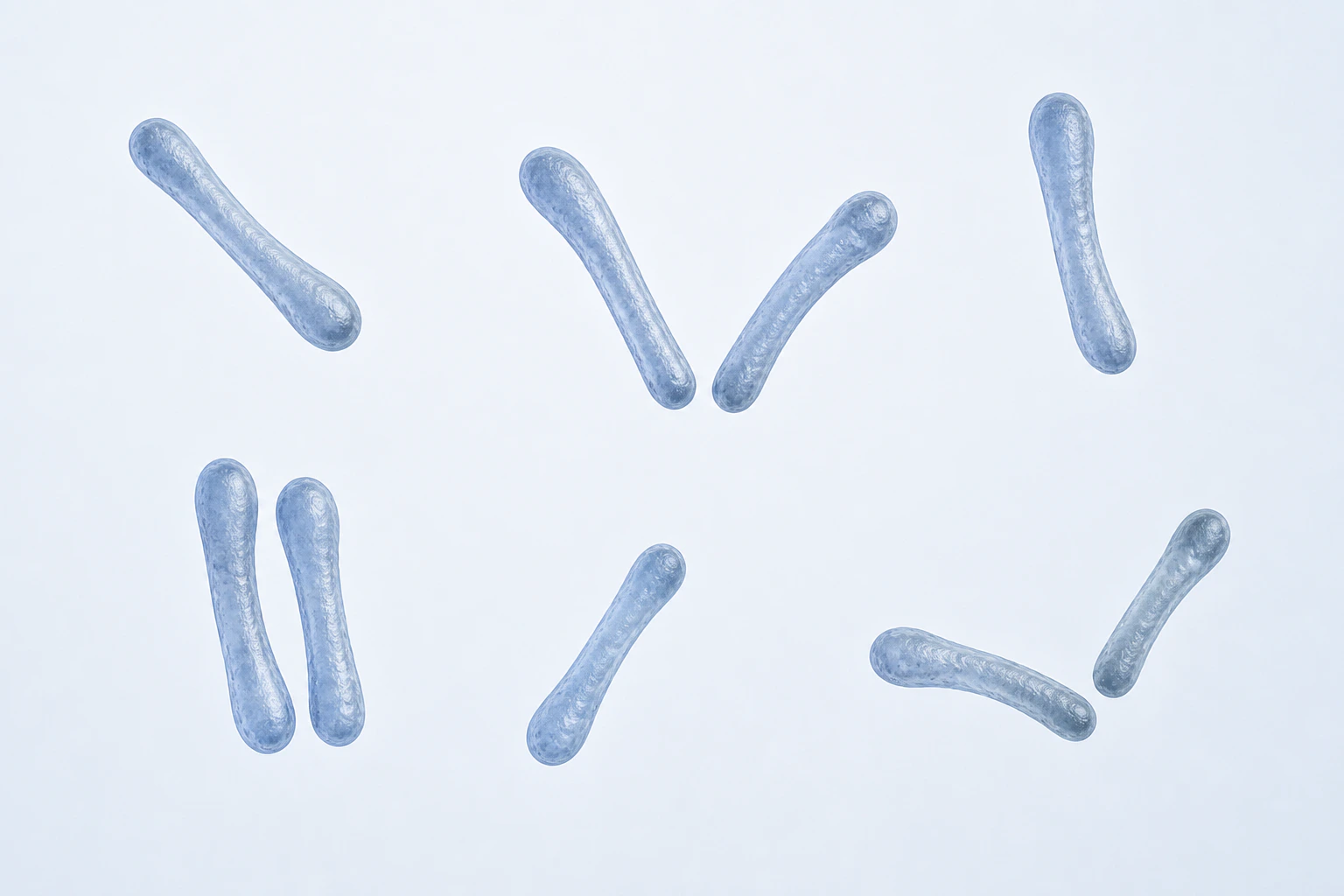
Selected type-species-anchored Corynebacterium club-shaped and pleomorphic rod forms, shown as nine bodies in six single, V-shaped, angled, or palisade groupings. This reconstruction is representative, non-diagnostic, and not a micrograph.
Scientific media record1 verified identifier
- Subject
- Corynebacteriumtaxon · genus
- Identifiers
- NCBITaxon:1716
- Review
- Editorial review completeIdentifiers authority-verified · Accessibility validated · · corynebacterium|corynebacterium-morphology-v1.webp
- Digital source
- Trained-algorithmic mediaCreated with a trained generative algorithm and reviewed by WikiBiome for subject identity, scientific framing, identifiers, provenance, and accessibility.
- Scientific basis
- Corynebacterium — NCBI TaxonomyCorynebacterium — LPSNCorynebacterium genus morphology
- License
- CC BY-SA 4.0Created
Corynebacterium is a large genus of Gram-positive, club-shaped bacteria with over 130 species spanning commensals, opportunistic pathogens, and the classic pathogen C. diphtheriae.
In the WikiBiome context, Corynebacterium is most notable for its dominance in the male reproductive tract microbiome—it is consistently one of the most abundant genera in seminal fluid, prostatic secretions, and urethral microbiota—and its iron-regulated virulence in pathogenic species.
Evidence map10 cited passagesInspect provenance +
Identified as a dominant genus in seminal fluid alongside Staphylococcus, Streptococcus, and Prevotella.
Environmental factors including heavy metal exposure alter Corynebacterium abundance in semen, with implications for sperm quality.
Depletion of Corynebacterium in semen is associated with male infertility, suggesting a commensal protective role in the reproductive tract.
Enriched in prostate cancer tissue compared to benign prostate.
Present in chronic bacterial prostatitis, where probiotic interventions alter Corynebacterium abundance.
Identified in cervical mucus microbiome of endometriosis patients.
Part of the vaginal microbiota shifts observed in deep endometriosis.
Mucosal lactoferrin levels affect Corynebacterium colonization in the genital tract, linking iron sequestration to reproductive tract ecology.
ASD: Altered Corynebacterium abundance in gut microbiota of ASD children.
Cadmium exposure: Corynebacterium abundance altered by environmental cadmium in animal models.
Contents
1. Reproductive Tract Dominance2. Metal Dependencies3. Other Associations4. Cross-ReferencesReproductive Tract Dominance#
Seminal Fluid Microbiome#
Corynebacterium is one of the core genera of the seminal fluid microbiome across multiple studies. Identified as a dominant genus in seminal fluid alongside Staphylococcus, Streptococcus, and Prevotella.[1]Molina Morales 2023 — The Microbiome of the Male Reproductive Tract: Uncovering Its Composition and OriginsNerea Molina Morales · 2023Open reference 1 ↓[2]Javurek 2016 — Discovery of a Novel Seminal Fluid Microbiome and Influence of Estrogen Receptor Alpha Genetic StatusAngela B. Javurek, William G. Spollen, Amber M. Mann Ali et al. · 2016Open reference 2 ↓
Environmental factors including heavy metal exposure alter Corynebacterium abundance in semen, with implications for sperm quality.[3]Neto 2024 — Effect of Environmental Factors on Seminal Microbiome and Impact on Sperm QualityFilipe T. Lira Neto, Marina C. Viana, Federica Cariati et al. · 2024Open reference 3 ↓
Depletion of Corynebacterium in semen is associated with male infertility, suggesting a commensal protective role in the reproductive tract.[4]Ughade 2024 — Navigating the Microbial Landscape: Understanding Dysbiosis in Human Genital Tracts and Its Impact on FertilityPrachi A. Ughade, Deepti Shrivastava, Kamlesh Chaudhari · 2024Open reference 4 ↓[5]Cai 2022 — Gut Microbiota Supports Male Reproduction via Nutrition, Immunity, and SignalingHui Cai, Xuanhong Cao, Dezhe Qin et al. · 2022Open reference 5 ↓
Prostate#
Enriched in prostate cancer tissue compared to benign prostate.[6]Bautista 2025 — Reprogramming Prostate Cancer Through the MicrobiomeJhommara Bautista, Walter D. Cardona-Maya, Kelly Gancino-Guevara et al. · 2025Open reference 6 ↓ Present in chronic bacterial prostatitis, where probiotic interventions alter Corynebacterium abundance.[7]Vocca 2025 — Probiotics in the Management of Chronic Bacterial Prostatitis: A Randomized, Double-Blind Trial to Evaluate a Possible Link Between Gut Microbiota Restoring and Symptom ReliefCristina Vocca, Diana Marisol Abrego-Guandique, Erika Cione et al. · 2025Open reference 7 ↓
Female Reproductive Tract#
Identified in cervical mucus microbiome of endometriosis patients.[8]Molecular detection of microbial colonization in cervical mucus of women with and without endometriosisAkiyama K, Nishioka K, Khan KN et al. · 2019Open reference 8 ↓[9]Ser 2023 — Current Updates on the Role of Microbiome in Endometriosis: A Narrative ReviewHooi-Leng Ser, Siu-Jung Au Yong, Mohamad Nasir Shafiee et al. · 2023Open reference 9 ↓ Part of the vaginal microbiota shifts observed in deep endometriosis.[10]Hernandes 2020 — Microbiome Profile of Deep Endometriosis Patients: Comparison of Vaginal Fluid, Endometrium and LesionCamila Hernandes, Paola Silveira, Aline Fernanda Rodrigues Sereia et al. · 2020Open reference 10 ↓[11]MacSharry 2024 — Endometriosis Specific Vaginal Microbiota Links to Urine and Serum N-GlycomeJohn MacSharry, Zsuzsanna Kovacs, Yongjing Xie et al. · 2024Open reference 11 ↓
Mucosal lactoferrin levels affect Corynebacterium colonization in the genital tract, linking iron sequestration to reproductive tract ecology.[12]Roberts 2019 — Mucosal Lactoferrin Response to Genital Tract Infections Is Associated with Iron and Nutritional BiomarkersS. A. Roberts, L. Brabin, S. Diallo et al. · 2019Open reference 12 ↓
Metal Dependencies#
Iron-Regulated Virulence#
The paradigm case is C. diphtheriae, whose diphtheria toxin gene (tox) is carried by a corynephage and is transcriptionally repressed by iron via the DtxR (diphtheria toxin repressor) regulator. Under iron limitation, DtxR releases the tox promoter, and toxin production begins. This means.
Iron restriction drives virulence—the host's attempt to starve the pathogen of iron paradoxically triggers its most dangerous weapon. DtxR is an iron-dependent metalloregulatory protein that also controls siderophore biosynthesis, iron storage, and Oxidative Stress genes across all Corynebacterium species.
Non-diphtheriae Corynebacterium species retain DtxR-family regulators that control iron homeostasis, making iron a central axis of the genus's biology.
Other Associations#
ASD: Altered Corynebacterium abundance in gut microbiota of ASD children.[13]Strati 2017 — New Evidences on the Altered Gut Microbiota in Autism Spectrum DisordersFrancesco Strati, Duccio Cavalieri, Davide Albanese et al. · 2017Open reference 13 ↓ Cadmium exposure: Corynebacterium abundance altered by environmental cadmium in animal models.[14]Environmental cadmium exposure alters the internal microbiota and metabolome of Sprague-Dawley ratsSongqing Liu, Xin Deng, Zheng Li et al. · 2023Open reference 14 ↓
Cross-References#
- Iron—DtxR-mediated iron regulation controls virulence and siderophore production
- Lactoferrin—mucosal lactoferrin affects genital tract Corynebacterium colonization
- Nutritional Immunity (Metal Sequestration)—iron restriction triggers diphtheria toxin production (paradoxical virulence)
- Endometriosis—cervical and vaginal microbiome associations
- Propionic Acid—some Corynebacterium species are propionate producers (cutaneous ecology)
References 14
Numbered by first appearance in the article, then reconciled with its declared source list.
- 1
Nerea Molina Morales (2023). Molina Morales 2023 — The Microbiome of the Male Reproductive Tract: Uncovering Its Composition and Origins. Doctoral Thesis, Universidad de Granada.
- 2
Angela B. Javurek, William G. Spollen, Amber M. Mann Ali et al. (2016). Javurek 2016 — Discovery of a Novel Seminal Fluid Microbiome and Influence of Estrogen Receptor Alpha Genetic Status. Scientific Reports.
- 3
Filipe T. Lira Neto, Marina C. Viana, Federica Cariati et al. (2024). Neto 2024 — Effect of Environmental Factors on Seminal Microbiome and Impact on Sperm Quality. Frontiers in Endocrinology.
- 4
Prachi A. Ughade, Deepti Shrivastava, Kamlesh Chaudhari (2024). Ughade 2024 — Navigating the Microbial Landscape: Understanding Dysbiosis in Human Genital Tracts and Its Impact on Fertility. Cureus.
- 5
Hui Cai, Xuanhong Cao, Dezhe Qin et al. (2022). Cai 2022 — Gut Microbiota Supports Male Reproduction via Nutrition, Immunity, and Signaling. Frontiers in Microbiology.
- 6
Jhommara Bautista, Walter D. Cardona-Maya, Kelly Gancino-Guevara et al. (2025). Bautista 2025 — Reprogramming Prostate Cancer Through the Microbiome. Frontiers in Medicine.
- 7
Cristina Vocca, Diana Marisol Abrego-Guandique, Erika Cione et al. (2025). Vocca 2025 — Probiotics in the Management of Chronic Bacterial Prostatitis: A Randomized, Double-Blind Trial to Evaluate a Possible Link Between Gut Microbiota Restoring and Symptom Relief. Microorganisms.
- 8
Akiyama K, Nishioka K, Khan KN et al. (2019). Molecular detection of microbial colonization in cervical mucus of women with and without endometriosis. American Journal of Reproductive Immunology.
- 9
Hooi-Leng Ser, Siu-Jung Au Yong, Mohamad Nasir Shafiee et al. (2023). Ser 2023 — Current Updates on the Role of Microbiome in Endometriosis: A Narrative Review. Microorganisms.
- 10
Camila Hernandes, Paola Silveira, Aline Fernanda Rodrigues Sereia et al. (2020). Hernandes 2020 — Microbiome Profile of Deep Endometriosis Patients: Comparison of Vaginal Fluid, Endometrium and Lesion. Diagnostics.
- 11
John MacSharry, Zsuzsanna Kovacs, Yongjing Xie et al. (2024). MacSharry 2024 — Endometriosis Specific Vaginal Microbiota Links to Urine and Serum N-Glycome. Scientific Reports.
- 12
S. A. Roberts, L. Brabin, S. Diallo et al. (2019). Roberts 2019 — Mucosal Lactoferrin Response to Genital Tract Infections Is Associated with Iron and Nutritional Biomarkers. European Journal of Clinical Nutrition.
- 13
Francesco Strati, Duccio Cavalieri, Davide Albanese et al. (2017). Strati 2017 — New Evidences on the Altered Gut Microbiota in Autism Spectrum Disorders. Microbiome.
- 14
Songqing Liu, Xin Deng, Zheng Li et al. (2023). Environmental cadmium exposure alters the internal microbiota and metabolome of Sprague-Dawley rats. Frontiers in Veterinary Science.
Article network
Mentioned here 6
Pages linking here 1
Connect the evidence
Publicly readable discussion by ORCID-authenticated researchers. Questions, interpretation, methods, corrections, and new evidence stay attached to this record.
No discussion yet. Start with a precise question or a source-backed observation.
Published page changes
This record shows only material changes published on this page, including changes to its content, evidence, conclusions, or author context. Internal processes and discussion activity are excluded. Pending, declined, and withdrawn proposals remain private.
- published revision
Added “Corynebacterium”: Corynebacterium is a large genus of Gram-positive, club-shaped bacteria with over 130 species spanning commensals, opportunistic pathogens, and the classic pathogen C. diphtheriae. In the WikiBiome…
Added “Corynebacterium”: Corynebacterium is a large genus of Gram-positive, club-shaped bacteria with over 130 species spanning commensals, opportunistic pathogens, and the classic pathogen C. diphtheriae. In the WikiBiome… Added “Seminal Fluid Microbiome”: Corynebacterium is one of the core genera of the seminal fluid microbiome across multiple studies: - Identified as a dominant genus in seminal fluid alongside Staphylococcus, Streptococcus, and… Added “Prostate”: - Enriched in prostate cancer tissue compared to benign prostate. - Present in chronic bacterial prostatitis, where probiotic interventions alter Corynebacterium abundance. Added “Female Reproductive Tract”: - Identified in cervical mucus microbiome of endometriosis patients. - Part of the vaginal microbiota shifts observed in deep endometriosis. - Mucosal lactoferrin levels affect Corynebacterium… Added “Iron-Regulated Virulence”: The paradigm case is C. diphtheriae, whose diphtheria toxin gene (tox) is carried by a corynephage and is transcriptionally repressed by iron via the DtxR (diphtheria toxin repressor) regulator. Under… Added “Other Associations”: - ASD: Altered Corynebacterium abundance in gut microbiota of ASD children. - Cadmium exposure: Corynebacterium abundance altered by environmental cadmium in animal models. Added “Cross-References”: - iron — DtxR-mediated iron regulation controls virulence and siderophore production - lactoferrin — mucosal lactoferrin affects genital tract Corynebacterium colonization - nutritional immunity —… Added citations to “Seminal Fluid Microbiome”: molina morales 2023 male reproductive tract microbiome; javurek 2016 seminal fluid microbiome esr1; neto 2024 environmental factors seminal microbiome sperm quality; ughade 2024 genital dysbiosis fertility review; cai 2022 gut microbiota male reproduction. Added citations to “Prostate”: bautista 2025 reprogramming prostate cancer microbiome; vocca 2025 probiotics chronic bacterial prostatitis rct. Added citations to “Female Reproductive Tract”: akiyama 2019 cervical mucus microbial colonization endometriosis; ser 2023 current updates microbiome endometriosis review; hernandes 2020 microbiome profile deep endometriosis; macsharry 2024 endometriosis vaginal microbiota n glycome; roberts 2019 mucosal lactoferrin genital infections iron. Added citations to “Other Associations”: strati 2017 altered gut microbiota mycobiota asd; liu 2023 cadmium microbiota metabolome rats. Added references: molina-morales-2023-male-reproductive-tract-microbiome; javurek-2016-seminal-fluid-microbiome-esr1; neto-2024-environmental-factors-seminal-microbiome-sperm-quality; bautista-2025-reprogramming-prostate-cancer-microbiome; vocca-2025-probiotics-chronic-bacterial-prostatitis-rct; cai-2022-gut-microbiota-male-reproduction; ughade-2024-genital-dysbiosis-fertility-review; akiyama-2019-cervical-mucus-microbial-colonization-endometriosis; ser-2023-current-updates-microbiome-endometriosis-review; hernandes-2020-microbiome-profile-deep-endometriosis; macsharry-2024-endometriosis-vaginal-microbiota-n-glycome; roberts-2019-mucosal-lactoferrin-genital-infections-iron; strati-2017-altered-gut-microbiota-mycobiota-asd; liu-2023-cadmium-microbiota-metabolome-rats. Added key enzymes: siderophore-uptake-systems; diphtheria-toxin-iron-regulated. Added metal dependencies: iron. · WikiBiome Deploy Bot · +74 −12
Inspect exact Git diff ↗ - published revision
Created “Corynebacterium”:
Created “Corynebacterium”: · WikiBiome Deploy Bot · +21 −0
Inspect exact Git diff ↗