
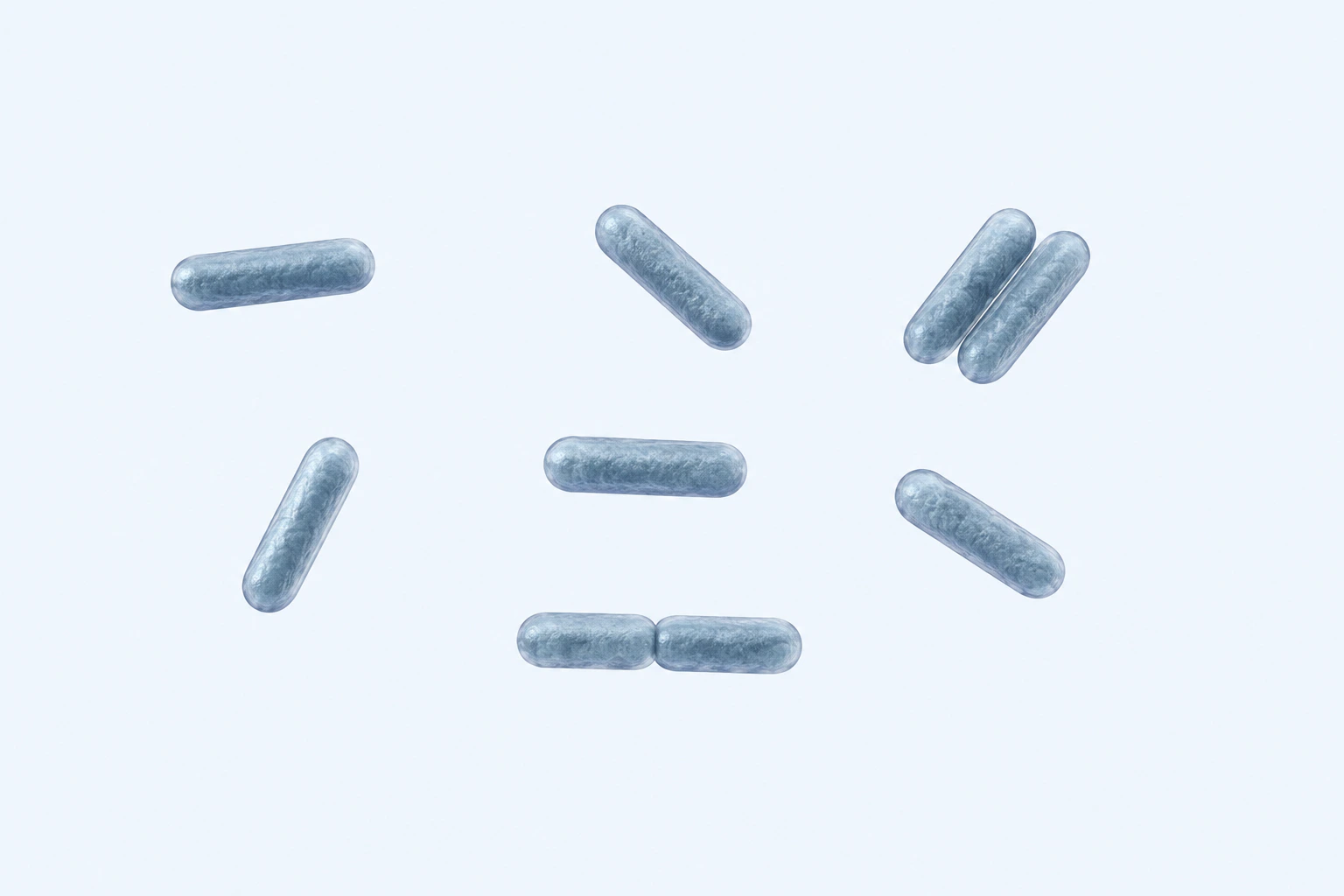
Type-species-anchored Salmonella reconstruction with nine straight short rods. This genus plate is representative, non-diagnostic, and not a micrograph; omitted appendages make no motility claim.
Scientific media record1 verified identifier
- Subject
- Salmonellataxon · genus
- Identifiers
- NCBITaxon:590
- Review
- Editorial review completeIdentifiers authority-verified · Accessibility validated · · salmonella|salmonella-morphology-v1.webp
- Digital source
- Trained-algorithmic mediaCreated with a trained generative algorithm and reviewed by WikiBiome for subject identity, scientific framing, identifiers, provenance, and accessibility.
- Scientific basis
- Salmonella — NCBI TaxonomySalmonella — LPSNSalmonella nomenclature reviewSalmonella enterica emended descriptionSalmonella morphology — CDC PHIL
- License
- CC BY-SA 4.0Created
Salmonella is a genus of Gram-negative, facultatively anaerobic bacteria in the family Enterobacteriaceae. The two species—S. enterica (with >2,500 serovars including Typhimurium and Typhi) and S. bongori—cause a spectrum of disease from self-limiting gastroenteritis to life-threatening typhoid fever.
Salmonella is one of the most studied organisms in nutritional immunity research, as its survival strategy inside macrophages depends entirely on metal acquisition systems that the host actively tries to block.
Evidence map9 cited passagesInspect provenance +
Salmochelin: A glucosylated derivative of enterobactin that evades host lipocalin 2—the primary counter-siderophore defense. This "stealth siderophore" strategy gives Salmonella a decisive advantage over organisms relying on enterobactin alone.
MntH and SitABCD transport Mn2+ into the bacterial cell, where it serves as a cofactor for superoxide dismutase (SodA)—the primary defense against the oxidative burst.
The ZntA zinc efflux pump is essential for intramacrophage survival, representing a host-pathogen arms race at the zinc level.
Salmonella harbors NiFe hydrogenases that support anaerobic respiration during gut colonization. Hydrogen oxidation provides a competitive advantage in the inflamed gut environment.
Environmental modulation: Cadmium and lead oral exposure exacerbates Salmonella-driven colitis by disrupting epithelial barrier integrity and altering the competitive landscape.
Dietary iron supplementation in populations with endemic Salmonella increases infection severity—the supplemented iron overwhelms nutritional immunity and feeds the pathogen.
The MdtABC efflux pump exports copper, zinc, AND multiple antibiotics in S. Typhimurium.
Agricultural use of copper and zinc as growth promoters in livestock selects for multidrug-resistant Salmonella strains that enter the human food chain.
Environmental nickel exposure selects for nickel-tolerant Salmonella with cross-resistance to fluoroquinolones.
Contents
1. Metal Dependencies—A Multi-Metal Strategy2. Nutritional Immunity Battleground3. Metal-Antibiotic Resistance Co-Selection4. Cross-ReferencesMetal Dependencies—A Multi-Metal Strategy#
Iron#
Salmonella's iron acquisition toolkit is one of the most sophisticated among enteric pathogens. Salmochelin: A glucosylated derivative of enterobactin that evades host Lipocalin-2—the primary counter-siderophore defense. This "stealth siderophore" strategy gives Salmonella a decisive advantage over organisms relying on enterobactin alone.[1]Metal Ion Acquisition in Staphylococcus aureus: Overcoming Nutritional ImmunityJames E. Cassat, Eric P. Skaar · 2012Open reference 1 ↓
Enterobactin: Standard catecholate siderophore with extreme iron(III) (Fe3+) affinity. SitABCD: ABC transporter for ferrous iron and manganese, critical for intramacrophage survival. Feo system: Ferrous iron transporter active under anaerobic conditions in the gut lumen.
Manganese#
Manganese is essential for Salmonella's defense against oxidative killing inside macrophages. MntH and SitABCD transport manganese(II) (Mn2+) into the bacterial cell, where it serves as a cofactor for superoxide dismutase (SodA)—the primary defense against the oxidative burst.[2]Martin & Waters 2022 — Manganese Homeostasis, Stress, and Pathogenesis in BacteriaJulia E. Martin, Lauren S. Waters · 2022Open reference 2 ↓
Host Calprotectin (S100A8/A9) sequesters both zinc (Zn) and manganese at infection sites, directly targeting this vulnerability. Manganese-starved Salmonella are hypersensitive to macrophage killing—demonstrating that manganese acquisition is a genuine Achilles' heel (Karen's Brain Primitive 4).
Zinc#
Salmonella requires zinc for multiple metalloenzymes but must also survive host zinc intoxication—macrophages pump toxic levels of zinc into Salmonella-containing vacuoles as an antimicrobial strategy.
The ZntA zinc efflux pump is essential for intramacrophage survival, representing a host-pathogen arms race at the zinc level.[3]McEwan 2024 — Metalloproteome Plasticity: A Factor in Bacterial Pathogen Adaptive Responses?Alastair G. McEwan · 2024Open reference 3 ↓
Nickel#
- Salmonella harbors NiFe hydrogenases that support anaerobic respiration during gut colonization.[4]Role of Nickel in Microbial PathogenesisRobert J. Maier, Stéphane L. Benoit · 2019Open reference 4 ↓ Hydrogen oxidation provides a competitive advantage in the inflamed gut environment.
Nutritional Immunity Battleground#
Salmonella infection is a paradigm case for nutritional immunity:
- Host response: Infection triggers hepcidin release → iron sequestration; calprotectin release → zinc (Zn)/manganese (Mn) sequestration; macrophage zinc intoxication of intracellular bacteria.
- Pathogen counter-response: Salmochelin evades lipocalin-2; SitABCD acquires manganese under restriction; ZntA pumps out toxic zinc.
- Environmental modulation: Cadmium and lead oral exposure exacerbates Salmonella-driven colitis by disrupting epithelial barrier integrity and altering the competitive landscape.[5]Does oral exposure to cadmium and lead mediate susceptibility to colitis? The dark-and-bright sides of heavy metals in gut ecologyBreton J, Daniel C, Vignal C et al. · 2016Open reference 5 ↓
Dietary iron supplementation in populations with endemic Salmonella increases infection severity—the supplemented iron overwhelms nutritional immunity and feeds the pathogen.[6]Bushman 2025 — The Exploitation of Nutrient Metals by Bacteria for Survival and Infection in the GutSummer D Bushman, Eric P Skaar, N Luisa Hiller · 2025Open reference 6 ↓
Metal-Antibiotic Resistance Co-Selection#
Salmonella is a major example of metal-antibiotic co-selection. The MdtABC efflux pump exports copper, zinc, AND multiple antibiotics in S. Typhimurium.[7]Understanding the Development of Environmental Resistance Among Microbes: A ReviewSrivastava J, Chandra H, Singh N et al. · 2016Open reference 7 ↓
Agricultural use of copper and zinc as growth promoters in livestock selects for multidrug-resistant Salmonella strains that enter the human food chain.[8]Co-Selection of Resistance to Antibiotics, Biocides and Heavy Metals, and Its Relevance to Foodborne PathogensWales AD, Davies RH · 2015Open reference 8 ↓[9]Baker-Austin 2006 — Co-selection of Antibiotic and Metal ResistanceBaker-Austin C, Wright MS, Stepanauskas R et al. · 2006Open reference 9 ↓
Environmental nickel exposure selects for nickel-tolerant Salmonella with cross-resistance to fluoroquinolones.[10]Genchi 2020 — Nickel: Human Health and Environmental ToxicologyGenchi G, Carocci A, Lauria G et al. · 2020Open reference 10 ↓
Cross-References#
- Iron—multi-system iron acquisition; salmochelin as stealth siderophore
- Siderophores—salmochelin evades lipocalin-2; enterobactin as backup
- Manganese—MntH/SitABCD for Oxidative Stress defense inside macrophages
- Zinc—zinc intoxication defense via ZntA; calprotectin-mediated sequestration
- Nickel—NiFe-hydrogenase for gut colonization
- Calprotectin (S100A8/A9)—primary host defense targeting manganese (Mn) and zinc (Zn)
- Nutritional Immunity (Metal Sequestration)—paradigm organism for metal restriction as antimicrobial strategy
- Co-Selection—MdtABC efflux pump exports metals and antibiotics
- Cadmium—cadmium (Cd) exposure exacerbates Salmonella colitis
- Lead—lead (Pb) exposure compounds Salmonella pathogenesis
References 10
Numbered by first appearance in the article, then reconciled with its declared source list.
- 1
★James E. Cassat, Eric P. Skaar (2012). Metal Ion Acquisition in Staphylococcus aureus: Overcoming Nutritional Immunity. Seminars in Immunopathology.
- 2
Julia E. Martin, Lauren S. Waters (2022). Martin & Waters 2022 — Manganese Homeostasis, Stress, and Pathogenesis in Bacteria. Frontiers in Molecular Biosciences.
- 3
Alastair G. McEwan (2024). McEwan 2024 — Metalloproteome Plasticity: A Factor in Bacterial Pathogen Adaptive Responses?. Emerging Topics in Life Sciences.
- 4
★Robert J. Maier, Stéphane L. Benoit (2019). Role of Nickel in Microbial Pathogenesis. Inorganics.
- 5
Breton J, Daniel C, Vignal C et al. (2016). Does oral exposure to cadmium and lead mediate susceptibility to colitis? The dark-and-bright sides of heavy metals in gut ecology. Scientific Reports.
- 6
Summer D Bushman, Eric P Skaar, N Luisa Hiller (2025). Bushman 2025 — The Exploitation of Nutrient Metals by Bacteria for Survival and Infection in the Gut. PLOS Pathogens.
- 7
Srivastava J, Chandra H, Singh N et al. (2016). Understanding the Development of Environmental Resistance Among Microbes: A Review. Clean - Soil, Air, Water.
- 8
Wales AD, Davies RH (2015). Co-Selection of Resistance to Antibiotics, Biocides and Heavy Metals, and Its Relevance to Foodborne Pathogens. Antibiotics.
- 9
Baker-Austin C, Wright MS, Stepanauskas R et al. (2006). Baker-Austin 2006 — Co-selection of Antibiotic and Metal Resistance. Trends in Microbiology.
- 10
Genchi G, Carocci A, Lauria G et al. (2020). Genchi 2020 — Nickel: Human Health and Environmental Toxicology. International Journal of Environmental Research and Public Health.
Article network
Connect the evidence
Publicly readable discussion by ORCID-authenticated researchers. Questions, interpretation, methods, corrections, and new evidence stay attached to this record.
No discussion yet. Start with a precise question or a source-backed observation.
Activity and accepted changes
Accepted researcher context, editorial status, public discussion, and upstream Git revisions are shown together. Pending, declined, and withdrawn proposals remain private.
- published revision
Backfill oxidative stress concept links
Karen Pendergrass · +1 −1
Inspect exact Git diff ↗ - published revision
Complete Hydrogenase contextual coverage
Karen Pendergrass · +1 −1
Inspect exact Git diff ↗ - published revision
massive wiki expansion: 149 stubs fixed, 100+ new pages, Rule 15 scan, keystone papers
WikiBiome Deploy Bot · +85 −12
Inspect exact Git diff ↗ - published revision
nightly maintenance: 94 stub demotions, 181 source_count fixes, 22 auto-discovered stubs, 5 adversarial audits, 3 boundary fixes, 3 evidence-level corrections
WikiBiome Deploy Bot · +21 −0
Inspect exact Git diff ↗