
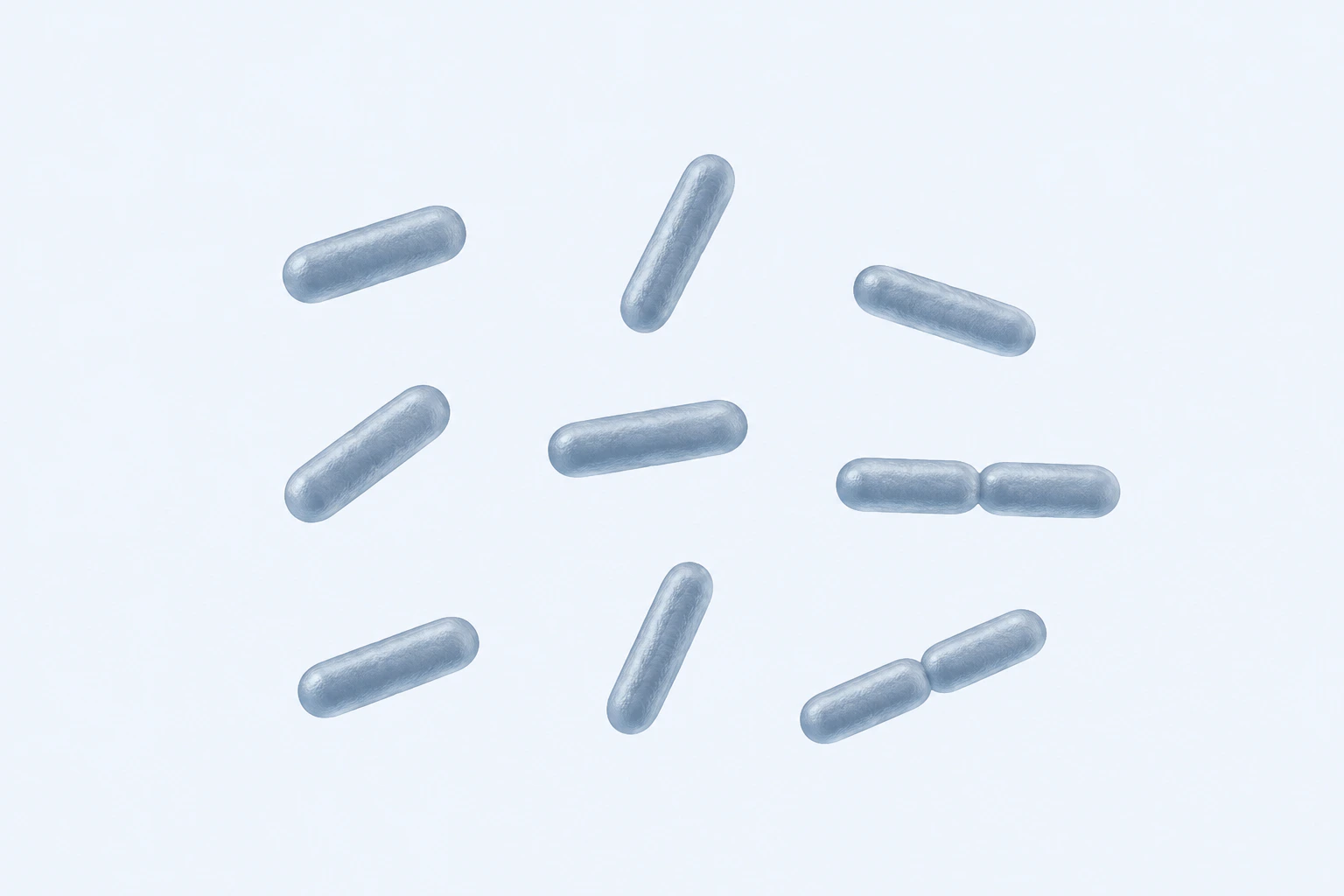
Medically conserved-name and type-species-anchored Shigella reconstruction with eleven rods. Representative, non-diagnostic, not visually separable from Escherichia coli, and not a micrograph.
Scientific media record1 verified identifier
- Subject
- Shigellataxon · genus
- Identifiers
- NCBITaxon:620
- Review
- Editorial review completeIdentifiers authority-verified · Accessibility validated · · shigella|shigella-morphology-v1.webp
- Digital source
- Trained-algorithmic mediaCreated with a trained generative algorithm and reviewed by WikiBiome for subject identity, scientific framing, identifiers, provenance, and accessibility.
- License
- CC BY-SA 4.0Created
Shigella is a genus of Gram-negative, facultatively anaerobic bacteria in the family Enterobacteriaceae, closely related to Escherichia coli—so closely that many 16S rRNA-based studies report them as the Escherichia/Shigella complex, unable to distinguish the two genera at the amplicon level.
Shigella species (S. dysenteriae, S. flexneri, S. sonnei, S. boydii) are the causative agents of bacillary dysentery and are among the most invasive enteric pathogens, capable of penetrating and destroying colonic epithelial cells.
In the WikiBiome framework, Shigella is notable for two reasons: its metal-dependent virulence (iron and nickel requirements that make it vulnerable to nutritional immunity) and its frequent appearance as part of the Escherichia/Shigella bloom that characterizes Dysbiosis across dozens of disease signatures.
Evidence map9 cited passagesInspect provenance +
Enterobactin: The primary catecholate siderophore shared with E. coli, with the highest known Fe3+ binding affinity (Kd ~10^-49 M). Countered by host lipocalin 2.
Shigella flexneri harbors nickel-dependent enzymes relevant to its acid resistance and survival during gastric transit. The nickel connection links Shigella to the broader pattern of nickel-dependent enteric pathogens in this wiki.
Endometriosis: Escherichia/Shigella enriched in cervical samples of endometriosis patients, with decreased Gardnerella, Atopobium, and Megasphaera.
Inflammatory bowel disease: Enrichment of Escherichia/Shigella is one of the most reproducible IBD microbiome findings, driven by inflammation-associated iron availability favoring siderophore producers.
Heart failure: Part of the Enterobacteriaceae bloom in decompensated heart failure.
ASD: Enrichment reported in altered gut microbiota of ASD children.
CKD: Escherichia/Shigella enrichment associated with metalloid resistance genes in CKD gut microbiome.
Estrogen recirculation: Escherichia/Shigella species possess beta-glucuronidase activity, contributing to estrogen deconjugation in the estrobolome.
Shigella species, like other Enterobacteriaceae, carry metal resistance genes co-located with antibiotic resistance determinants on mobile genetic elements. Environmental metal exposure selects for multidrug-resistant Shigella strains—a direct example of the co-selection paradigm.
Contents
1. Metal Dependencies2. Key Virulence Factors3. The Escherichia/Shigella Complex in Dysbiosis4. Metal-Antibiotic Resistance5. Cross-ReferencesMetal Dependencies#
Iron—Siderophore Arsenal#
Shigella possesses multiple iron acquisition systems, reflecting the critical importance of iron for its intracellular survival and replication. Enterobactin: The primary catecholate siderophore shared with E. coli, with the highest known iron(III) (Fe3+) binding affinity (Kd ~10^-49 M). Countered by host Lipocalin-2.[1]Role of Nickel in Microbial PathogenesisRobert J. Maier, Stéphane L. Benoit · 2019Open reference 1 ↓
Aerobactin: A hydroxamate siderophore that evades lipocalin-2 neutralization, providing a backup iron acquisition system when enterobactin is blocked. Heme uptake: Shigella can acquire iron directly from host hemoglobin and heme proteins during tissue invasion.
Iron availability in the gut directly affects Shigella virulence—iron supplementation in endemic regions has been associated with increased dysentery severity, while host Hepcidin-driven iron sequestration during infection represents nutritional immunity against Shigella (Karen's Brain Primitive 2).
Nickel#
Shigella flexneri harbors nickel-dependent enzymes relevant to its acid resistance and survival during gastric transit.[1]Role of Nickel in Microbial PathogenesisRobert J. Maier, Stéphane L. Benoit · 2019Open reference 1 ↓ The nickel connection links Shigella to the broader pattern of nickel-dependent enteric pathogens in this wiki.
Key Virulence Factors#
Type III secretion system (T3SS): Encoded on the virulence plasmid; injects effector proteins (IpaB, IpaC, IpaD) into host epithelial cells to trigger bacterial uptake and intracellular spread.
IcsA/VirG: Surface protein enabling actin-based motility within host cells—Shigella propels itself through the cytoplasm and spreads directly to adjacent cells without extracellular exposure.
Shiga toxin: Produced by S. dysenteriae type 1; inhibits protein synthesis; causes hemorrhagic colitis and hemolytic uremic syndrome (HUS). LPS endotoxin: Drives the intense inflammatory response characteristic of shigellosis.
The Escherichia/Shigella Complex in Dysbiosis#
Because 16S rRNA sequencing cannot reliably distinguish Escherichia from Shigella, most microbiome studies report an Escherichia/Shigella operational taxonomic unit. This complex is one of the most consistently enriched taxa across disease signatures in this wiki.
Endometriosis: Escherichia/Shigella enriched in cervical samples of endometriosis patients, with decreased Gardnerella, Atopobium, and Megasphaera.[2]Ata 2019 — The Endobiota Study: Comparison of Vaginal, Cervical and Gut Microbiota Between Women with Stage 3/4 Endometriosis and Healthy ControlsBaris Ata, Sule Yildiz, Engin Turkgeldi et al. · 2019Open reference 2 ↓[3]Hicks et al. 2025 — Oral, Vaginal, and Stool Microbial Signatures in Patients With Endometriosis as Potential Diagnostic Non-Invasive BiomarkersChloe Hicks, Mathew Leonardi, Xin-Yi Chua et al. · 2025Open reference 3 ↓[4]Ser 2023 — Current Updates on the Role of Microbiome in Endometriosis: A Narrative ReviewHooi-Leng Ser, Siu-Jung Au Yong, Mohamad Nasir Shafiee et al. · 2023Open reference 4 ↓
Inflammatory bowel disease: Enrichment of Escherichia/Shigella is one of the most reproducible IBD microbiome findings, driven by Metal-Driven Inflammation-associated iron availability favoring siderophore producers.[5]Wang 2024 — Integrated 16S rRNA sequencing and metagenomics insights into microbial dysbiosis and distinct virulence factors in inflammatory bowel diseaseHaijing Wang, Yuanjun Wang, Libin Yang et al. · 2024Open reference 5 ↓[6]Diagnosis of Crohn's Disease and Ulcerative Colitis Using the MicrobiomeKang DY, Park JL, Yeo MK et al. · 2023Open reference 6 ↓[7]Comparative Diet-Gut Microbiome Analysis in Crohn's Disease and Hidradenitis SuppurativaCronin P, McCarthy S, Hurley C et al. · 2023Open reference 7 ↓
Heart failure: Part of the Enterobacteriaceae bloom in decompensated heart failure.[8]Gut Microbiome and Plasma Microbiome-Related Metabolites in Patients With Decompensated and Compensated Heart FailureTomohiro Hayashi, Tomoya Yamashita, Hikaru Watanabe et al. · 2019Open reference 8 ↓[9]Gut microbial taxa as potential predictive biomarkers for acute coronary syndrome and post-STEMI cardiovascular eventsJing Gao, Kun-Tao Yan, Ji-Xiang Wang et al. · 2020Open reference 9 ↓
ASD: Enrichment reported in altered gut microbiota of ASD children.[10]Strati 2017 — New Evidences on the Altered Gut Microbiota in Autism Spectrum DisordersFrancesco Strati, Duccio Cavalieri, Davide Albanese et al. · 2017Open reference 10 ↓ CKD: Escherichia/Shigella enrichment associated with metalloid resistance genes in CKD Gut Microbiome.[11]Miranda 2022 — Characterization of Metal(loid)s and Antibiotic Resistance in Bacteria of Human Gut Microbiota from CKD SubjectsMaría V. Miranda, Fernanda C. González, Osvaldo S. Paredes-Godoy et al. · 2022Open reference 11 ↓
Estrogen recirculation: Escherichia/Shigella species possess beta-glucuronidase activity, contributing to estrogen deconjugation in the estrobolome.[12]Kaliannan et al. 2018 — Estrogen-Mediated Gut Microbiome Alterations Influence Sexual Dimorphism in Metabolic Syndrome in MiceKanakaraju Kaliannan, Ruairi C. Robertson, Kiera Murphy et al. · 2018Open reference 12 ↓
Metal-Antibiotic Resistance#
Shigella species, like other Enterobacteriaceae, carry metal resistance genes co-located with antibiotic resistance determinants on mobile genetic elements. Environmental metal exposure selects for multidrug-resistant Shigella strains—a direct example of the co-selection paradigm.[11]Miranda 2022 — Characterization of Metal(loid)s and Antibiotic Resistance in Bacteria of Human Gut Microbiota from CKD SubjectsMaría V. Miranda, Fernanda C. González, Osvaldo S. Paredes-Godoy et al. · 2022Open reference 11 ↓[13]Toxic and Essential Metals: Metabolic Interactions with the Gut Microbiota and Health ImplicationsQinheng Zhu, Boyan Chen, Fu Zhang et al. · 2024Open reference 13 ↓
Cross-References#
- Escherichia coli—phylogenetically near-identical; reported together in most 16S studies
- Adherent-Invasive Escherichia coli (AIEC)—shares iron-dependent invasive strategy
- Iron—siderophore-dependent virulence; nutritional immunity target
- Siderophores—enterobactin and aerobactin as primary iron acquisition systems
- Nickel—nickel-dependent acid resistance
- Lipocalin-2—host counter-siderophore defense
- Estrobolome—beta-glucuronidase activity contributes to estrogen recirculation
- Co-Selection—metal and antibiotic resistance on shared mobile elements
- Enterobacteriaceae—family-level enrichment in dysbiosis across conditions
References 14
Numbered by first appearance in the article, then reconciled with its declared source list.
- 1
★Robert J. Maier, Stéphane L. Benoit (2019). Role of Nickel in Microbial Pathogenesis. Inorganics.
- 2
Baris Ata, Sule Yildiz, Engin Turkgeldi et al. (2019). Ata 2019 — The Endobiota Study: Comparison of Vaginal, Cervical and Gut Microbiota Between Women with Stage 3/4 Endometriosis and Healthy Controls. Scientific Reports.
- 3
Chloe Hicks, Mathew Leonardi, Xin-Yi Chua et al. (2025). Hicks et al. 2025 — Oral, Vaginal, and Stool Microbial Signatures in Patients With Endometriosis as Potential Diagnostic Non-Invasive Biomarkers. BJOG: An International Journal of Obstetrics and Gynaecology.
- 4
Hooi-Leng Ser, Siu-Jung Au Yong, Mohamad Nasir Shafiee et al. (2023). Ser 2023 — Current Updates on the Role of Microbiome in Endometriosis: A Narrative Review. Microorganisms.
- 5
Haijing Wang, Yuanjun Wang, Libin Yang et al. (2024). Wang 2024 — Integrated 16S rRNA sequencing and metagenomics insights into microbial dysbiosis and distinct virulence factors in inflammatory bowel disease. Frontiers in Microbiology.
- 6
Kang DY, Park JL, Yeo MK et al. (2023). Diagnosis of Crohn's Disease and Ulcerative Colitis Using the Microbiome. BMC Microbiology.
- 7
Cronin P, McCarthy S, Hurley C et al. (2023). Comparative Diet-Gut Microbiome Analysis in Crohn's Disease and Hidradenitis Suppurativa. Frontiers in Microbiology.
- 8
Tomohiro Hayashi, Tomoya Yamashita, Hikaru Watanabe et al. (2019). Gut Microbiome and Plasma Microbiome-Related Metabolites in Patients With Decompensated and Compensated Heart Failure. Circulation Journal.
- 9
Jing Gao, Kun-Tao Yan, Ji-Xiang Wang et al. (2020). Gut microbial taxa as potential predictive biomarkers for acute coronary syndrome and post-STEMI cardiovascular events. Scientific Reports.
- 10
Francesco Strati, Duccio Cavalieri, Davide Albanese et al. (2017). Strati 2017 — New Evidences on the Altered Gut Microbiota in Autism Spectrum Disorders. Microbiome.
- 11
María V. Miranda, Fernanda C. González, Osvaldo S. Paredes-Godoy et al. (2022). Miranda 2022 — Characterization of Metal(loid)s and Antibiotic Resistance in Bacteria of Human Gut Microbiota from CKD Subjects. Biological Research.
- 12
Kanakaraju Kaliannan, Ruairi C. Robertson, Kiera Murphy et al. (2018). Kaliannan et al. 2018 — Estrogen-Mediated Gut Microbiome Alterations Influence Sexual Dimorphism in Metabolic Syndrome in Mice. Microbiome.
- 13
★Qinheng Zhu, Boyan Chen, Fu Zhang et al. (2024). Toxic and Essential Metals: Metabolic Interactions with the Gut Microbiota and Health Implications. Frontiers in Nutrition.
- 14
Khan F, Rizvi M, Shukla I et al. (2011). A Novel Approach for Identification of Members of Enterobacteriaceae Isolated from Clinical Samples. Biology and Medicine.
Article network
Connect the evidence
Publicly readable discussion by ORCID-authenticated researchers. Questions, interpretation, methods, corrections, and new evidence stay attached to this record.
No discussion yet. Start with a precise question or a source-backed observation.
Activity and accepted changes
Accepted researcher context, editorial status, public discussion, and upstream Git revisions are shown together. Pending, declined, and withdrawn proposals remain private.
- published revision
Backfill gut microbiome concept links
Karen Pendergrass · +1 −1
Inspect exact Git diff ↗ - published revision
Backfill inflammation concept links
Karen Pendergrass · +1 −1
Inspect exact Git diff ↗ - published revision
Complete corpus-wide Dysbiosis linking
Karen Pendergrass · +1 −1
Inspect exact Git diff ↗ - published revision
massive wiki expansion: 149 stubs fixed, 100+ new pages, Rule 15 scan, keystone papers
WikiBiome Deploy Bot · +82 −12
Inspect exact Git diff ↗ - published revision
nightly maintenance: 94 stub demotions, 181 source_count fixes, 22 auto-discovered stubs, 5 adversarial audits, 3 boundary fixes, 3 evidence-level corrections
WikiBiome Deploy Bot · +21 −0
Inspect exact Git diff ↗