

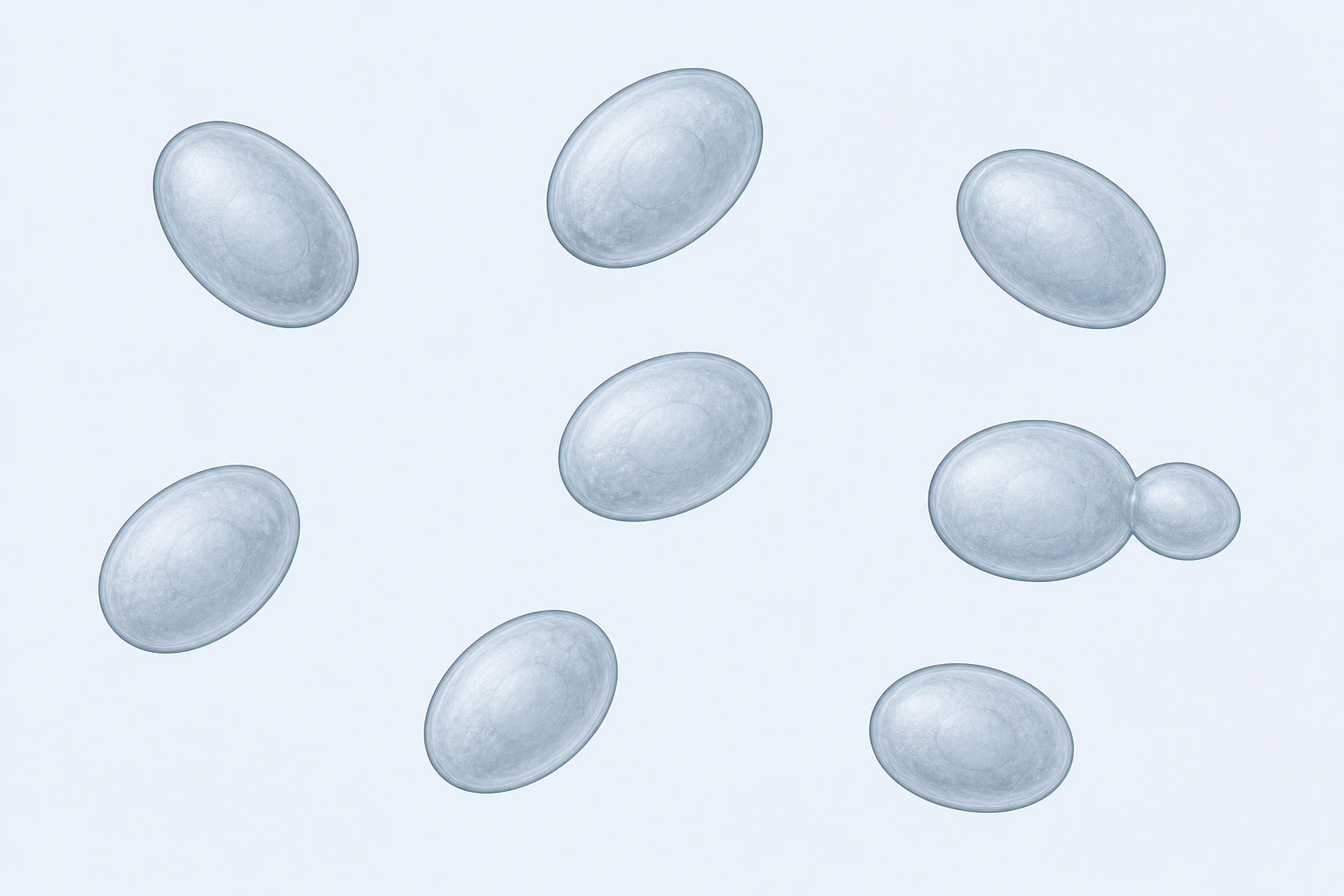
Representative Candidozyma auris budding-yeast morphology, shown as nine bodies in eight single or paired groupings. This reconstruction is non-diagnostic, is not a micrograph, and is keyed only to the current species name.
Scientific media record1 verified identifier
- Subject
- Candidozyma auristaxon · species
- Identifiers
- NCBITaxon:498019
- Review
- Editorial review completeIdentifiers authority-verified · Accessibility validated · · candidozyma-auris|candidozyma-auris-morphology-v1.webp
- Digital source
- Trained-algorithmic mediaCreated with a trained generative algorithm and reviewed by WikiBiome for subject identity, scientific framing, identifiers, provenance, and accessibility.
- Scientific basis
- Candidozyma auris — NCBI TaxonomyPhylogenomic circumscription of CandidozymaCandida auris sp. nov. original type descriptionOriginal Candidozyma auris type-description article
- License
- CC BY-SA 4.0Created
Candidozyma auris is the current name for NCBITaxon:498019. Liu and colleagues established the combination in 2024 as MycoBank MB 848169; Candida auris Satoh & Makimura 2009 is its basionym, not a separate species.[1]NCBI Taxonomy — Candidozyma auris (NCBITaxon:498019)Author information pendingOpen reference 1 ↓[2]Index Fungorum — Candidozyma aurisAuthor information pendingOpen reference 2 ↓[3]Liu 2024 — Phylogenomic analysis and reclassification of the Candida auris-Candida haemuli cladeFengyan Liu, Zhendong Hu, Xiaomei Zhao et al. · 2024Open reference 3 ↓
Satoh and colleagues originally described the taxon from strain JCM 15448 (CBS 10913; DSM 21092), isolated from a patient's external ear canal.[4]Satoh 2009 — Candida auris sp. nov., original descriptionKazuo Satoh, Koichi Makimura, Yayoi Hasumi et al. · 2009Open reference 4 ↓
The clinical and mechanistic sources summarized below largely use the historical name Candida auris, which WikiBiome preserves where it reflects the cited literature.
Under that name, the organism is described as an emerging multidrug-resistant fungal pathogen and as a healthcare-associated pathogen with outbreak potential, resistance to multiple antifungal drug classes, and persistence on environmental surfaces. Historical study wording is not evidence for a second taxon.
Evidence map2 cited passagesInspect provenance +
Candidozyma auris is the current name for NCBITaxon:498019. Liu and colleagues established the combination in 2024 as MycoBank MB 848169; Candida auris Satoh & Makimura 2009 is its basionym, not a separate species. Satoh and colleagues originally described the taxon from strain JCM 15448 (CBS 10913; DSM 21092), isolated from a patient's external ear canal.
Like other Candida species, C. auris employs a reductive iron acquisition system (surface ferric reductases, multicopper ferroxidase Fet3, and iron permease Ftr1) alongside siderophore-like metallophores. It can also use heme as an iron source via the Rbt5/Pga7 heme-binding cell wall protein family. Iron restriction arrests hyphal morphogenesis and downregul
Contents
1. Metal Dependencies2. Key Virulence Features3. Gut Microbiome Context4. Interkingdom Relationships5. Distinction from Other Clinically Used Candida Names6. Therapeutic Implications7. Open Questions8. Cross-ReferencesMetal Dependencies#
C. auris requires zinc, iron, copper, and manganese for growth and virulence, and must acquire each under conditions of active host sequestration (Nutritional Immunity (Metal Sequestration)).
The broad metal vulnerability profile is a direct consequence of its evolutionary niche—hospital bloodstream and skin, environments dominated by Calprotectin (S100A8/A9) (zinc (Zn)/manganese (Mn) sequestration), Transferrin/Lactoferrin (iron sequestration), and Ceruloplasmin-coordinated copper redistribution.
Iron#
Like other Candida species, C. auris employs a reductive iron acquisition system (surface ferric reductases, multicopper ferroxidase Fet3, and iron permease Ftr1) alongside siderophore-like metallophores.[5]Alves et al. 2020 — Adapting to Survive: How Candida Overcomes Host-Imposed ConstraintsAlves R, et al. · 2020Open reference 5 ↓ It can also use heme as an iron source via the Rbt5/Pga7 heme-binding cell wall protein family.
Iron restriction arrests hyphal morphogenesis and downregulates biofilm production—establishing Iron as a primary ecological choke point for C. auris.
Zinc#
Zinc-dependent virulence factors include secreted aspartyl proteases (SAPs), zinc metalloproteases, and copper (Cu)/zinc (Zn) superoxide dismutase (Sod1), which neutralises the neutrophil oxidative burst. C. auris expresses the Zrt1/Zrt2/Pra1 zincophore system homologous to C. albicans, scavenging zinc from Calprotectin (S100A8/A9)-sequestered pools. Zinc chelation strategies have been explored as adjunct antifungal approaches (Citiulo et al.
2012; Crawford & Wilson 2015).
Copper#
Copper is required for Fet3 ferroxidase activity (iron uptake) and mitochondrial cytochrome c oxidase. C. auris responds to host copper toxicity (a macrophage defence mechanism) by inducing metallothionein-like sequestration.
This dual role—copper as required cofactor and copper as toxin—is a known vulnerability being explored therapeutically (Hu et al. 2022, against other Candida species).
Manganese#
Manganese is sequestered by Calprotectin (S100A8/A9) in the bloodstream alongside zinc. C. auris requires manganese (Mn) for mitochondrial Sod2 and for glycosylation of virulence-relevant cell wall proteins. Depletion below ~0.1 µM arrests growth within hours.
Key Virulence Features#
Multidrug resistance—exhibits resistance to azoles (fluconazole), polyenes (amphotericin B), and echinocandins in a significant proportion of isolates; pan-resistant strains have been documented (Lockhart et al. 2017).
Biofilm formation—forms biofilms on catheters and medical devices that reduce antifungal penetration and immune clearance (Sherry et al. 2017).
Thermotolerance—one of the few fungi that can proliferate at human body temperature (37°C) and above, facilitating systemic infection (Casadevall et al. 2019).
Surface persistence—survives on hospital surfaces for weeks to months, enabling environmental transmission (Welsh et al. 2017). Genomic plasticity—multiple distinct clades (I–vanadium (V)) with separate geographic origins, suggesting parallel emergence (Lockhart et al.
2017; Chow et al. 2020).
Gut Microbiome Context#
C. auris is primarily a nosocomial bloodstream and skin pathogen rather than a gut commensal in healthy individuals. However, gut colonisation is increasingly documented in ICU patients (Proctor et al. 2021, Nat Med; detection in ~15-20% of rectal swabs during outbreaks) and represents a reservoir for systemic translocation.
Risk factors for gut colonisation mirror those for broader Candida overgrowth: broad-spectrum antibiotic exposure depleting Lachnospiraceae and Bifidobacterium, PPI-induced hypochlorhydria, enteral feeding, and prolonged ICU stay.
Unlike Candida albicans, C. auris rarely causes invasive candidiasis via direct gut-blood translocation in otherwise-healthy hosts; the dominant route appears to be skin colonisation followed by catheter-associated bloodstream invasion. Nevertheless, gut decolonisation protocols are being evaluated as part of outbreak control.
Interkingdom Relationships#
C. auris co-colonises with Staphylococcus aureus on skin and catheter surfaces, forming mixed biofilms where S. aureus benefits from fungal matrix protection while providing proteolytic activity that enhances fungal dispersal (Kean et al. 2018, mSphere).
This mirrors the Functional Shielding pattern documented between C. albicans and pathogenic bacteria in other body sites. Bacterial partners may also relieve C. auris of iron-acquisition costs by producing scavengeable siderophores that C. auris pirates via its reductive uptake system.
Distinction from Other Clinically Used Candida Names#
| Feature | Candidozyma auris (Candida auris) | C. albicans | C. tropicalis |
|---|---|---|---|
| Primary context | Nosocomial | Commensal/opportunistic | Commensal/opportunistic |
| Drug resistance | High (multidrug) | Moderate | Moderate |
| Biofilm | Strong | Strong | Moderate |
| Gut colonization | Rare (pathological) | Common | Occasional |
Therapeutic Implications#
The metal-dependence profile suggests several adjunct strategies relevant to a fungus with limited antifungal options. Iron restriction—Lactoferrin, deferasirox, and Gallium maltolate have all demonstrated in-vitro activity against Candida spp. by competing with fungal siderophores (Lai et al. 2016; Venturini et al.
2011).
Copper-based coatings on hospital surfaces reduce C. auris persistence; copper-impregnated textiles are under evaluation for ICU use (Souli et al. 2019).
Zinc chelation via clioquinol or calprotectin-mimetic peptides (Crawford & Wilson 2015) potentiates azole activity in other Candida species and is a plausible C. auris adjunct.
Echinocandin + copper combinations have shown synergy against C. auris biofilms in preclinical work (Hu et al. 2022).
Open Questions#
Unresolved questions identified by the current evidence record.
01Does gut colonisation with C. auris alter bacterial community metal availability in ways that promote bacterial co-pathogens (e.g., Enterococcus faecium, Escherichia coli)?+
The current WikiBiome record identifies this as an unresolved evidence gap.
02What host factors govern the transition from skin/gut colonisation to bloodstream invasion—is it primarily catheter-mediated, or does impaired host nutritional immunity play a triggering role?+
The current WikiBiome record identifies this as an unresolved evidence gap.
03Can Calprotectin (S100A8/A9) status (e.g., in IBD patients with elevated faecal calprotectin) paradoxically select for C. auris by pre-adapting it to nutritional-immunity pressure?+
The current WikiBiome record identifies this as an unresolved evidence gap.
Cross-References#
- Candida albicans—the most common Candida pathogen; commensal that can become opportunistic
- Candida tropicalis—related species with gut Dysbiosis associations
- Mycobiome—the fungal community context
- Biofilm—key virulence mechanism
- Functional Shielding—interkingdom biofilm protection of bacterial pathogens
- Antimicrobial Resistance—pan-resistant strains documented; critical-priority WHO pathogen
- Iron—iron acquisition via siderophore-like metallophores essential for virulence
- Zinc—zincophore system, calprotectin competition
- Copper—required cofactor and host defence toxin (dual role)
- Calprotectin (S100A8/A9)—host sequestration target C. auris must overcome
- Lactoferrin—iron-sequestration host defence; proposed adjunct therapy
- Gallium—iron(III) (Fe3+) mimic under investigation against C. auris
- Nutritional Immunity (Metal Sequestration)—framework explaining why C. auris evolved broad metal competence
- Staphylococcus aureus—biofilm co-coloniser on skin and catheters
References 7
Numbered by first appearance in the article, then reconciled with its declared source list.
- 1
Author information pending. NCBI Taxonomy — Candidozyma auris (NCBITaxon:498019). NCBI Taxonomy.
- 2
Author information pending. Index Fungorum — Candidozyma auris. Index Fungorum.
- 3
Fengyan Liu, Zhendong Hu, Xiaomei Zhao et al. (2024). Liu 2024 — Phylogenomic analysis and reclassification of the Candida auris-Candida haemuli clade. Persoonia.
- 4
Kazuo Satoh, Koichi Makimura, Yayoi Hasumi et al. (2009). Satoh 2009 — Candida auris sp. nov., original description. Microbiology and Immunology.
- 5
Alves R, et al. (2020). Alves et al. 2020 — Adapting to Survive: How Candida Overcomes Host-Imposed Constraints. PLoS Pathogens.
- 6
Paulo Henrique Fonseca do Carmo, Maira Terra Garcia, Livia Mara Alves Figueiredo-Godoi et al. (2023). Metal Nanoparticles to Combat Candida albicans Infections: An Update. Microorganisms.
- 7
Pasman ME, et al. (2025). Pasman et al. 2025 — Candida-Staphylococcus Reciprocal Virulence and Masking in Co-culture. Frontiers in Cellular and Infection Microbiology.
Article network
Mentioned here 18
Pages linking here 4
Connect the evidence
Publicly readable discussion by ORCID-authenticated researchers. Questions, interpretation, methods, corrections, and new evidence stay attached to this record.
No discussion yet. Start with a precise question or a source-backed observation.
Published page changes
This record shows only material changes published on this page, including changes to its content, evidence, conclusions, or author context. Internal processes and discussion activity are excluded. Pending, declined, and withdrawn proposals remain private.
- published revision
Revised “Introduction”: now reads “Candidozyma auris is the current name for NCBITaxon:498019. Liu and colleagues established the combination in 2024 as MycoBank MB 848169; Candida auris Satoh & Makimura 2009 is its basionym, not a…”.
Revised “Introduction”: changed “Candida auris is an emerging multidrug-resistant fungal pathogen first identified in 2009 (Satoh et al. 2009, from a Japanese patient's ear canal) and now classified as a critical-priority pathogen by…” to “Candidozyma auris is the current name for NCBITaxon:498019. Liu and colleagues established the combination in 2024 as MycoBank MB 848169; Candida auris Satoh & Makimura 2009 is its basionym, not a…”. Added “Distinction from Other Clinically Used Candida Names”: | Feature | Candidozyma auris (Candida auris) | C. albicans | C. tropicalis | |---------|-----------|--------------|----------------| | Primary context | Nosocomial | Commensal/opportunistic |… Removed “Distinction from Other Candida Species”: | Feature | C. auris | C. albicans | C. tropicalis | |---------|-----------|--------------|----------------| | Primary context | Nosocomial | Commensal/opportunistic | Commensal/opportunistic | | Drug… Added citations to “Introduction”: ncbi taxonomy candidozyma auris; index fungorum candidozyma auris; liu 2024 candidozyma auris reclassification; satoh 2009 candida auris original description. Title changed from “Candida auris” to “Candidozyma auris”. Added references: ncbi-taxonomy-candidozyma-auris; index-fungorum-candidozyma-auris; liu-2024-candidozyma-auris-reclassification; satoh-2009-candida-auris-original-description. · Karen Pendergrass · +21 −10
Inspect exact Git diff ↗