

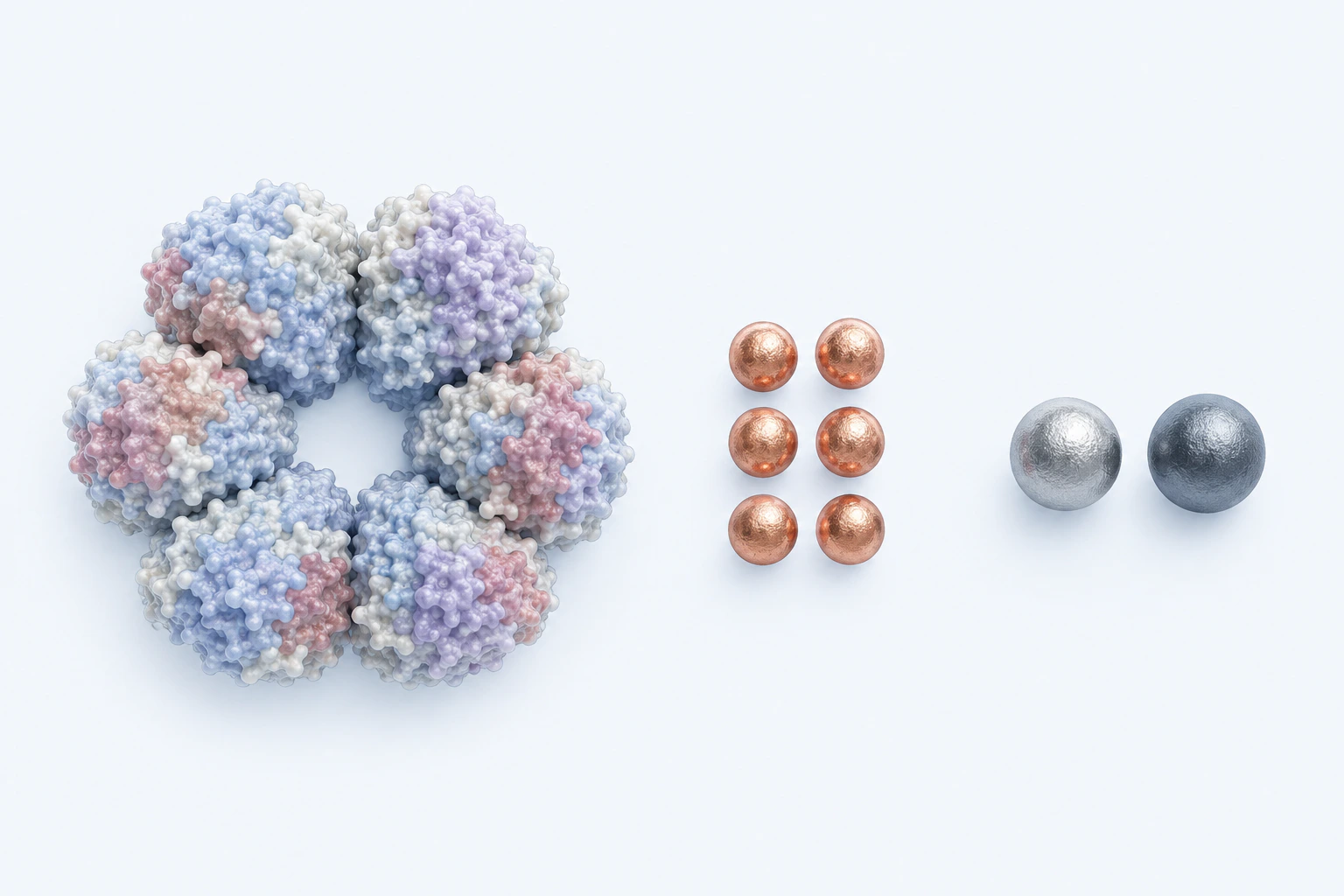
Human ceruloplasmin identity and metal context. Colors do not assign oxidation state, and the separated models do not establish literal structure, copper occupancy, binding, catalysis, transport, a laboratory result, disease, or treatment effect.
Scientific media record2 verified identifiers
- Subject
- Ceruloplasminbiological-process
- Identifiers
- WikiBiome:ceruloplasminUniProt:P00450
- Review
- Editorial review completeIdentifiers authority-verified · Accessibility validated · · ceruloplasmin|ceruloplasmin-mechanism-v1.webp
- Digital source
- Trained-algorithmic mediaCreated with a trained generative algorithm and reviewed by WikiBiome for subject identity, scientific framing, identifiers, provenance, and accessibility.
- Scientific basis
- Ceruloplasmin — UniProt P00450Ceruloplasmin
- License
- CC BY-SA 4.0Created
The major copper-carrying protein in human blood, binding approximately 95% of circulating copper.
Ceruloplasmin is far more than a passive transport vehicle—it is a multicopper oxidase with ferroxidase activity, an acute-phase reactant that rises with Metal-Driven Inflammation, and a protein whose dysfunction sits at the intersection of copper toxicity, iron dysregulation, and neurodegeneration.
Understanding ceruloplasmin is essential for interpreting serum copper levels across virtually every disease studied in this wiki: elevated serum copper nearly always reflects elevated ceruloplasmin, which nearly always reflects inflammation.
Evidence map5 cited passagesInspect provenance +
Three possibilities exist for any condition showing elevated Cu:
Serum copper is elevated across virtually all cancer types. Ceruloplasmin-mediated copper transport delivers Cu to tumor-promoting enzymes including lysyl oxidase-like proteins (extracellular matrix remodeling) and supports the cuproptosis/cuproplasia axis.
In alzheimers disease, ceruloplasmin activity is reduced in brain tissue despite elevated peripheral copper:
Brain ceruloplasmin reduction may contribute to the paradox of peripheral copper excess and central copper deficiency in AD
Ceruloplasmin-bound Cu is elevated in acute myocardial infarction (0.85 vs 0.73 ug/mL, p<0.01) and remains elevated one month post-PCI, tracking the acute-phase inflammatory response.
Structure and Function#
Copper Carrier#
Synthesized in the liver; loaded with 6 copper atoms per molecule via ATP7B (the Wilson disease protein) in hepatocyte trans-Golgi network. Secreted as holoceruloplasmin (copper-loaded) into blood. Without copper loading (as in Wilson disease), apoceruloplasmin is rapidly degraded, resulting in paradoxically low serum ceruloplasmin despite hepatic copper overload.
Ferroxidase Activity#
Ceruloplasmin's most critical enzymatic function is oxidizing iron(II) (Fe2+) to iron(III), enabling iron loading onto Transferrin. iron(II) (ferrous) is the form exported from cells via Ferroportin. iron(III) (ferric) is the form that binds transferrin for safe plasma transport.
Without ceruloplasmin's ferroxidase activity, iron accumulates as toxic iron(II) in tissues.
This connects copper metabolism directly to iron homeostasis: copper deficiency causes iron overload through failed ferroxidase activity.
Acute-Phase Reactant#
Ceruloplasmin is upregulated by IL-6 during inflammation, making it a positive acute-phase protein. This has profound implications for interpreting serum copper. Elevated serum copper (Cu) in cancer, PCOS, IBD, RA, depression, and schizophrenia may largely reflect ceruloplasmin's acute-phase elevation rather than true copper excess.
The copper/zinc (Zn) ratio—one of the most replicated biomarkers across diseases—is partly an inflammation marker (ceruloplasmin up) combined with a zinc consumption marker (zinc used in immune cell proliferation).
The Interpretive Challenge#
Ceruloplasmin creates a fundamental conundrum for metallomic studies: is elevated serum copper a cause or consequence of disease?
Three possibilities exist for any condition showing elevated copper (Cu):[1]Recent advances in the application of metallomics in diagnosis and prognosis of human cancerYan Zhang, Jie He, Jiao Jin et al. · 2022Open reference 1 ↓
- Copper drives pathology: Excess copper generates ROS via Fenton-like chemistry, promotes cuproplasia in cancer, or acts as a metalloestrogen
- Inflammation drives copper: Ceruloplasmin rises as an acute-phase reactant; copper rises passively as cargo. The copper elevation is epiphenomenal
- Bidirectional amplification: Inflammation raises ceruloplasmin/copper, and elevated free (non-ceruloplasmin-bound) copper generates additional oxidative damage, which drives more inflammation
Distinguishing these requires measuring free copper (non-ceruloplasmin-bound copper), which is not part of standard clinical panels. Free copper is the fraction capable of redox cycling and mis-metallation; ceruloplasmin-bound copper is largely inert.
Disease Contexts#
Cancer (Pan-Cancer Elevation)#
Serum copper is elevated across virtually all cancer types. Ceruloplasmin-mediated copper transport delivers copper (Cu) to tumor-promoting enzymes including lysyl oxidase-like proteins (extracellular matrix remodeling) and supports the Cuproptosis/cuproplasia axis.[1]Recent advances in the application of metallomics in diagnosis and prognosis of human cancerYan Zhang, Jie He, Jiao Jin et al. · 2022Open reference 1 ↓
Neurodegeneration (Paradoxical Reduction)#
In Alzheimer's Disease, ceruloplasmin activity is reduced in brain tissue despite elevated peripheral copper.[2]Exposure of metal toxicity in Alzheimer's disease: An extensive reviewIslam F, Shohag S, Akhter S et al. · 2022Open reference 2 ↓
Reduced ferroxidase activity impairs iron oxidation, promoting iron(II) (Fe2+) accumulation in amyloid plaques. This creates a dual metal problem: copper mislocalized to plaques (driving amyloid-beta-aggregation) and iron trapped in reduced form (driving Ferroptosis).
Brain ceruloplasmin reduction may contribute to the paradox of peripheral copper excess and central copper deficiency in AD.[3]Scholefield et al. 2024 — Brain Metallomic Signatures Distinguish DLB from AD and PDDMelissa Scholefield, Stephanie J. Church, Jingshu Xu et al. · 2024Open reference 3 ↓
Cardiovascular Disease#
Ceruloplasmin-bound copper (Cu) is elevated in acute myocardial infarction (0.85 vs 0.73 ug/mL, p<0.01) and remains elevated one month post-PCI, tracking the acute-phase inflammatory response.[4]Plasma metallomics reveals potential biomarkers and insights into the ambivalent associations of elements with acute myocardial infarctionSi Ying Lim, Hiranya Dayal, Song Jie Seah et al. · 2023Open reference 4 ↓
Depression and Schizophrenia#
Elevated serum copper (Cu) and ceruloplasmin with depressed zinc (Zn) yields the high copper/zinc ratio that is among the most replicated findings in biological psychiatry. Whether this reflects genuine copper toxicity in the brain or simply systemic inflammation remains debated.
Connections#
- Copper—ceruloplasmin carries >95% of circulating copper (Cu)
- Iron—ceruloplasmin ferroxidase activity is essential for iron homeostasis
- Ferroportin—iron exported via ferroportin requires ceruloplasmin for oxidation
- Transferrin—iron(III) (Fe3+) generated by ceruloplasmin loads onto transferrin
- copper-dysregulation—ceruloplasmin dysfunction is central to copper/zinc (Zn) ratio pathology
- Oxidative Stress—free (non-ceruloplasmin) copper drives Fenton-like ROS
- Amyloid-Beta—reduced ceruloplasmin in AD brain promotes iron/copper mislocalization
References 4
Numbered by first appearance in the article, then reconciled with its declared source list.
- 1
Yan Zhang, Jie He, Jiao Jin et al. (2022). Recent advances in the application of metallomics in diagnosis and prognosis of human cancer. Metallomics.
- 2
Islam F, Shohag S, Akhter S et al. (2022). Exposure of metal toxicity in Alzheimer's disease: An extensive review. Frontiers in Pharmacology.
- 3
★Melissa Scholefield, Stephanie J. Church, Jingshu Xu et al. (2024). Scholefield et al. 2024 — Brain Metallomic Signatures Distinguish DLB from AD and PDD. Frontiers in Neuroscience.
- 4
Si Ying Lim, Hiranya Dayal, Song Jie Seah et al. (2023). Plasma metallomics reveals potential biomarkers and insights into the ambivalent associations of elements with acute myocardial infarction. Journal of Trace Elements in Medicine and Biology.
Article network
Mentioned here 11
Pages linking here 8
Connect the evidence
Publicly readable discussion by ORCID-authenticated researchers. Questions, interpretation, methods, corrections, and new evidence stay attached to this record.
No discussion yet. Start with a precise question or a source-backed observation.
Published page changes
This record shows only material changes published on this page, including changes to its content, evidence, conclusions, or author context. Internal processes and discussion activity are excluded. Pending, declined, and withdrawn proposals remain private.
- published revision
Created “Ceruloplasmin”: The major copper-carrying protein in human blood, binding approximately 95% of circulating copper. Ceruloplasmin is far more than a passive transport vehicle -- it is a multicopper oxidase with…
Created “Ceruloplasmin”: The major copper-carrying protein in human blood, binding approximately 95% of circulating copper. Ceruloplasmin is far more than a passive transport vehicle -- it is a multicopper oxidase with… Published sections: Ceruloplasmin; Copper Carrier; Ferroxidase Activity; Acute-Phase Reactant; The Interpretive Challenge; Cancer (Pan-Cancer Elevation); Neurodegeneration (Paradoxical Reduction); Cardiovascular Disease; Depression and Schizophrenia; Connections. · WikiBiome Deploy Bot · +85 −0
Inspect exact Git diff ↗