
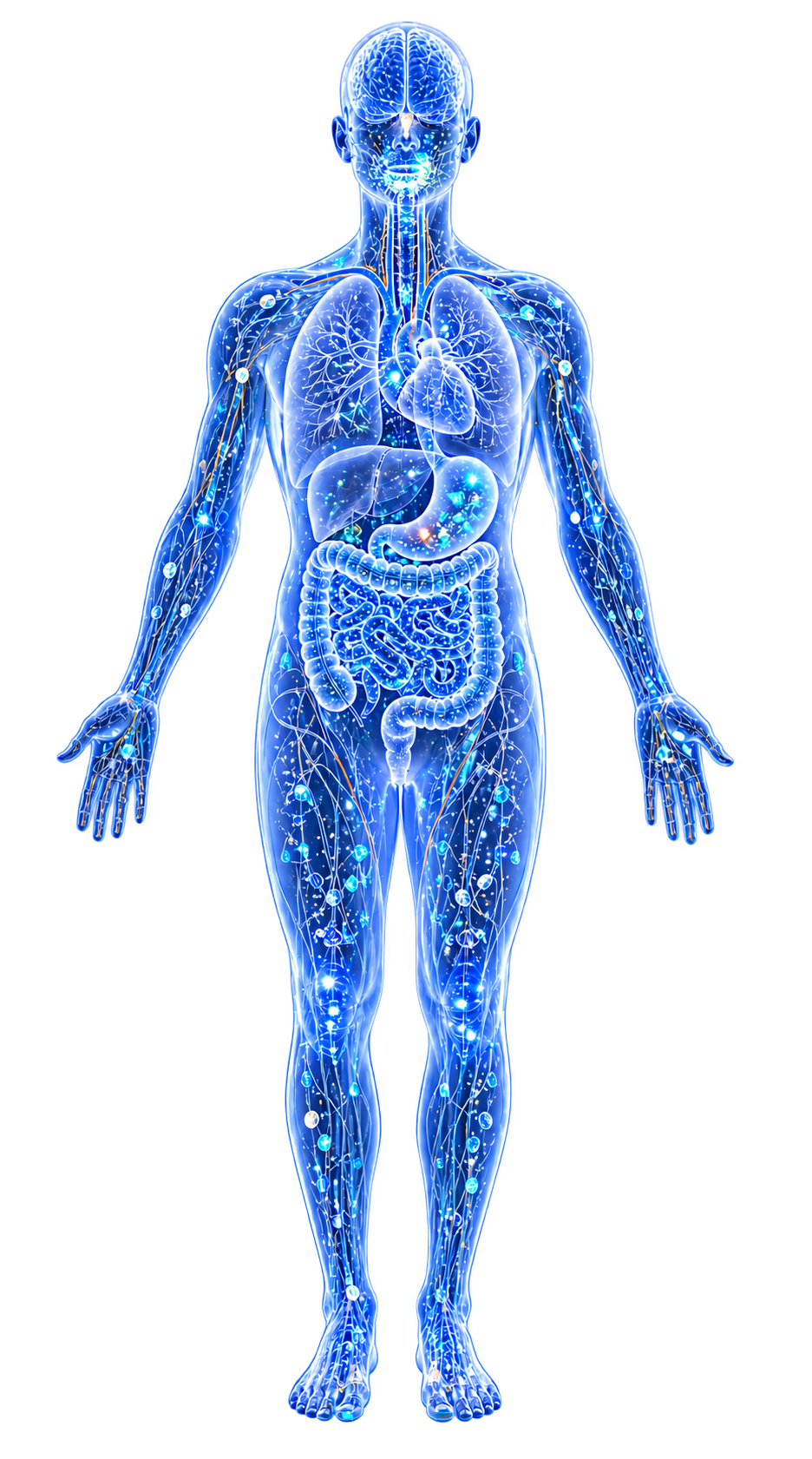
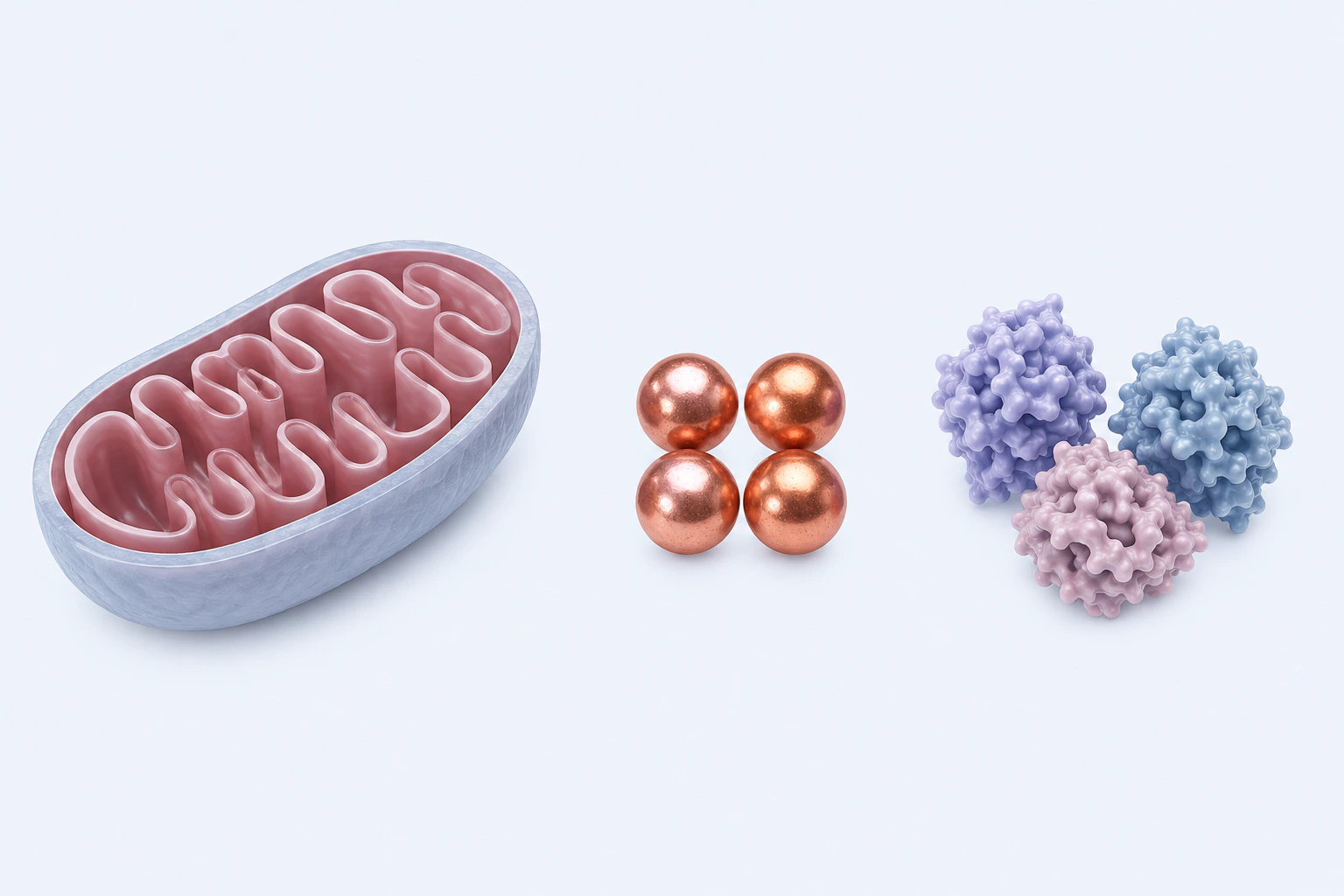
Cuproptosis context orientation. The separated models do not depict literal ultrastructure, copper accumulation, lipoylation, protein aggregation, an observed cell-death event, an assay result, disease status, or treatment response.
Scientific media record3 verified identifiers
- Subject
- Cuproptosisbiological-process
- Review
- Editorial review completeIdentifiers authority-verified · Accessibility validated · · cuproptosis|cuproptosis-mechanism-v1.webp
- Digital source
- Trained-algorithmic mediaCreated with a trained generative algorithm and reviewed by WikiBiome for subject identity, scientific framing, identifiers, provenance, and accessibility.
- Scientific basis
- Cuproptosis — Medical Subject HeadingsCopper induces cell death by targeting lipoylated TCA cycle proteinsCuproptosis
- License
- CC BY-SA 4.0Created
A distinct form of regulated cell death caused by excess intracellular copper binding to lipoylated proteins in the TCA cycle, first characterized by Tsvetkov et al. in Science (2022).
Unlike Ferroptosis (iron-dependent lipid peroxidation) or apoptosis (caspase-dependent), cuproptosis operates through a unique mechanism: copper-induced aggregation of lipoylated mitochondrial proteins and destabilization of iron-sulfur cluster proteins.
Mechanism#
The cuproptotic cascade proceeds through defined steps. Copper accumulation—Excess copper(II) (Cu2+) enters cells through copper transporters (CTR1/SLC31A1) or when copper chaperones and export systems (ATP7A/ATP7B) are overwhelmed. FDX1-dependent reduction—Ferredoxin 1 (FDX1) reduces copper(II) to copper(1), the biologically active form.
FDX1 is the essential upstream regulator of cuproptosis.
Lipoylated protein binding—copper(1) directly binds lipoylated TCA cycle enzymes including dihydrolipoamide S-acetyltransferase (DLAT, a component of the pyruvate dehydrogenase complex) and dihydrolipoamide S-succinyltransferase (DLST).
Protein aggregation—Copper-bound lipoylated proteins form insoluble aggregates, disrupting TCA cycle function and triggering proteotoxic stress. iron (Fe)-S cluster destabilization—Copper simultaneously destabilizes iron-sulfur cluster proteins, compounding mitochondrial dysfunction.
Cell death—The combined proteotoxic stress and metabolic collapse triggers cell death through a pathway independent of known apoptotic, necroptotic, or ferroptotic machinery.
Distinction from Ferroptosis#
| Feature | Cuproptosis | Ferroptosis |
|---|---|---|
| Metal trigger | Copper (copper(1) (Cu1+)) | Iron (iron(II) (Fe2+)) |
| Key regulator | FDX1 | GPX4 |
| Target | Lipoylated TCA proteins | Membrane lipids (PUFAs) |
| Mechanism | Protein aggregation | Lipid peroxidation |
| Metabolic dependency | Cells relying on mitochondrial respiration are more sensitive | Cells with high PUFA content are more sensitive |
| Protective factor | Copper chelators (tetrathiomolybdate) | Lipophilic antioxidants (ferrostatin-1) |
Both cuproptosis and ferroptosis are relevant to the Mis-Metallation framework: they represent what happens when metal homeostasis fails and the wrong metal accumulates in the wrong compartment.
Therapeutic Relevance#
Cancer#
Copper chelators (tetrathiomolybdate, disulfiram/copper (Cu)) are being explored as anti-cancer agents that reshape the tumor microenvironment by inducing cuproptosis in copper-dependent tumor cells. FDX1 expression correlates with cuproptosis sensitivity and may serve as a biomarker for patient stratification.
Immune checkpoint synergy—Cuproptosis-induced cell death releases damage-associated molecular patterns (DAMPs) that enhance anti-tumor immunity, potentially synergizing with checkpoint blockade.
Wilson's Disease and Copper Toxicosis#
Wilson's disease (ATP7B mutations) causes copper accumulation that may partly kill hepatocytes through cuproptosis, not just oxidative damage as traditionally assumed. This reframes copper chelation therapy as cuproptosis prevention rather than simply reducing Oxidative Stress.
Microbiome Intersection#
- Gut bacteria modulate copper bioavailability through copper-binding metallothioneins and siderophore-like molecules. Dysbiosis may alter systemic copper distribution, potentially influencing cuproptosis susceptibility in distant tissues.
Cross-References#
- Copper—The metal driving cuproptosis
- Ferroptosis—Parallel metal-dependent cell death pathway
- Mis-Metallation—Framework for understanding metal-triggered pathology
- Iron—iron (Fe)-S cluster destabilization as secondary cuproptosis mechanism
- Glutathione (GSH)—Copper detoxification pathway upstream of cuproptosis
References 4
Numbered by first appearance in the article, then reconciled with its declared source list.
- 1
Yingxian Wang, Tongqiang Wen, Fuchao Mao et al. (2025). Wang 2025 — Engineering Copper and Copper-Based Materials for a Post-Antibiotic Era. Frontiers in Bioengineering and Biotechnology.
- 2
Ying Xia, Ming Sun, Hai Huang et al. (2024). Drug Repurposing for Cancer Therapy. Signal Transduction and Targeted Therapy.
- 3
Chen, et al. (2026). Chen et al. 2026 — Metalloimmunology in the Tumor Microenvironment. Theranostics.
- 4
★Brylinski L, Kostelecka K, Wolinski F et al. (2025). Effects of Trace Elements on Endocrine Function and Pathogenesis of Thyroid Diseases — A Literature Review. Nutrients.
Article network
Connect the evidence
Publicly readable discussion by ORCID-authenticated researchers. Questions, interpretation, methods, corrections, and new evidence stay attached to this record.
No discussion yet. Start with a precise question or a source-backed observation.
Activity and accepted changes
Accepted researcher context, editorial status, public discussion, and upstream Git revisions are shown together. Pending, declined, and withdrawn proposals remain private.
- published revision
Backfill oxidative stress concept links
Karen Pendergrass · +1 −1
Inspect exact Git diff ↗ - published revision
Complete corpus-wide Dysbiosis linking
Karen Pendergrass · +1 −1
Inspect exact Git diff ↗ - published revision
massive wiki expansion: 149 stubs fixed, 100+ new pages, Rule 15 scan, keystone papers
WikiBiome Deploy Bot · +17 −15
Inspect exact Git diff ↗ - published revision
nightly maintenance: 94 stub demotions, 181 source_count fixes, 22 auto-discovered stubs, 5 adversarial audits, 3 boundary fixes, 3 evidence-level corrections
WikiBiome Deploy Bot · +2 −0
Inspect exact Git diff ↗ - published revision
pre-overnight checkpoint 2026-04-18
WikiBiome Deploy Bot · +1 −1
Inspect exact Git diff ↗ - published revision
Health check gap fill: 15 missing pages identified and created
WikiBiome Deploy Bot · +64 −0
Inspect exact Git diff ↗