
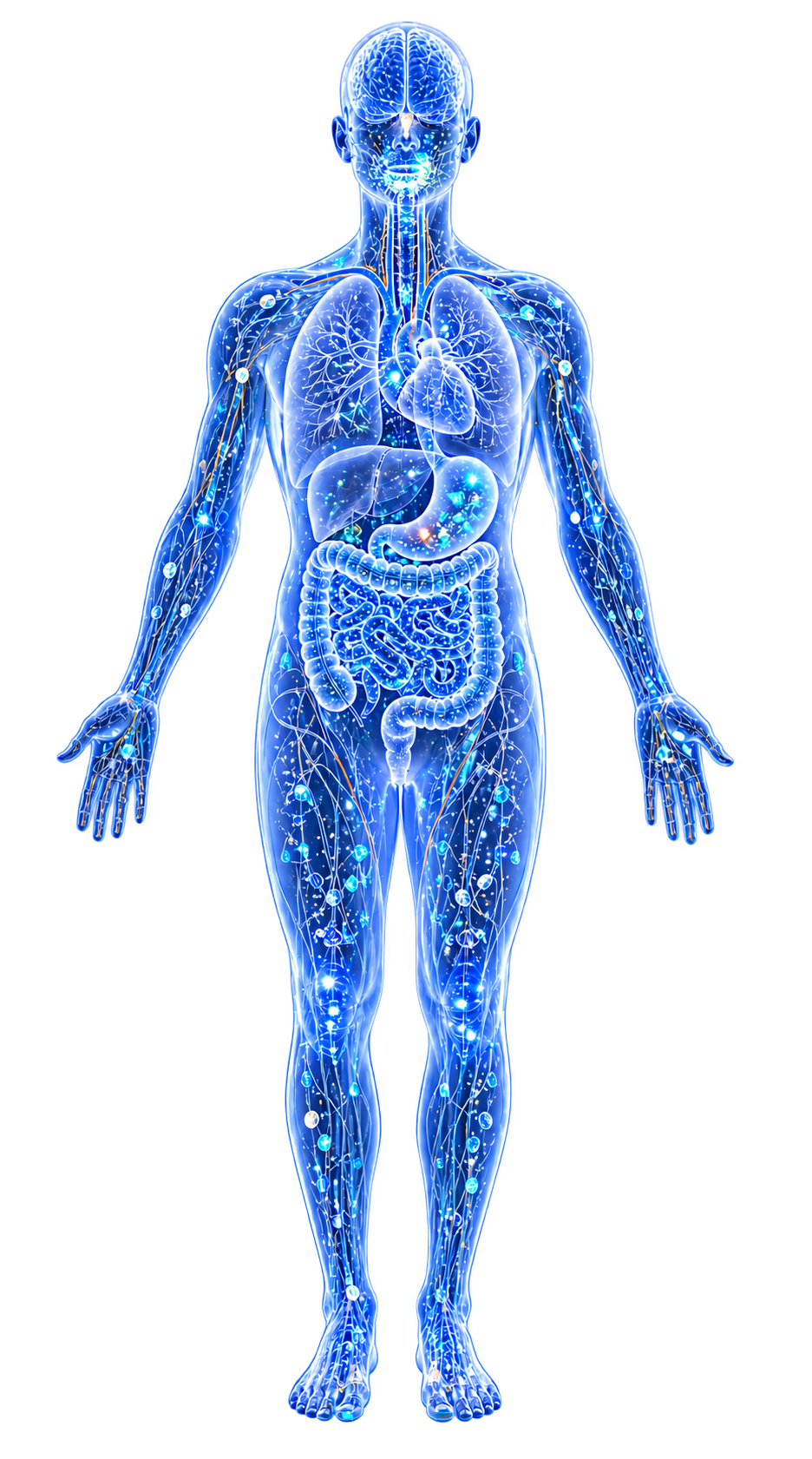
Transferrin is a glycoprotein (β₁-globulin, ~80 kDa) synthesized primarily by the liver that functions as the principal iron-transport protein in blood plasma. It binds ferric iron (iron (Fe)³⁺) with extraordinarily high affinity (Kd ~10⁻²³ M) and delivers it to cells via transferrin receptor-mediated endocytosis.
In the context of Nutritional Immunity (Metal Sequestration), elevated transferrin is a hallmark of host defense—the organism is actively sequestering circulating iron from pathogenic bacteria.
Transferrin is not itself an antimicrobial; it is a scavenging protein that renders iron biologically unavailable to iron-dependent pathogens in blood and tissues.
Mechanism#
Transferrin binds iron (Fe)³⁺ at two high-affinity sites, each coordinated by two tyrosine residues, one Histidine, and one aspartate, plus a synergistic carbonate ion. The protein exists in multiple iron-saturation states.
Apo-transferrin (0% saturated): Iron-free; circulates looking for iron. Monoferric transferrin (1 site occupied): Intermediate state. Diferric transferrin (2 sites occupied): Fully loaded; transport form.
Iron uptake and release are pH-dependent. At the acidic pH of endosomal compartments (pH ~5.5), iron³⁺ dissociates; at physiological pH (~7.4), iron³⁺ binds tightly. This pH gradient enables cellular iron loading while preventing uncontrolled iron loss during circulation.
The concentration of transferrin saturation (serum iron ÷ total iron-binding capacity × 100) is a key clinical metric. Normal values: 20–50% saturation; >50% is considered iron overload.
Role in Disease#
Elevated serum transferrin occurs in:
- Crohn's Disease: Nutritional immunity response to AIEC and other iron-dependent pathogens
- Colorectal Cancer: Metal-Driven Inflammation-driven iron sequestration; tumor microenvironment hypoxia increases transferrin gene expression
- Obesity: Chronic systemic inflammation triggers hepatic transferrin production
- Endometriosis: Peritoneal inflammation; local iron sequestration in lesions
- Infection generally: Acute-phase response to bacterial and fungal pathogens
- Anemia of chronic disease: Iron is locked in transferrin but unavailable for erythropoiesis (functional anemia)
Important: Low serum iron with high transferrin saturation is not iron deficiency—it is iron sequestration and reflects successful nutritional immunity. Supplementing iron in this state feeds the pathogen.
Metal Connections#
Transferrin is the primary delivery vehicle for iron (iron (Fe)³⁺) and also binds copper and other metals with lower affinity. In metallomics.
Iron compartmentalization: Transferrin controls iron flux; hepcidin regulates transferrin-iron internalization by targeting Ferroportin. Iron-dependent pathogens: E. coli, H. pylori, B. fragilis, C. albicans all require ferric iron; transferrin sequestration blocks them. Interlinking with Lactoferrin: Both are iron-chelators; different anatomical compartments (transferrin = serum, lactoferrin = mucosal secretions).
Connections#
Related proteins. Lactoferrin—mucosal iron defense; higher affinity for iron (Fe)³⁺ than transferrin. Hepcidin—regulates iron absorption and recycling; increases transferrin synthesis during infection.—iron exporter; hepcidin blocks it, driving iron intracellular sequestration.
Related concepts. Nutritional Immunity (Metal Sequestration)—host defense via metal sequestration.—bacterial iron-scavenging molecules competing with transferrin. Crohn's Disease, Colorectal Cancer, Obesity—conditions with elevated transferrin.
Metal entities. Iron—the substrate; iron overload vs. iron sequestration distinction is clinically critical.
References 8
Numbered by first appearance in the article, then reconciled with its declared source list.
- 1
Zirun Jin, Yuzhuo Yang, Yalei Cao et al. (2023). Jin 2023 — Gut Metabolite 3-HPAA Rejuvenates Spermatogenic Dysfunction in Aged Mice through GPX4-Mediated Ferroptosis. Microbiome.
- 2
Ann-Katrin Kraeuter, Zoltan Sarnyai (2026). Kraeuter 2026 — Ketogenic Diet-Derived Faecal Microbiota Transplantation Improved Sensorimotor Gating Deficits in an Acute NMDA-Receptor Antagonist Model of Schizophrenia in Mice. Food & Function.
- 3
★Monisha Jaishankar, Tenzin Tseten, Naresh Anbalagan et al. (2014). Toxicity, Mechanism and Health Effects of Some Heavy Metals. Interdisciplinary Toxicology.
- 4
Vollenweider, V., et al. (2024). Vollenweider et al. 2024 — Pyoverdines as Iron-Depriving Antimicrobials. eLife.
- 5
Bastian Blume, Philippe Schmitt-Kopplin, Bernhard Michalke (2026). Blume 2026 — Combined Metallomics and Metabolomics Reveal Impact of Metal Homeostasis on Biological Pathways in C. elegans. Analytical and Bioanalytical Chemistry.
- 6
Prakash Lingasamy, Vijayachitra Modhukur, Reet Mändar et al. (2024). Lingasamy 2024 — Exploring Immunome and Microbiome Interplay in Reproductive Health. Seminars in Reproductive Medicine.
- 7
Konstantin Salnikov, Anatoly Zhitkovich (2008). Genetic and Epigenetic Mechanisms in Metal Carcinogenesis and Cocarcinogenesis: Nickel, Arsenic, and Chromium. Chemical Research in Toxicology.
- 8
Hawkins SM, Nephew KP (2022). Hawkins 2022 — Unintended Consequences of Antibiotic Therapy on the Microbiome Delivers a Gut Punch in Ovarian Cancer. Cancer Research.
Article network
Mentioned here 18
Pages linking here 16
Connect the evidence
Publicly readable discussion by ORCID-authenticated researchers. Questions, interpretation, methods, corrections, and new evidence stay attached to this record.
No discussion yet. Start with a precise question or a source-backed observation.
Activity and accepted changes
Accepted researcher context, editorial status, public discussion, and upstream Git revisions are shown together. Pending, declined, and withdrawn proposals remain private.
- published revision
Backfill inflammation concept links
Karen Pendergrass · +1 −1
Inspect exact Git diff ↗ - published revision
massive wiki expansion: 149 stubs fixed, 100+ new pages, Rule 15 scan, keystone papers
WikiBiome Deploy Bot · +28 −22
Inspect exact Git diff ↗ - published revision
ingest: 87 papers (17 endometriosis, 67 erectile dysfunction, 3 cross-condition)
WikiBiome Deploy Bot · +1 −1
Inspect exact Git diff ↗ - published revision
nightly maintenance: 94 stub demotions, 181 source_count fixes, 22 auto-discovered stubs, 5 adversarial audits, 3 boundary fixes, 3 evidence-level corrections
WikiBiome Deploy Bot · +3 −0
Inspect exact Git diff ↗ - published revision
pre-overnight checkpoint 2026-04-18
WikiBiome Deploy Bot · +4 −2
Inspect exact Git diff ↗ - published revision
WikiBiome update — 2026-04-15 17:23
WikiBiome Deploy Bot · +2 −2
Inspect exact Git diff ↗ - published revision
WikiBiome update — integrity fixes, metallomic diet pages, cross-condition analyses
WikiBiome Deploy Bot · +15 −13
Inspect exact Git diff ↗ - published revision
WikiBiome update — 2026-04-10 17:16
WikiBiome Deploy Bot · +63 −0
Inspect exact Git diff ↗