

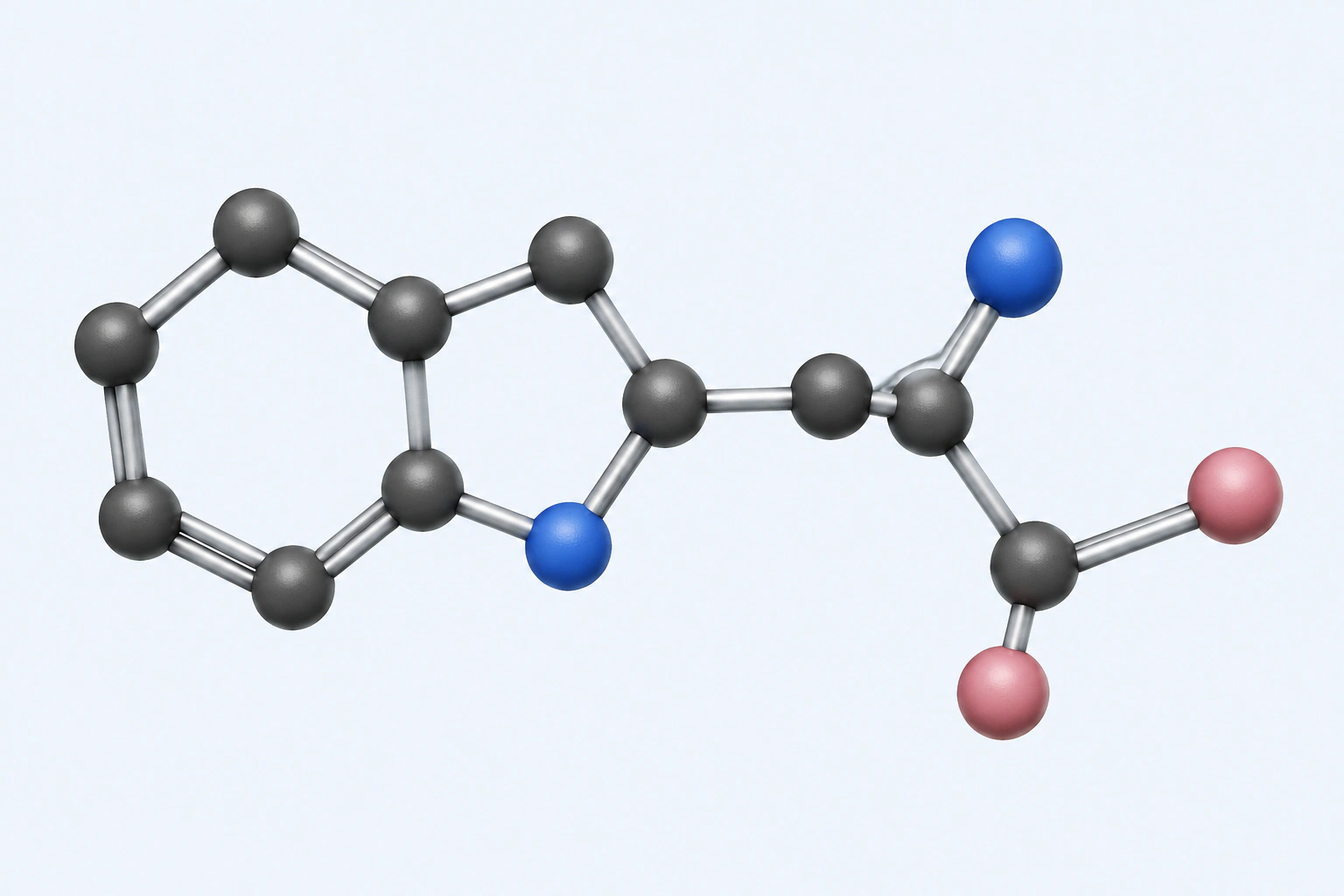
Heavy-atom connectivity orientation for L-tryptophan. Hydrogens, measured conformation, assay-confirmed stereochemical pose, metabolic fate, concentration, and disease claims are intentionally omitted; this is an educational reconstruction.
Scientific media record5 verified identifiers
- Subject
- L-Tryptophanbiological-process
- Identifiers
- WikiBiome:tryptophanPubChem:6305ChEBI:16828MeSH:D014364InChIKey:QIVBCDIJIAJPQS-VIFPVBQESA-N
- Review
- Editorial review completeIdentifiers authority-verified · Accessibility validated · · tryptophan|tryptophan-mechanism-v1.webp
- Digital source
- Trained-algorithmic mediaCreated with a trained generative algorithm and reviewed by WikiBiome for subject identity, scientific framing, identifiers, provenance, and accessibility.
- Scientific basis
- L-Tryptophan — PubChemL-Tryptophan — ChEBITryptophan — Medical Subject HeadingsTryptophan
- License
- CC BY-SA 4.0Created
Tryptophan (Trp) is an essential amino acid that the human body cannot synthesize and must obtain from diet.
It occupies a uniquely important position at the intersection of neuroscience, immunology, and microbial ecology because it is the sole precursor to serotonin, a major substrate for the Kynurenine Pathway, and the raw material for a suite of microbial metabolites that shape gut-brain communication.
What makes tryptophan particularly relevant to the Metallomics story is that the enzymes controlling its fate are metal-dependent: the rate-limiting enzymes of the kynurenine pathway (IDO and TDO) both require heme Iron as a cofactor, meaning that metal availability directly determines how tryptophan is metabolized and which downstream products predominate.
Evidence map10 cited passagesInspect provenance +
Gut bacteria directly metabolize tryptophan via tryptophanase and other enzymes to produce indole derivatives: indole-3-propionic acid (IPA), indole-3-acetic acid (IAA), indole-3-aldehyde (IAld), and tryptamine. These metabolites activate the aryl hydrocarbon receptor (AhR) on gut epithelial cells and immune cells, driving IL-22 production and strengthening
Iron as IDO/TDO cofactor: The rate-limiting enzymes of the kynurenine pathway are heme-iron-dependent. Iron dysregulation—whether excess or deficiency—alters pathway flux and shifts the balance between neuroprotective and neurotoxic metabolites.
Cadmium and tryptophan depletion: Cd exposure is associated with altered tryptophan metabolism in animal models, potentially through oxidative depletion of cofactors.
Autism spectrum disorder: Fecal kynurenate, indolelactate, and 5-HTP are significantly lower in ASD children. Brain activity in the insula and cingulate cortex mediates the relationship between tryptophan metabolite levels and ASD severity.
Depression: The "serotonin hypothesis" is an oversimplification, but IDO-mediated tryptophan steal—diverting substrate from serotonin to kynurenine—is well-documented in inflammatory depression.
Schizophrenia: Kynurenine pathway dysregulation with elevated kynurenic acid (an NMDA antagonist) is implicated in cognitive deficits.
Chronic kidney disease: Indoxyl sulfate, a uremic toxin derived from bacterial tryptophan metabolism, is a key driver of CKD progression and cardiovascular complications. See uremic-toxins.
Cardiovascular disease: Microbial IPA is atheroprotective; its depletion in dysbiosis may accelerate atherosclerosis.
PMDD: Tryptophan-serotonin pathway alterations are implicated in the neuroinflammatory component of premenstrual dysphoric disorder.
Parkinson's disease: Kynurenine pathway metabolites contribute to neuroinflammation and dopaminergic neuron damage.
Contents
1. Dietary Sources and Absorption2. Three Metabolic Fates3. Metal Connections4. Disease Relevance5. Cross-ReferencesDietary Sources and Absorption#
Tryptophan is the least abundant essential amino acid in the diet, found in protein-rich foods including poultry, eggs, cheese, nuts, seeds, and legumes. Dietary intake typically ranges from 250 to 1,000 mg/day.
Absorption occurs primarily in the small intestine via the large neutral amino acid transporter (LAT1), where tryptophan competes with other large neutral amino acids (leucine, isoleucine, valine, phenylalanine, tyrosine) for transport across both the intestinal epithelium and the Blood-Brain Barrier.
This competition has a practical consequence: the ratio of tryptophan to competing amino acids, rather than absolute tryptophan levels, determines how much reaches the brain. High-protein meals can paradoxically reduce brain tryptophan availability because branched-chain amino acids flood the transporter.
Three Metabolic Fates#
Only about 1% of ingested tryptophan is used for serotonin synthesis. The vast majority is metabolized via three competing pathways, each with distinct biological consequences. For detailed pathway biochemistry, see Tryptophan Metabolism.
The Kynurenine Pathway (~95% of Trp catabolism)#
The dominant route, controlled by iron-dependent IDO1/IDO2 (in immune and gut cells) and TDO (in liver). Inflammation upregulates IDO via IFN-gamma, diverting tryptophan away from serotonin and toward kynurenine metabolites. This produces a spectrum of neuroactive compounds ranging from neuroprotective (kynurenic acid) to neurotoxic (quinolinic acid).
See Kynurenine Pathway for the full cascade.
The metal dependency here is critical: both IDO and TDO require heme iron, and Iron availability modulates pathway flux. In iron-overloaded inflammatory states, IDO activity increases, amplifying the shift toward neurotoxic metabolites.
The Serotonin Pathway (~1-2%)#
Tryptophan hydroxylase (TPH1 in gut, TPH2 in brain) converts tryptophan to 5-HTP, then to serotonin (5-HT). Approximately 95% of the body's serotonin is produced in the gut by enterochromaffin cells, regulated by gut bacteria—particularly spore-forming Clostridia.
Gut serotonin does not cross the BBB but regulates motility, secretion, and visceral sensation, and signals to the brain via vagal afferents (Gut-Brain Axis).
The Microbial Indole Pathway#
Gut bacteria directly metabolize tryptophan via tryptophanase and other enzymes to produce indole derivatives: indole-3-propionic acid (IPA), indole-3-acetic acid (IAA), indole-3-aldehyde (IAld), and tryptamine. These metabolites activate the aryl hydrocarbon receptor (AhR) on gut epithelial cells and immune cells, driving IL-22 production and strengthening barrier integrity.
IPA produced by Clostridium sporogenes is atheroprotective and inversely correlated with arterial plaque burden.[1]Emerging therapy targets to modulate microbiome-mediated effects evident in cardiovascular diseaseDorothea Katharina Hoffelner, Tim Hendrikx · 2025Open reference 1 ↓
Metal Connections#
Tryptophan metabolism is intimately tied to metal biology through several mechanisms. Iron as IDO/TDO cofactor: The rate-limiting enzymes of the kynurenine pathway are heme-iron-dependent. Iron dysregulation—whether excess or deficiency—alters pathway flux and shifts the balance between neuroprotective and neurotoxic metabolites.[2]Microbial Metallomics and Parkinson's Disease: A Unified Metal-Driven Framework Linking Ferroptosis, Dysbiosis, and alpha-Synuclein PathologyKaren Pendergrass · 2025Open reference 2 ↓
Zinc and serotonin: Zinc is required for aromatic amino acid decarboxylase activity and modulates serotonin receptor binding. Zinc deficiency, common in many of the conditions discussed in this wiki, compounds tryptophan pathway disruption.
Manganese and tryptophan hydroxylase: manganese (Mn) exposure can alter TPH activity, disrupting serotonin synthesis in both gut and brain.
Cadmium and tryptophan depletion: cadmium (Cd) exposure is associated with altered tryptophan metabolism in animal models, potentially through oxidative depletion of cofactors.[3]Exposure to Cadmium and Its Impacts on Human Health: A Short ReviewPuthiyavalappil Rasin, Ashwathi A V, Sabeel M Basheer et al. · 2025Open reference 3 ↓
Disease Relevance#
Tryptophan depletion or pathway imbalance appears across a remarkable range of conditions.
Autism spectrum disorder: Fecal kynurenate, indolelactate, and 5-HTP are significantly lower in ASD children. Brain activity in the insula and cingulate cortex mediates the relationship between tryptophan metabolite levels and ASD severity.[4]Aziz-Zadeh 2025 — Relationships Between Brain Activity, Tryptophan-Related Gut Metabolites, and Autism SymptomatologyLisa Aziz-Zadeh, Sofronia M. Ringold, Aditya Jayashankar et al. · 2025Open reference 4 ↓
Depression: The "serotonin hypothesis" is an oversimplification, but IDO-mediated tryptophan steal—diverting substrate from serotonin to kynurenine—is well-documented in inflammatory depression.[5]Current Perspectives on Gut Microbiome Dysbiosis and DepressionCapuco A, Urits I, Hasoon J et al. · 2020Open reference 5 ↓
Schizophrenia: Kynurenine pathway dysregulation with elevated kynurenic acid (an NMDA antagonist) is implicated in cognitive deficits.[6]The Gut Microbiome and Schizophrenia: The Current State of the Field and Clinical ApplicationsSzeligowski T, Yun AL, Lennox BR et al. · 2020Open reference 6 ↓
Chronic kidney disease: Indoxyl sulfate, a uremic toxin derived from bacterial tryptophan metabolism, is a key driver of CKD progression and cardiovascular complications. See uremic-toxins.[7]Wehedy et al. 2022 — The Human Microbiome in CKD: A Double-Edged SwordWehedy, Ghali, Matboli · 2022Open reference 7 ↓
Cardiovascular disease: Microbial IPA is atheroprotective; its depletion in Dysbiosis may accelerate atherosclerosis.[1]Emerging therapy targets to modulate microbiome-mediated effects evident in cardiovascular diseaseDorothea Katharina Hoffelner, Tim Hendrikx · 2025Open reference 1 ↓ PMDD: Tryptophan-serotonin pathway alterations are implicated in the neuroinflammatory component of premenstrual dysphoric disorder.[8]Cheng 2025 — Neuroinflammation in PMS and PMDD (Review)Cheng et al. · 2025Open reference 8 ↓
Parkinson's disease: Kynurenine pathway metabolites contribute to neuroinflammation and dopaminergic neuron damage.[2]Microbial Metallomics and Parkinson's Disease: A Unified Metal-Driven Framework Linking Ferroptosis, Dysbiosis, and alpha-Synuclein PathologyKaren Pendergrass · 2025Open reference 2 ↓
Cross-References#
- Tryptophan Metabolism—detailed pathway biochemistry and regulation
- Kynurenine Pathway—the dominant catabolic route and its neuroactive products
- AhR (Aryl Hydrocarbon Receptor)—aryl hydrocarbon receptor activation by microbial indoles
- Indoles—microbial tryptophan derivatives
- Serotonin—the neurotransmitter product
- Iron—cofactor for IDO/TDO
- Gut-Brain Axis—the communication system tryptophan metabolites mediate
- microbiome-derived metabolites—broader context for microbial tryptophan products
- Neuroinflammation—downstream consequence of kynurenine pathway imbalance
References 16
Numbered by first appearance in the article, then reconciled with its declared source list.
- 1
Dorothea Katharina Hoffelner, Tim Hendrikx (2025). Emerging therapy targets to modulate microbiome-mediated effects evident in cardiovascular disease. Frontiers in Cardiovascular Medicine.
- 2
★Karen Pendergrass (2025). Microbial Metallomics and Parkinson's Disease: A Unified Metal-Driven Framework Linking Ferroptosis, Dysbiosis, and alpha-Synuclein Pathology. Conference Presentation.
- 3
★Puthiyavalappil Rasin, Ashwathi A V, Sabeel M Basheer et al. (2025). Exposure to Cadmium and Its Impacts on Human Health: A Short Review. Journal of Hazardous Materials Advances.
- 4
Lisa Aziz-Zadeh, Sofronia M. Ringold, Aditya Jayashankar et al. (2025). Aziz-Zadeh 2025 — Relationships Between Brain Activity, Tryptophan-Related Gut Metabolites, and Autism Symptomatology. Nature Communications.
- 5
Capuco A, Urits I, Hasoon J et al. (2020). Current Perspectives on Gut Microbiome Dysbiosis and Depression. Advances in Therapy.
- 6
Szeligowski T, Yun AL, Lennox BR et al. (2020). The Gut Microbiome and Schizophrenia: The Current State of the Field and Clinical Applications. Frontiers in Psychiatry.
- 7
Wehedy, Ghali, Matboli (2022). Wehedy et al. 2022 — The Human Microbiome in CKD: A Double-Edged Sword. Frontiers in Medicine.
- 8
Cheng et al. (2025). Cheng 2025 — Neuroinflammation in PMS and PMDD (Review). Frontiers in Endocrinology.
- 9
You Yu, Yujing Wang, Jie Zhang et al. (2025). Yu 2025 — The Gut Commensal Faecalibacterium hominis Attenuates Indole-AhR Signaling and Restores ASD-Like Behaviors with BTBR Mice. Frontiers in Microbiology.
- 10
Tingting Wang, Beidi Chen, Mingcui Luo et al. (2023). Wang 2023 — Microbiota-Indole 3-Propionic Acid-Brain Axis Mediates Abnormal Synaptic Pruning of Hippocampal Microglia and Susceptibility to ASD in IUGR Offspring. Microbiome.
- 11
Federica Gevi, Lello Zolla, Stefano Gabriele et al. (2016). Gevi 2016 — Urinary Metabolomics of Young Italian Autistic Children Supports Abnormal Tryptophan and Purine Metabolism. Molecular Autism.
- 12
★Karen Pendergrass (2026). Heavy Metals, Microbial Metallomics, and the US Obesity Epidemic: A Mechanistic Examination of a Population-Level Metabolic Disruption. Zenodo Preprint.
- 13
Agnieszka Krawczyk, Tomasz Kasperski, Tomasz Gosiewski et al. (2025). Krawczyk 2025 — Effects of Fecal Microbiota Transplantation on the Abundance and Diversity of Selected Fungal and Archaeal Species in the Gut Microbiota in the Rat Model of Schizophrenia. Pharmacological Reports.
- 14
Christophe Barba, Berengere Benoit, Emilie Bres et al. (2021). Barba 2021 — A Low Aromatic Amino-Acid Diet Improves Renal Function and Prevents Kidney Fibrosis in Mice with CKD. Scientific Reports.
- 15
V. Martinelli, M. Albanese, M. Altieri et al. (2022). Gut-oriented interventions in patients with multiple sclerosis: fact or fiction?. European Review for Medical and Pharmacological Sciences.
- 16
Dan Wang, Juan Song, Ye Cheng et al. (2023). Wang 2023 — Plasma amino acid metabolomics identifies diagnostic signature for cerebral palsy. Frontiers in Molecular Neuroscience.
Article network
Mentioned here 15
Pages linking here 10
Connect the evidence
Publicly readable discussion by ORCID-authenticated researchers. Questions, interpretation, methods, corrections, and new evidence stay attached to this record.
No discussion yet. Start with a precise question or a source-backed observation.
Activity and accepted changes
Accepted researcher context, editorial status, public discussion, and upstream Git revisions are shown together. Pending, declined, and withdrawn proposals remain private.
- published revision
Strengthen Metallomics and link high-leverage contexts
Karen Pendergrass · +1 −1
Inspect exact Git diff ↗ - published revision
Consolidate microbial metabolite knowledge
Karen Pendergrass · +2 −2
Inspect exact Git diff ↗ - published revision
Complete corpus-wide Dysbiosis linking
Karen Pendergrass · +1 −1
Inspect exact Git diff ↗ - published revision
Add Interleukin-22 concept and contextual links
Karen Pendergrass · +1 −1
Inspect exact Git diff ↗ - published revision
massive wiki expansion: 149 stubs fixed, 100+ new pages, Rule 15 scan, keystone papers
WikiBiome Deploy Bot · +12 −12
Inspect exact Git diff ↗ - published revision
pre-overnight checkpoint 2026-04-18
WikiBiome Deploy Bot · +74 −0
Inspect exact Git diff ↗ - published revision
WikiBiome update — 2026-04-11 22:49
WikiBiome Deploy Bot · +0 −16
Inspect exact Git diff ↗ - published revision
WikiBiome update — integrity fixes, metallomic diet pages, cross-condition analyses
WikiBiome Deploy Bot · +2 −0
Inspect exact Git diff ↗ - published revision
WikiBiome update — 2026-04-10 15:45
WikiBiome Deploy Bot · +14 −0
Inspect exact Git diff ↗