
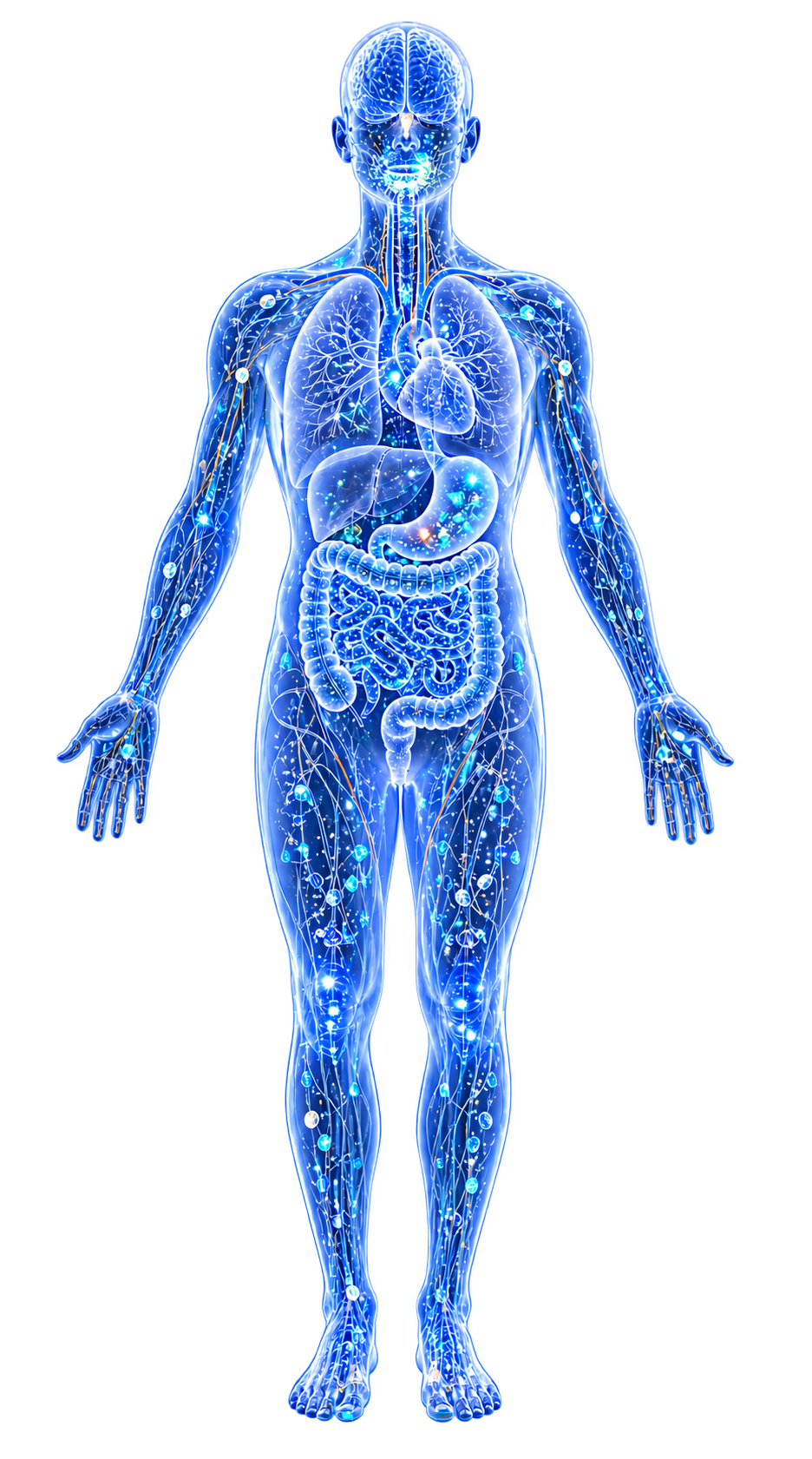
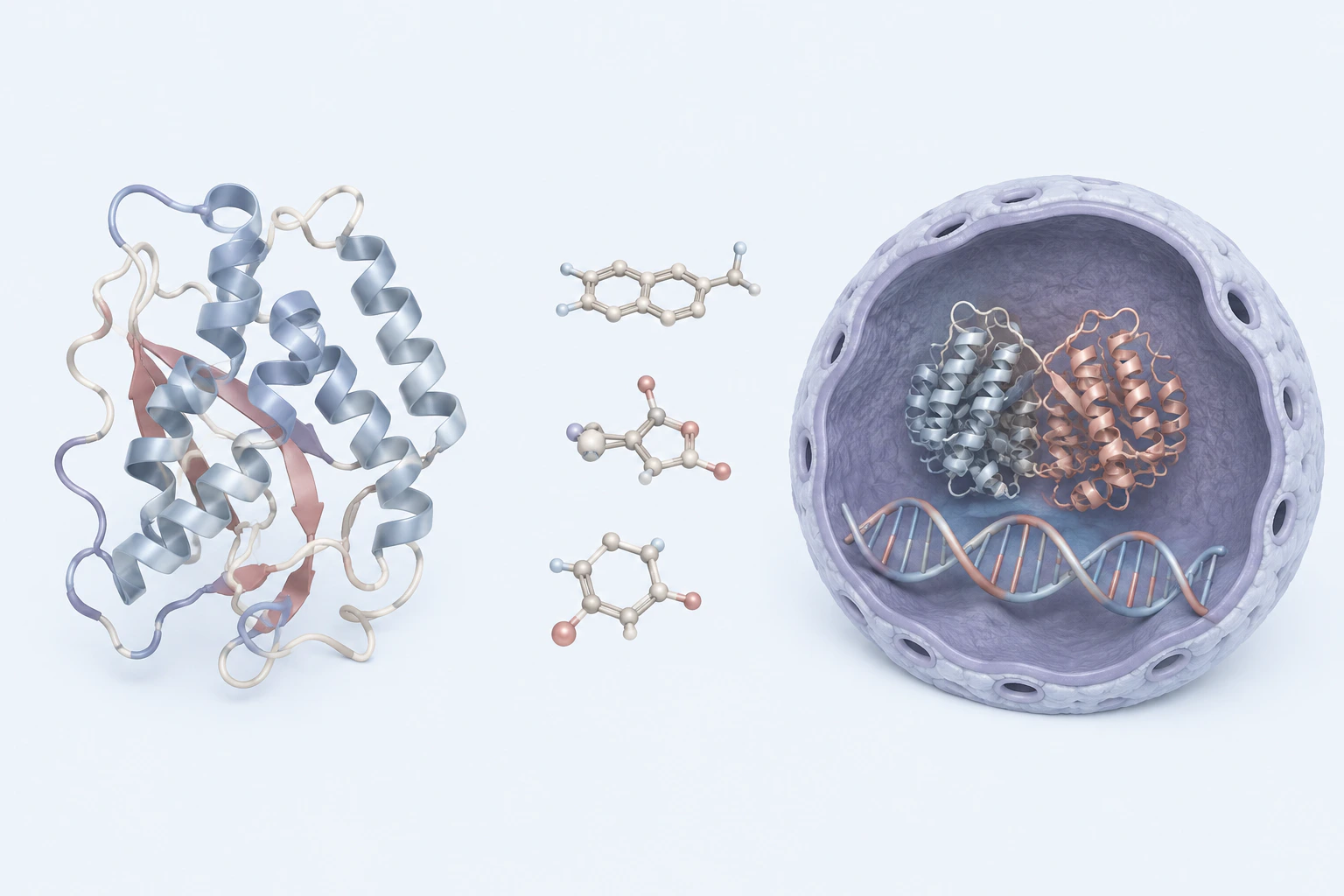
Human AhR context orientation. Protein and ligand forms are generic abstractions, not measured structures, docking poses, activation, translocation, DNA binding, expression, mechanism, or biomarker evidence.
Scientific media record2 verified identifiers
- Subject
- Aryl Hydrocarbon Receptorbiological-process
- Identifiers
- WikiBiome:ahrUniProt:P35869
- Review
- Editorial review completeIdentifiers authority-verified · Accessibility validated · · ahr|ahr-mechanism-v1.webp
- Digital source
- Trained-algorithmic mediaCreated with a trained generative algorithm and reviewed by WikiBiome for subject identity, scientific framing, identifiers, provenance, and accessibility.
- Scientific basis
- Aryl hydrocarbon receptor — UniProtKB P35869AhR
- License
- CC BY-SA 4.0Created
The aryl hydrocarbon receptor (AhR) is a ligand-activated transcription factor that functions as a master sensor at the intersection of gut microbial metabolism, environmental chemical exposure, and immune regulation. It is expressed broadly across immune cells, intestinal epithelium, neurons, and liver cells.
AhR represents one of the key mechanisms through which Gut Microbiome-derived metabolites directly influence host immunity and systemic Metal-Driven Inflammation.
Contents
1. What AhR Senses2. AhR in Gut-Immune Regulation3. Microbiome Connection4. Conditions Where AhR is Implicated5. Cross-ReferencesWhat AhR Senses#
AhR binds a structurally diverse set of ligands divided into two major categories:
Endogenous / microbial ligands (protective). Indoles—produced by tryptophan-metabolizing bacteria (Lactobacillus, Clostridiales, Bacteroidetes); indole, indole-3-acetic acid (IAA), indole-3-propionic acid (IPA), indole-3-aldehyde (IAld). Kynurenines—tryptophan catabolism products from the kynurenine pathway.
FICZ (6-formylindolo[3,2-b]carbazole)—endogenous high-affinity ligand.
Exogenous / xenobiotic ligands (often disruptive). Polycyclic aromatic hydrocarbons (PAHs)—from combustion, smoked foods. Dioxins (TCDD)—persistent organic pollutants; the prototypical AhR agonist at toxic doses.
PCBs—polychlorinated biphenyls.
Cadmium, arsenic, and certain Heavy Metals—can activate or disrupt AhR signaling.
AhR in Gut-Immune Regulation#
Activation by microbial indoles produces profoundly different effects than activation by dioxins. Indole-driven AhR signaling promotes.
Barrier integrity—upregulates tight junction proteins and mucin production; protects against leaky gut. IL-22 production—promotes intestinal epithelial regeneration and antimicrobial peptide secretion. Treg/Th17 balance—physiological AhR activation favors regulatory T cells; supports immune tolerance.
ILC3 activation—innate lymphoid cells that defend mucosal barriers.
Pathological AhR signaling (dioxin-like, or absent signaling from indole depletion) produces. Barrier failure—reduced tight junctions, increased intestinal permeability. Th17 bias—pro-inflammatory immune skewing associated with autoimmunity.
Neuroinflammation—AhR is expressed in microglia and astrocytes; disrupted signaling contributes to neuroinflammatory cascades.
Microbiome Connection#
Tryptophan-metabolizing bacteria are the primary source of indole AhR ligands. The depletion of these organisms—consistently observed across ASD, MS, Hashimoto's, depression, and other conditions with overlapping metallomic signatures—directly reduces AhR ligand availability. The result is a shift from protective indole-driven AhR signaling toward inflammatory defaults.
The metal-Dysbiosis framework explains this depletion: iron-enriched, oxygen-depleted gut environments favor siderophore-equipped Enterobacteriaceae over indole-producing Clostridia and Bacteroidetes. The loss of AhR ligands is a downstream consequence of metal-driven ecological disruption.
Conditions Where AhR is Implicated#
ASD—depleted indole-producing bacteria; AhR hypoactivation linked to social behavior circuits in animal models. Multiple Sclerosis—depleted Clostridiales; AhR activates neuroprotective signaling; ILC3 and Treg balance disrupted. Hashimoto's Thyroiditis—tryptophan metabolism disruption noted in metabolomics studies.
Depression—AhR connected to the tryptophan-serotonin-kynurenine axis that is perturbed in MDD.
Cross-References#
Indoles—the primary gut microbiome-derived AhR ligands. Tryptophan Metabolism—the biosynthetic pathway generating AhR ligands. Nutritional Immunity (Metal Sequestration)—iron ecology disrupts indole-producer abundance → reduces AhR signaling.
Gut-Brain Axis—AhR as a molecular conduit between gut metabolites and brain immune state. inflammation—AhR as a brake on inflammatory signaling when properly activated.
References 5
Numbered by first appearance in the article, then reconciled with its declared source list.
- 1
You Yu, Yujing Wang, Jie Zhang et al. (2025). Yu 2025 — The Gut Commensal Faecalibacterium hominis Attenuates Indole-AhR Signaling and Restores ASD-Like Behaviors with BTBR Mice. Frontiers in Microbiology.
- 2
Teresa Zelante, Giuseppe Paolicelli, Francesca Fallarino et al. (2024). A microbially produced AhR ligand promotes a Tph1-driven tolerogenic program in multiple sclerosis. Scientific Reports.
- 3
Natalia A. Borges, Amanda F. Barros, Lia S. Nakao et al. (2016). Protein-Bound Uremic Toxins from Gut Microbiota and Inflammatory Markers in CKD. Journal of Renal Nutrition.
- 4
Friederike Gutmann, Lina Samira Bahr, Ulrike Bruning et al. (2025). Functional Microbiome Reprogramming Links Dietary Interventions to Neuroinflammatory Outcomes in Multiple Sclerosis. Research Square (preprint).
- 5
Katz Sand I (2018). The Role of Diet in Multiple Sclerosis: Mechanistic Connections and Current Evidence. Current Nutrition Reports.
Article network
Mentioned here 14
Pages linking here 16
Connect the evidence
Publicly readable discussion by ORCID-authenticated researchers. Questions, interpretation, methods, corrections, and new evidence stay attached to this record.
No discussion yet. Start with a precise question or a source-backed observation.
Activity and accepted changes
Accepted researcher context, editorial status, public discussion, and upstream Git revisions are shown together. Pending, declined, and withdrawn proposals remain private.
- published revision
Backfill heavy metals concept links
Karen Pendergrass · +1 −1
Inspect exact Git diff ↗ - published revision
Backfill gut microbiome concept links
Karen Pendergrass · +1 −1
Inspect exact Git diff ↗ - published revision
Backfill inflammation concept links
Karen Pendergrass · +2 −2
Inspect exact Git diff ↗ - published revision
Complete corpus-wide Dysbiosis linking
Karen Pendergrass · +1 −1
Inspect exact Git diff ↗ - published revision
Complete Tight junctions contextual coverage
Karen Pendergrass · +1 −1
Inspect exact Git diff ↗ - published revision
Add Interleukin-22 concept and contextual links
Karen Pendergrass · +1 −1
Inspect exact Git diff ↗ - published revision
massive wiki expansion: 149 stubs fixed, 100+ new pages, Rule 15 scan, keystone papers
WikiBiome Deploy Bot · +29 −26
Inspect exact Git diff ↗ - published revision
nightly maintenance: 94 stub demotions, 181 source_count fixes, 22 auto-discovered stubs, 5 adversarial audits, 3 boundary fixes, 3 evidence-level corrections
WikiBiome Deploy Bot · +3 −0
Inspect exact Git diff ↗ - published revision
pre-overnight checkpoint 2026-04-18
WikiBiome Deploy Bot · +4 −1
Inspect exact Git diff ↗ - published revision
WikiBiome v2 migration: signature pages + safety fixes + gap analysis
WikiBiome Deploy Bot · +62 −0
Inspect exact Git diff ↗