
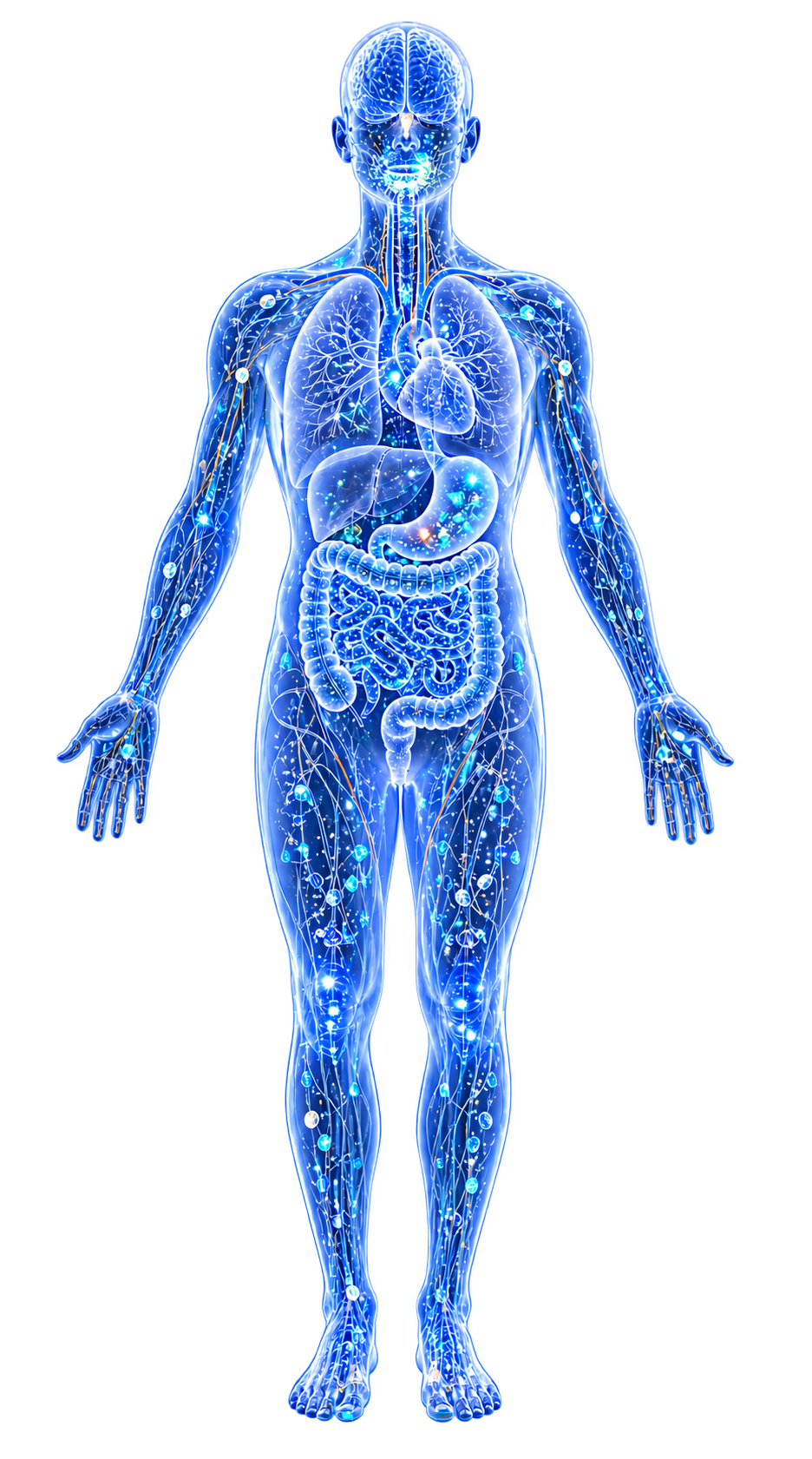
Serotonin (5-hydroxytryptamine, 5-HT) is a monoamine neurotransmitter with a remarkable split life: ~90-95% of body serotonin is produced in the gut by enterochromaffin (EC) cells, not in the brain. This peripheral serotonin regulates intestinal motility, secretion, visceral sensation, and vagal signaling.
Brain serotonin—synthesized independently because gut 5-HT does not cross the blood-brain barrier—controls mood, appetite, sleep, and cognition.
The Gut Microbiome directly regulates serotonin production. Spore-forming Clostridia stimulate EC cells to produce serotonin, and tryptophan availability (the precursor) is shaped by microbial consumption and metabolic diversion. This makes serotonin biology a primary pathway through which Dysbiosis affects both gut function and brain health.
Evidence map4 cited passagesInspect provenance +
~95% of tryptophan is catabolized via the kynurenine pathway under normal conditions. inflammation tips this balance further: IDO1 induction by inflammatory cytokines shunts tryptophan away from serotonin toward kynurenine—the mechanistic basis for serotonin depletion in inflammatory depression.
3-Indolealdehyde (3-IAld), produced by lactobacillus species, activates the aryl hydrocarbon receptor (AhR) in mast cells, inducing TPH1 expression and tipping tryptophan metabolism toward serotonin and away from kynurenine. This represents a microbial mechanism for directly promoting serotonin synthesis.
In schizophrenia, roseburia intestinalis was negatively correlated with serotonin levels. Chronic antibiotics decreased hippocampal 5-HT and increased the kynurenine/tryptophan ratio.
| Condition | Serotonin Relevance | |-----------|-------------------| | depression | IDO1-mediated tryptophan diversion → serotonin depletion; elevated kyn/trp ratio (p=0.008) | | autism spectrum disorder | 5-HTP significantly lower in ASD children; tryptophan metabolite-brain activity mediation | | fibromyalgia / ibs | 28-59% FM-IBS comorbidity shares alter
Contents
1. Synthesis and the Tryptophan Fork2. Microbiome Regulation of Serotonin3. Gut Serotonin Functions4. Conditions Associated5. Cross-ReferencesSynthesis and the Tryptophan Fork#
Serotonin is synthesized from tryptophan, an essential amino acid obtained exclusively from diet. Tryptophan metabolism faces a critical fork.
Serotonin pathway: Tryptophan → 5-HTP → 5-HT (serotonin). Rate-limited by TPH1 (gut) and TPH2 (brain). Kynurenine pathway: Tryptophan → kynurenine → downstream metabolites. Rate-limited by IDO1 (immune cells; IFN-gamma-inducible) and TDO (liver; constitutive).
Both enzymes require heme iron.
~95% of tryptophan is catabolized via the kynurenine pathway under normal conditions. Metal-Driven Inflammation tips this balance further: IDO1 induction by inflammatory cytokines shunts tryptophan away from serotonin toward kynurenine—the mechanistic basis for serotonin depletion in inflammatory depression.[1]Current Perspectives on Gut Microbiome Dysbiosis and DepressionCapuco A, Urits I, Hasoon J et al. · 2020Open reference 1 ↓
A third pathway—Indoles production by gut bacteria (via tryptophanase)—also competes for tryptophan, further reducing precursor availability for serotonin synthesis.
Microbiome Regulation of Serotonin#
Bacteria That Stimulate Serotonin Production#
Spore-forming Clostridia (primarily Clostridium cluster IV and XIVa) stimulate EC cells to produce serotonin. Depletion of these commensals (common in metal-driven dysbiosis) reduces gut serotonin output, contributing to constipation, altered motility, and impaired vagal signaling.
Bacteria That Divert Tryptophan#
Bacterial consumption of tryptophan reduces precursor availability for both gut and brain serotonin synthesis. Proteobacteria (Pseudomonadota) (especially E. coli) convert tryptophan to indoxyl sulfate, a nephrotoxic metabolite, rather than serotonin-supportive metabolites.
3-IAld: The Metabolic Toggle#
3-Indolealdehyde (3-IAld), produced by Lactobacillus species, activates the aryl hydrocarbon receptor (AhR) in mast cells, inducing TPH1 expression and tipping tryptophan metabolism toward serotonin and away from Kynurenine.[2]A microbially produced AhR ligand promotes a Tph1-driven tolerogenic program in multiple sclerosisTeresa Zelante, Giuseppe Paolicelli, Francesca Fallarino et al. · 2024Open reference 2 ↓ This represents a microbial mechanism for directly promoting serotonin synthesis.
Microbial-Serotonin Correlations#
In schizophrenia, Roseburia intestinalis was negatively correlated with serotonin levels.[3]Functional Associations of the Gut Microbiome with Dopamine, Serotonin, and BDNF in Schizophrenia: A Pilot StudyGhorbani M, Joseph GBS, Tew MM et al. · 2024Open reference 3 ↓ Chronic antibiotics decreased hippocampal 5-HT and increased the kynurenine/tryptophan ratio.[1]Current Perspectives on Gut Microbiome Dysbiosis and DepressionCapuco A, Urits I, Hasoon J et al. · 2020Open reference 1 ↓
Gut Serotonin Functions#
Peripheral (gut) serotonin does not cross the Blood-Brain Barrier. Its functions are local.
Motility: 5-HT activates intrinsic primary afferent neurons, triggering peristaltic and secretory reflexes. Serotonin dysfunction underlies both constipation-predominant and diarrhea-predominant IBS. Visceral sensation: 5-HT3 and 5-HT4 receptors on vagal afferents transmit gut signals to the brain.
Immune modulation: Serotonin modulates immune cell function in the lamina propria.
Bone metabolism: Gut-derived serotonin inhibits osteoblast activity (high gut 5-HT → reduced bone density).
Conditions Associated#
| Condition | Serotonin Relevance |
|---|---|
| Depression | IDO1-mediated tryptophan diversion → serotonin depletion; elevated kyn/trp ratio (p=0.008)[1]Current Perspectives on Gut Microbiome Dysbiosis and DepressionCapuco A, Urits I, Hasoon J et al. · 2020Open reference 1 ↓ |
| Autism Spectrum Disorder | 5-HTP significantly lower in ASD children; tryptophan metabolite-brain activity mediation[4]Aziz-Zadeh 2025 — Relationships Between Brain Activity, Tryptophan-Related Gut Metabolites, and Autism SymptomatologyLisa Aziz-Zadeh, Sofronia M. Ringold, Aditya Jayashankar et al. · 2025Open reference 4 ↓ |
| Fibromyalgia / Irritable Bowel Syndrome (IBS) | 28-59% FM-IBS comorbidity shares altered serotonin/tryptophan metabolism[5]Bheemanenni 2025 — Fibromyalgia and IBS (Systematic Review)Bheemanenni et al. · 2025Open reference 5 ↓ |
| Schizophrenia | FMT from SCZ patients elevated hippocampal 5-HT in mice[6]Theleritis 2024 -- Association of gut dysbiosis with first-episode psychosis (Review)Christos Theleritis, Maria-Ioanna Stefanou, Marina Demetriou et al. · 2024Open reference 6 ↓ |
| Parkinson's Disease | Tryptophan diverted from serotonin to Kynurenine pathway[7]Novikova 2025 -- Microbiome-Derived Metabolites in Parkinson's Disease (Thesis)Polina Novikova · 2025Open reference 7 ↓ |
| Postpartum Depression | Catecholamine/serotonin fluctuations postpartum |
| Premenstrual Dysphoric Disorder | Serotonergic dysfunction in premenstrual context[8]Cheng 2025 — Neuroinflammation in PMS and PMDD (Review)Cheng et al. · 2025Open reference 8 ↓ |
| Endometriosis | Serotonin-estrogen signaling interactions |
Cross-References#
- Tryptophan Metabolism—Parent pathway; serotonin vs. kynurenine fork
- Kynurenine—Competing pathway for tryptophan
- Dopamine—Parallel monoamine neurotransmitter
- Gut-Brain Axis—Serotonin as primary signaling molecule
- Indoles—Third tryptophan metabolic pathway
- AhR (Aryl Hydrocarbon Receptor)—AhR activation by 3-IAld promotes TPH1/serotonin
- Microbiome-Derived Metabolites—Microbial tryptophan metabolism
- Iron—IDO1/TDO require heme iron
- inflammation—IFN-gamma induces IDO1, depleting serotonin
References 10
Numbered by first appearance in the article, then reconciled with its declared source list.
- 1
Capuco A, Urits I, Hasoon J et al. (2020). Current Perspectives on Gut Microbiome Dysbiosis and Depression. Advances in Therapy.
- 2
Teresa Zelante, Giuseppe Paolicelli, Francesca Fallarino et al. (2024). A microbially produced AhR ligand promotes a Tph1-driven tolerogenic program in multiple sclerosis. Scientific Reports.
- 3
Ghorbani M, Joseph GBS, Tew MM et al. (2024). Functional Associations of the Gut Microbiome with Dopamine, Serotonin, and BDNF in Schizophrenia: A Pilot Study. Egyptian Journal of Neurology, Psychiatry and Neurosurgery.
- 4
Lisa Aziz-Zadeh, Sofronia M. Ringold, Aditya Jayashankar et al. (2025). Aziz-Zadeh 2025 — Relationships Between Brain Activity, Tryptophan-Related Gut Metabolites, and Autism Symptomatology. Nature Communications.
- 5
Bheemanenni et al. (2025). Bheemanenni 2025 — Fibromyalgia and IBS (Systematic Review). Cureus.
- 6
Christos Theleritis, Maria-Ioanna Stefanou, Marina Demetriou et al. (2024). Theleritis 2024 -- Association of gut dysbiosis with first-episode psychosis (Review). Molecular Medicine Reports.
- 7
Polina Novikova (2025). Novikova 2025 -- Microbiome-Derived Metabolites in Parkinson's Disease (Thesis). PhD Thesis.
- 8
Cheng et al. (2025). Cheng 2025 — Neuroinflammation in PMS and PMDD (Review). Frontiers in Endocrinology.
- 9
Srinivas Kamath, Elysia Sokolenko, Scott R Clark et al. (2025). Kamath 2025 — Gut Microbiome and Mental Health: Causation or Correlation? (Review). Preprint (no DOI found in document).
- 10
Pengya Feng, Shuai Zhao, Yangyang Zhang et al. (2023). Feng 2023 — Probiotics in Treatment of ASD: Gut-Brain Axis Perspectives. Frontiers in Microbiology.
Article network
Mentioned here 18
Pages linking here 23
Connect the evidence
Publicly readable discussion by ORCID-authenticated researchers. Questions, interpretation, methods, corrections, and new evidence stay attached to this record.
No discussion yet. Start with a precise question or a source-backed observation.
Activity and accepted changes
Accepted researcher context, editorial status, public discussion, and upstream Git revisions are shown together. Pending, declined, and withdrawn proposals remain private.
- published revision
Backfill gut microbiome concept links
Karen Pendergrass · +1 −1
Inspect exact Git diff ↗ - published revision
Backfill inflammation concept links
Karen Pendergrass · +2 −2
Inspect exact Git diff ↗ - published revision
Complete corpus-wide Dysbiosis linking
Karen Pendergrass · +1 −1
Inspect exact Git diff ↗ - published revision
massive wiki expansion: 149 stubs fixed, 100+ new pages, Rule 15 scan, keystone papers
WikiBiome Deploy Bot · +22 −22
Inspect exact Git diff ↗ - published revision
pre-overnight checkpoint 2026-04-18
WikiBiome Deploy Bot · +84 −0
Inspect exact Git diff ↗