

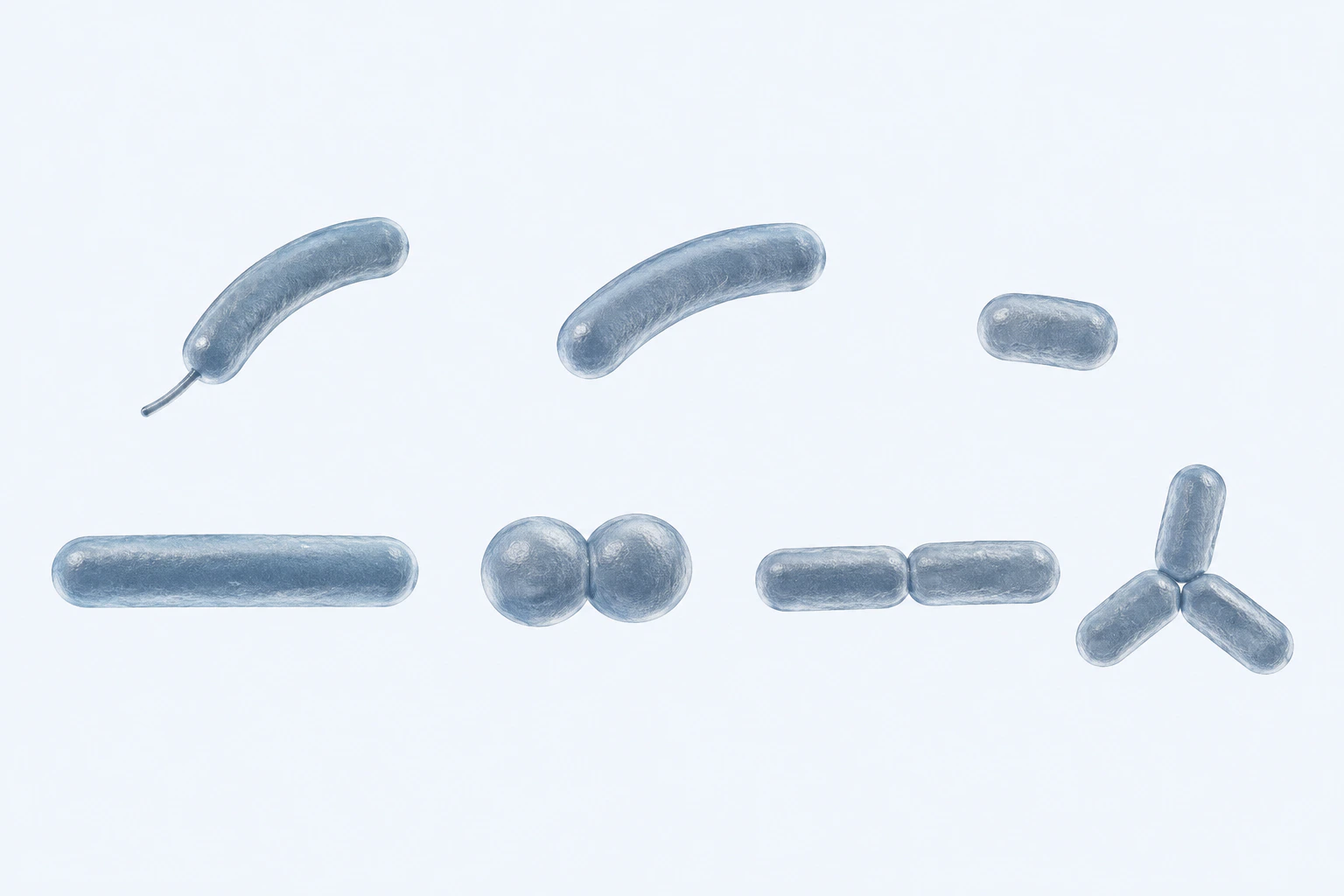
Selected-descendant Pseudomonadota reconstruction on the Proteobacteria route, with eleven cellular bodies in seven groupings and exactly one restrained polar stalk. This phylum plate is non-exhaustive, non-universal, non-diagnostic, and not a micrograph; relative scale is illustrative.
Scientific media record1 verified identifier
- Subject
- Pseudomonadotataxon · phylum
- Identifiers
- NCBITaxon:1224
- Review
- Editorial review completeIdentifiers authority-verified · Accessibility validated · · proteobacteria|proteobacteria-microbial-community-v1.webp
- Digital source
- Trained-algorithmic mediaCreated with a trained generative algorithm and reviewed by WikiBiome for subject identity, scientific framing, identifiers, provenance, and accessibility.
- Scientific basis
- Pseudomonadota — NCBI TaxonomyPseudomonadota — LPSNValid publication of the names of forty-two phyla of prokaryotesPseudomonas aeruginosa — CDC PHIL 10043
- License
- CC BY-SA 4.0Created
Proteobacteria (recently reclassified as Pseudomonadota) is the phylum that signals trouble. In a healthy adult gut, Proteobacteria comprise less than 1% of the community.
When they bloom to 10-50% of the microbiome, it marks a fundamental ecological shift—the collapse of obligate anaerobe dominance and the expansion of facultative aerobes that thrive in the inflamed, oxygenated, metal-rich environment of the dysbiotic gut.
Proteobacteria enrichment is the most consistent microbiome signature across inflammatory and neurodegenerative diseases—more reliable than any single species or the Firmicutes (Bacillota)/Bacteroidetes (Bacteroidota) ratio. This phylum houses the major gut pathobionts (E. coli, Klebsiella, Pseudomonas) and its expansion represents a qualitative ecological state change, not merely a quantitative shift.
Evidence map7 cited passagesInspect provenance +
Facultative aerobiosis: Unlike obligate anaerobe commensals (firmicutes, bacteroidetes), Proteobacteria can respire oxygen. When inflammation disrupts the epithelial barrier and oxygenates the normally anaerobic lumen, Proteobacteria gain a respiratory advantage.
Superior iron acquisition: Proteobacteria encode the most sophisticated siderophores metallophores systems in the gut. When calprotectin and lactoferrin sequester free iron, organisms with high-affinity siderophores (enterobactin Kd ~10^-52 M) outcompete commensals for the remaining iron.
Metal tolerance: Proteobacteria carry dedicated metal resistance genes (cadA for cadmium, arsR for arsenic, merA for mercury) that enable survival under heavy metal stress that kills sensitive commensals.
LPS as inflammatory amplifier: Some proteobacterial LPS structures activate TLR4, driving NF-kB-mediated inflammation that can further oxygenate the lumen and damage the epithelial barrier—a proposed self-reinforcing cycle.
| Metal | Effect on Proteobacteria | Mechanism | |-------|--------------------------|-----------| | Cadmium | Enriched | Cd-resistant strains carry cadA efflux genes; sensitive commensals are eliminated | | Iron excess | Enriched | Siderophore-producing enterobacteriaceae thrive; iron supplementation displaces Lactobacillus | | Zinc deficiency | Enriched | L
A particularly concerning feature: metal resistance genes and antibiotic resistance genes (ARGs) frequently co-locate on the same mobile genetic elements (plasmids, integrative conjugative elements). Proteobacteria enriched by heavy metal exposure carry co-selected ARGs, meaning environmental metal contamination drives antibiotic resistance,. This is the co
| Condition | Proteobacteria Signature | Key Feature | |-----------|--------------------------|------------| | parkinsons disease | Enriched | Most consistent PD signature; LPS biosynthesis genes elevated | | necrotizing enterocolitis | Dominant | Proteobacteria dominance in preterm gut; Ni-fueled urease loop | | IBD / crohns disease / ulcerative colitis | E
Contents
1. Key Genera with WikiBiome Entity Pages2. Why Proteobacteria Bloom in Dysbiosis3. Metal Interactions4. AMR Co-Selection5. Disease Associations6. Ecological Significance7. Cross-ReferencesKey Genera with WikiBiome Entity Pages#
Major Pathobionts#
| Genus/Family | Notable Species | Key Virulence Features |
|---|---|---|
| Escherichia coli | AIEC, UPEC, EHEC strains | Siderophores (enterobactin, yersiniabactin); LPS; iron (Fe)-S enzymes |
| Klebsiella pneumoniae | K. pneumoniae | Capsule; siderophores; carbapenem resistance |
| Pseudomonas aeruginosa | P. aeruginosa | Biofilm; pyoverdine siderophore; MnSOD + copper/zinc superoxide dismutase (Cu/Zn-SOD) |
| Enterobacteriaceae | Family | Shared siderophore systems; LPS; type III secretion |
| Salmonella enterica serovar Typhimurium | S. Typhimurium | SodCI (copper/zinc superoxide dismutase (Cu/Zn-SOD)); intracellular survival |
| Shigella flexneri | S. flexneri | Intracellular invasion; iron acquisition |
| Proteus mirabilis | P. mirabilis | Urease (nickel (Ni)-dependent); urinary stones |
Commensal/Context-Dependent Members#
| Genus | Notable Species | Ecological Role |
|---|---|---|
| Helicobacter pylori | H. pylori | Gastric pathogen; nickel (Ni)-dependent urease |
| Campylobacter jejuni | C. jejuni | Foodborne pathogen; microaerophilic |
| Desulfovibrio | Multiple species | Sulfate reduction; H2S production; iron (Fe)-S dependent |
| Bilophila | B. wadsworthensis | Taurine-derived H2S production; dsrAB iron-S clusters |
| Oxalobacter | O. formigenes | Oxalate degradation; calcium bioavailability |
| Sutterella | S. wadsworthensis | Mucosa-associated; IgA protease |
| Parasutterella | Multiple species | Depleted in multiple conditions |
| Acinetobacter | A. baumannii | Nosocomial pathogen; metal resistance |
| Neisseria Meningitidis | N. meningitidis | Invasive pathogen; MnSOD; calprotectin target |
Why Proteobacteria Bloom in Dysbiosis#
The Proteobacteria bloom is not random—it reflects specific ecological advantages these organisms possess in the inflamed gut:
- Facultative aerobiosis: Unlike obligate anaerobe commensals (Firmicutes (Bacillota), Bacteroidetes (Bacteroidota)), Proteobacteria can respire oxygen. When Metal-Driven Inflammation disrupts the epithelial barrier and oxygenates the normally anaerobic lumen, Proteobacteria gain a respiratory advantage.[1]Sampah & Hackam 2021 — Prenatal Immunity and Pathophysiology of NECSampah MES, Hackam DJ · 2021Open reference 1 ↓
- Superior iron acquisition: Proteobacteria encode the most sophisticated Siderophores and Metallophores systems in the gut. When Calprotectin (S100A8/A9) and Lactoferrin sequester free iron, organisms with high-affinity siderophores (enterobactin Kd ~10^-52 M) outcompete commensals for the remaining iron.[2]Khorsand 2022 — Overrepresentation of Enterobacteriaceae and Escherichia coli is the major gut microbiome signature in Crohn's and UC: comprehensive metagenomic analysis of IBDMDB datasetsBabak Khorsand, Hamid Asadzadeh Aghdaei, Ehsan Nazemalhosseini-Mojarad et al. · 2022Open reference 2 ↓
- Metal tolerance: Proteobacteria carry dedicated metal resistance genes (cadA for cadmium, arsR for arsenic, merA for mercury) that enable survival under heavy metal stress that kills sensitive commensals.[3]Miranda 2022 — Characterization of Metal(loid)s and Antibiotic Resistance in Bacteria of Human Gut Microbiota from CKD SubjectsMaría V. Miranda, Fernanda C. González, Osvaldo S. Paredes-Godoy et al. · 2022Open reference 3 ↓
- LPS as inflammatory amplifier: Some proteobacterial LPS structures activate TLR4, driving NF-kB-mediated inflammation that can further oxygenate the lumen and damage the epithelial barrier—a proposed self-reinforcing cycle.[4]Wang 2024 — Integrated 16S rRNA sequencing and metagenomics insights into microbial dysbiosis and distinct virulence factors in inflammatory bowel diseaseHaijing Wang, Yuanjun Wang, Libin Yang et al. · 2024Open reference 4 ↓
Metal Interactions#
| Metal | Effect on Proteobacteria | Mechanism |
|---|---|---|
| Cadmium | Enriched | cadmium (Cd)-resistant strains carry cadA efflux genes; sensitive commensals are eliminated[5]Heavy Metal Exposure Causes Changes in the Metabolic Health-Associated Gut Microbiome and MetabolitesXuanji Li, Asker Daniel Brejnrod, Madeleine Ernst et al. · 2019Open reference 5 ↓ |
| Iron excess | Enriched | Siderophore-producing Enterobacteriaceae thrive; iron supplementation displaces Lactobacillus |
| Zinc deficiency | Enriched | Low zinc (Zn) increases Proteobacteria + Desulfovibrio[6]Chen 2021 — Effect of Long-Term and Short-Term Imbalanced Zn Manipulation on Gut Microbiota and Screening for Microbial Markers Sensitive to Zinc StatusLingjun Chen, Zhonghang Wang, Peng Wang et al. · 2021Open reference 6 ↓ |
| Nickel | Enriched | Urease-mediated pH increase favors Proteobacteria; enriches Escherichia-Shigella |
| Arsenic/Mercury | Enriched | Selects for metal-resistant pathogenic strains |
| Lead | Decreased | Unusual—opposite direction from most metals |
| Gallium | Therapeutic target | Ga3+ mimics iron(III) (Fe3+), exploiting siderophore uptake to deliver a redox-inactive Trojan horse that poisons iron-dependent enzymes[7]Probiotics functionalized with a gallium-polyphenol network modulate the intratumor microbiota and promote anti-tumor immune responses in pancreatic cancerZi-Yi Han, Zhuang-Jiong Fu, Yu-Zhang Wang et al. · 2024Open reference 7 ↓ |
AMR Co-Selection#
A particularly concerning feature: metal resistance genes and antibiotic resistance genes (ARGs) frequently co-locate on the same mobile genetic elements (plasmids, integrative conjugative elements).
Proteobacteria enriched by heavy metal exposure carry co-selected ARGs, meaning environmental metal contamination drives antibiotic resistance.[8]Airborne antibiotic and metal resistance genes - A neglected potential risk at e-waste recycling facilitiesAgarwal V, Meier B, Schreiner C et al. · 2024Open reference 8 ↓[3]Miranda 2022 — Characterization of Metal(loid)s and Antibiotic Resistance in Bacteria of Human Gut Microbiota from CKD SubjectsMaría V. Miranda, Fernanda C. González, Osvaldo S. Paredes-Godoy et al. · 2022Open reference 3 ↓ This is the Co-Selection mechanism—selecting for metal tolerance simultaneously selects for antibiotic resistance.
Disease Associations#
| Condition | Proteobacteria Signature | Key Feature |
|---|---|---|
| Parkinson's Disease | Enriched | Most consistent PD signature; LPS biosynthesis genes elevated[9]Wallen 2022 -- Metagenomics of Parkinson's Disease Implicates the Gut MicrobiomeZachary D Wallen, Mary B Makarious, Cornelis Blauwendraat et al. · 2022Open reference 9 ↓ |
| Necrotizing Enterocolitis | Dominant | Proteobacteria dominance in preterm gut; nickel (Ni)-fueled urease loop[1]Sampah & Hackam 2021 — Prenatal Immunity and Pathophysiology of NECSampah MES, Hackam DJ · 2021Open reference 1 ↓ |
| IBD / Crohn's Disease / Ulcerative Colitis | Enriched | Enterobacteriaceae enrichment as consistent IBD marker[2]Khorsand 2022 — Overrepresentation of Enterobacteriaceae and Escherichia coli is the major gut microbiome signature in Crohn's and UC: comprehensive metagenomic analysis of IBDMDB datasetsBabak Khorsand, Hamid Asadzadeh Aghdaei, Ehsan Nazemalhosseini-Mojarad et al. · 2022Open reference 2 ↓ |
| Chronic Kidney Disease | Enriched | cadmium (Cd)-resistant Proteobacteria with cadA; indoxyl sulfate production (nephrotoxic)[3]Miranda 2022 — Characterization of Metal(loid)s and Antibiotic Resistance in Bacteria of Human Gut Microbiota from CKD SubjectsMaría V. Miranda, Fernanda C. González, Osvaldo S. Paredes-Godoy et al. · 2022Open reference 3 ↓ |
| Schizophrenia | Enriched | Associated with lead (Pb) and As burden |
| Celiac Disease | Bloom | Proteobacteria expansion during active disease |
| Long COVID | Enriched | LPS production; bacterial translocation to blood |
| Pancreatic Cancer | Intratumoral | Proteobacteria within tumor microenvironment; gallium therapeutic target[7]Probiotics functionalized with a gallium-polyphenol network modulate the intratumor microbiota and promote anti-tumor immune responses in pancreatic cancerZi-Yi Han, Zhuang-Jiong Fu, Yu-Zhang Wang et al. · 2024Open reference 7 ↓ |
| Hashimoto's Thyroiditis | Enriched | Iodine excess shifts microbiota toward Proteobacteria |
Ecological Significance#
Proteobacteria bloom represents a phase transition in gut ecology—not a gradual shift but a tipping point.
In a healthy anaerobic gut, Proteobacteria are kept below 1% by competitive exclusion from abundant SCFA producers. When SCFA production drops (from Firmicutes iron (Fe)-S damage, antibiotic exposure, or dietary changes), Butyrate-fueled colonocyte oxygen consumption decreases. Luminal oxygen rises, favoring facultative aerobes.
Proteobacteria expand, produce LPS, drive inflammation, further oxygenate the lumen. The system locks into a self-reinforcing dysbiotic state.
Breaking this cycle requires restoring the conditions that suppress Proteobacteria: anaerobiosis (via SCFA production), iron restriction (via nutritional immunity support), and competitive exclusion (via Probiotics and dietary fiber).
Cross-References#
- Firmicutes (Bacillota)—Phylum whose SCFA producers are displaced as Proteobacteria bloom
- Bacteroidetes (Bacteroidota)—cobalt (Co)-depleted with Firmicutes in severe Dysbiosis
- Siderophores and Metallophores—Iron acquisition systems that give Proteobacteria competitive advantage
- Co-Selection—Metal resistance and antibiotic resistance co-located
- Antimicrobial Resistance—ARG enrichment in metal-tolerant Proteobacteria
- Iron—Iron excess feeds Proteobacteria; iron restriction suppresses them
- Gallium—Therapeutic iron (Fe) mimic targeting Proteobacteria siderophore uptake
- dysbiosis—Proteobacteria bloom as the most reliable dysbiosis marker
- Nutritional Immunity (Metal Sequestration)—Host iron sequestration affects Proteobacteria-commensal competition
References 10
Numbered by first appearance in the article, then reconciled with its declared source list.
- 1
Sampah MES, Hackam DJ (2021). Sampah & Hackam 2021 — Prenatal Immunity and Pathophysiology of NEC. Frontiers in Immunology.
- 2
Babak Khorsand, Hamid Asadzadeh Aghdaei, Ehsan Nazemalhosseini-Mojarad et al. (2022). Khorsand 2022 — Overrepresentation of Enterobacteriaceae and Escherichia coli is the major gut microbiome signature in Crohn's and UC: comprehensive metagenomic analysis of IBDMDB datasets. Frontiers in Cellular and Infection Microbiology.
- 3
María V. Miranda, Fernanda C. González, Osvaldo S. Paredes-Godoy et al. (2022). Miranda 2022 — Characterization of Metal(loid)s and Antibiotic Resistance in Bacteria of Human Gut Microbiota from CKD Subjects. Biological Research.
- 4
Haijing Wang, Yuanjun Wang, Libin Yang et al. (2024). Wang 2024 — Integrated 16S rRNA sequencing and metagenomics insights into microbial dysbiosis and distinct virulence factors in inflammatory bowel disease. Frontiers in Microbiology.
- 5
Xuanji Li, Asker Daniel Brejnrod, Madeleine Ernst et al. (2019). Heavy Metal Exposure Causes Changes in the Metabolic Health-Associated Gut Microbiome and Metabolites. Environment International.
- 6
Lingjun Chen, Zhonghang Wang, Peng Wang et al. (2021). Chen 2021 — Effect of Long-Term and Short-Term Imbalanced Zn Manipulation on Gut Microbiota and Screening for Microbial Markers Sensitive to Zinc Status. Microbiology Spectrum.
- 7
Zi-Yi Han, Zhuang-Jiong Fu, Yu-Zhang Wang et al. (2024). Probiotics functionalized with a gallium-polyphenol network modulate the intratumor microbiota and promote anti-tumor immune responses in pancreatic cancer. Nature Communications.
- 8
Agarwal V, Meier B, Schreiner C et al. (2024). Airborne antibiotic and metal resistance genes - A neglected potential risk at e-waste recycling facilities. Science of the Total Environment.
- 9
Zachary D Wallen, Mary B Makarious, Cornelis Blauwendraat et al. (2022). Wallen 2022 -- Metagenomics of Parkinson's Disease Implicates the Gut Microbiome. Nature Communications.
- 10
Richardson JB, Dancy BCR, Horton CL et al. (2018). Exposure to toxic metals triggers unique responses from the rat gut microbiota. Scientific Reports.
Article network
Mentioned here 18
Pages linking here 26
Connect the evidence
Publicly readable discussion by ORCID-authenticated researchers. Questions, interpretation, methods, corrections, and new evidence stay attached to this record.
No discussion yet. Start with a precise question or a source-backed observation.
Activity and accepted changes
Accepted researcher context, editorial status, public discussion, and upstream Git revisions are shown together. Pending, declined, and withdrawn proposals remain private.
- published revision
Strengthen TLR4 and link high-leverage contexts
Karen Pendergrass · +1 −1
Inspect exact Git diff ↗ - published revision
Backfill inflammation concept links
Karen Pendergrass · +1 −1
Inspect exact Git diff ↗ - published revision
Complete corpus-wide Dysbiosis linking
Karen Pendergrass · +2 −2
Inspect exact Git diff ↗ - published revision
Fix Urease links in structured tables
Karen Pendergrass · +1 −1
Inspect exact Git diff ↗ - published revision
Complete reviewed Urease contextual coverage
Karen Pendergrass · +2 −2
Inspect exact Git diff ↗ - published revision
massive wiki expansion: 149 stubs fixed, 100+ new pages, Rule 15 scan, keystone papers
WikiBiome Deploy Bot · +40 −40
Inspect exact Git diff ↗ - published revision
pre-overnight checkpoint 2026-04-18
WikiBiome Deploy Bot · +124 −0
Inspect exact Git diff ↗