
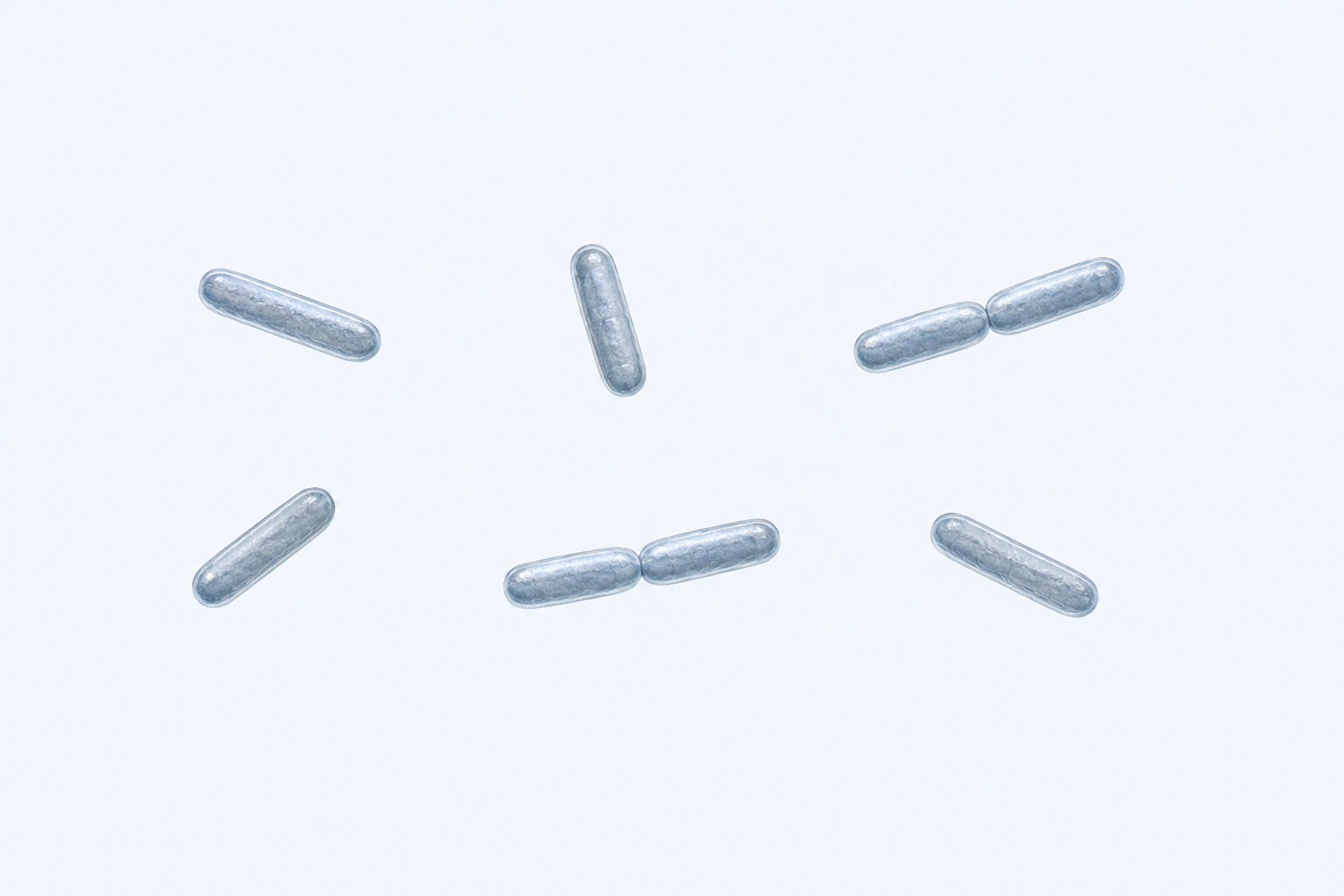
Type-strain-anchored Pseudomonas aeruginosa reconstruction with eight rods in four single and two paired groupings. Appendages are intentionally absent and their omission makes no motility claim; the plate is representative, non-diagnostic, and not a micrograph.
Scientific media record1 verified identifier
- Subject
- Pseudomonas aeruginosataxon · species
- Identifiers
- NCBITaxon:287
- Review
- Editorial review completeIdentifiers authority-verified · Accessibility validated · · pseudomonas-aeruginosa|pseudomonas-aeruginosa-morphology-v1.webp
- Digital source
- Trained-algorithmic mediaCreated with a trained generative algorithm and reviewed by WikiBiome for subject identity, scientific framing, identifiers, provenance, and accessibility.
- Scientific basis
- Pseudomonas aeruginosa — NCBI TaxonomyPseudomonas aeruginosa — LPSNPseudomonas aeruginosa type strain — BacDive
- License
- CC BY-SA 4.0Created
An opportunistic Gram-negative pathogen with a unique dual-use siderophore system: its pyoverdine and pyochelin serve not only as iron scavengers but as extracellular chelators of toxic metals including nickel, copper, and cadmium. This makes P. aeruginosa unusually well-adapted to metal-rich and metal-variable environments, from contaminated wounds to the CF lung.
Evidence map4 cited passagesInspect provenance +
Detoxifies methylglyoxal, a toxic byproduct of glycolysis that accumulates during rapid growth and metabolic stress.
High-affinity iron chelator, but also binds Al3+, Co2+, Cu2+, Eu3+, Ni2+, Pb2+, Tb3+, and Zn2+ extracellularly.
Nicotianamine-like metallophore analogous to staphylopine in staphylococcus aureus.
PAD07 (PVD-/PCH- double mutant): more sensitive to toxic metals and showed higher intracellular metal accumulation than wild type.
Contents
1. Metal-Dependent Virulence Factors2. Metal Acquisition Systems3. Nutritional Immunity Evasion4. Disease Associations5. Connection to Environmental Metal Exposure6. ConnectionsMetal-Dependent Virulence Factors#
Ni-Dependent Glyoxalase I (Ni-GloI)#
Detoxifies methylglyoxal, a toxic byproduct of glycolysis that accumulates during rapid growth and metabolic stress.[1]Role of Nickel in Microbial PathogenesisRobert J. Maier, Stéphane L. Benoit · 2019Open reference 1 ↓
The prokaryotic GloI in P. aeruginosa is nickel (Ni)-dependent (unlike the zinc (Zn)-dependent mammalian form), making it a potential drug target with selectivity over the host enzyme.
Also found in other pathogens (N. meningitidis, Y. pestis, Clostridia), but P. aeruginosa is a key model.
Ni-Acireductone Dioxygenase (ARD)#
Part of the methionine salvage pathway. The nickel (Ni)-bound form produces different products than the iron (Fe)-bound form, giving P. aeruginosa metabolic flexibility depending on metal availability. Found across all pathogenic gamma-proteobacteriaceae.
Fe-Dependent Virulence#
Iron is essential for growth and virulence gene expression. Multiple iron-regulated virulence factors: elastase, exotoxin A, alkaline protease. Pyoverdine itself acts as a signaling molecule: iron (Fe)-pyoverdine binding triggers a signaling cascade (FpvA/FpvR/PvdS) that activates virulence gene expression.
Metal Acquisition Systems#
Pyoverdine (PVD)—Primary Siderophore#
High-affinity iron chelator, but also binds aluminum(III) (Al3+), cobalt(II) (Co2+), copper(II) (Cu2+), Eu3+, nickel(II) (Ni2+), lead(II) (Pb2+), Tb3+, and zinc(II) (Zn2+) extracellularly.[2]Presence of the siderophores pyoverdine and pyochelin in the extracellular medium reduces toxic metal accumulation in Pseudomonas aeruginosa and increases bacterial metal toleranceBraud A, Geoffroy V, Hoegy F et al. · 2010Open reference 2 ↓ Only iron is efficiently imported via the TonB-dependent FpvA pathway; other metals are chelated outside the cell but not taken up.
This extracellular sequestration reduces intracellular accumulation of toxic metals—a defensive strategy.
copper(II) and nickel(II) specifically induce PVD production (290% and 380% increase respectively at 10 uM), suggesting PVD production is a direct response to nickel/copper stress.
Pyochelin (PCH)—Secondary Siderophore#
Chelates aluminum(III) (Al3+), cobalt(II) (Co2+), copper(II) (Cu2+), nickel(II) (Ni2+), lead(II) (Pb2+), and zinc(II) (Zn2+) in addition to iron. PCH is more efficient than PVD at reducing intracellular accumulation of cobalt(II), iron(III) (Fe3+), nickel(II), and zinc(II). Imported via the FptA receptor (iron-loaded only).
Pseudopaline Metallophore#
Nicotianamine-like metallophore analogous to staphylopine in Staphylococcus aureus.[1]Role of Nickel in Microbial PathogenesisRobert J. Maier, Stéphane L. Benoit · 2019Open reference 1 ↓ Primary mechanism for nickel acquisition in chelating (metal-restricted) environments. Exported and reimported as metal-pseudopaline complexes via the CntI/CntO system.
Experimental Evidence: Siderophore-Deficient Mutants#
PAD07 (PVD-/PCH- double mutant): more sensitive to toxic metals and showed higher intracellular metal accumulation than wild type.[2]Presence of the siderophores pyoverdine and pyochelin in the extracellular medium reduces toxic metal accumulation in Pseudomonas aeruginosa and increases bacterial metal toleranceBraud A, Geoffroy V, Hoegy F et al. · 2010Open reference 2 ↓
Adding purified PVD or PCH to siderophore-deficient strains restored metal tolerance. Five metals toxic at 100 uM to the mutant: cobalt(II) (Co2+), copper(II) (Cu2+), Ga3+, nickel(II) (Ni2+), tin(II) (Sn2+).
Nutritional Immunity Evasion#
The dual siderophore system gives P. aeruginosa a two-pronged strategy: acquire iron for growth while simultaneously detoxifying host-deployed metal poisons. Host calprotectin restricts zinc (Zn) and manganese (Mn) at infection sites; pseudopaline counteracts this.
In the CF lung, chronic iron limitation drives PVD/PCH production, which in turn activates virulence gene expression—creating a positive feedback loop between metal scarcity and pathogenicity.
Disease Associations#
- Cystic fibrosis lung infections: chronic colonizer, leading cause of morbidity/mortality in CF
- Ventilator-associated pneumonia
- Burn wound infections: thrives in the metal-rich wound environment
- Chronic wound infections (diabetic ulcers)
- Urinary tract infections (catheter-associated)
- Bacteremia in immunocompromised patients
- Otitis externa (swimmer's ear)
Connection to Environmental Metal Exposure#
P. aeruginosa is ubiquitous in soil, water, and hospital environments where metal contamination is common. Its siderophore-based metal tolerance system means environmental metal pollution selects for more virulent strains (higher PVD/PCH production = more virulence gene activation).
Nickel-contaminated water sources may promote P. aeruginosa populations with enhanced metal tolerance and virulence capacity.
Connections#
- Metal-Dependent Virulence—nickel (Ni)-GloI, nickel-ARD, iron (Fe)-regulated virulence factors
- Nickel—induces PVD production; acquired via pseudopaline; cofactor for GloI and ARD
- Iron—primary target of siderophore system; triggers virulence gene signaling
- Staphylococcus aureus—parallel metallophore strategy (pseudopaline vs. staphylopine)
- Nutritional Immunity (Metal Sequestration)—siderophores counteract host metal restriction
- Helicobacter pylori—both have nickel-dependent enzymes but use completely different acquisition strategies
References 9
Numbered by first appearance in the article, then reconciled with its declared source list.
- 1
★Robert J. Maier, Stéphane L. Benoit (2019). Role of Nickel in Microbial Pathogenesis. Inorganics.
- 2
Braud A, Geoffroy V, Hoegy F et al. (2010). Presence of the siderophores pyoverdine and pyochelin in the extracellular medium reduces toxic metal accumulation in Pseudomonas aeruginosa and increases bacterial metal tolerance. Environmental Microbiology Reports.
- 3
Golden, M., et al. (2024). Golden et al. 2024 — Metal Chelation as Antibacterial Strategy Against Pseudomonas and Acinetobacter. RSC Chemical Biology.
- 4
Srivastava J, Chandra H, Singh N et al. (2016). Understanding the Development of Environmental Resistance Among Microbes: A Review. Clean - Soil, Air, Water.
- 5
Khady O Ouattara, Amanda G Oglesby (2025). Ouattara 2025 — Iron and Peroxide Regulation of the PrrF sRNAs and a Conserved Dps-Like Protein in Pseudomonas aeruginosa and Pseudomonas fluorescens. bioRxiv.
- 6
Bheemanenni et al. (2025). Bheemanenni 2025 — Fibromyalgia and IBS (Systematic Review). Cureus.
- 7
Ning Sun, Yong Chen, Jiaxun Zhang et al. (2023). Identification and characterization of pancreatic infections in severe and critical acute pancreatitis patients using 16S rRNA gene next generation sequencing. Frontiers in Microbiology.
- 8
Karishma Bisht, Moamen M Elmassry, Hafij Al Mahmud et al. (2024). Bisht 2024 — Malonate Is Relevant to the Lung Environment and Induces Genome-Wide Stress Responses in Pseudomonas aeruginosa. Research Square.
- 9
Emma Michetti, Tulasi Abinya Mandava, Valerio Secli et al. (2025). Michetti 2025 — Modelling Host-Pathogen Interactions: Galleria mellonella as a Platform to Study Pseudomonas aeruginosa Response to Host-Imposed Zinc Starvation. Microbiology.
Article network
Mentioned here 6
Pages linking here 28
Connect the evidence
Publicly readable discussion by ORCID-authenticated researchers. Questions, interpretation, methods, corrections, and new evidence stay attached to this record.
No discussion yet. Start with a precise question or a source-backed observation.
Activity and accepted changes
Accepted researcher context, editorial status, public discussion, and upstream Git revisions are shown together. Pending, declined, and withdrawn proposals remain private.
- published revision
massive wiki expansion: 149 stubs fixed, 100+ new pages, Rule 15 scan, keystone papers
WikiBiome Deploy Bot · +30 −24
Inspect exact Git diff ↗ - published revision
nightly maintenance: 94 stub demotions, 181 source_count fixes, 22 auto-discovered stubs, 5 adversarial audits, 3 boundary fixes, 3 evidence-level corrections
WikiBiome Deploy Bot · +3 −0
Inspect exact Git diff ↗ - published revision
wiki: bulk entity upgrades, new article pages, and site regeneration
WikiBiome Deploy Bot · +6 −0
Inspect exact Git diff ↗ - published revision
WikiBiome update — integrity fixes, metallomic diet pages, cross-condition analyses
WikiBiome Deploy Bot · +10 −5
Inspect exact Git diff ↗ - published revision
WikiBiome v7 — interactive microbiome metallomics encyclopedia
Karen Pendergrass · +83 −0
Inspect exact Git diff ↗