
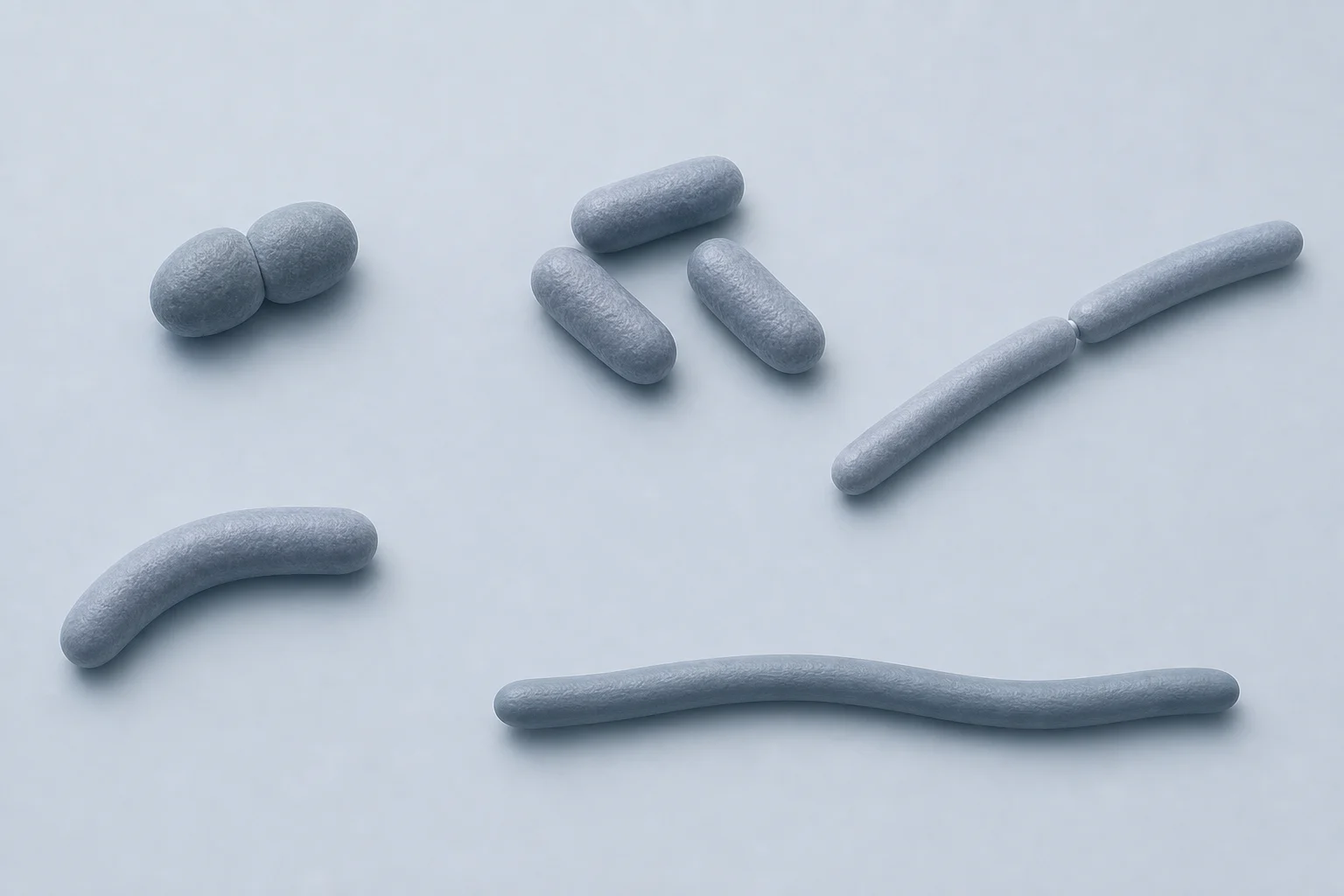
Selected cellular-form breadth within Bacteroidota, historically Bacteroidetes, shown as nine cells in five groupings. The plate is phylum-level, non-exhaustive, non-diagnostic, and not a micrograph.
Scientific media record1 verified identifier
- Subject
- Bacteroidotataxon · phylum
- Identifiers
- NCBITaxon:976
- Review
- Editorial review completeIdentifiers authority-verified · Accessibility validated · · bacteroidetes|bacteroidetes-microbial-community-v1.webp
- Digital source
- Trained-algorithmic mediaCreated with a trained generative algorithm and reviewed by WikiBiome for subject identity, scientific framing, identifiers, provenance, and accessibility.
- Scientific basis
- Bacteroidota — NCBI TaxonomyThe phylum BacteroidetesTaxonomic classification of 1000 microbial genomesValid publication of the phylum name Bacteroidota
- License
- CC BY-SA 4.0Created
Bacteroidetes (recently reclassified as Bacteroidota) is one of the two dominant bacterial phyla in the human gut, together with Firmicutes (Bacillota) typically comprising >90% of the intestinal microbiota. Bacteroidetes are Gram-negative, obligately anaerobic, non-spore-forming rods characterized by their extraordinary capacity for complex polysaccharide degradation.
They encode some of the largest repertoires of carbohydrate-active enzymes (CAZymes) in the Gut Microbiome, enabling them to break down dietary fiber, host mucins, and other glycans that the human genome cannot digest.
The phylum's abundance relative to Firmicutes—the Firmicutes/Bacteroidetes (F/B) ratio—has been one of the most widely reported microbiome metrics in disease research, though its utility is now understood to be limited by the functional diversity within each phylum.
Evidence map1 cited passagesInspect provenance +
| Metal | Effect on Bacteroidetes | Evidence | |-------|------------------------|---------| | Cadmium | Significantly decreased | Cd selects against Bacteroidetes while enriching proteobacteria | | Arsenic | Increased | As exposure increases Bacteroidetes at phylum level | | Mercury | Increased | Hg increases Bacteroidetes | | Nickel | F/B ratio disturbed |
Contents
1. Key Genera with WikiBiome Entity Pages2. Metabolic Roles3. Metal Interactions4. The Firmicutes/Bacteroidetes Ratio5. Ecological Role6. Cross-ReferencesKey Genera with WikiBiome Entity Pages#
| Genus | Notable Species | Primary Function |
|---|---|---|
| Bacteroides fragilis | B. fragilis | Polysaccharide metabolism; BFT toxin producer; zinc (Zn)-dependent metalloprotease |
| Bacteroides thetaiotaomicron | B. thetaiotaomicron | Premier glycan degrader; starch utilization system (Sus) |
| Bacteroides vulgatus | B. vulgatus | Common gut commensal; immunomodulatory |
| Prevotella copri | P. copri | Plant polysaccharide degradation; enriched in plant-based diets |
| Prevotella | Multiple species | Fiber fermentation; oral and gut habitats |
| Alistipes | Multiple species | Bile acid metabolism; tryptophan metabolism |
| Porphyromonas gingivalis | P. gingivalis | Periodontal pathogen; manganese (Mn)-SOD; gingipain proteases |
| Odoribacter | O. splanchnicus | iron (Fe)-S dependent anaerobic fermentation |
| Parabacteroides | P. distasonis | Bile acid deconjugation; anti-inflammatory |
| Butyricimonas | Multiple species | Butyrate production (unusual for Bacteroidetes) |
| Alloprevotella | Multiple species | Oral and gut commensal |
Metabolic Roles#
Polysaccharide Degradation#
Bacteroidetes are the primary degraders of complex carbohydrates in the gut. B. thetaiotaomicron alone encodes over 260 glycoside hydrolases—more than the entire human genome. This enzymatic arsenal enables.
Dietary fiber fermentation (resistant starch, pectin, xylan, arabinoxylan). Host mucin degradation (when dietary fiber is scarce). Release of monosaccharides that cross-feed other community members.
Propionate Production#
Bacteroidetes are the dominant propionate producers in the gut, primarily via the succinate pathway. Propionate has systemic effects including appetite regulation, hepatic gluconeogenesis modulation, and anti-inflammatory signaling.
Bile Acid Metabolism#
Several Bacteroidetes genera (particularly Alistipes and Parabacteroides) participate in bile acid deconjugation and biotransformation, linking this phylum to Bile Acid Metabolism and its downstream effects on metabolic and immune signaling.
Metal Interactions#
Heavy metal exposure differentially affects Bacteroidetes abundance, creating a phylum-level signature that varies by metal:
| Metal | Effect on Bacteroidetes | Evidence |
|---|---|---|
| Cadmium | Significantly decreased | cadmium (Cd) selects against Bacteroidetes while enriching Proteobacteria (Pseudomonadota)[1]Heavy Metal Exposure Causes Changes in the Metabolic Health-Associated Gut Microbiome and MetabolitesXuanji Li, Asker Daniel Brejnrod, Madeleine Ernst et al. · 2019Open reference 1 ↓ |
| Arsenic | Increased | arsenic (As) exposure increases Bacteroidetes at phylum level[1]Heavy Metal Exposure Causes Changes in the Metabolic Health-Associated Gut Microbiome and MetabolitesXuanji Li, Asker Daniel Brejnrod, Madeleine Ernst et al. · 2019Open reference 1 ↓ |
| Mercury | Increased | mercury (Hg) increases Bacteroidetes[2]Toxic and Essential Metals: Metabolic Interactions with the Gut Microbiota and Health ImplicationsQinheng Zhu, Boyan Chen, Fu Zhang et al. · 2024Open reference 2 ↓ |
| Nickel | F/B ratio disturbed | nickel (Ni) disrupts the balance; direction varies by dose[3]The influence of nickel on intestinal microbiota disturbancesSwierc J, Drzymala S, Wozniak D et al. · 2022Open reference 3 ↓ |
| Zinc | Dose-dependent; B:F ratio negatively related to zinc (Zn) dosage (short-term) | High-dose zinc may suppress Bacteroidetes relative to Firmicutes[4]Chen 2021 — Effect of Long-Term and Short-Term Imbalanced Zn Manipulation on Gut Microbiota and Screening for Microbial Markers Sensitive to Zinc StatusLingjun Chen, Zhonghang Wang, Peng Wang et al. · 2021Open reference 4 ↓ |
| Iron | Increased (supplementation) | Iron supplementation increases Bacteroidetes in African children[2]Toxic and Essential Metals: Metabolic Interactions with the Gut Microbiota and Health ImplicationsQinheng Zhu, Boyan Chen, Fu Zhang et al. · 2024Open reference 2 ↓ |
| Lead | Increased (both phyla) | lead (Pb) increases both Firmicutes and Bacteroidetes |
The Firmicutes/Bacteroidetes Ratio#
The F/B ratio was among the first microbiome metrics to gain widespread attention (Ley et al., 2006, linking elevated F/B to obesity). It remains widely reported but is now recognized as overly simplistic—phylum-level changes obscure functionally important genus-level shifts.
| F/B Direction | Conditions |
|---|---|
| Elevated F/B (Bacteroidetes relatively depleted) | Obesity, Endometriosis (stages 3/4), Autism Spectrum Disorder (some cohorts), IBS, hypertension, Hashimoto's Thyroiditis |
| Decreased F/B (Bacteroidetes relatively enriched) | IBD, Graves' Disease, Pancreatic Cancer, antidepressant treatment |
| Both phyla decline | Severe Dysbiosis where Proteobacteria (Pseudomonadota) dominate |
The ratio's clinical utility is limited because a "high F/B" could mean loss of beneficial Bacteroidetes polysaccharide degraders OR gain of pathogenic Firmicutes—two very different ecological situations requiring different interventions.
Ecological Role#
In the healthy gut, Bacteroidetes occupy the mucus-adjacent niche, specializing in complex glycan degradation at the mucus-epithelium interface. Their ecological role includes.
Primary degraders of dietary fiber, producing substrates for cross-feeding networks. Mucin foragers when dietary fiber is scarce—a double-edged sword that can thin the mucus barrier. Competitive exclusion of pathogens through niche occupation and bacteriocin production.
Immune education through capsular polysaccharides (PSA from B. fragilis promotes Treg differentiation).
Cross-References#
- Firmicutes (Bacillota)—Partner phylum in the F/B ratio
- Proteobacteria (Pseudomonadota)—Phylum that expands when both Firmicutes and Bacteroidetes decline
- Short-Chain Fatty Acids (SCFAs)—Bacteroidetes are major propionate producers
- Bile Acid Metabolism—Bacteroidetes genera participate in bile acid biotransformation
- gut microbiome—Bacteroidetes as one of two dominant phyla
- Cadmium—cadmium (Cd) significantly depletes Bacteroidetes
- dysbiosis—F/B ratio as (imperfect) dysbiosis metric
References 10
Numbered by first appearance in the article, then reconciled with its declared source list.
- 1
Xuanji Li, Asker Daniel Brejnrod, Madeleine Ernst et al. (2019). Heavy Metal Exposure Causes Changes in the Metabolic Health-Associated Gut Microbiome and Metabolites. Environment International.
- 2
★Qinheng Zhu, Boyan Chen, Fu Zhang et al. (2024). Toxic and Essential Metals: Metabolic Interactions with the Gut Microbiota and Health Implications. Frontiers in Nutrition.
- 3
Swierc J, Drzymala S, Wozniak D et al. (2022). The influence of nickel on intestinal microbiota disturbances. Pomeranian Journal of Life Sciences.
- 4
Lingjun Chen, Zhonghang Wang, Peng Wang et al. (2021). Chen 2021 — Effect of Long-Term and Short-Term Imbalanced Zn Manipulation on Gut Microbiota and Screening for Microbial Markers Sensitive to Zinc Status. Microbiology Spectrum.
- 5
Ming Yuan, Dong Li, Zhe Zhang et al. (2018). Yuan 2018 — Endometriosis Induces Gut Microbiota Alterations in Mice. Human Reproduction.
- 6
Francesco Strati, Duccio Cavalieri, Davide Albanese et al. (2017). Strati 2017 — New Evidences on the Altered Gut Microbiota in Autism Spectrum Disorders. Microbiome.
- 7
Bao K, Lin H, Guo S (2025). Gut Microbiota and Thyroid Diseases: A Comprehensive Review of Mechanisms and Clinical Implications. X-Disciplinarity.
- 8
Heba M. Ismail, Carmella Evans-Molina (2022). Ismail 2022 — Does the Gut Microbiome Play a Role in Obesity in Type 1 Diabetes? Unanswered Questions and Review. Frontiers in Cellular and Infection Microbiology.
- 9
Wenli Zhou, De Zhang, Zhengpeng Li et al. (2021). The fecal microbiota of patients with pancreatic ductal adenocarcinoma and autoimmune pancreatitis characterized by metagenomic sequencing. Journal of Translational Medicine.
- 10
Yinhui Liu, Xiaobo Song, Huimin Zhou et al. (2018). Gut Microbiome Associates With Lipid-Lowering Effect of Rosuvastatin in Vivo. Frontiers in Microbiology.
Article network
Mentioned here 18
Pages linking here 13
Connect the evidence
Publicly readable discussion by ORCID-authenticated researchers. Questions, interpretation, methods, corrections, and new evidence stay attached to this record.
No discussion yet. Start with a precise question or a source-backed observation.
Activity and accepted changes
Accepted researcher context, editorial status, public discussion, and upstream Git revisions are shown together. Pending, declined, and withdrawn proposals remain private.
- published revision
Backfill gut microbiome concept links
Karen Pendergrass · +2 −2
Inspect exact Git diff ↗ - published revision
Complete corpus-wide Dysbiosis linking
Karen Pendergrass · +2 −2
Inspect exact Git diff ↗ - published revision
massive wiki expansion: 149 stubs fixed, 100+ new pages, Rule 15 scan, keystone papers
WikiBiome Deploy Bot · +29 −29
Inspect exact Git diff ↗ - published revision
pre-overnight checkpoint 2026-04-18
WikiBiome Deploy Bot · +103 −0
Inspect exact Git diff ↗