

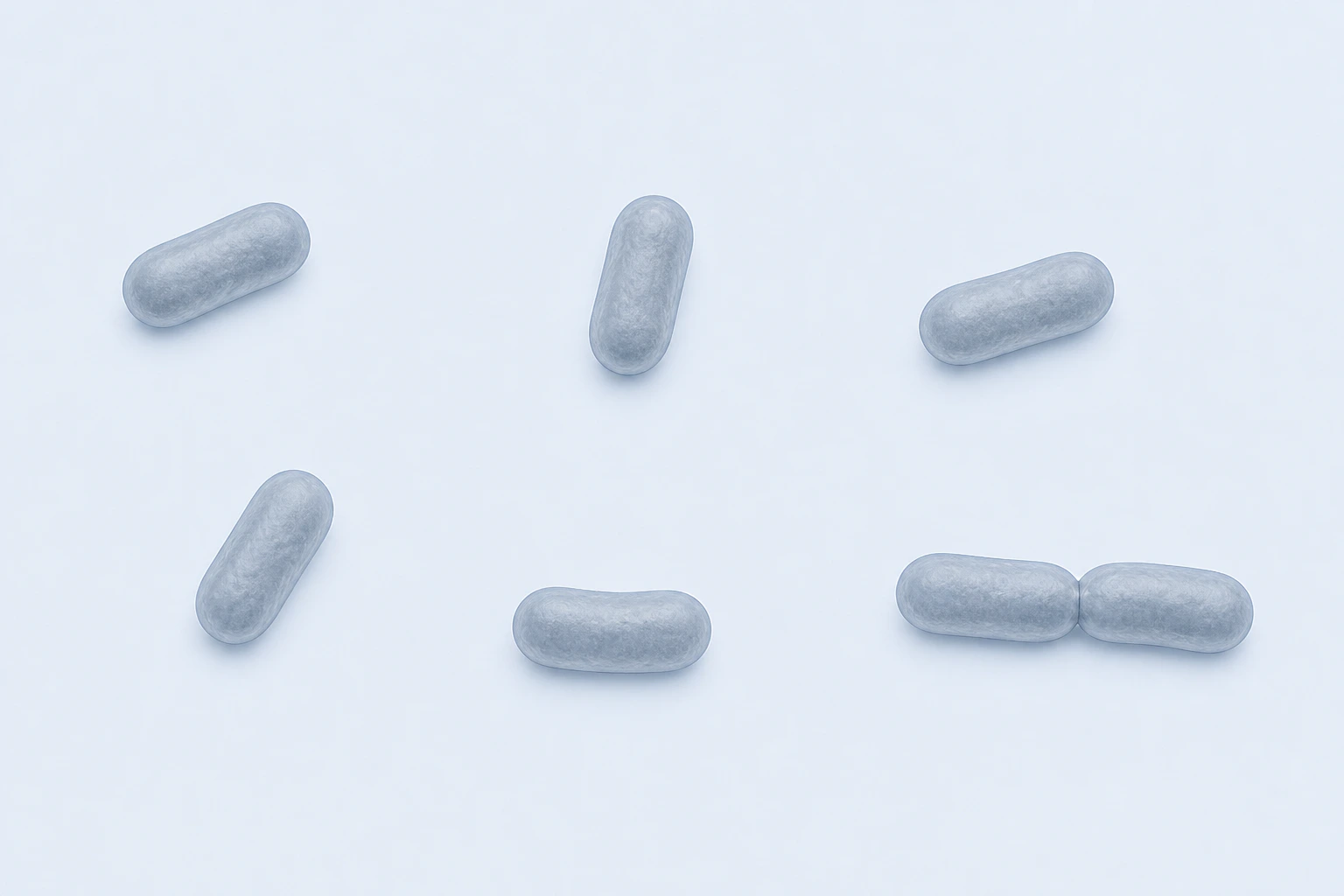
Representative Butyricimonas short-rod morphology, shown as seven bodies in six single or paired groupings. This genus-level reconstruction is non-diagnostic and is not a micrograph.
Scientific media record1 verified identifier
- Subject
- Butyricimonastaxon · genus
- Identifiers
- NCBITaxon:574697
- Review
- Editorial review completeIdentifiers authority-verified · Accessibility validated · · butyricimonas|butyricimonas-morphology-v1.webp
- Digital source
- Trained-algorithmic mediaCreated with a trained generative algorithm and reviewed by WikiBiome for subject identity, scientific framing, identifiers, provenance, and accessibility.
- Scientific basis
- Butyricimonas — NCBI TaxonomyButyricimonas synergistica gen. nov., sp. nov. and Butyricimonas virosa sp. nov.Butyricimonas synergistica type strain — BacDiveButyricimonas virosa type strain — BacDive
- License
- CC BY-SA 4.0Created
A Gram-negative, obligate anaerobic genus within the Bacteroidetes phylum (family Odoribacteraceae). Despite its relatively recent characterization, Butyricimonas has gained significant attention as a member of the protective Butyrate-producing consortium that is consistently depleted in inflammatory and autoimmune conditions. Key species include B. virosa and B. synergistica.
Evidence map8 cited passagesInspect provenance +
Decreased in MS patients in the landmark Jangi 2016 study, which established the foundational MS-microbiome connection.
Butyricimonas abundance showed negative correlations with pro-inflammatory gene expression in circulating T cells and monocytes, including genes involved in dendritic cell maturation, interferon signaling, and nf kappa b signaling.
This is the inverse of the pattern seen with methanobrevibacter and akkermansia muciniphila, which were increased in MS and positively correlated with these inflammatory pathways.
Higher baseline abundance in MS patients reported in the Troci 2022 study (as part of broader Bacteroidetes expansion), illustrating study-to-study variability.
Dietary intake patterns strongly modulate Butyricimonas abundance in MS cohorts, suggesting responsiveness to nutritional interventions.
Abundance altered by antidepressant medications (fluoxetine, amitriptyline), suggesting that drug-microbiome interactions modulate this genus.
Identified among differentially abundant taxa in endometriosis-associated gut microbiome profiles.
MR evidence links Butyricimonas to thyroid disease risk across multiple thyroid conditions.
Contents
1. Role in Gut Ecosystem2. Disease Associations3. Key Metabolites4. Mechanistic Significance in MS5. ConnectionsRole in Gut Ecosystem#
One of the few Bacteroidetes members that produces significant butyrate, placing it in an unusual metabolic niche—most Bacteroidetes produce acetate, propionate, or succinate rather than butyrate.
Butyrate production supports colonocyte energy metabolism, tight junction protein expression, and Treg differentiation via HDAC inhibition and GPR109A signaling. Contributes to colonization resistance as part of the diverse anaerobic community that prevents pathogen expansion. Name derives from "butyric acid" (butyrici-) and "unit" (monas), reflecting its defining metabolic feature.
Disease Associations#
Multiple Sclerosis—Key Depleted Taxon#
Decreased in MS patients in the landmark Jangi 2016 study, which established the foundational MS-microbiome connection.[1]Alterations of the human gut microbiome in multiple sclerosisSushrut Jangi, Roopali Gandhi, Laura M. Cox et al. · 2016Open reference 1 ↓
Butyricimonas abundance showed negative correlations with pro-inflammatory gene expression in circulating T cells and monocytes, including genes involved in dendritic cell maturation, interferon signaling, and NF-kB Signaling Pathway signaling.[1]Alterations of the human gut microbiome in multiple sclerosisSushrut Jangi, Roopali Gandhi, Laura M. Cox et al. · 2016Open reference 1 ↓
This is the inverse of the pattern seen with Methanobrevibacter and Akkermansia muciniphila, which were increased in MS and positively correlated with these inflammatory pathways.[1]Alterations of the human gut microbiome in multiple sclerosisSushrut Jangi, Roopali Gandhi, Laura M. Cox et al. · 2016Open reference 1 ↓
Higher baseline abundance in MS patients reported in the Troci 2022 study (as part of broader Bacteroidetes expansion), illustrating study-to-study variability.[2]B-cell-depletion reverses dysbiosis of the microbiome in multiple sclerosis patientsAlba Troci, Olga Zimmermann, Daniela Esser et al. · 2022Open reference 2 ↓
Dietary intake patterns strongly modulate Butyricimonas abundance in MS cohorts, suggesting responsiveness to nutritional interventions.[3]Feeding the gut microbiome: impact on multiple sclerosisMatteo Bronzini, Alessandro Maglione, Rachele Rosso et al. · 2023Open reference 3 ↓
Antidepressant Response#
- Abundance altered by antidepressant medications (fluoxetine, amitriptyline), suggesting that drug-microbiome interactions modulate this genus.[4]Antidepressants fluoxetine and amitriptyline induce alterations in intestinal microbiota and gut microbiome function in rats exposed to chronic unpredictable mild stressWeijie Zhang, Wan Qu, Hua Wang et al. · 2021Open reference 4 ↓
Endometriosis#
- Identified among differentially abundant taxa in Endometriosis-associated Gut Microbiome profiles.[5]Associations Between Endometriosis and Gut MicrobiotaSvensson A, Brunkwall L, Roth B et al. · 2021Open reference 5 ↓
Thyroid Disease#
- MR evidence links Butyricimonas to thyroid disease risk across multiple thyroid conditions.[6]Uncovering a Causal Connection between Gut Microbiota and Six Thyroid Diseases: A Two-Sample Mendelian Randomization StudyChen J, Wang Y, Yao H et al. · 2024Open reference 6 ↓
Key Metabolites#
- Butyrate—primary product; anti-inflammatory HDAC inhibitor, colonocyte energy source, Treg inducer
- Iso-butyrate—branched-chain fatty acid from protein fermentation
Mechanistic Significance in MS#
The Jangi 2016 findings position Butyricimonas as a key anti-inflammatory species in MS.
Its negative correlation with interferon signaling genes suggests that butyrate from Butyricimonas may suppress the type I IFN response that drives MS pathology. The anti-inflammatory effect parallels that of Faecalibacterium prausnitzii but from within the Bacteroidetes phylum, providing taxonomic diversity in the butyrate-producing consortium.
Loss of Butyricimonas in MS may contribute to the reduced serum butyric acid levels and increased gut permeability documented in MS patients.
Connections#
- Multiple Sclerosis—depleted in MS; negative correlation with inflammatory gene expression
- Faecalibacterium prausnitzii—fellow butyrate producer; complementary anti-inflammatory role from Firmicutes
- Coprococcus—co-depleted butyrate producer in inflammatory disease
- Methanobrevibacter—shows opposite pattern in MS (increased); inflammatory correlations
- Short-Chain Fatty Acids (SCFAs)—butyrate production is its defining metabolic feature
- NF-kB Signaling Pathway—butyrate suppresses NF-kB signaling in immune cells
- Metal-Driven Inflammation—anti-inflammatory via butyrate-mediated HDAC inhibition and Treg induction
- Endometriosis—altered in endometriosis gut microbiome
- Graves' Disease—MR evidence links to thyroid disease risk
- Dysbiosis—depletion marks inflammatory dysbiosis across multiple conditions
References 6
Numbered by first appearance in the article, then reconciled with its declared source list.
- 1
Sushrut Jangi, Roopali Gandhi, Laura M. Cox et al. (2016). Alterations of the human gut microbiome in multiple sclerosis. Nature Communications.
- 2
Alba Troci, Olga Zimmermann, Daniela Esser et al. (2022). B-cell-depletion reverses dysbiosis of the microbiome in multiple sclerosis patients. Scientific Reports.
- 3
Matteo Bronzini, Alessandro Maglione, Rachele Rosso et al. (2023). Feeding the gut microbiome: impact on multiple sclerosis. Frontiers in Immunology.
- 4
Weijie Zhang, Wan Qu, Hua Wang et al. (2021). Antidepressants fluoxetine and amitriptyline induce alterations in intestinal microbiota and gut microbiome function in rats exposed to chronic unpredictable mild stress. Translational Psychiatry.
- 5
Svensson A, Brunkwall L, Roth B et al. (2021). Associations Between Endometriosis and Gut Microbiota. Reproductive Sciences.
- 6
Chen J, Wang Y, Yao H et al. (2024). Uncovering a Causal Connection between Gut Microbiota and Six Thyroid Diseases: A Two-Sample Mendelian Randomization Study. Biology.
Article network
Mentioned here 14
Pages linking here 6
Connect the evidence
Publicly readable discussion by ORCID-authenticated researchers. Questions, interpretation, methods, corrections, and new evidence stay attached to this record.
No discussion yet. Start with a precise question or a source-backed observation.
Activity and accepted changes
Accepted researcher context, editorial status, public discussion, and upstream Git revisions are shown together. Pending, declined, and withdrawn proposals remain private.
- published revision
Backfill gut microbiome concept links
Karen Pendergrass · +1 −1
Inspect exact Git diff ↗ - published revision
Complete Tight junctions contextual coverage
Karen Pendergrass · +1 −1
Inspect exact Git diff ↗ - published revision
massive wiki expansion: 149 stubs fixed, 100+ new pages, Rule 15 scan, keystone papers
WikiBiome Deploy Bot · +5 −5
Inspect exact Git diff ↗ - published revision
nightly maintenance: 94 stub demotions, 181 source_count fixes, 22 auto-discovered stubs, 5 adversarial audits, 3 boundary fixes, 3 evidence-level corrections
WikiBiome Deploy Bot · +1 −0
Inspect exact Git diff ↗ - published revision
Add 11 deepened microbe entities and 9 new OC/CVD/infertility source pages
WikiBiome Deploy Bot · +3 −2
Inspect exact Git diff ↗ - published revision
WikiBiome update — 2026-04-15 17:23
WikiBiome Deploy Bot · +0 −1
Inspect exact Git diff ↗ - published revision
wiki: bulk entity upgrades, new article pages, and site regeneration
WikiBiome Deploy Bot · +6 −0
Inspect exact Git diff ↗ - published revision
WikiBiome update — integrity fixes, metallomic diet pages, cross-condition analyses
WikiBiome Deploy Bot · +15 −8
Inspect exact Git diff ↗ - published revision
WikiBiome update — 2026-04-10 13:49
WikiBiome Deploy Bot · +63 −0
Inspect exact Git diff ↗