
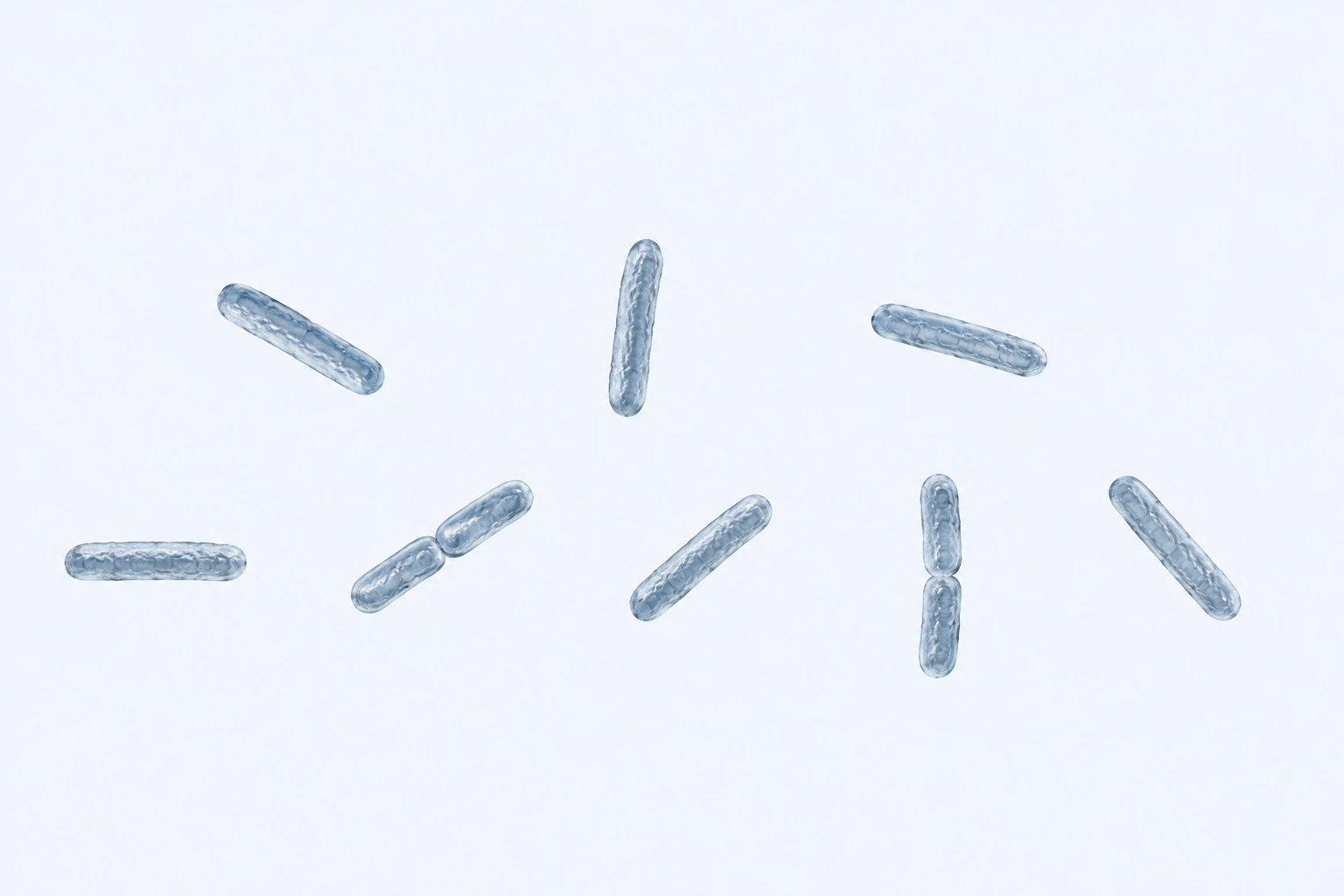
Type-strain-anchored Prevotella copri reconstruction showing ten rods in six single and two paired groupings. LPSN treats Prevotella copri as the correct name while NCBI displays the homotypic Segatella copri under NCBITaxon:165179. This plate is representative, non-diagnostic, and not a micrograph.
Scientific media record1 verified identifier
- Subject
- Prevotella copritaxon · species
- Identifiers
- NCBITaxon:165179
- Review
- Editorial review completeIdentifiers authority-verified · Accessibility validated · · prevotella-copri|prevotella-copri-morphology-v1.webp
- Digital source
- Trained-algorithmic mediaCreated with a trained generative algorithm and reviewed by WikiBiome for subject identity, scientific framing, identifiers, provenance, and accessibility.
- Scientific basis
- NCBITaxon:165179 — NCBI TaxonomyPrevotella copri — LPSNPrevotella copri sp. nov. and Prevotella stercorea sp. nov.
- License
- CC BY-SA 4.0Created
A Gram-negative obligate anaerobe that occupies a unique context-dependent niche in the human Gut Microbiome. P. copri is significantly enriched in Rheumatoid Arthritis patients and is associated with metabolic syndrome and obesity, yet in other contexts it can function as a commensal or even beneficial fiber-degrader.
Its abundance and pathogenic potential are modulated by iron availability and by the presence of other community members—making P. copri a key example of the commensal-pathobiont spectrum.
Contents
1. The Paradox of Prevotella copri2. Iron Acquisition and Metal Dependency3. Carbohydrate Metabolism and Fiber Degradation4. Disease Mechanisms in Rheumatoid Arthritis5. Metabolic Syndrome and Obesity6. Ecological Interactions7. Ecological Modulators8. ConnectionsThe Paradox of Prevotella copri#
Disease Association Context#
Notably enriched in untreated RA patients, particularly those positive for anti-CCP antibodies or rheumatoid factor. RA microbiome signatures show elevated P. copri often alongside elevated iron and depleted Faecalibacterium prausnitzii. In metabolic syndrome and obesity cohorts, P. copri dominance is associated with worse metabolic markers (higher fasting glucose, HOMA-IR, triglycerides).
Yet P. copri is a normal component of healthy gut microbiota in many individuals and populations (particularly high in non-industrialized cohorts).
The Context Dependency#
Pathogenic behavior occurs when P. copri dominates numerically and metabolic conditions favor its expansion (high-carbohydrate/low-fiber diets, iron elevation).
Commensal behavior is observed when P. copri exists at moderate abundance within a diverse community, particularly when Faecalibacterium prausnitzii, Akkermansia muciniphila, and other barrier-protective taxa are abundant.
This suggests that P. copri pathogenicity is dose-dependent and context-dependent, not intrinsic to the species itself.
Iron Acquisition and Metal Dependency#
Iron Specialization#
P. copri expresses robust siderophore-mediated iron acquisition systems and can scavenge heme-iron from lysed cells. Outcompetes less metal-savvy anaerobes under high-iron conditions, making iron availability a key determinant of P. copri prevalence.
In RA microbiome signatures, elevated systemic iron (sometimes reflected in elevated serum ferritin and tissue iron deposition) selects for iron-dependent pathobionts like P. copri.
Iron as a Selective Pressure#
High-iron environments (inflamed joints, dysbiotic gut with barrier breakdown and hemorrhage) create a selective pressure favoring P. copri over fiber-degrading commensals that do not aggressively compete for iron.
This represents a mechanistic link: RA-associated metal dyshomeostasis (elevated iron, depleted zinc) selects for dysbiotic P. copri-dominated communities.
Carbohydrate Metabolism and Fiber Degradation#
Glycoside Hydrolases and CAZymes#
P. copri expresses a large suite of glycoside hydrolases and carbohydrate-active enzymes (CAZymes) for breaking down plant polysaccharides. Can degrade resistant starch, beta-glucans, xylans, and other complex carbohydrates that humans cannot digest.
This is a beneficial function: in a diverse, balanced microbiota, P. copri-mediated fiber degradation produces short-chain fatty acids (primarily acetate and propionate) that benefit the host and feed downstream SCFA producers.
Dysbiotic Context#
In dysbiotic states (high P. copri, low Faecalibacterium prausnitzii), the balance tips: P. copri acetate and propionate may not be efficiently captured by SCFA-producing commensals, leading to.
Acetate overflow → hyperacetylation that can promote Th17 differentiation (pro-inflammatory in RA context). Loss of Butyrate production → reduced short-chain fatty acid diversity and Treg induction.
Disease Mechanisms in Rheumatoid Arthritis#
The RA Microbiome Signature#
The P. copri-dominant Dysbiosis in RA involves. Iron elevation (from bleeding joints and systemic Metal-Driven Inflammation). Zinc depletion (sequestered by Calprotectin (S100A8/A9) in inflamed joints; lost in feces).
Reduced barrier colonizers Faecalibacterium prausnitzii, Akkermansia muciniphila.
Reduced diversity overall, with P. copri as the dominant or co-dominant genus.
Mechanism: Iron-Driven Selection and Epithelial Dysfunction#
High-iron gut environment selects for P. copri, which outcompetes barrier-supportive anaerobes.
Loss of Faecalibacterium prausnitzii and other butyrogenic commensals → reduced butyrate production → loss of HDAC inhibition → reduced histone acetylation → downregulation of tight junction genes.
Barrier breakdown increases intestinal permeability, allowing increased LPS translocation and systemic endotoxemia.
Systemic endotoxemia (LPS + bacterial lipoteichoic acids) drives TLR4/TLR2 signaling on immune cells, promoting Th17 differentiation and anti-microbial Th1 responses—both pathogenic in RA.
T cell and B cell responses to P. copri antigens (oral tolerance loss) may contribute to RA initiation or progression.
Metabolic Syndrome and Obesity#
P. copri dominance is associated with insulin resistance and metabolic dysbiosis. Proposed mechanisms. Hyperacetylation (from unopposed P. copri acetate production) promotes lipogenesis and glucose intolerance.
Loss of butyrate → loss of GPR43/GPR41 signaling and IL-22 induction → compromised intestinal barrier and systemic inflammation. P. copri-derived lipopolysaccharide (LPS) as a chronic metabolic endotoxemia driver.
Ecological Interactions#
Synergistic Pathogenic Partnerships#
P. copri is often enriched alongside Prevotella intermedia, Bacteroides vulgatus, and Fusobacterium nucleatum in dysbiotic states. These species together form a coordinated dysbiotic community that. Competes aggressively for limiting metals (iron, zinc).
Collectively degrade barrier proteins and tight junction scaffolding. Overwhelm local nutritional immunity via sheer biomass and shared metabolic burden.
Sensitivity to Diversity#
Introduction of Faecalibacterium prausnitzii or supplementation with inulin (prebiotic promoting butyrate producers) can reduce P. copri relative abundance, even without targeting P. copri directly.
This suggests that P. copri dominance is not due to intrinsic fitness, but to the absence of competitors in dysbiotic microbiota.
Ecological Modulators#
Prebiotic Strategy#
Promoting butyrate-producing commensals through fermentable substrates (inulin, acacia, partially hydrolyzed guar gum) shifts ecological balance away from P. copri dominance while restoring barrier function.
This operates through competitive exclusion rather than direct killing: restoring ecological diversity returns P. copri to commensal abundance levels.
Metal Modulation#
Zinc repletion: Restoring zinc availability supports barrier-protective taxa and reduces the iron-driven selective pressure that favors P. copri expansion. Iron restriction: Reducing bioavailable luminal iron removes a key growth advantage for P. copri in dysbiotic, iron-enriched environments.
Context-Dependent Ecology#
- In diverse, high-fiber microbiomes, elevated P. copri reflects commensal function rather than pathobiont behavior. The ecological context—particularly competitor diversity and metal availability—determines whether P. copri abundance is adaptive or dysbiotic.
Connections#
- Iron—iron-dependent; high-iron environments select for P. copri dominance
- Zinc—zinc depletion in RA allows P. copri expansion via loss of competitive barrier-protective taxa
- Rheumatoid Arthritis—enriched in RA microbiome; iron elevation and zinc depletion are selective pressures
- Faecalibacterium prausnitzii—co-depleted with P. copri elevation in dysbiotic RA
- Metabolic Syndrome and Metal Exposure—P. copri dominance associated with insulin resistance and obesity
- Short-Chain Fatty Acids (SCFAs)—P. copri produces acetate and propionate; dysbiotic overflow leads to pro-inflammatory Th17 promotion
- nutritional immunity—P. copri dysbiosis correlates with reduced butyrate-driven tight junction maintenance
- prototype organism showing context-dependent behavior
- dysbiosis—dominance defines dysbiotic state in RA and metabolic syndrome
References 6
Numbered by first appearance in the article, then reconciled with its declared source list.
- 1
Tiffany L Weir, Daniel K Manter, Amy M Sheflin et al. (2013). Stool Microbiome and Metabolome Differences between Colorectal Cancer Patients and Healthy Adults. PLoS ONE.
- 2
Georgina Quaranta, Mauro Pittiruti, Brunella Posteraro et al. (2019). Quaranta 2019 — FMT as a Potential Tool for Female Reproductive Tract Diseases (Review). Frontiers in Immunology.
- 3
Shuya Lv, Jingrong Huang, Yadan Luo et al. (2024). Lv 2024 — Gut Microbiota Is Involved in Male Reproductive Function: A Review. Frontiers in Microbiology.
- 4
Fiona C. Ross, Dhrati Patangia, Ghjuvan Grimaud et al. (2024). The interplay between diet and the gut microbiome: implications for health and disease. Nature Reviews Microbiology.
- 5
Dagar S, Singh J, Saini A et al. (2023). Gut Bacteriome, Mycobiome and Virome Alterations in Rheumatoid Arthritis. Frontiers in Endocrinology.
- 6
Luyun Fan, Junru Chen, Qi Zhang et al. (2025). Fecal microbiota transplantation for hypertension: an exploratory, multicenter, randomized, blinded, placebo-controlled trial. Microbiome.
Article network
Mentioned here 18
Pages linking here 10
Connect the evidence
Publicly readable discussion by ORCID-authenticated researchers. Questions, interpretation, methods, corrections, and new evidence stay attached to this record.
No discussion yet. Start with a precise question or a source-backed observation.
Activity and accepted changes
Accepted researcher context, editorial status, public discussion, and upstream Git revisions are shown together. Pending, declined, and withdrawn proposals remain private.
- published revision
Backfill gut microbiome concept links
Karen Pendergrass · +1 −1
Inspect exact Git diff ↗ - published revision
Backfill inflammation concept links
Karen Pendergrass · +1 −1
Inspect exact Git diff ↗ - published revision
Complete corpus-wide Dysbiosis linking
Karen Pendergrass · +2 −2
Inspect exact Git diff ↗ - published revision
Complete Tight junctions contextual coverage
Karen Pendergrass · +1 −1
Inspect exact Git diff ↗ - published revision
Add Interleukin-22 concept and contextual links
Karen Pendergrass · +1 −1
Inspect exact Git diff ↗ - published revision
massive wiki expansion: 149 stubs fixed, 100+ new pages, Rule 15 scan, keystone papers
WikiBiome Deploy Bot · +26 −22
Inspect exact Git diff ↗ - published revision
nightly maintenance: 94 stub demotions, 181 source_count fixes, 22 auto-discovered stubs, 5 adversarial audits, 3 boundary fixes, 3 evidence-level corrections
WikiBiome Deploy Bot · +3 −0
Inspect exact Git diff ↗ - published revision
Citation integrity pass: 38 citations added, 24 parenthesized citations fixed
WikiBiome Deploy Bot · +1 −1
Inspect exact Git diff ↗ - published revision
Adversarial audit fixes: confidence downgrades, disclaimers, STOP safety, entity cleanup
WikiBiome Deploy Bot · +7 −7
Inspect exact Git diff ↗ - published revision
WikiBiome update — 2026-04-15 17:23
WikiBiome Deploy Bot · +10 −10
Inspect exact Git diff ↗ - published revision
wiki: bulk entity upgrades, new article pages, and site regeneration
WikiBiome Deploy Bot · +6 −0
Inspect exact Git diff ↗ - published revision
WikiBiome update — integrity fixes, metallomic diet pages, cross-condition analyses
WikiBiome Deploy Bot · +3 −1
Inspect exact Git diff ↗ - published revision
WikiBiome update — 2026-04-10 17:16
WikiBiome Deploy Bot · +129 −0
Inspect exact Git diff ↗