

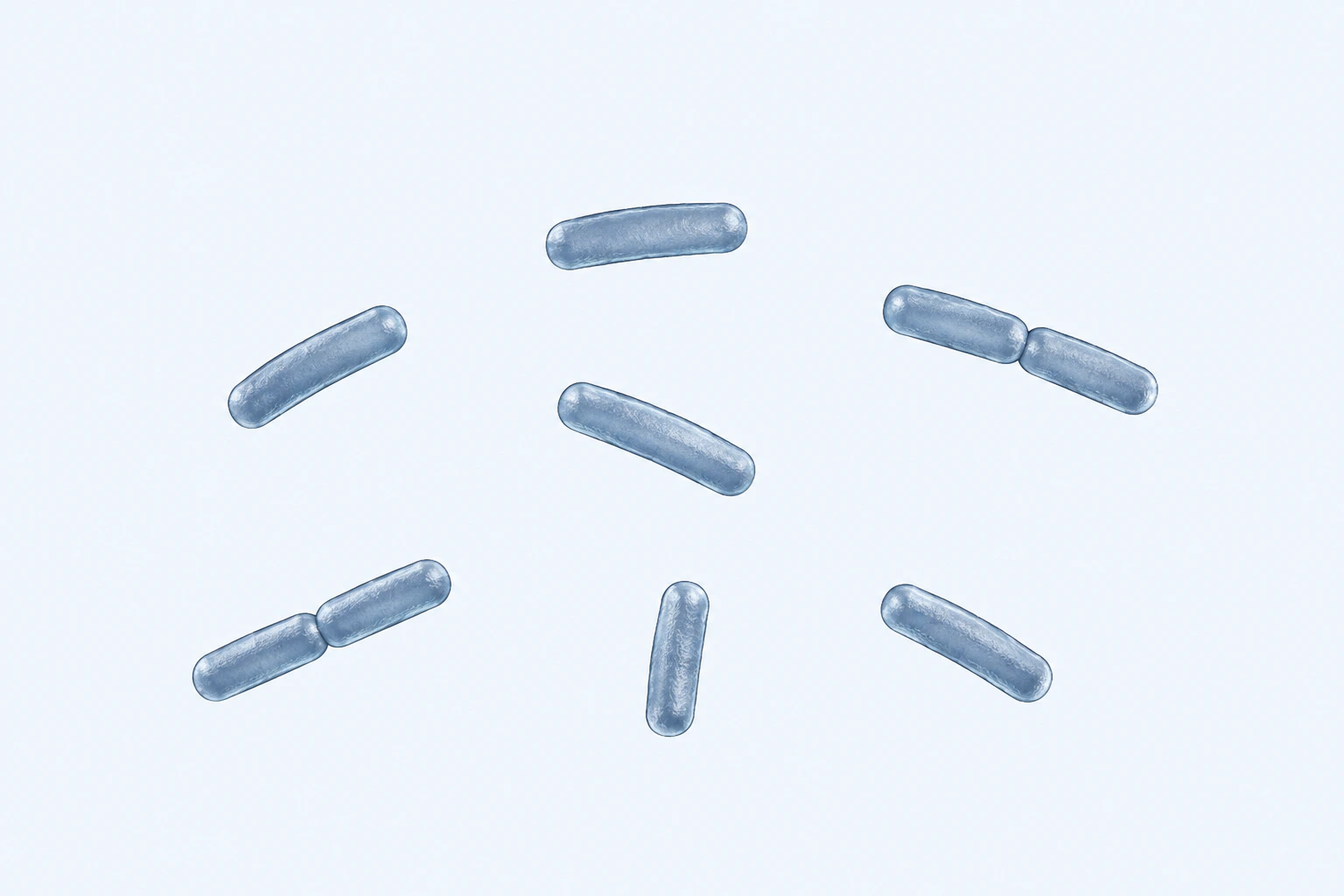
Type-strain-anchored Prevotella intermedia reconstruction showing nine rods in five single and two paired groupings. This species plate is representative, non-diagnostic, does not claim visual separability from related species, and is not a micrograph.
Scientific media record1 verified identifier
- Subject
- Prevotella intermediataxon · species
- Identifiers
- NCBITaxon:28131
- Review
- Editorial review completeIdentifiers authority-verified · Accessibility validated · · prevotella-intermedia|prevotella-intermedia-morphology-v1.webp
- Digital source
- Trained-algorithmic mediaCreated with a trained generative algorithm and reviewed by WikiBiome for subject identity, scientific framing, identifiers, provenance, and accessibility.
- Scientific basis
- Prevotella intermedia — NCBI TaxonomyPrevotella intermedia — LPSNConfirmation of the species Prevotella intermedia and Prevotella nigrescensPrevotella intermedia type strain — BacDive
- License
- CC BY-SA 4.0Created
A Gram-negative, obligately anaerobic, black-pigmented bacterium and one of the classical periodontopathogens.
P. intermedia belongs to the "orange complex" of periodontal pathogens (Socransky classification) and is distinguished by its iron and heme dependency—the characteristic black pigmentation of its colonies results from the accumulation of iron protoporphyrin IX (hemin) on the cell surface.
This metal sequestration strategy is both a virulence mechanism and a potential therapeutic vulnerability.
Unlike gut-associated Prevotella species (such as P. copri, which may be protective in some contexts), P. intermedia is primarily an oral pathobiont whose enrichment in disease states reflects disrupted oral-gut axis ecology.
Evidence map11 cited passagesInspect provenance +
Iron in the form of hemin is essential for P. intermedia growth and virulence. The organism actively acquires heme from host hemoglobin and stores it on its cell surface as the black pigment mu-oxo bisheme, creating a visible biomarker of iron acquisition (, cross-sectional). This surface iron deposit serves multiple functions:
In a cross-sectional study of adolescents with cerebral palsy, P. intermedia was detected alongside other periodontopathogens, with significant quantitative differences between control groups with and without gingivitis (, cross-sectional, n=65). The neurologically impaired population showed elevated periodontal pathogen burdens, likely due to compromised or
P. intermedia is increasingly recognized beyond its oral niche. In multiple sclerosis, oral P. intermedia is enriched alongside P. dentalis and P. buccalis as part of a broader shift toward pathogenic Gram-negative taxa and away from protective Gram-positive early colonizers (, case-control, n=100). This oral dysbiosis pattern parallels but differs from gut
P. intermedia is among the CRC-enriched species identified through multi-omic profiling (metagenomics + exome sequencing + transcriptomics) of matched tumor and stool samples (, cross-sectional, n=41). A systematic review also identified oral P. intermedia as consistently associated with CRC risk through serum antibody studies (, systematic-review-meta-analy
Multiple sclerosis—Enriched in the oral microbiome of relapsing-remitting MS patients (, case-control)
Colorectal cancer—Enriched in CRC tissue and associated with CRC risk via serum antibodies (, cross-sectional;, systematic-review)
Cerebral palsy—Elevated in neurologically impaired adolescents with gingivitis (, cross-sectional)
(cross-sectional, n=65)—First q-PCR quantification of P. intermedia in saliva of cerebral palsy adolescents; documents elevated periodontopathogens in neurologically impaired population.
(case-control, n=100)—Oral P. intermedia enriched in MS as part of Gram-negative pathobiont expansion; depleted protective early colonizers.
(systematic-review-meta-analysis)—Identifies P. intermedia antibody levels as consistently associated with CRC risk across populations.
(cross-sectional, n=41)—Multi-omic confirmation of P. intermedia enrichment in CRC tissue samples.
Contents
1. Metal Dependencies2. Key Enzymes and Virulence Factors3. Ecological Role4. Conditions Associated5. Key Studies6. Cross-ReferencesMetal Dependencies#
Iron and Heme: The Defining Dependency#
Iron in the form of hemin is essential for P. intermedia growth and virulence. The organism actively acquires heme from host hemoglobin and stores it on its cell surface as the black pigment mu-oxo bisheme, creating a visible biomarker of iron acquisition (,[1]Yoshida 2023 — Detection and Quantification of Pathogens in Saliva of Adolescents With Cerebral Palsy: A Cross-Sectional StudyRosemeire Arai Yoshida, Tiago Bertola Lobato, Renata Gorjão et al. · 2023Open reference 1 ↓ cross-sectional).
This surface iron deposit serves multiple functions. Iron reservoir—Stored hemin provides iron under conditions of host iron restriction. Oxidative Stress defense—Heme catalases and peroxidases protect against host-generated reactive oxygen species. Tissue destruction—Heme-dependent proteases degrade periodontal connective tissue.
The iron dependency of P. intermedia connects it to the broader Nutritional Immunity (Metal Sequestration) framework: host iron-sequestering proteins like Lactoferrin in saliva and gingival crevicular fluid directly compete with bacterial heme acquisition.
Key Enzymes and Virulence Factors#
| Factor | Function |
|---|---|
| Heme-binding proteins | Surface hemin acquisition and storage (black pigment) |
| Hemolysins | Red blood cell lysis for hemoglobin release |
| Proteases | Collagen and tissue degradation in periodontal pockets |
| Lipopolysaccharide | Potent inflammatory stimulus; contributes to bone resorption |
| Capsule | Immune evasion; resistance to phagocytosis |
Ecological Role#
In the Oral Cavity#
P. intermedia colonizes the subgingival sulcus, where it forms part of polymicrobial biofilms with other periodontopathogens including Porphyromonas gingivalis and Fusobacterium nucleatum. Fusobacterium serves as a critical "bridge" organism, co-aggregating with both early colonizers (streptococci) and late colonizers like P. intermedia, facilitating biofilm maturation.
In a cross-sectional study of adolescents with cerebral palsy, P. intermedia was detected alongside other periodontopathogens, with significant quantitative differences between control groups with and without gingivitis (,[1]Yoshida 2023 — Detection and Quantification of Pathogens in Saliva of Adolescents With Cerebral Palsy: A Cross-Sectional StudyRosemeire Arai Yoshida, Tiago Bertola Lobato, Renata Gorjão et al. · 2023Open reference 1 ↓ cross-sectional, n=65).
The neurologically impaired population showed elevated periodontal pathogen burdens, likely due to compromised oral hygiene and altered salivary function.
Oral-Gut Axis#
P. intermedia is increasingly recognized beyond its oral niche. In multiple sclerosis, oral P. intermedia is enriched alongside P. dentalis and P. buccalis as part of a broader shift toward pathogenic Gram-negative taxa and away from protective Gram-positive early colonizers (,[2]Multiple Sclerosis Patients Exhibit Oral Dysbiosis with Decreased Early Colonizers and Lower Hypotaurine LevelRachel L. Fitzjerrells, Leeann Aguilar Meza, Meeta Yadav et al. · 2025Open reference 2 ↓ case-control, n=100).
This oral Dysbiosis pattern parallels but differs from gut dysbiosis in MS, suggesting distinct but interconnected microbial disruption along the oral-gut axis.
In Colorectal Cancer#
P. intermedia is among the CRC-enriched species identified through multi-omic profiling (metagenomics + exome sequencing + transcriptomics) of matched tumor and stool samples (,[3]Multi-omic profiling reveals associations between the gut microbiome, host genome and transcriptome in patients with colorectal cancerShaomin Zou, Chao Yang, Jieping Zhang et al. · 2024Open reference 3 ↓ cross-sectional, n=41).
A systematic review also identified oral P. intermedia as consistently associated with CRC risk through serum antibody studies (,[4]A Systematic Review of Microbial Markers for Risk Prediction of Colorectal NeoplasiaYu L, Zhao G, Wang L et al. · 2022Open reference 4 ↓ systematic-review-meta-analysis).
Conditions Associated#
Periodontal disease—Classical orange complex periodontopathogen; enriched in gingivitis and periodontitis. Multiple sclerosis—Enriched in the oral microbiome of relapsing-remitting MS patients (,[2]Multiple Sclerosis Patients Exhibit Oral Dysbiosis with Decreased Early Colonizers and Lower Hypotaurine LevelRachel L. Fitzjerrells, Leeann Aguilar Meza, Meeta Yadav et al. · 2025Open reference 2 ↓ case-control).
Colorectal cancer—Enriched in CRC tissue and associated with CRC risk via serum antibodies (,[3]Multi-omic profiling reveals associations between the gut microbiome, host genome and transcriptome in patients with colorectal cancerShaomin Zou, Chao Yang, Jieping Zhang et al. · 2024Open reference 3 ↓ cross-sectional;,[4]A Systematic Review of Microbial Markers for Risk Prediction of Colorectal NeoplasiaYu L, Zhao G, Wang L et al. · 2022Open reference 4 ↓ systematic-review).
Cerebral palsy—Elevated in neurologically impaired adolescents with gingivitis (,[1]Yoshida 2023 — Detection and Quantification of Pathogens in Saliva of Adolescents With Cerebral Palsy: A Cross-Sectional StudyRosemeire Arai Yoshida, Tiago Bertola Lobato, Renata Gorjão et al. · 2023Open reference 1 ↓ cross-sectional).
Key Studies#
[1]Yoshida 2023 — Detection and Quantification of Pathogens in Saliva of Adolescents With Cerebral Palsy: A Cross-Sectional StudyRosemeire Arai Yoshida, Tiago Bertola Lobato, Renata Gorjão et al. · 2023Open reference 1 ↓ (cross-sectional, n=65)—First q-PCR quantification of P. intermedia in saliva of cerebral palsy adolescents; documents elevated periodontopathogens in neurologically impaired population.
[2]Multiple Sclerosis Patients Exhibit Oral Dysbiosis with Decreased Early Colonizers and Lower Hypotaurine LevelRachel L. Fitzjerrells, Leeann Aguilar Meza, Meeta Yadav et al. · 2025Open reference 2 ↓ (case-control, n=100)—Oral P. intermedia enriched in MS as part of Gram-negative pathobiont expansion; depleted protective early colonizers.
[4]A Systematic Review of Microbial Markers for Risk Prediction of Colorectal NeoplasiaYu L, Zhao G, Wang L et al. · 2022Open reference 4 ↓ (systematic-review-meta-analysis)—Identifies P. intermedia antibody levels as consistently associated with CRC risk across populations.[3]Multi-omic profiling reveals associations between the gut microbiome, host genome and transcriptome in patients with colorectal cancerShaomin Zou, Chao Yang, Jieping Zhang et al. · 2024Open reference 3 ↓ (cross-sectional, n=41)—Multi-omic confirmation of P. intermedia enrichment in CRC tissue samples.
Cross-References#
- Prevotella—Genus-level page; note that gut Prevotella species may have protective roles distinct from P. intermedia
- Iron—Essential growth requirement; heme acquisition drives pigmentation and virulence
- Porphyromonas gingivalis—cobalt (Co)-pathogen in periodontal biofilms; shares heme dependency
- Fusobacterium nucleatum—Bridge organism enabling P. intermedia biofilm integration
- Oral Microbiome—Primary habitat; disease-specific enrichment patterns
- Multiple Sclerosis—Oral enrichment as part of Gram-negative pathobiont shift
- Colorectal Cancer—CRC-associated via both tissue enrichment and serum antibodies
- Nutritional Immunity (Metal Sequestration)—Host iron restriction as counter-strategy to heme-dependent pathogens
References 4
Numbered by first appearance in the article, then reconciled with its declared source list.
- 1
Rosemeire Arai Yoshida, Tiago Bertola Lobato, Renata Gorjão et al. (2023). Yoshida 2023 — Detection and Quantification of Pathogens in Saliva of Adolescents With Cerebral Palsy: A Cross-Sectional Study. Frontiers in Dental Medicine.
- 2
Rachel L. Fitzjerrells, Leeann Aguilar Meza, Meeta Yadav et al. (2025). Multiple Sclerosis Patients Exhibit Oral Dysbiosis with Decreased Early Colonizers and Lower Hypotaurine Level. npj Biofilms and Microbiomes.
- 3
Shaomin Zou, Chao Yang, Jieping Zhang et al. (2024). Multi-omic profiling reveals associations between the gut microbiome, host genome and transcriptome in patients with colorectal cancer. Journal of Translational Medicine.
- 4
Yu L, Zhao G, Wang L et al. (2022). A Systematic Review of Microbial Markers for Risk Prediction of Colorectal Neoplasia. British Journal of Cancer.
Article network
Connect the evidence
Publicly readable discussion by ORCID-authenticated researchers. Questions, interpretation, methods, corrections, and new evidence stay attached to this record.
No discussion yet. Start with a precise question or a source-backed observation.
Activity and accepted changes
Accepted researcher context, editorial status, public discussion, and upstream Git revisions are shown together. Pending, declined, and withdrawn proposals remain private.
- published revision
Backfill oxidative stress concept links
Karen Pendergrass · +1 −1
Inspect exact Git diff ↗ - published revision
Complete corpus-wide Dysbiosis linking
Karen Pendergrass · +1 −1
Inspect exact Git diff ↗ - published revision
massive wiki expansion: 149 stubs fixed, 100+ new pages, Rule 15 scan, keystone papers
WikiBiome Deploy Bot · +12 −12
Inspect exact Git diff ↗ - published revision
pre-overnight checkpoint 2026-04-18
WikiBiome Deploy Bot · +90 −0
Inspect exact Git diff ↗