
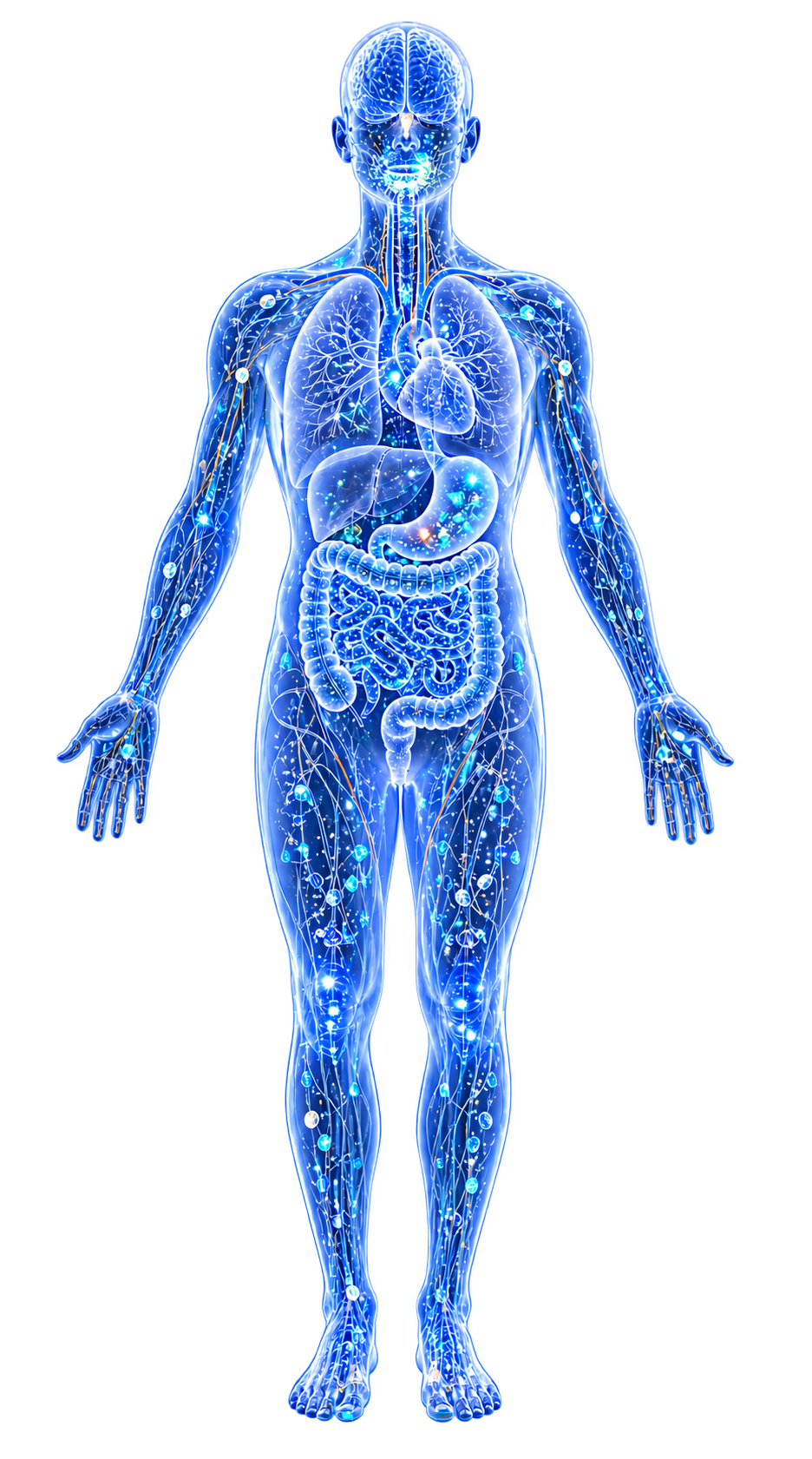
Oxalobacter formigenes is an obligate anaerobic, Gram-negative bacterium that occupies a unique metabolic niche in the human gut as the primary oxalate-degrading specialist.
Its loss from the gut microbiome—most commonly from antibiotic exposure—has cascading consequences for calcium oxalate metabolism, metal bioavailability, kidney health, and potentially cardiovascular function.
Evidence map6 cited passagesInspect provenance +
Calcium: Ca2+-oxalate forms insoluble calcium oxalate crystals (kidney stones at supersaturation; reduced calcium absorption at lower concentrations). O. formigenes degrades the oxalate, freeing calcium from this complex and improving calcium bioavailability.
Lead and cadmium: Oxalate can also chelate toxic metals. The role of O. formigenes in modulating toxic metal bioavailability—whether its oxalate degradation increases or decreases toxic metal absorption—is context-dependent.
Genetically predicted higher Oxalobacter abundance: OR = 1.08 for coronary heart disease; independently confirmed in (OR = 1.06, P = 1.67×10⁻⁴) and (OR = 1.059).
The Oxalobacteraceae family (which includes O. formigenes) was identified as a protective factor for ADHD in Mendelian randomization analysis. Higher Oxalobacteraceae abundance was associated with reduced ADHD risk (P = 0.048), adding a neurological dimension to this primarily metabolic organism's disease associations.
In the systematic meta-analysis of opposing microbiome signatures, Oxalobacter was among six genera showing true opposite directionality: increased in cancer cohorts but decreased in autoimmune disease studies.
Oxalate can chelate and immobilize cadmium and lead in the gut lumen, potentially reducing toxic metal absorption.
Contents
1. Taxonomy and Metabolic Specialization2. Oxalate Degradation Enzymes3. Oxalate-Metal Interactions: The Metal Bioavailability Connection4. Kidney Stone Prevention and CKD5. Antibiotic Vulnerability and Ecological Loss6. Cardiovascular Disease Associations7. ADHD: Protective Family Association8. Cancer vs. Autoimmune Directionality9. Heavy Metal Detoxification Context10. Cross-ReferencesTaxonomy and Metabolic Specialization#
Family Oxalobacteraceae, order Burkholderiales, class Betaproteobacteria. Two groups: Group I (originally described) and Group II; both colonize the human intestine, primarily the colon.
Unique metabolic niche: obligate oxalotroph—oxalate is its sole carbon and energy source. This extreme specialization means O. formigenes cannot survive without dietary oxalate, and cannot be easily replaced by other bacteria if lost.
No other common human gut bacterium relies exclusively on oxalate; functional redundancy for this role is minimal, making O. formigenes loss ecologically irreplaceable in the short term.
Oxalate Degradation Enzymes#
The oxalate catabolism pathway involves three enzymes, all requiring metal cofactors:
Oxalate-CoA ligase (OxcA / formyl-CoA transferase). Activates oxalate to oxalyl-CoA using CoA and ATP; requires magnesium as cofactor for the ATP-dependent activation step. The magnesium(II) (Mg2+) requirement links O. formigenes activity to magnesium availability—in magnesium-depleted states (common in dysbiosis), this activation step may be rate-limiting.
Oxalyl-CoA decarboxylase (OXC). Converts oxalyl-CoA to formyl-CoA + CO2; requires thiamine pyrophosphate (TPP) as cofactor, and TPP synthesis itself requires magnesium. This is the energy-generating step—decarboxylation drives proton motive force through an oxalate/formate antiporter that creates membrane potential.
Formyl-CoA transferase. Completes the cycle by regenerating CoA from formate. The net result: oxalate → formate + CO2, with energy captured via the antiporter.
The formate generated is either secreted (contributing to the gut formate pool available to other microbes) or further oxidized to CO2. The overall reaction consumes oxalate while contributing to the gut's volatile fatty acid and one-carbon metabolite landscape.
Oxalate-Metal Interactions: The Metal Bioavailability Connection#
Oxalate is a powerful chelator of divalent metal cations. Its presence in the gut lumen profoundly affects metal bioavailability through insoluble complex formation.
Calcium: Ca2+-oxalate forms insoluble calcium oxalate crystals (kidney stones at supersaturation; reduced calcium absorption at lower concentrations). O. formigenes degrades the oxalate, freeing calcium from this complex and improving calcium bioavailability.[1]Gut Microbiota: A Target for Heavy Metal Toxicity and a Probiotic Protective StrategyHui Duan, Leilei Yu, Fengwei Tian et al. · 2020Open reference 1 ↓
Iron: iron(II) (Fe2+)/Fe3+-oxalate complexes are less bioavailable than free iron. O. formigenes oxalate degradation thus partially increases iron bioavailability—a consideration in iron deficiency states where dietary oxalate (spinach, legumes) is often simultaneously elevated.
Zinc: Zn2+-oxalate complexes form readily; zinc deficiency from high-oxalate diets is partially mediated through this chelation mechanism. O. formigenes loss would exacerbate zinc depletion from oxalate-rich diets.
Magnesium: Mg2+-oxalate complexes reduce magnesium absorption. This creates a feedback loop: loss of O. formigenes → increased gut oxalate → reduced magnesium absorption → impaired O. formigenes enzyme activity (which requires magnesium(II) (Mg2+)).
Lead and cadmium: Oxalate can also chelate toxic metals. The role of O. formigenes in modulating toxic metal bioavailability—whether its oxalate degradation increases or decreases toxic metal absorption—is context-dependent.[2]Potential Application of Living Microorganisms in the Detoxification of Heavy MetalsRunqiu Chen, Huaijun Tu, Tingtao Chen · 2022Open reference 2 ↓
This positions O. formigenes at the intersection of dietary mineral absorption, kidney stone prevention, and the broader gut-metal-microbiome axis.
Kidney Stone Prevention and CKD#
O. formigenes is the primary gut defense against dietary oxalate overload. By degrading oxalate in the colon, it reduces the pool available for intestinal absorption and subsequent urinary excretion.
Hyperoxaluria (elevated urinary oxalate) is the primary risk factor for recurrent calcium oxalate kidney stones—the most common stone type (80% of all nephrolithiasis).
Absence of O. formigenes is associated with 70% higher odds of recurrent kidney stones in clinical studies. In Chronic Kidney Disease, oxalate nephropathy (crystal deposition in renal tubules) contributes to progressive renal damage; O. formigenes depletion accelerates this pathway.
An O. formigenes probiotic (OXPF-001 / OxThera) has been in clinical development for primary hyperoxaluria—a rare but severe inherited form characterized by extreme urinary oxalate levels.
Antibiotic Vulnerability and Ecological Loss#
O. formigenes is strikingly sensitive to broad-spectrum antibiotic courses. A single course of amoxicillin, tetracycline, or fluoroquinolones can eliminate O. formigenes from the colon.
Recolonization after antibiotic loss is poor: the combination of obligate anaerobic status, narrow metabolic niche (requires oxalate substrate), and absence of spore formation means O. formigenes cannot re-establish easily.
In Western populations with high antibiotic use, carriage rates of O. formigenes are significantly lower than in pre-antibiotic-era populations or in communities with low antibiotic exposure.
Its oxalate-dependent metabolism makes it a poor competitor during post-antibiotic microbiome recovery, when carbohydrate fermenters with broader metabolic repertoires dominate the recolonization wave.
Cardiovascular Disease Associations#
Mendelian randomization studies have identified a causal positive association between Oxalobacter abundance and coronary heart disease risk.
Genetically predicted higher Oxalobacter abundance: OR = 1.08 for coronary heart disease;[3]Gut Microbiota and Risk of Coronary Heart Disease: A Two-Sample Mendelian Randomization StudyXiang-zhi Hu, Ling-ling Fu, Bin Ye et al. · 2024Open reference 3 ↓ independently confirmed in[4]Causal associations between gut microbiome and cardiovascular disease: A Mendelian randomization studyYuxuan Zhang, Xinyi Zhang, Delong Chen et al. · 2022Open reference 4 ↓ (OR = 1.06, P = 1.67×10⁻⁴) and[5]Assessment of the causal relationship between gut microbiota and cardiovascular diseases: a bidirectional Mendelian randomization analysisXiao-Ce Dai, Yi Yu, Si-Yu Zhou et al. · 2024Open reference 5 ↓ (OR = 1.059).
The blood pressure mediation of this association is particularly notable: the CHD risk appears to operate via blood pressure rather than direct lipid effects, suggesting that oxalate metabolism may influence vascular tone through calcium and magnesium handling—or through formate production affecting methylation and endothelial function.
Consistency across three independent MR studies increases confidence that this is a genuine causal relationship, not a chance finding.
The apparent paradox—O. formigenes protects from kidney stones but is a CHD risk factor—may reflect that oxalate degradation and the metabolic products generated (formate, CO2, altered calcium flux) have beneficial local effects in the colon but subtly adverse systemic effects on vascular biology.
ADHD: Protective Family Association#
The Oxalobacteraceae family (which includes O. formigenes) was identified as a protective factor for ADHD in Mendelian randomization analysis.[6]Wang 2023 — Two-Sample Mendelian Randomization Analysis Investigates Causal Associations Between Gut Microbiota and ADHDLei Wang, Zhihao Xie, Guoliang Li et al. · 2023Open reference 6 ↓ Higher Oxalobacteraceae abundance was associated with reduced ADHD risk (P = 0.048), adding a neurological dimension to this primarily metabolic organism's disease associations.
Cancer vs. Autoimmune Directionality#
In the systematic meta-analysis of opposing microbiome signatures, Oxalobacter was among six genera showing true opposite directionality: increased in cancer cohorts but decreased in autoimmune disease studies.[7]Reproducible and opposing gut microbiome signatures distinguish autoimmune diseases and cancers: a systematic review and meta-analysisMd Zohorul Islam, Melissa Tran, Tao Xu et al. · 2022Open reference 7 ↓
This pattern may reflect divergent immunological environments. In cancer (immunosuppression): oxalate degradation and calcium availability in the tumor microenvironment may support tumor growth pathways; immune suppression permits O. formigenes expansion.
In autoimmune disease (immune hyperactivation): the pro-inflammatory environment may deplete O. formigenes; alternatively, low oxalate bioavailability from O. formigenes activity may alter the calcium-driven T cell activation threshold.
Heavy Metal Detoxification Context#
O. formigenes oxalate metabolism intersects with gut-based heavy metal detoxification. Oxalate can chelate and immobilize cadmium and lead in the gut lumen, potentially reducing toxic metal absorption.[2]Potential Application of Living Microorganisms in the Detoxification of Heavy MetalsRunqiu Chen, Huaijun Tu, Tingtao Chen · 2022Open reference 2 ↓
When O. formigenes degrades oxalate, it may reduce this metal-chelating capacity—a subtle consideration in populations with concurrent antibiotic use and toxic metal exposure.
Conversely, the formate produced can contribute to the gut reducing environment that supports the activity of metal-detoxifying bacteria.
Cross-References#
- Chronic Kidney Disease—Oxalate degradation prevents calcium oxalate nephropathy and urinary oxalate supersaturation
- Cardiovascular Disease—MR evidence links Oxalobacter to CHD risk via blood pressure mediation
- Iron—Oxalate-iron chelation affects dietary iron bioavailability
- Calcium—Primary target of oxalate chelation; kidney stone formation
- Magnesium—Required as cofactor for oxalyl-CoA ligase; depleted by oxalate chelation
- Dysbiosis—Antibiotic-induced loss of Oxalobacter has lasting metabolic consequences
- Heavy Metals—Oxalate chelation capacity intersects with cadmium and lead detoxification
- Probiotics—O. formigenes supplementation under clinical investigation for hyperoxaluria
- Short-Chain Fatty Acids (SCFAs)—Formate production from oxalate contributes to gut metabolite pool
References 7
Numbered by first appearance in the article, then reconciled with its declared source list.
- 1
★Hui Duan, Leilei Yu, Fengwei Tian et al. (2020). Gut Microbiota: A Target for Heavy Metal Toxicity and a Probiotic Protective Strategy. Science of the Total Environment.
- 2
Runqiu Chen, Huaijun Tu, Tingtao Chen (2022). Potential Application of Living Microorganisms in the Detoxification of Heavy Metals. Foods.
- 3
Xiang-zhi Hu, Ling-ling Fu, Bin Ye et al. (2024). Gut Microbiota and Risk of Coronary Heart Disease: A Two-Sample Mendelian Randomization Study. Frontiers in Cardiovascular Medicine.
- 4
Yuxuan Zhang, Xinyi Zhang, Delong Chen et al. (2022). Causal associations between gut microbiome and cardiovascular disease: A Mendelian randomization study. Frontiers in Cardiovascular Medicine.
- 5
Xiao-Ce Dai, Yi Yu, Si-Yu Zhou et al. (2024). Assessment of the causal relationship between gut microbiota and cardiovascular diseases: a bidirectional Mendelian randomization analysis. BioData Mining.
- 6
Lei Wang, Zhihao Xie, Guoliang Li et al. (2023). Wang 2023 — Two-Sample Mendelian Randomization Analysis Investigates Causal Associations Between Gut Microbiota and ADHD. Frontiers in Microbiology.
- 7
Md Zohorul Islam, Melissa Tran, Tao Xu et al. (2022). Reproducible and opposing gut microbiome signatures distinguish autoimmune diseases and cancers: a systematic review and meta-analysis. Microbiome.
Article network
Connect the evidence
Publicly readable discussion by ORCID-authenticated researchers. Questions, interpretation, methods, corrections, and new evidence stay attached to this record.
No discussion yet. Start with a precise question or a source-backed observation.
Activity and accepted changes
Accepted researcher context, editorial status, public discussion, and upstream Git revisions are shown together. Pending, declined, and withdrawn proposals remain private.
- published revision
massive wiki expansion: 149 stubs fixed, 100+ new pages, Rule 15 scan, keystone papers
WikiBiome Deploy Bot · +19 −19
Inspect exact Git diff ↗ - published revision
pre-overnight checkpoint 2026-04-18
WikiBiome Deploy Bot · +1 −3
Inspect exact Git diff ↗ - published revision
Batch: fix 1025 broken wikilinks, wire 13 STOP pages, deepen PPD/GERD/T1D/8 microbes
WikiBiome Deploy Bot · +92 −37
Inspect exact Git diff ↗ - published revision
WikiBiome update — 2026-04-15 17:23
WikiBiome Deploy Bot · +3 −4
Inspect exact Git diff ↗ - published revision
wiki: bulk entity upgrades, new article pages, and site regeneration
WikiBiome Deploy Bot · +6 −0
Inspect exact Git diff ↗ - published revision
WikiBiome update — integrity fixes, metallomic diet pages, cross-condition analyses
WikiBiome Deploy Bot · +14 −7
Inspect exact Git diff ↗ - published revision
WikiBiome update — 2026-04-10 13:49
WikiBiome Deploy Bot · +55 −0
Inspect exact Git diff ↗