

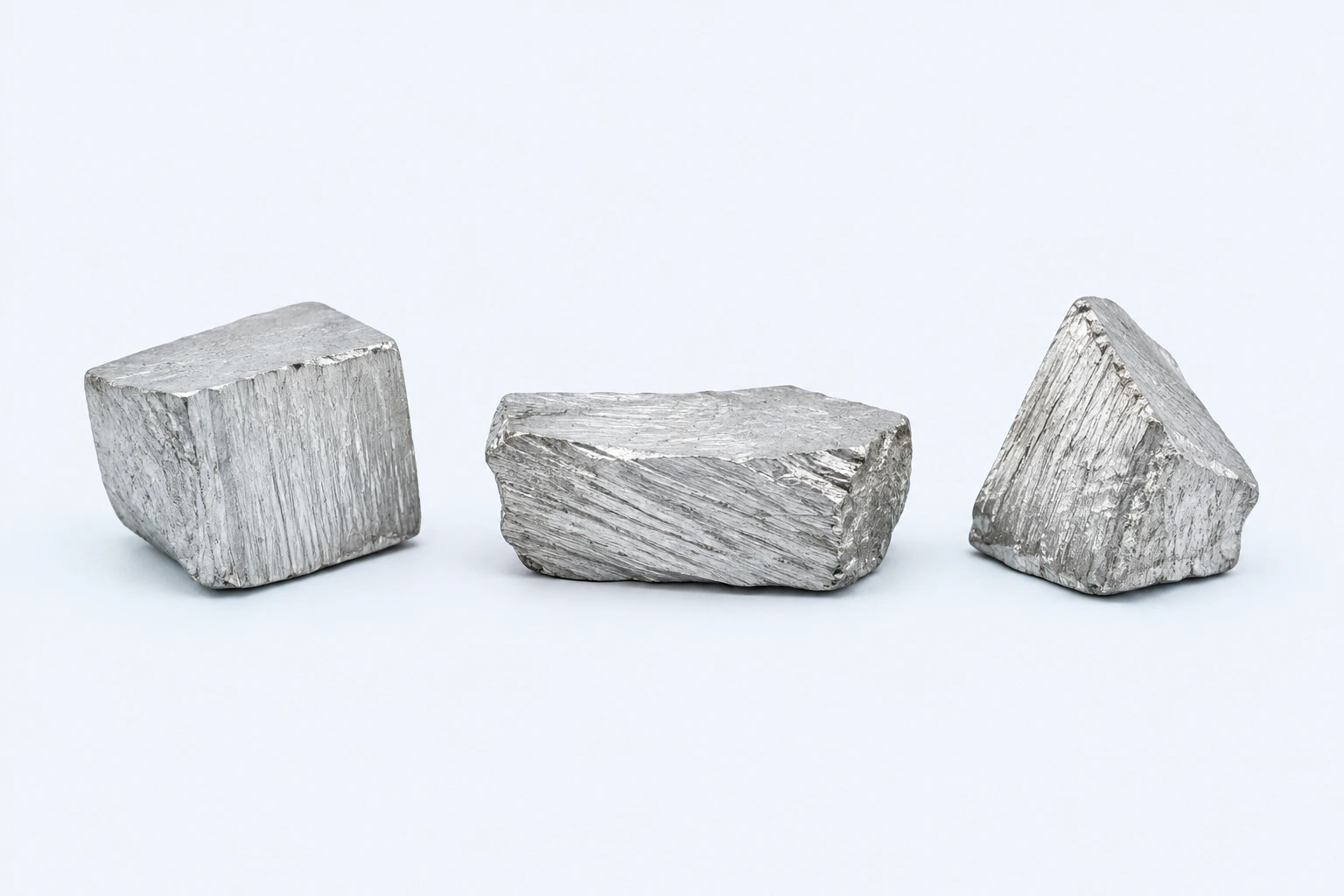
Elemental magnesium (Mg), shown as three representative pale silvery cut specimens. Form and surface vary with purity, processing, and oxidation; this is not a supplement, analytical reference material, or a photograph.
Scientific media record2 verified identifiers
- Subject
- Magnesiumelement
- Identifiers
- Atomic number 12PubChem CID:5462224
- Review
- Editorial review completeIdentifiers authority-verified · Accessibility validated · · magnesium|magnesium-technical-specimen-v1.webp
- Digital source
- Trained-algorithmic mediaCreated with a trained generative algorithm and reviewed by WikiBiome for subject identity, scientific framing, identifiers, provenance, and accessibility.
- Scientific basis
- Magnesium — PubChem ElementMagnesium, PubChem CID 5462224
- License
- CC BY-SA 4.0Created
An essential macromineral required as a cofactor for over 300 enzymatic reactions in the body, including energy metabolism, protein synthesis, DNA/RNA stability, and neuromuscular function.
Magnesium is not a heavy metal or trace element but is frequently measured alongside them in metallomics studies because of its importance in metabolic and reproductive health. It appears in this wiki primarily through its roles in Polycystic Ovary Syndrome, thyroid autoimmunity, and postpartum depression research.
Evidence map14 cited passagesInspect provenance +
Women with PCOS consumed significantly less Mg (238.9 vs 273.9 mg/day) than controls despite similar caloric intake.
Mg intake negatively correlated with insulin resistance (HOMA-IR), CRP, and testosterone; positively correlated with HDL.
Mg supplementation in PCOS women reduced weight, BMI, waist circumference, and TNF-alpha.
Supplementation with Zn, Cr, Se, Mg, and Ca shows potential benefits for reducing oxidative stress and improving endocrine parameters in PCOS.
Low serum Mg is associated with increased risk of TgAb positivity, hashimotos thyroiditis, and hypothyroidism (OR = 4.482-4.971 for lowest Mg group).
Mg exhibits immunomodulating effects through NF-kB, IL-6, and TNF-alpha regulation and is important for mTOR pathway regulation.
Mg supplementation may improve thyroid function, though evidence is less robust than for selenium.
In the PERSIAN Birth Cohort study (n=224), no significant association was found between maternal serum Mg levels (measured at 38 weeks gestation) and postpartum depression risk (OR: 0.29, 95% CI: 0.04-1.77).
Mean Mg was similar between depressed (1.91 mg/dL) and non-depressed (1.97 mg/dL) mothers.
This null finding may reflect that Mg levels within the normal range are not a risk factor; deficiency rather than sufficiency may be the relevant threshold.
Contrasts with, which found roles for multiple trace elements in PPD pathophysiology.
Mg deficiency is prevalent in T2DM and associated with impaired insulin signaling; Mg is required for tyrosine kinase activity of the insulin receptor.
Lead follows ionic mechanisms similar to Ca2+, Mg2+, and Fe2+, meaning Pb can displace Mg from binding sites.
Mg is frequently co-measured with toxic metals in PCOS studies, where it is typically low while heavy metals are elevated.
Contents
1. Chemical Properties2. Sources of Exposure3. Health Effects4. Interactions with Heavy Metals5. ConnectionsChemical Properties#
Alkaline earth metal (Group 2); exists exclusively as magnesium(II) (Mg2+) in biological systems. Fourth most abundant cation in the body; ~60% stored in bone, ~39% intracellular, ~1% extracellular. Normal serum range: 1.7-2.2 mg/dL.
Cofactor for ATP-dependent enzymes (magnesium-ATP is the actual substrate for kinases), DNA/RNA polymerases, and ion channels.
Sources of Exposure#
Dietary#
Green leafy vegetables, nuts, seeds, legumes, whole grains, dark chocolate. Dietary intake is often suboptimal in Western populations; estimated 50% of US adults consume less than the EAR.
Supplementation#
Common forms: magnesium oxide, citrate, glycinate, taurate, threonate. Supplementation studied in PCOS, thyroid disease, and mood disorders.
Health Effects#
PCOS and Insulin Resistance#
Magnesium deficiency is consistently associated with metabolic features of PCOS.
Women with PCOS consumed significantly less magnesium (Mg) (238.9 vs 273.9 mg/day) than controls despite similar caloric intake.[1]Low intakes of dietary fiber and magnesium are associated with insulin resistance and hyperandrogenism in polycystic ovary syndrome: A cohort studyCutler DA, Pride SM, Cheung AP · 2019Open reference 1 ↓ magnesium intake negatively correlated with insulin resistance (HOMA-IR), CRP, and testosterone; positively correlated with HDL.[1]Low intakes of dietary fiber and magnesium are associated with insulin resistance and hyperandrogenism in polycystic ovary syndrome: A cohort studyCutler DA, Pride SM, Cheung AP · 2019Open reference 1 ↓
magnesium supplementation in PCOS women reduced weight, BMI, waist circumference, and TNF-alpha.[2]Heavy Metals and Essential Elements in Association with Oxidative Stress in Women with Polycystic Ovary Syndrome -- A Systematic ReviewSmovrsnik T, Virant-Klun I, Pinter B · 2023Open reference 2 ↓
Supplementation with zinc (Zn), chromium (Cr), selenium (Se), magnesium, and calcium (Ca) shows potential benefits for reducing Oxidative Stress and improving endocrine parameters in PCOS.[2]Heavy Metals and Essential Elements in Association with Oxidative Stress in Women with Polycystic Ovary Syndrome -- A Systematic ReviewSmovrsnik T, Virant-Klun I, Pinter B · 2023Open reference 2 ↓
Thyroid Autoimmunity#
Low serum magnesium (Mg) is associated with increased risk of TgAb positivity, Hashimoto's Thyroiditis, and hypothyroidism (OR = 4.482-4.971 for lowest magnesium group).[3]Kravchenko 2023 — Thyroid hormones and minerals in immunocorrection of disorders in autoimmune thyroid diseasesKravchenko V, Zakharchenko T · 2023Open reference 3 ↓
magnesium exhibits immunomodulating effects through NF-kB, IL-6, and TNF-alpha regulation and is important for mTOR pathway regulation.[3]Kravchenko 2023 — Thyroid hormones and minerals in immunocorrection of disorders in autoimmune thyroid diseasesKravchenko V, Zakharchenko T · 2023Open reference 3 ↓ magnesium supplementation may improve thyroid function, though evidence is less robust than for Selenium.[3]Kravchenko 2023 — Thyroid hormones and minerals in immunocorrection of disorders in autoimmune thyroid diseasesKravchenko V, Zakharchenko T · 2023Open reference 3 ↓
Postpartum Depression#
In the PERSIAN Birth Cohort study (n=224), no significant association was found between maternal serum magnesium (Mg) levels (measured at 38 weeks gestation) and postpartum depression risk (OR: 0.29, 95% CI: 0.04-1.77).[4]Association of Postpartum Depression with Maternal Serum Magnesium Levels, Infant Growth, and Neurodevelopmental IndicesPourmirzaiee MA, Daniali S, Riahi R et al. · 2024Open reference 4 ↓
Mean magnesium was similar between depressed (1.91 mg/dL) and non-depressed (1.97 mg/dL) mothers.[4]Association of Postpartum Depression with Maternal Serum Magnesium Levels, Infant Growth, and Neurodevelopmental IndicesPourmirzaiee MA, Daniali S, Riahi R et al. · 2024Open reference 4 ↓
This null finding may reflect that magnesium levels within the normal range are not a risk factor; deficiency rather than sufficiency may be the relevant threshold.[4]Association of Postpartum Depression with Maternal Serum Magnesium Levels, Infant Growth, and Neurodevelopmental IndicesPourmirzaiee MA, Daniali S, Riahi R et al. · 2024Open reference 4 ↓
Contrasts with,[5]Postpartum Depression and Role of Serum Trace ElementsEtebary S, Nikseresht S, Sadeghipour HR et al. · 2010Open reference 5 ↓ which found roles for multiple trace elements in PPD pathophysiology.
Dysmenorrhea#
- Investigated alongside other minerals in studies of menstrual pain; mechanistically linked through smooth muscle relaxation and prostaglandin modulation.
Type 2 Diabetes#
- magnesium (Mg) deficiency is prevalent in T2DM and associated with impaired insulin signaling; magnesium is required for tyrosine kinase activity of the insulin receptor.[6]Metals in the pathogenesis of type 2 diabetesAbdul Rehman Khan, Fazli Rabbi Awan · 2014Open reference 6 ↓
Interactions with Heavy Metals#
Lead follows ionic mechanisms similar to calcium(II) (Ca2+), magnesium(II) (Mg2+), and iron(II) (Fe2+), meaning lead (Pb) can displace magnesium from binding sites.[7]Toxicity, Mechanism and Health Effects of Some Heavy MetalsMonisha Jaishankar, Tenzin Tseten, Naresh Anbalagan et al. · 2014Open reference 7 ↓
Adequate magnesium status may provide partial protection against heavy metal toxicity through competition at shared binding sites.
magnesium is frequently co-measured with toxic metals in PCOS studies, where it is typically low while Heavy Metals are elevated.[2]Heavy Metals and Essential Elements in Association with Oxidative Stress in Women with Polycystic Ovary Syndrome -- A Systematic ReviewSmovrsnik T, Virant-Klun I, Pinter B · 2023Open reference 2 ↓
Connections#
- Polycystic Ovary Syndrome—low magnesium (Mg) intake associated with insulin resistance and hyperandrogenism
- oxidative stress—magnesium supplementation reduces TNF-alpha and improves antioxidant status in PCOS
- Selenium, Zinc, Chromium—co-supplemented with magnesium in PCOS clinical trials
- Iron—both are essential minerals frequently deficient in reproductive-age women
- Mis-Metallation—magnesium and calcium (Ca) interact in bone metabolism, muscle contraction, and mTOR signaling
- Metabolic Syndrome and Metal Exposure—magnesium deficiency linked to insulin resistance and T2DM
References 11
Numbered by first appearance in the article, then reconciled with its declared source list.
- 1
Cutler DA, Pride SM, Cheung AP (2019). Low intakes of dietary fiber and magnesium are associated with insulin resistance and hyperandrogenism in polycystic ovary syndrome: A cohort study. Food Science & Nutrition.
- 2
Smovrsnik T, Virant-Klun I, Pinter B (2023). Heavy Metals and Essential Elements in Association with Oxidative Stress in Women with Polycystic Ovary Syndrome -- A Systematic Review. Antioxidants.
- 3
★Kravchenko V, Zakharchenko T (2023). Kravchenko 2023 — Thyroid hormones and minerals in immunocorrection of disorders in autoimmune thyroid diseases. Frontiers in Endocrinology.
- 4
Pourmirzaiee MA, Daniali S, Riahi R et al. (2024). Association of Postpartum Depression with Maternal Serum Magnesium Levels, Infant Growth, and Neurodevelopmental Indices. International Journal of Preventive Medicine.
- 5
Etebary S, Nikseresht S, Sadeghipour HR et al. (2010). Postpartum Depression and Role of Serum Trace Elements. Iranian Journal of Psychiatry.
- 6
★Abdul Rehman Khan, Fazli Rabbi Awan (2014). Metals in the pathogenesis of type 2 diabetes. Journal of Diabetes and Metabolic Disorders.
- 7
★Monisha Jaishankar, Tenzin Tseten, Naresh Anbalagan et al. (2014). Toxicity, Mechanism and Health Effects of Some Heavy Metals. Interdisciplinary Toxicology.
- 8
Tatarchuk TF, Kosei NV, Vetokh HV et al. (2016). Serum Micro- and Macroelements Levels in Women with Polycystic Ovary Syndrome Associated with Pelvic Inflammatory Disease. Reproductive Endocrinology.
- 9
Kamila Pokorska-Niewiada, Agnieszka Brodowska, Jacek Brodowski et al. (2022). Levels of Trace Elements in Erythrocytes as Endocrine Disruptors in Obese and Nonobese Women with Polycystic Ovary Syndrome. International Journal of Environmental Research and Public Health.
- 10
Kuo CS, Wang KT, Lai JCY et al. (2025). Influence of tobacco smoking and alcohol drinking on dysmenorrhoea: a cross-sectional analysis of data from the Taiwan Biobank. BMJ Open.
- 11
Kathrin Schilling, Fiona Larner, Amina Saad et al. (2020). Urine metallomics signature as an indicator of pancreatic cancer. Metallomics.
Article network
Connect the evidence
Publicly readable discussion by ORCID-authenticated researchers. Questions, interpretation, methods, corrections, and new evidence stay attached to this record.
No discussion yet. Start with a precise question or a source-backed observation.
Activity and accepted changes
Accepted researcher context, editorial status, public discussion, and upstream Git revisions are shown together. Pending, declined, and withdrawn proposals remain private.
- published revision
Backfill heavy metals concept links
Karen Pendergrass · +1 −1
Inspect exact Git diff ↗ - published revision
Backfill oxidative stress concept links
Karen Pendergrass · +1 −1
Inspect exact Git diff ↗ - published revision
massive wiki expansion: 149 stubs fixed, 100+ new pages, Rule 15 scan, keystone papers
WikiBiome Deploy Bot · +1 −1
Inspect exact Git diff ↗ - published revision
pre-overnight checkpoint 2026-04-18
WikiBiome Deploy Bot · +3 −3
Inspect exact Git diff ↗ - published revision
WikiBiome update — 2026-04-15 17:23
WikiBiome Deploy Bot · +1 −1
Inspect exact Git diff ↗ - published revision
wiki: bulk entity upgrades, new article pages, and site regeneration
WikiBiome Deploy Bot · +6 −0
Inspect exact Git diff ↗ - published revision
WikiBiome update — integrity fixes, metallomic diet pages, cross-condition analyses
WikiBiome Deploy Bot · +16 −14
Inspect exact Git diff ↗ - published revision
WikiBiome v7 — interactive microbiome metallomics encyclopedia
Karen Pendergrass · +76 −0
Inspect exact Git diff ↗