
 metals · microbes · host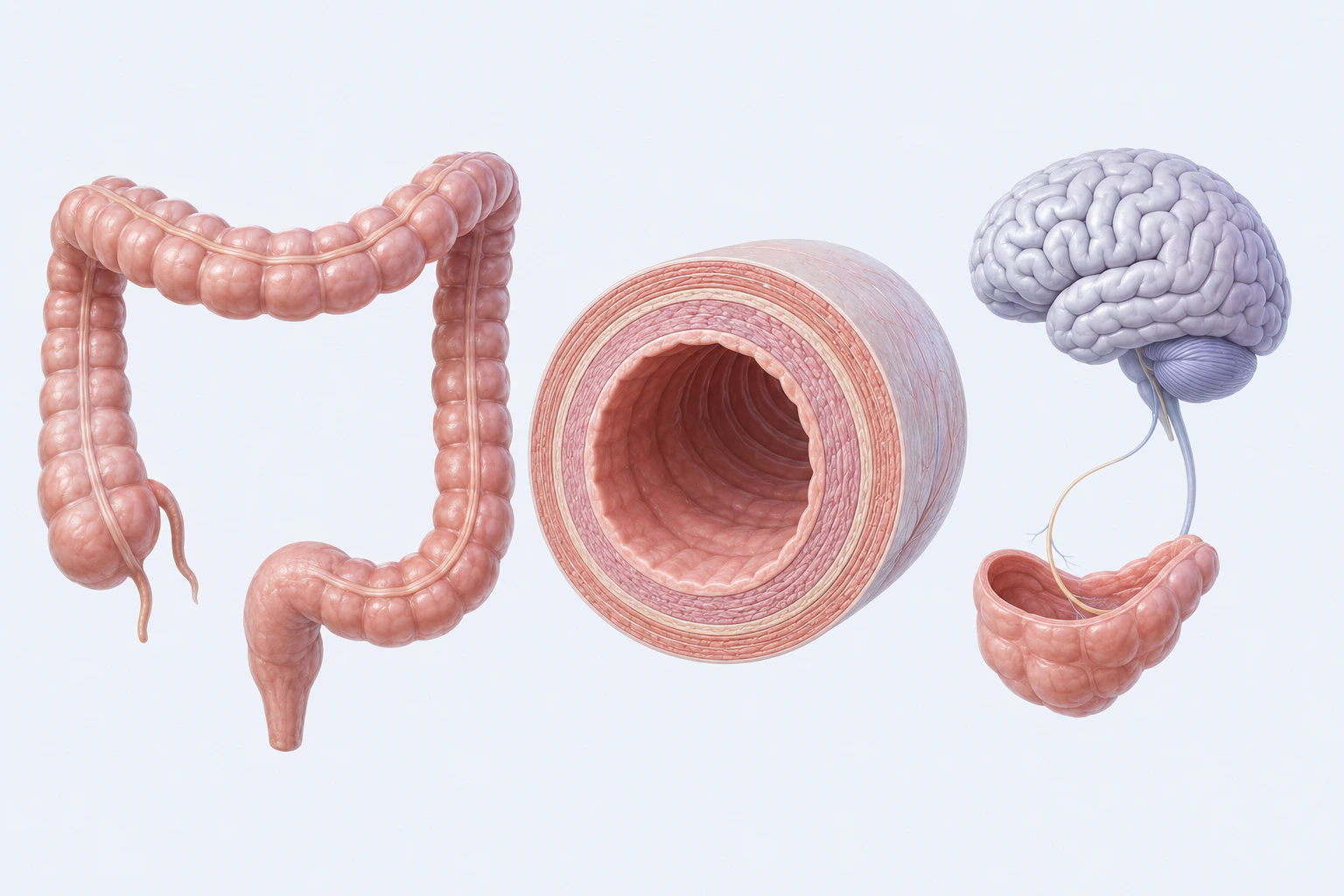
Neutral gut–brain orientation for irritable bowel syndrome, shown without visible structural bowel damage. The two fine strands are not a named pathway and do not establish a mechanism, subtype, biomarker, severity, or diagnosis.
Scientific media record1 verified identifier
- Subject
- Irritable Bowel Syndromecondition
- Identifiers
- MeSH:D043183
- Review
- Editorial review completeIdentifiers authority-verified · Accessibility validated · · ibs|ibs-pathology-v1.webp
- Digital source
- Trained-algorithmic mediaCreated with a trained generative algorithm and reviewed by WikiBiome for subject identity, scientific framing, identifiers, provenance, and accessibility.
- License
- CC BY-SA 4.0Created
A functional gastrointestinal disorder affecting 10-15% of the global population, characterized by chronic abdominal pain, bloating, and altered bowel habits (diarrhea-predominant, constipation-predominant, or mixed) without identifiable structural pathology.
From a Metallomics perspective, IBS is remarkable for its overlap with systemic Nickel Allergy and Allergic Contact Dermatitis syndrome (SNAS), where nickel-rich foods trigger IBS-identical symptoms in nickel-sensitized individuals—raising the question of how many "IBS" patients actually have an undiagnosed metal hypersensitivity.
Evidence map20 cited passagesInspect provenance +
probiotics—Historical trials reported strain 35624 as “B. infantis,” but genome analysis assigns 35624 to B. longum subsp. longum; its results do not support the infantis subspecies generally
Nickel ACM prevalence: 30-65% of IBS patients in European studies test positive for nickel sensitization
90.3% positivity in endometriosis patients with GI symptoms tested for Ni ACM via oral mucosa patch test
Low-nickel diet response: Dramatic improvement in all GI, extra-intestinal, and even gynecological symptoms in nickel-sensitized patients
Nickel exposure in occupational workers increases Escherichia-Shigella and decreases Lactobacillus, Lachnospiraceae, Blautia
Dietary nickel is the primary trigger for SNAS symptoms. High-nickel foods overlap significantly with high-FODMAP foods: legumes, whole wheat, onions, garlic, and nuts are high in both FODMAP compounds and nickel
Cadmium from tobacco compounds metal-driven dysbiosis in IBS patients who smoke
Heavy metals disrupt tight junction proteins (claudin, occludin, ZO-1) via multiple mechanisms, compounding the barrier dysfunction already present in IBS
ruminococcus and dorea—Enriched in IBS; associated with altered fermentation patterns and gas production contributing to bloating.
escherichia coli—May expand in the setting of nickel-driven dysbiosis and SIBO. Nickel exposure increases Escherichia-Shigella abundance.
lactobacillus—Depleted in IBS. Nickel exposure specifically reduces Lactobacillus abundance. L. rhamnosus GG has the best evidence for IBS symptom relief.
bifidobacterium—Depleted in IBS. Clinical studies historically labeled strain 35624 as “B. infantis,” but comparative genomics assigns 35624 to B. longum subsp. longum; those findings are strain-specific and are not evidence for B. longum subsp. infantis.
TLR4 activation by nickel—Nickel activates TLR4 on mucosal immune cells, triggering innate immune responses and mast cell degranulation in sensitized individuals. This is a direct metal-immune interface that does not require microbial involvement.
Nickel allergic contact mucositis (ACM)—In sensitized individuals (30-65% of IBS patients), dietary nickel triggers type IV hypersensitivity in the intestinal mucosa. Mucosal biopsies show increased eosinophils and mast cells at sites of nickel contact. This allergic inflammation is the primary ecological driver, not infection or autoimmunity.
Fermentative dysbiosis—64.71% of SNAS patients have fermentative dysbiosis (elevated urinary indican, indicating small intestinal disruption), 3.92% putrefactive, and 31.37% mixed. This suggests the small bowel microbiota is primarily perturbed.
Diet + probiotics synergy—Low-nickel diet combined with targeted probiotics achieves eubiosis in 72.73% of SNAS patients vs. 41.38% with diet alone (p=0.026), but benefits are maintained only 4-6 weeks after treatment cessation.
endometriosis (overlap score: 0.55)—Highest overlap. Shared nickel sensitivity (90.3% Ni ACM positivity in endometriosis patients with GI symptoms), shared estrogen connections via estrobolome, and shared mast cell activation. Low-nickel diet improves both GI and gynecological symptoms in endometriosis.
Probiotic durability—Benefits of low-nickel diet + probiotics last only 4-6 weeks post-treatment. What maintains the dysbiotic state, and can longer interventions achieve durable remission?
Primitive 1: Metals as Selective Pressures—Dietary nickel selects for nickel-tolerant taxa (Escherichia-Shigella) while suppressing nickel-sensitive taxa (Lactobacillus, Lachnospiraceae, Blautia). This metal-driven microbial selection produces the IBS dysbiosis pattern in sensitized individuals.
Primitive 5: Two-Sided Ecological Engineering—Low-nickel diet + targeted probiotics achieves eubiosis in 72.73% vs. 41.38% with diet alone. The intervention suppresses the allergic trigger (nickel) while restoring beneficial taxa (Lactobacillus, Bifidobacterium).
One disease. Five evidence layers.
A generated systems view of the metals, organisms, host sequestration signals, ecological conditions, and microbial functions indexed for Irritable Bowel Syndrome (IBS).
Evidence layer
Taxonomic signature
Organisms reported as enriched or depleted, with their indexed functional context kept beside the name.Firmicutes genus — enriched in IBS; associated with altered fermentation patterns
Lachnospiraceae member — enriched in IBS; associated with gas production and bloating
Methanogenic archaeon — enriched in IBS-C; methane slows colonic transit
Enriched in SIBO-associated IBS; may expand in nickel-driven dysbiosis
Protective commensal — depleted in IBS; reduced barrier support and SCFA production
SCFA producer — depleted in IBS; strain 35624 IBS studies used a historical B. infantis label, but the strain is B. longum subsp. longum
Major butyrate producer — depleted in IBS; anti-inflammatory effects lost
Evidence layer
Nutritional immunity
Host metal-withholding, inflammatory, antioxidant, and microbial-metabolite signals indexed in the signature.Elevated host signals
4Depleted protective signals
1Evidence layer
Ecological state
The environmental conditions that connect the organism-level observations into a system.Evidence layer
Virulence functions
Microbial structures, enzymes, and acquisition systems implicated by the linked evidence.The disease record, in full.
The original WikiBiome disease narrative remains intact beneath the generated signature atlas.
The Nickel-IBS Connection#
Nickel Allergic Contact Mucositis (ACM)#
Rizzi et al. (2017) demonstrated that a subset of IBS patients have nickel ACM—allergic Metal-Driven Inflammation of the intestinal mucosa triggered by dietary nickel. Key findings.
Nickel patch test-positive IBS patients improve dramatically on a low-nickel diet. Symptoms (bloating, pain, diarrhea) are indistinguishable from "classical" IBS. Mucosal biopsies show increased eosinophils and mast cells at sites of nickel contact.
The prevalence of nickel sensitization in IBS cohorts ranges from 30-65% in European studies.
SNAS (Systemic Nickel Allergy Syndrome)#
Nickel Allergy and Allergic Contact Dermatitis is not limited to contact dermatitis. SNAS manifests as. GI symptoms (identical to IBS): bloating, abdominal pain, diarrhea, nausea.
Extra-intestinal symptoms: headache, fatigue, urticaria, joint pain. Triggered by dietary nickel (legumes, whole grains, chocolate, nuts, canned foods).
Resolves with low-nickel diet; confirmed by oral nickel challenge.
The overlap between IBS and SNAS is so extensive that Lombardi et al. (2020) proposed routine nickel patch testing in IBS patients.
The FODMAP-Nickel Overlap#
A critical observation: many high-FODMAP foods are also high-nickel foods. Legumes (beans, lentils, chickpeas)—high FODMAP and high nickel. Whole wheat—fructans (FODMAP) and nickel.
Onions, garlic—fructans and moderate nickel.
Nuts—some are high FODMAP and high nickel.
This overlap means the clinical response to a low-FODMAP diet in IBS may partly reflect nickel avoidance. Patients who respond to low-FODMAP should be evaluated for nickel sensitization, as a targeted low-nickel diet may be less restrictive than full FODMAP elimination.
Gut Barrier Dysfunction#
IBS, once considered purely "functional," now has documented Intestinal Permeability abnormalities. Increased lactulose/mannitol ratio in IBS-D (diarrhea-predominant) patients. Reduced ZO-1 and occludin expression in colonic biopsies.
Elevated serum LPS and LBP, indicating bacterial translocation.
Mast cell proximity to nerve endings correlates with pain severity—the "mast cell-nerve axis".
Nickel exacerbates barrier dysfunction in sensitized individuals via TLR4 activation and mast cell degranulation, connecting Nickel Allergy and Allergic Contact Dermatitis directly to the permeability pathology.
Visceral Hypersensitivity#
The hallmark of IBS—exaggerated pain perception to normal intestinal distension.
Mast cell mediators (histamine, tryptase, serotonin) sensitize afferent nerve endings. Nickel-triggered mast cell activation in the mucosa directly drives visceral hypersensitivity. Serotonin (5-HT) dysregulation: ~95% of body serotonin is in the gut; altered 5-HT signaling underlies both motility and pain abnormalities.
Metal-induced inflammation lowers pain thresholds via peripheral and central sensitization.
Microbiome in IBS#
IBS microbiome signatures are distinct from Inflammatory Bowel Disease (IBD). Reduced diversity—less dramatic than IBD but consistently found. Depleted: Lactobacillus, Bifidobacterium, Faecalibacterium prausnitzii.
Enriched: Firmicutes/Bacteroidetes ratio often increased; Ruminococcus, Dorea.
Methanogenic archaea—Methanobrevibacter smithii enrichment in constipation-predominant IBS (methane slows transit). SIBO (Small Intestinal Bacterial Overgrowth)—overlaps with IBS; lactulose breath test positive in 30-85% depending on criteria.
Metal exposure compounds these shifts: Dysbiosis from dietary nickel, cadmium (in tobacco), and other metals overlays the existing IBS microbiome disruption.
Comorbidities#
IBS co-occurs frequently with Depression (50% comorbidity), Endometriosis (shared nickel sensitivity and estrogen connections via Estrobolome), fibromyalgia, and contact dermatitis—all conditions with metal and microbiome dimensions.
Connections#
- Nickel Allergy and Allergic Contact Dermatitis—the underlying sensitization driving nickel ACM; 30-65% of IBS cohorts are nickel-sensitized
- Nickel—dietary nickel triggers SNAS symptoms identical to IBS in sensitized individuals
- Dietary Nickel Exposure—the trigger for SNAS symptoms; high overlap with FODMAP foods
- Zinc—supplementation restores barrier function and supports antimicrobial peptide production
- Intestinal Permeability—barrier dysfunction documented in IBS-D with elevated serum LPS
- Inflammatory Bowel Disease (IBD)—the key differential diagnosis; calprotectin distinguishes the two
- dysbiosis—reduced diversity with depletion of Lactobacillus, Bifidobacterium, F. prausnitzii
- Probiotics—Historical trials reported strain 35624 as “B. infantis,” but genome analysis assigns 35624 to B. longum subsp. longum; its results do not support the infantis subspecies generally[6]Genome Analysis and Characterisation of the Exopolysaccharide Produced by Bifidobacterium longum subsp. longum 35624Friedrich Altmann, Paul Kosma, Amy O'Callaghan et al. · 2016Open reference 6 ↓
- Depression—50% comorbidity rate; shared gut-brain axis and mast cell-nerve axis pathways
- Endometriosis—shared nickel sensitivity and estrogen connections via estrobolome
- Calprotectin (S100A8/A9)—normal in IBS (<50 mcg/g) vs. markedly elevated in IBD; key differential biomarker
- Estrobolome—connects IBS-endometriosis comorbidity through estrogen-microbiome interactions
- Methanobrevibacter smithii—enriched in constipation-predominant IBS; methane slows transit
- Gut-Brain Axis—visceral hypersensitivity and serotonin dysregulation mediated by gut-brain signaling
References 8
Numbered by first appearance in the article, then reconciled with its declared source list.
- 1
Borghini R, Porpora MG, Casale R et al. (2020). Irritable Bowel Syndrome-Like Disorders in Endometriosis: Prevalence of Nickel Sensitivity and Effects of a Low-Nickel Diet. An Open-Label Pilot Study. Nutrients.
- 2
Lombardi F, Fiasca F, Minelli M et al. (2020). The Effects of Low-Nickel Diet Combined with Oral Administration of Selected Probiotics on Patients with Systemic Nickel Allergy Syndrome (SNAS) and Gut Dysbiosis. Nutrients.
- 3
Rizzi A, Nucera E, Laterza L et al. (2017). Irritable Bowel Syndrome and Nickel Allergy: What Is the Role of the Low Nickel Diet?. Journal of Neurogastroenterology and Motility.
- 4
★Federica Giambo, Sebastiano Italia, Michele Teodoro et al. (2021). Influence of Toxic Metal Exposure on the Gut Microbiota (Review). World Academy of Sciences Journal.
- 5
M. Firoze Khan, Hui Wang (2020). Environmental Exposures and Autoimmune Diseases: Contribution of Gut Microbiome. Frontiers in Immunology.
- 6
Friedrich Altmann, Paul Kosma, Amy O'Callaghan et al. (2016). Genome Analysis and Characterisation of the Exopolysaccharide Produced by Bifidobacterium longum subsp. longum 35624. PLOS ONE.
- 7
★Qinheng Zhu, Boyan Chen, Fu Zhang et al. (2024). Toxic and Essential Metals: Metabolic Interactions with the Gut Microbiota and Health Implications. Frontiers in Nutrition.
- 8
★Sweta Ghosh, Syam P. Nukavarpu, Venkatakrishna Rao Jala (2024). Effects of Heavy Metals on Gut Barrier Integrity and Gut Microbiota. Microbiota and Host.
Article network
Mentioned here 16
Pages linking here 21
Connect the evidence
Publicly readable discussion by ORCID-authenticated researchers. Questions, interpretation, methods, corrections, and new evidence stay attached to this record.
No discussion yet. Start with a precise question or a source-backed observation.
Activity and accepted changes
Accepted researcher context, editorial status, public discussion, and upstream Git revisions are shown together. Pending, declined, and withdrawn proposals remain private.
- published revision
Strengthen Metallomics and link high-leverage contexts
Karen Pendergrass · +1 −1
Inspect exact Git diff ↗ - published revision
Backfill inflammation concept links
Karen Pendergrass · +2 −2
Inspect exact Git diff ↗ - published revision
Complete corpus-wide Dysbiosis linking
Karen Pendergrass · +1 −1
Inspect exact Git diff ↗ - published revision
Canonicalize Bifidobacterium infantis
Karen Pendergrass · +3 −3
Inspect exact Git diff ↗ - published revision
massive wiki expansion: 149 stubs fixed, 100+ new pages, Rule 15 scan, keystone papers
WikiBiome Deploy Bot · +10 −10
Inspect exact Git diff ↗ - published revision
nightly maintenance: 94 stub demotions, 181 source_count fixes, 22 auto-discovered stubs, 5 adversarial audits, 3 boundary fixes, 3 evidence-level corrections
WikiBiome Deploy Bot · +1 −0
Inspect exact Git diff ↗ - published revision
cycle 1: health check + lint fixes + 8 ingests + 2 stubs + gestational-diabetes signature
WikiBiome Deploy Bot · +1 −0
Inspect exact Git diff ↗ - published revision
pre-overnight checkpoint 2026-04-18
WikiBiome Deploy Bot · +5 −5
Inspect exact Git diff ↗ - published revision
Citation integrity pass: 38 citations added, 24 parenthesized citations fixed
WikiBiome Deploy Bot · +1 −8
Inspect exact Git diff ↗ - published revision
v2 migration Priority 2: All 29 disease entity pages upgraded with associated_conditions, seo_target, wikipedia_differentiation
WikiBiome Deploy Bot · +6 −0
Inspect exact Git diff ↗ - published revision
WikiBiome v2 migration: signature pages + safety fixes + gap analysis
WikiBiome Deploy Bot · +24 −8
Inspect exact Git diff ↗ - published revision
WikiBiome update — 2026-04-11 22:49
WikiBiome Deploy Bot · +105 −0
Inspect exact Git diff ↗