

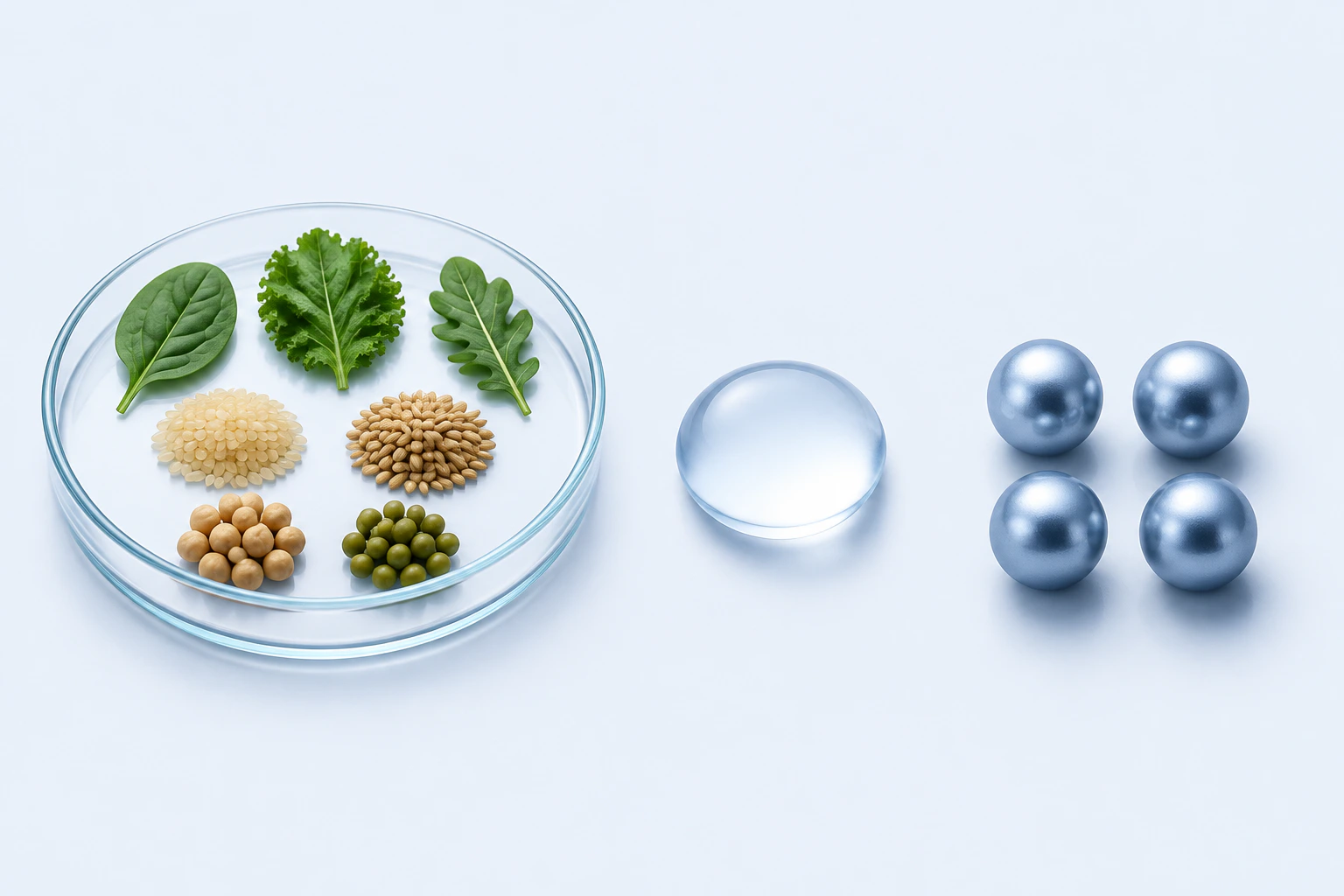
Dietary nickel-exposure context. Separation does not establish nickel in a depicted matrix and does not identify a food, nickel compound, concentration, dose, threshold, allergy, toxicity, or individual risk.
Scientific media record2 verified identifiers
- Subject
- Dietary Nickel Exposurebiological-process
- Review
- Editorial review completeIdentifiers authority-verified · Accessibility validated · · dietary-nickel-exposure|dietary-nickel-exposure-mechanism-v1.webp
- Digital source
- Trained-algorithmic mediaCreated with a trained generative algorithm and reviewed by WikiBiome for subject identity, scientific framing, identifiers, provenance, and accessibility.
- Scientific basis
- Nickel — Medical Subject HeadingsToxicological Profile for NickelDietary Nickel Exposure
- License
- CC BY-SA 4.0Created
Food is the primary source of Nickel exposure for the general (non-occupational) population. While food nickel poses minimal risk to most adults, children and nickel-sensitized individuals are high-risk groups.
Evidence map8 cited passagesInspect provenance +
Nickel-rich sources (mg Ni/kg):
Stainless steel cookware (especially with acidic foods like tomato, vinegar, lemon)
EFSA TDI: 13 μg/kg body weight/day.
Children are particularly vulnerable:
A striking connection: gluten-free diets are naturally high in nickel:
Practical guidance for reducing dietary nickel:
Target intake for sensitized individuals: 100-150 μg/day may be beneficial.
—most comprehensive data on children's exposure
Contents
1. Nickel Content in Foods2. Regulatory Thresholds3. Children as a High-Risk Group4. Celiac Disease Intersection5. Low-Nickel Diet6. ConnectionsNickel Content in Foods#
Nickel-rich sources (mg nickel (Ni)/kg):[1]Nickel Exposure from Food and Levels in Children's Blood and Tissues: Health ImplicationsDobrzyńska MM, Gajowik A, Jankowska-Steifer EA et al. · 2025Open reference 1 ↓
| Food | nickel content (mg/kg) |
|---|---|
| Cocoa | 8.2-17.1 |
| Grains, legumes, cereals | 0.3-9.8 |
| Nuts | 0.2-6.7 |
| Soy products | 0.1-5.1 |
| Mushrooms | 1.5-5.0 |
| Oatmeal | 0.77-1.76 |
| Chocolate | ~0.6 |
| Canned vegetables | <0.01-0.52 |
Other sources of dietary nickel contamination. Stainless steel cookware (especially with acidic foods like tomato, vinegar, lemon).[2]Dietary Nickel as a Cause of Systemic Contact DermatitisZirwas MJ, Molenda MA · 2009Open reference 2 ↓ Tap water (first quart from faucet may contain leached nickel from fixtures).
Canned foods (metal leaching from cans).
Food processing equipment (industrial nickel contamination).
Regulatory Thresholds#
EFSA TDI: 13 μg/kg body weight/day.[1]Nickel Exposure from Food and Levels in Children's Blood and Tissues: Health ImplicationsDobrzyńska MM, Gajowik A, Jankowska-Steifer EA et al. · 2025Open reference 1 ↓ LOAEL: 4.3 μg nickel (Ni)/kg body weight (critical effect: eczematous flare-up in nickel-sensitized humans). Margin of Exposure: recommended ≥30.
Normal diet provides ~300 μg/day for adults; nickel is not regulated in food in most jurisdictions.
Children as a High-Risk Group#
Children are particularly vulnerable.[1]Nickel Exposure from Food and Levels in Children's Blood and Tissues: Health ImplicationsDobrzyńska MM, Gajowik A, Jankowska-Steifer EA et al. · 2025Open reference 1 ↓ Immature detoxification systems. Higher food intake relative to body weight.
High consumption of nickel-rich foods (chocolate, cocoa, cereals).
French study: 7.9-37.9% of children (1-36 months) exceeded TDI; up to 98% under upper-bound estimates. Main sources for children: chocolate/cocoa products, cereals. Infant formula: soy-based formulas contain more nickel (0.05 mg/kg with iron fortification vs 0.02 without).
Celiac Disease Intersection#
A striking connection: gluten-free diets are naturally high in nickel.[3]Beneficial Effects of a Low-Nickel Diet on Relapsing IBS-Like and Extraintestinal Symptoms of Celiac Patients during a Proper Gluten-Free DietBorghini R, De Amicis N, Bella A et al. · 2020Open reference 3 ↓
GF staples (corn, chickpeas, lentils, buckwheat) overlap significantly with high-nickel foods. Celiac patients on strict GFD may develop nickel (Ni) ACM symptoms due to increased nickel load. A combined GFD + low-nickel diet resolved symptoms in 83.4% of cases.
Low-Nickel Diet#
Practical guidance for reducing dietary nickel:[2]Dietary Nickel as a Cause of Systemic Contact DermatitisZirwas MJ, Molenda MA · 2009Open reference 2 ↓
Avoid: whole grains (wheat bran, oatmeal), beans/lentils/peas/soy, all nuts and seeds, chocolate/cocoa, canned foods, black tea, commercial salad dressings, stainless steel cookware for acidic foods.
Reduce absorption. Vitamin C with meals (competitive inhibitor of nickel absorption). High iron diet (iron competes for absorption).
Run tap water briefly before use (flush nickel from faucet fixtures).
Target intake for sensitized individuals: 100-150 μg/day may be beneficial.[4]Nickel contact dermatitis in childrenTuchman M, Silverberg JI, Jacob SE et al. · 2015Open reference 4 ↓
Connections#
- Nickel Allergy and Allergic Contact Dermatitis—dietary nickel triggers systemic contact dermatitis
- Nickel—the metal
- [1]Nickel Exposure from Food and Levels in Children's Blood and Tissues: Health ImplicationsDobrzyńska MM, Gajowik A, Jankowska-Steifer EA et al. · 2025Open reference 1 ↓—most comprehensive data on children's exposure
- Relates to Metabolic Syndrome and Metal Exposure—dietary nickel as non-occupational exposure route
References 5
Numbered by first appearance in the article, then reconciled with its declared source list.
- 1
Dobrzyńska MM, Gajowik A, Jankowska-Steifer EA et al. (2025). Nickel Exposure from Food and Levels in Children's Blood and Tissues: Health Implications. Acta Sci Pol Technol Aliment.
- 2
Zirwas MJ, Molenda MA (2009). Dietary Nickel as a Cause of Systemic Contact Dermatitis. Journal of Clinical and Aesthetic Dermatology.
- 3
Borghini R, De Amicis N, Bella A et al. (2020). Beneficial Effects of a Low-Nickel Diet on Relapsing IBS-Like and Extraintestinal Symptoms of Celiac Patients during a Proper Gluten-Free Diet. Nutrients.
- 4
Tuchman M, Silverberg JI, Jacob SE et al. (2015). Nickel contact dermatitis in children. Clin Dermatol.
- 5
Ahlström MG, Thyssen JP, Wennervaldt M et al. (2019). Nickel Allergy and Allergic Contact Dermatitis: A Clinical Review. Contact Dermatitis.
Article network
Mentioned here 3
Pages linking here 28
Connect the evidence
Publicly readable discussion by ORCID-authenticated researchers. Questions, interpretation, methods, corrections, and new evidence stay attached to this record.
No discussion yet. Start with a precise question or a source-backed observation.
Activity and accepted changes
Accepted researcher context, editorial status, public discussion, and upstream Git revisions are shown together. Pending, declined, and withdrawn proposals remain private.
- published revision
massive wiki expansion: 149 stubs fixed, 100+ new pages, Rule 15 scan, keystone papers
WikiBiome Deploy Bot · +17 −17
Inspect exact Git diff ↗ - published revision
nightly maintenance: 94 stub demotions, 181 source_count fixes, 22 auto-discovered stubs, 5 adversarial audits, 3 boundary fixes, 3 evidence-level corrections
WikiBiome Deploy Bot · +1 −0
Inspect exact Git diff ↗ - published revision
pre-overnight checkpoint 2026-04-18
WikiBiome Deploy Bot · +3 −1
Inspect exact Git diff ↗ - published revision
WikiBiome update — 2026-04-15 17:23
WikiBiome Deploy Bot · +0 −1
Inspect exact Git diff ↗ - published revision
WikiBiome update — integrity fixes, metallomic diet pages, cross-condition analyses
WikiBiome Deploy Bot · +14 −7
Inspect exact Git diff ↗ - published revision
WikiBiome v7 — interactive microbiome metallomics encyclopedia
Karen Pendergrass · +77 −0
Inspect exact Git diff ↗