

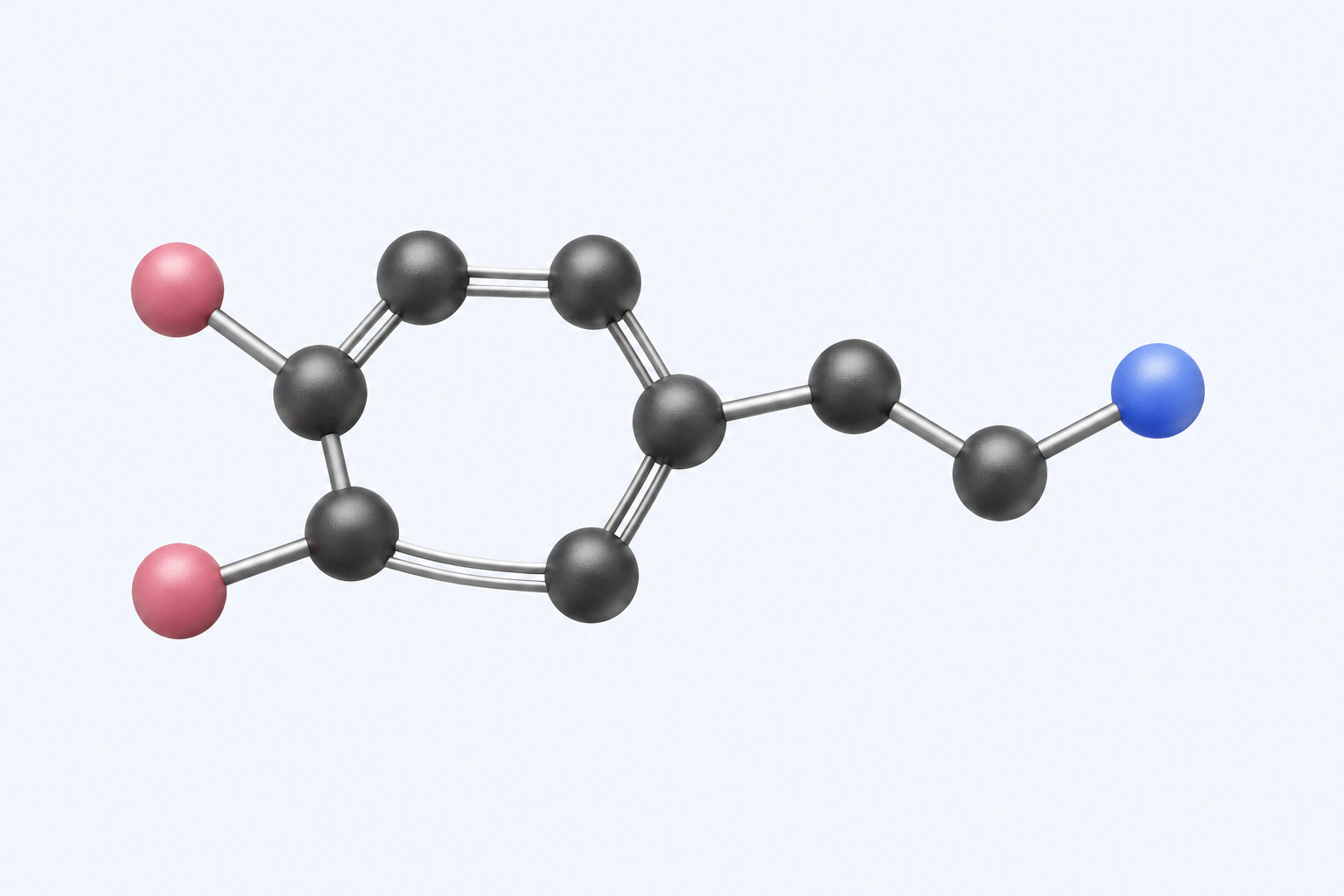
Heavy-atom connectivity orientation for neutral dopamine. Hydrogens, physiological protonation state, measured conformation, formulation, concentration, receptor binding, signaling, treatment, and disease claims are intentionally omitted; this is an educational reconstruction.
Scientific media record3 verified identifiers
- Subject
- Dopamineevidence-index
- Review
- Editorial review completeIdentifiers authority-verified · Accessibility validated · · dopamine|dopamine-evidence-index-v1.webp
- Digital source
- Trained-algorithmic mediaCreated with a trained generative algorithm and reviewed by WikiBiome for subject identity, scientific framing, identifiers, provenance, and accessibility.
- Scientific basis
- Dopamine — PubChemDopamine
- License
- CC BY-SA 4.0Created
Dopamine is a catecholamine neurotransmitter central to reward, motivation, motor control, and executive function. Its synthesis is directly dependent on iron—the rate-limiting enzyme tyrosine hydroxylase (TH) requires iron(II) (Fe2+) as a cofactor.
This iron dependency makes dopamine biology uniquely vulnerable to metal dyshomeostasis and positions it at the intersection of metallomics, the Gut Microbiome, and neurodegeneration.
The gut produces dopamine independently of the brain. Certain gut bacteria (Bacillus, Serratia, Staphylococcus) synthesize dopamine directly, and the enteric nervous system (ENS) expresses dopaminergic signaling systems identical to the CNS—directly exposed to luminal metals and microbial metabolites.
Evidence map9 cited passagesInspect provenance +
Tyrosine hydroxylase (TH) catalyzes the rate-limiting step: tyrosine → L-DOPA. TH requires Fe2+ in its active site and is stimulated up to 13-fold by 1 mM Fe.
In Parkinson's disease, 60% TH activity reduction is observed in the striatum.
p-Cresol—a microbial metabolite elevated in PD gut—inhibits dopamine synthesis by interfering with iron-containing TH,.
ferroptosis—iron-dependent programmed cell death via lipid peroxidation—is the convergent mechanism for dopaminergic neuron loss in PD:
Neuromelanin in SN neurons chelates iron, providing oxidative protection. In individuals with MC1R variants (redheads), neuromelanin shifts toward pheomelanin, which chelates iron less effectively, increasing labile iron and ferroptotic vulnerability.
p-Cresol (from Clostridioides, Blautia, and other fermenters): Inhibits TH, reducing dopamine synthesis.
In schizophrenia patients, pilot shotgun metagenomics revealed alistipes indistinctus, Dorea longicatena, and roseburia inulinivorans negatively correlated with plasma dopamine levels.
Probio-M8 (a probiotic formulation) significantly elevated serum dopamine in PD patients in a randomized controlled trial—the first human RCT evidence for probiotic-mediated dopamine modulation.
| Condition | Dopamine Relevance | |-----------|-------------------| | parkinsons disease | Dopaminergic neuron loss in SN; iron accumulation; ferroptosis; p-cresol inhibition of TH | | schizophrenia | Dopaminergic dysregulation; FMT from SCZ patients elevated prefrontal dopamine in germ-free mice | | depression | Anhedonia linked to dopaminergic dysfunction
Contents
1. Iron-Dependent Synthesis2. Dopaminergic Neurodegeneration and Iron3. Microbiome-Dopamine Interactions4. Conditions Associated5. Cross-ReferencesIron-Dependent Synthesis#
Dopamine synthesis: Tyrosine → L-DOPA → Dopamine
Tyrosine hydroxylase (TH) catalyzes the rate-limiting step: tyrosine → L-DOPA. TH requires iron(II) (Fe2+) in its active site and is stimulated up to 13-fold by 1 mM iron.[1]Riederer 2021 — Iron as Concert Master in Parkinson's DiseaseRiederer P, Monoranu C, Strobel S et al. · 2021Open reference 1 ↓
In Parkinson's disease, 60% TH activity reduction is observed in the striatum.[1]Riederer 2021 — Iron as Concert Master in Parkinson's DiseaseRiederer P, Monoranu C, Strobel S et al. · 2021Open reference 1 ↓
p-Cresol—a microbial metabolite elevated in PD gut—inhibits dopamine synthesis by interfering with iron-containing TH.[2]Novikova 2025 -- Microbiome-Derived Metabolites in Parkinson's Disease (Thesis)Polina Novikova · 2025Open reference 2 ↓[3]Microbial Metallomics and Parkinson's Disease: A Unified Metal-Driven Framework Linking Ferroptosis, Dysbiosis, and alpha-Synuclein PathologyKaren Pendergrass · 2025Open reference 3 ↓
This creates a direct pathway: gut Dysbiosis → elevated p-cresol → TH inhibition → dopamine depletion.
Dopaminergic Neurodegeneration and Iron#
Ferroptosis#
Ferroptosis—iron-dependent programmed cell death via lipid peroxidation—is the convergent mechanism for dopaminergic neuron loss in PD.[3]Microbial Metallomics and Parkinson's Disease: A Unified Metal-Driven Framework Linking Ferroptosis, Dysbiosis, and alpha-Synuclein PathologyKaren Pendergrass · 2025Open reference 3 ↓
Iron accumulates in the substantia nigra (SN) in PD. Free iron catalyzes Fenton Chemistry (Fenton reaction), generating hydroxyl radicals. GPX4 downregulation removes the brake on lipid peroxidation.
The result: selective death of dopaminergic neurons in the SN.
Neuromelanin-Iron Axis#
Neuromelanin in SN neurons chelates iron, providing oxidative protection. In individuals with MC1R variants (redheads), neuromelanin shifts toward pheomelanin, which chelates iron less effectively, increasing labile iron and ferroptotic vulnerability.[4]Pheomelanin, Eumelanin, and Neuromelanin: A Metal-Linked Hypothesis for Parkinson's Risk in RedheadsEyer K, Karen Pendergrass · 2025Open reference 4 ↓
Microbiome-Dopamine Interactions#
Microbial Dopamine Production#
Gut bacteria produce dopamine and its precursors. Bacillus spp., Serratia spp. synthesize dopamine directly. The ENS uses this microbially-derived dopamine for motility and signaling.
Microbial Metabolites Affecting Dopamine#
p-Cresol (from Clostridioides, Blautia, and other fermenters): Inhibits TH, reducing dopamine synthesis.[2]Novikova 2025 -- Microbiome-Derived Metabolites in Parkinson's Disease (Thesis)Polina Novikova · 2025Open reference 2 ↓ SCFAs (Butyrate, propionate): Support dopaminergic neuron health through anti-inflammatory effects and mitochondrial function. Indoxyl sulfate: Neurotoxic metabolite from Proteobacteria (Pseudomonadota) (E. coli) tryptophan metabolism.
Plasma Dopamine-Microbiome Correlations#
In schizophrenia patients, pilot shotgun metagenomics revealed Alistipes indistinctus, Dorea longicatena, and Roseburia inulinivorans negatively correlated with plasma dopamine levels.[5]Functional Associations of the Gut Microbiome with Dopamine, Serotonin, and BDNF in Schizophrenia: A Pilot StudyGhorbani M, Joseph GBS, Tew MM et al. · 2024Open reference 5 ↓
Probiotic Evidence#
Probio-M8 (a probiotic formulation) significantly elevated serum dopamine in PD patients in a randomized controlled trial—the first human RCT evidence for probiotic-mediated dopamine modulation.[6]Sun 2022 — Probiotics synergized with conventional regimen in managing Parkinson's disease (Probio-M8 RCT)Hairong Sun, Feiyan Zhao, Yuanyuan Liu et al. · 2022Open reference 6 ↓
Conditions Associated#
| Condition | Dopamine Relevance |
|---|---|
| Parkinson's Disease | Dopaminergic neuron loss in SN; iron accumulation; ferroptosis; p-cresol inhibition of TH |
| Schizophrenia | Dopaminergic dysregulation; FMT from SCZ patients elevated prefrontal dopamine in germ-free mice[7]Theleritis 2024 -- Association of gut dysbiosis with first-episode psychosis (Review)Christos Theleritis, Maria-Ioanna Stefanou, Marina Demetriou et al. · 2024Open reference 7 ↓ |
| Depression | Anhedonia linked to dopaminergic dysfunction; gut dysbiosis reduces dopamine precursor availability |
| Postpartum Depression | Catecholamine fluctuations postpartum |
| Fibromyalgia | Altered reward/pain processing |
Cross-References#
- Iron—TH requires iron(II) (Fe2+); iron accumulation drives ferroptosis in dopaminergic neurons
- Ferroptosis—Iron-dependent cell death mechanism for dopamine neuron loss
- Fenton Chemistry—Hydroxyl radical generation from labile iron in SN
- Gut-Brain Axis—ENS dopamine systems exposed to microbial metabolites
- Serotonin—Parallel monoamine neurotransmitter with microbiome connections
- Alpha-Synuclein—Aggregation in dopaminergic neurons; metal-catalyzed
- microbiome-derived metabolites—p-cresol, SCFAs affecting dopamine biology
- Tryptophan Metabolism—Shared precursor pathways and competition
References 8
Numbered by first appearance in the article, then reconciled with its declared source list.
- 1
Riederer P, Monoranu C, Strobel S et al. (2021). Riederer 2021 — Iron as Concert Master in Parkinson's Disease. Journal of Neural Transmission.
- 2
Polina Novikova (2025). Novikova 2025 -- Microbiome-Derived Metabolites in Parkinson's Disease (Thesis). PhD Thesis.
- 3
★Karen Pendergrass (2025). Microbial Metallomics and Parkinson's Disease: A Unified Metal-Driven Framework Linking Ferroptosis, Dysbiosis, and alpha-Synuclein Pathology. Conference Presentation.
- 4
★Eyer K, Karen Pendergrass (2025). Pheomelanin, Eumelanin, and Neuromelanin: A Metal-Linked Hypothesis for Parkinson's Risk in Redheads. Conference Presentation.
- 5
Ghorbani M, Joseph GBS, Tew MM et al. (2024). Functional Associations of the Gut Microbiome with Dopamine, Serotonin, and BDNF in Schizophrenia: A Pilot Study. Egyptian Journal of Neurology, Psychiatry and Neurosurgery.
- 6
Hairong Sun, Feiyan Zhao, Yuanyuan Liu et al. (2022). Sun 2022 — Probiotics synergized with conventional regimen in managing Parkinson's disease (Probio-M8 RCT). npj Parkinson's Disease.
- 7
Christos Theleritis, Maria-Ioanna Stefanou, Marina Demetriou et al. (2024). Theleritis 2024 -- Association of gut dysbiosis with first-episode psychosis (Review). Molecular Medicine Reports.
- 8
Samuel F Santos, Haroldo L de Oliveira, Elizabeth S Yamada (2022). Santos 2022 -- Gut Microbiome and Its Role in Parkinson's Disease. World Journal of Clinical Cases.
Article network
Mentioned here 18
Pages linking here 7
Connect the evidence
Publicly readable discussion by ORCID-authenticated researchers. Questions, interpretation, methods, corrections, and new evidence stay attached to this record.
No discussion yet. Start with a precise question or a source-backed observation.
Activity and accepted changes
Accepted researcher context, editorial status, public discussion, and upstream Git revisions are shown together. Pending, declined, and withdrawn proposals remain private.
- published revision
Consolidate microbial metabolite knowledge
Karen Pendergrass · +2 −2
Inspect exact Git diff ↗ - published revision
Backfill gut microbiome concept links
Karen Pendergrass · +1 −1
Inspect exact Git diff ↗ - published revision
Complete corpus-wide Dysbiosis linking
Karen Pendergrass · +1 −1
Inspect exact Git diff ↗ - published revision
massive wiki expansion: 149 stubs fixed, 100+ new pages, Rule 15 scan, keystone papers
WikiBiome Deploy Bot · +16 −16
Inspect exact Git diff ↗ - published revision
pre-overnight checkpoint 2026-04-18
WikiBiome Deploy Bot · +84 −0
Inspect exact Git diff ↗