

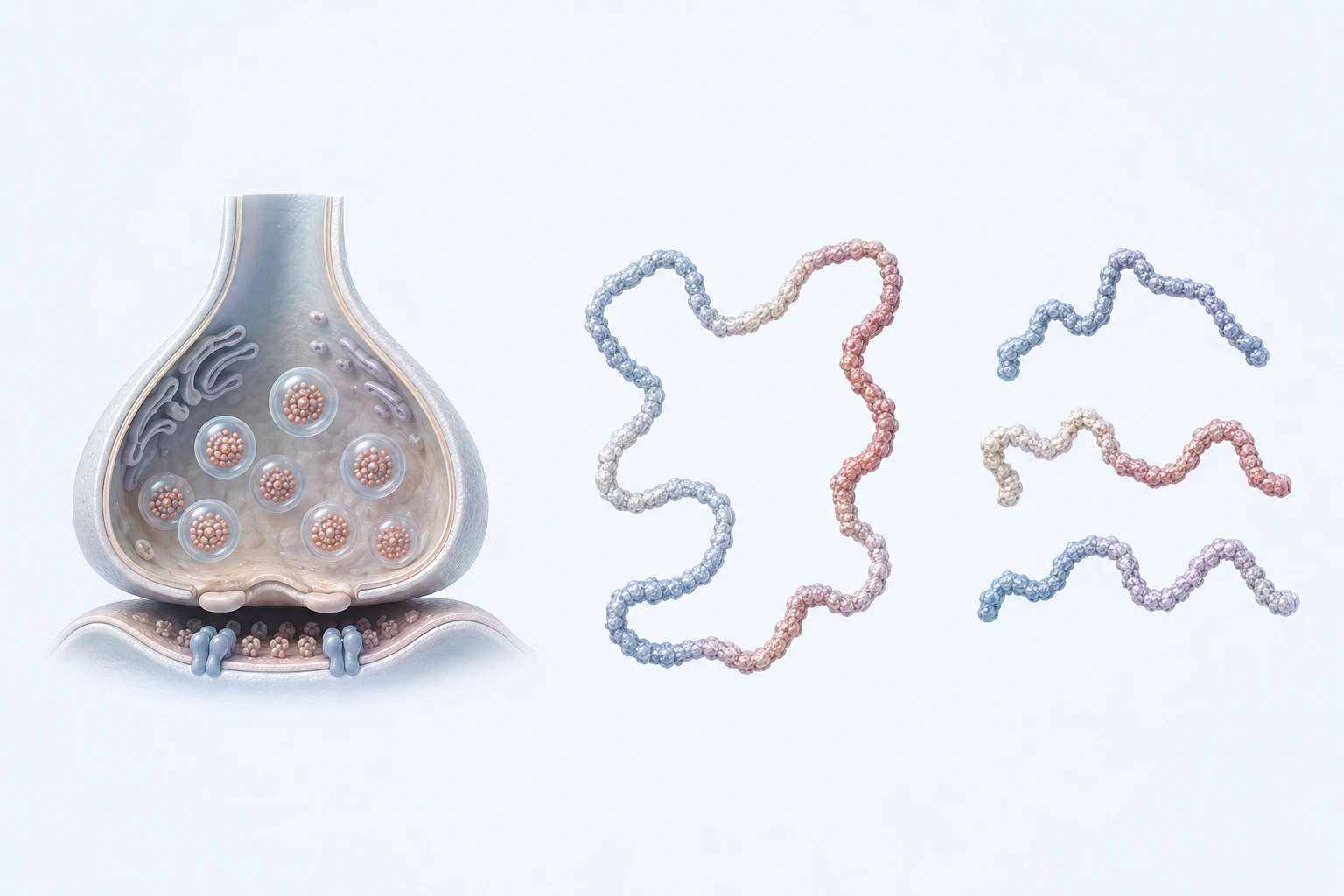
Human alpha-synuclein orientation. Protein forms are generic abstractions and do not establish conformation, membrane binding, aggregation state, Lewy pathology, mechanism, biomarker, or diagnosis.
Scientific media record2 verified identifiers
- Subject
- Alpha-synucleinbiological-process
- Identifiers
- WikiBiome:alpha-synucleinUniProt:P37840
- Review
- Editorial review completeIdentifiers authority-verified · Accessibility validated · · alpha-synuclein|alpha-synuclein-mechanism-v1.webp
- Digital source
- Trained-algorithmic mediaCreated with a trained generative algorithm and reviewed by WikiBiome for subject identity, scientific framing, identifiers, provenance, and accessibility.
- Scientific basis
- Alpha-synuclein — UniProtKB P37840Alpha-Synuclein
- License
- CC BY-SA 4.0Created
A 140-amino-acid presynaptic protein whose misfolding into insoluble fibrils and their deposition in Lewy bodies is the defining neuropathological hallmark of Parkinson's Disease and the broader family of synucleinopathies (including Lewy body dementia and multiple system atrophy).
Under normal conditions, alpha-synuclein is a soluble monomer involved in synaptic vesicle regulation and neurotransmitter release. The transition from functional monomer to toxic fibril is the central event in Parkinson's pathogenesis—and the Gut Microbiome is increasingly implicated in triggering it.
Evidence map13 cited passagesInspect provenance +
Alpha-synuclein aggregates are detected in the enteric nervous system (myenteric and submucosal plexuses) in 65–85% of PD patients, and in some cases years to decades before motor symptoms appear
Epidemiological studies show significantly reduced PD risk in vagotomised patients—truncal vagotomy severs the anatomical highway between the enteric nervous system and the dorsal vagal nucleus, consistent with a gut-to-brain propagation route
Germ-free mouse models show reduced alpha-synuclein aggregation; colonization with PD-patient microbiota increases aggregation
Alpha-synuclein is a metal-binding protein whose aggregation is directly modulated by metal concentrations—particularly those that constitute the metallomic signature of Parkinson's disease:
Iron chelation therapy (deferiprone) has shown preliminary benefit in slowing PD progression in small trials
SCFA-mediated protection: Short-chain fatty acid-producing bacteria—depleted in PD microbiomes—normally maintain gut barrier integrity and dampen neuroinflammation. Their loss removes a critical buffer against enteric alpha-synuclein misfolding. In a prospective cohort study, depletion of Prevotella (an SCFA producer) at baseline correlated with faster s
Enterobacteriaceae enrichment: A large shotgun metagenomics study of 212 PD patients confirmed enrichment of Escherichia coli and Klebsiella in PD gut microbiomes. These Proteobacteria produce LPS (activating TLR4-mediated neuroinflammation), express siderophore systems that increase iron competition, and generate hydrogen sulfide. Their enrichment directly
Microbial amyloids and cross-seeding: E. coli strains expressing curli fibers (functional bacterial amyloids) can cross-seed mammalian alpha-synuclein aggregation. Ingestion of curli-expressing bacteria in mouse models accelerates enteric and brain alpha-synuclein pathology—providing a direct mechanism by which gut microbial products trigger protein misfol
H. pylori: Helicobacter pylori infection (a common gut dysbiosis pathobiont) has been identified as a triggering factor for PD in epidemiological studies. H. pylori produces urease (a nickel-dependent enzyme), generates reactive oxygen species, and chronically activates mucosal immune responses—all of which could promote enteric alpha-synuclein misfolding.
Vitamin B2 and B7 deficiency: A large meta-analysis of shotgun metagenomic studies found reduced genes encoding riboflavin (B2) and biotin (B7) biosynthesis in PD microbiomes. Riboflavin is required for mitochondrial Complex I function—its depletion increases mitochondrial reactive oxygen species, which in turn promotes alpha-synuclein oxidative modificati
If alpha-synuclein pathology begins in the gut, interventions targeting gut microbiome composition represent a theoretically rational early-stage strategy—acting before pathology has propagated rostrally to the brainstem and substantia nigra:
FMT: A pilot randomized FMT study in PD patients showed constipation improvement and motor score stabilization. The gut-first model predicts FMT would be most effective if administered before motor symptoms develop—a testable hypothesis that requires microbiome-based PD screening tools.
| Source | Evidence Level | Key Contribution | |--------|---------------|-----------------| | (2019) | Prospective cohort | Baseline microbiome predicts motor progression; Prevotella loss tracks worsening | | (2022) | Cross-sectional metagenomics | 55 differentially abundant species; Proteobacteria enrichment; LPS biosynthesis genes elevated | | (2021) | Exp
Contents
1. The Gut-First Hypothesis (Braak Staging)2. Metal Interactions3. Gut Microbiome Connection4. Pathological Cascade5. Differential Diagnosis Relevance6. Therapeutic Implications of the Gut-First Model7. Key Studies8. Cross-ReferencesThe Gut-First Hypothesis (Braak Staging)#
The Braak staging system for Parkinson's disease proposes that alpha-synuclein pathology does not originate in the brain's substantia nigra—it begins in the gut and olfactory bulb, then spreads rostrally through the nervous system via a prion-like propagation mechanism.
Key evidence supporting gut-first pathology. Alpha-synuclein aggregates are detected in the enteric nervous system (myenteric and submucosal plexuses) in 65–85% of PD patients, and in some cases years to decades before motor symptoms appear.[1]Gut microbial imbalance and neurodegenerative proteinopathies: from molecular mechanisms to prospects of clinical applicationsAlonso-Garcia P, Martin R, Martinez-Pinilla E · 2021Open reference 1 ↓
Epidemiological studies show significantly reduced PD risk in vagotomised patients—truncal vagotomy severs the anatomical highway between the enteric nervous system and the dorsal vagal nucleus, consistent with a gut-to-brain propagation route.[1]Gut microbial imbalance and neurodegenerative proteinopathies: from molecular mechanisms to prospects of clinical applicationsAlonso-Garcia P, Martin R, Martinez-Pinilla E · 2021Open reference 1 ↓
Constipation precedes motor symptoms in a large proportion of PD patients by 10–20 years—constipation reflects enteric nervous system dysfunction and prolonged gut transit that may increase metal absorption and bacterial exposure time.
Germ-free mouse models show reduced alpha-synuclein aggregation; colonization with PD-patient microbiota increases aggregation.[1]Gut microbial imbalance and neurodegenerative proteinopathies: from molecular mechanisms to prospects of clinical applicationsAlonso-Garcia P, Martin R, Martinez-Pinilla E · 2021Open reference 1 ↓
Metal Interactions#
Alpha-synuclein is a metal-binding protein whose aggregation is directly modulated by metal concentrations—particularly those that constitute the metallomic signature of Parkinson's disease:[2]Common and Trace Metals in Alzheimer's and Parkinson's DiseasesDoroszkiewicz J, Farhan JA, Mroczko J et al. · 2023Open reference 2 ↓
Iron (iron (Fe)) iron(III) directly accelerates alpha-synuclein fibrillization; iron promotes the transition from soluble monomer to insoluble fibril at physiological concentrations. Iron accumulates selectively in the substantia nigra of PD patients, the brain region with the most profound dopaminergic neuron loss.
Ferroptosis—iron-catalyzed, lipid-peroxidation-dependent programmed cell death—is a dominant mechanism of dopaminergic neuron death in PD. Fenton chemistry at iron deposits generates hydroxyl radicals that directly damage alpha-synuclein and promote its aggregation.
Iron chelation therapy (deferiprone) has shown preliminary benefit in slowing PD progression in small trials.[2]Common and Trace Metals in Alzheimer's and Parkinson's DiseasesDoroszkiewicz J, Farhan JA, Mroczko J et al. · 2023Open reference 2 ↓
Copper (copper (Cu)) copper(II) binds to the N-terminal region of alpha-synuclein and promotes oligomerization into toxic soluble aggregates (which may be more neurotoxic than insoluble fibrils). Copper dyshomeostasis is documented in PD brain tissue; ceruloplasmin (the main circulating copper protein) shows reduced ferroxidase activity in PD, impairing iron regulation.
Disrupted copper metabolism increases both free copper and free iron concentrations in affected brain regions.
Manganese (manganese (Mn)) Chronic occupational manganese exposure causes manganism—a clinical parkinsonism syndrome with overlapping features to PD. Manganese accumulates selectively in the globus pallidus and striatum, promoting alpha-synuclein aggregation and mitochondrial complex I inhibition. manganese-induced protein aggregation also impairs the ubiquitin-proteasome system and autophagy, reducing clearance of misfolded alpha-synuclein.
Lead (lead (Pb)) Developmental lead exposure upregulates alpha-synuclein expression via epigenetic mechanisms—changes that persist decades after exposure ceases.
The developmental origins model: lead exposure in utero or in early childhood programs elevated alpha-synuclein baseline that increases vulnerability to aggregation triggers in later life.
Gut Microbiome Connection#
The gut microbiome modulates alpha-synuclein biology through several converging mechanisms:
SCFA-mediated protection: Short-chain fatty acid-producing bacteria—depleted in PD microbiomes—normally maintain gut barrier integrity and dampen neuroinflammation. Their loss removes a critical buffer against enteric alpha-synuclein misfolding.
In a prospective cohort study, depletion of Prevotella (an SCFA producer) at baseline correlated with faster subsequent motor symptom progression—consistent with progressive SCFA loss enabling accelerating alpha-synuclein pathology.[3]Aho 2019 -- Gut Microbiome and Disease Progression in Parkinson's DiseaseVelma T E Aho, Pedro A B Pereira, Sanna Koskinen et al. · 2019Open reference 3 ↓
Enterobacteriaceae enrichment: A large shotgun metagenomics study of 212 PD patients confirmed enrichment of Escherichia coli and Klebsiella in PD gut microbiomes.[4]Wallen 2022 -- Metagenomics of Parkinson's Disease Implicates the Gut MicrobiomeZachary D Wallen, Mary B Makarious, Cornelis Blauwendraat et al. · 2022Open reference 4 ↓ These Proteobacteria produce LPS (activating TLR4-mediated neuroinflammation), express siderophore systems that increase iron competition, and generate hydrogen sulfide.
Their enrichment directly feeds the iron-Dysbiosis cycle that drives alpha-synuclein aggregation.
Microbial amyloids and cross-seeding: E. coli strains expressing curli fibers (functional bacterial amyloids) can cross-seed mammalian alpha-synuclein aggregation. Ingestion of curli-expressing bacteria in mouse models accelerates enteric and brain alpha-synuclein pathology—providing a direct mechanism by which gut microbial products trigger protein misfolding.[1]Gut microbial imbalance and neurodegenerative proteinopathies: from molecular mechanisms to prospects of clinical applicationsAlonso-Garcia P, Martin R, Martinez-Pinilla E · 2021Open reference 1 ↓
H. pylori: Helicobacter pylori infection (a common gut dysbiosis pathobiont) has been identified as a triggering factor for PD in epidemiological studies.
H. pylori produces Urease (a nickel-dependent enzyme), generates reactive oxygen species, and chronically activates mucosal immune responses—all of which could promote enteric alpha-synuclein misfolding.[1]Gut microbial imbalance and neurodegenerative proteinopathies: from molecular mechanisms to prospects of clinical applicationsAlonso-Garcia P, Martin R, Martinez-Pinilla E · 2021Open reference 1 ↓
Vitamin B2 and B7 deficiency: A large meta-analysis of shotgun metagenomic studies found reduced genes encoding riboflavin (B2) and biotin (B7) biosynthesis in PD microbiomes.[5]Nishiwaki 2024 — Meta-analysis of shotgun sequencing of gut microbiota in Parkinson's disease (6 countries, riboflavin/biotin pathway depletion)Hiroshi Nishiwaki, Jun Ueyama, Mikako Ito et al. · 2024Open reference 5 ↓
Riboflavin is required for mitochondrial Complex I function—its depletion increases mitochondrial reactive oxygen species, which in turn promotes alpha-synuclein oxidative modification and aggregation.
Pathological Cascade#
The convergence of these factors creates a reinforcing pathological cascade.
Gut dysbiosis (metal-driven, age-related, or pathogen-triggered) depletes SCFA producers and enriches LPS-producing Proteobacteria. Gut barrier dysfunction allows microbial LPS and structural amyloids (curli) to contact enteric neurons. Enteric alpha-synuclein misfolding is triggered by metal exposure (iron, copper, manganese) and microbial cross-seeding.
Misfolded alpha-synuclein propagates via vagal afferents rostrally through brainstem to substantia nigra. Substantia nigra iron accumulation (partly driven by gut-liver-brain iron miscommunication amplified by dysbiosis) accelerates local aggregation. Dopaminergic neuron loss via ferroptosis and Lewy body accumulation produces motor symptoms.
Differential Diagnosis Relevance#
The gut-first model has practical diagnostic implications: detection of alpha-synuclein aggregates in colonic biopsy tissue—obtainable by colonoscopy—may provide years of diagnostic lead time before motor symptoms. This is an active area of clinical research that depends on the mechanistic understanding of enteric alpha-synuclein pathology described above.
Therapeutic Implications of the Gut-First Model#
If alpha-synuclein pathology begins in the gut, interventions targeting gut microbiome composition represent a theoretically rational early-stage strategy—acting before pathology has propagated rostrally to the brainstem and substantia nigra:[1]Gut microbial imbalance and neurodegenerative proteinopathies: from molecular mechanisms to prospects of clinical applicationsAlonso-Garcia P, Martin R, Martinez-Pinilla E · 2021Open reference 1 ↓
Probiotics: Multiple Lactobacillus and Bifidobacterium strains reduce neuroinflammation and alpha-synuclein aggregation in PD animal models. An RCT of a multi-strain probiotic in PD patients (sun-2022-probio-m8-parkinsons-rct) showed motor score improvement over placebo at 12 weeks.
The mechanism likely involves SCFA production, LPS reduction, and gut barrier reinforcement rather than direct anti-aggregation activity.
FMT: A pilot randomized FMT study in PD patients showed constipation improvement and motor score stabilization.[6]DuPont 2023 — Fecal microbiota transplantation in Parkinson's disease: a randomized repeat-dose, placebo-controlled clinical pilot studyHerbert L. DuPont, Jessika Suescun, Zhi-Dong Jiang et al. · 2023Open reference 6 ↓ The gut-first model predicts FMT would be most effective if administered before motor symptoms develop—a testable hypothesis that requires microbiome-based PD screening tools.
Metal restriction: If iron and manganese drive alpha-synuclein aggregation, reducing dietary and environmental exposure to these metals in genetically predisposed individuals represents a preventive strategy that is currently untested but mechanistically grounded.
Vagal nerve stimulation: Given the vagus nerve's role in transmitting enteric alpha-synuclein pathology rostrally, cervical vagal nerve stimulation may interrupt this propagation pathway—an unexpected therapeutic implication of the gut-first model.
Key Studies#
| Source | Evidence Level | Key Contribution |
|---|---|---|
| [3]Aho 2019 -- Gut Microbiome and Disease Progression in Parkinson's DiseaseVelma T E Aho, Pedro A B Pereira, Sanna Koskinen et al. · 2019Open reference 3 ↓ (2019) | Prospective cohort | Baseline microbiome predicts motor progression; Prevotella loss tracks worsening |
| [4]Wallen 2022 -- Metagenomics of Parkinson's Disease Implicates the Gut MicrobiomeZachary D Wallen, Mary B Makarious, Cornelis Blauwendraat et al. · 2022Open reference 4 ↓ (2022) | Cross-sectional metagenomics | 55 differentially abundant species; Proteobacteria enrichment; LPS biosynthesis genes elevated |
| [1]Gut microbial imbalance and neurodegenerative proteinopathies: from molecular mechanisms to prospects of clinical applicationsAlonso-Garcia P, Martin R, Martinez-Pinilla E · 2021Open reference 1 ↓ (2021) | Expert opinion (review) | Gut-first model; 65–85% enteric alpha-synuclein; vagotomy epidemiology; curli cross-seeding |
| [2]Common and Trace Metals in Alzheimer's and Parkinson's DiseasesDoroszkiewicz J, Farhan JA, Mroczko J et al. · 2023Open reference 2 ↓ (2023) | Expert opinion (review) | Iron, copper, zinc, manganese metal profiles in PD brain tissue |
Cross-References#
- Parkinson's Disease—alpha-synuclein aggregation is the defining pathology
- Ferroptosis—iron-dependent cell death in dopaminergic neurons
- Gut-Brain Axis—anatomical route for vagal transmission of alpha-synuclein pathology
- Iron—catalyzes fibrillization; accumulates in substantia nigra
- Manganese—causes manganism; promotes aggregation via mitochondrial complex I inhibition
- Copper—binds N-terminus; promotes toxic oligomerization
- Neuroinflammation—microglial activation by aggregated alpha-synuclein amplifies damage
- dysbiosis—the ecological disruption that initiates or accelerates enteric misfolding
- Short-Chain Fatty Acids (SCFAs)—SCFA depletion removes protective barrier function
- Helicobacter pylori—triggers enteric neuroinflammation; associated with PD risk
References 8
Numbered by first appearance in the article, then reconciled with its declared source list.
- 1
Alonso-Garcia P, Martin R, Martinez-Pinilla E (2021). Gut microbial imbalance and neurodegenerative proteinopathies: from molecular mechanisms to prospects of clinical applications. Exploration of Neuroprotective Therapy.
- 2
Doroszkiewicz J, Farhan JA, Mroczko J et al. (2023). Common and Trace Metals in Alzheimer's and Parkinson's Diseases. International Journal of Molecular Sciences.
- 3
Velma T E Aho, Pedro A B Pereira, Sanna Koskinen et al. (2019). Aho 2019 -- Gut Microbiome and Disease Progression in Parkinson's Disease. Movement Disorders.
- 4
Zachary D Wallen, Mary B Makarious, Cornelis Blauwendraat et al. (2022). Wallen 2022 -- Metagenomics of Parkinson's Disease Implicates the Gut Microbiome. Nature Communications.
- 5
Hiroshi Nishiwaki, Jun Ueyama, Mikako Ito et al. (2024). Nishiwaki 2024 — Meta-analysis of shotgun sequencing of gut microbiota in Parkinson's disease (6 countries, riboflavin/biotin pathway depletion). npj Parkinson's Disease.
- 6
Herbert L. DuPont, Jessika Suescun, Zhi-Dong Jiang et al. (2023). DuPont 2023 — Fecal microbiota transplantation in Parkinson's disease: a randomized repeat-dose, placebo-controlled clinical pilot study. Frontiers in Neurology.
- 7
Riederer P, Monoranu C, Strobel S et al. (2021). Riederer 2021 — Iron as Concert Master in Parkinson's Disease. Journal of Neural Transmission.
- 8
Velma T E Aho, Madelyn C Houser, Pedro A B Pereira et al. (2021). Aho 2021 -- Relationships of Gut Microbiota, Short-Chain Fatty Acids, Inflammation, and the Gut Barrier in Parkinson's Disease. Molecular Neurodegeneration.
Article network
Mentioned here 12
Pages linking here 16
Connect the evidence
Publicly readable discussion by ORCID-authenticated researchers. Questions, interpretation, methods, corrections, and new evidence stay attached to this record.
No discussion yet. Start with a precise question or a source-backed observation.
Activity and accepted changes
Accepted researcher context, editorial status, public discussion, and upstream Git revisions are shown together. Pending, declined, and withdrawn proposals remain private.
- published revision
Backfill gut microbiome concept links
Karen Pendergrass · +1 −1
Inspect exact Git diff ↗ - published revision
Complete corpus-wide Dysbiosis linking
Karen Pendergrass · +2 −2
Inspect exact Git diff ↗ - published revision
Complete reviewed Urease contextual coverage
Karen Pendergrass · +1 −1
Inspect exact Git diff ↗ - published revision
massive wiki expansion: 149 stubs fixed, 100+ new pages, Rule 15 scan, keystone papers
WikiBiome Deploy Bot · +21 −21
Inspect exact Git diff ↗ - published revision
Deepen 8 concept pages + 2 CP source pages (co-selection, AMR, alpha-synuclein, metabolites, gut-microbiome, propionic-acid, amyloid-beta, dyshomeostasis)
WikiBiome Deploy Bot · +100 −18
Inspect exact Git diff ↗ - published revision
WikiBiome update — integrity fixes, metallomic diet pages, cross-condition analyses
WikiBiome Deploy Bot · +6 −4
Inspect exact Git diff ↗ - published revision
WikiBiome update — 2026-04-10 23:44
WikiBiome Deploy Bot · +30 −0
Inspect exact Git diff ↗