

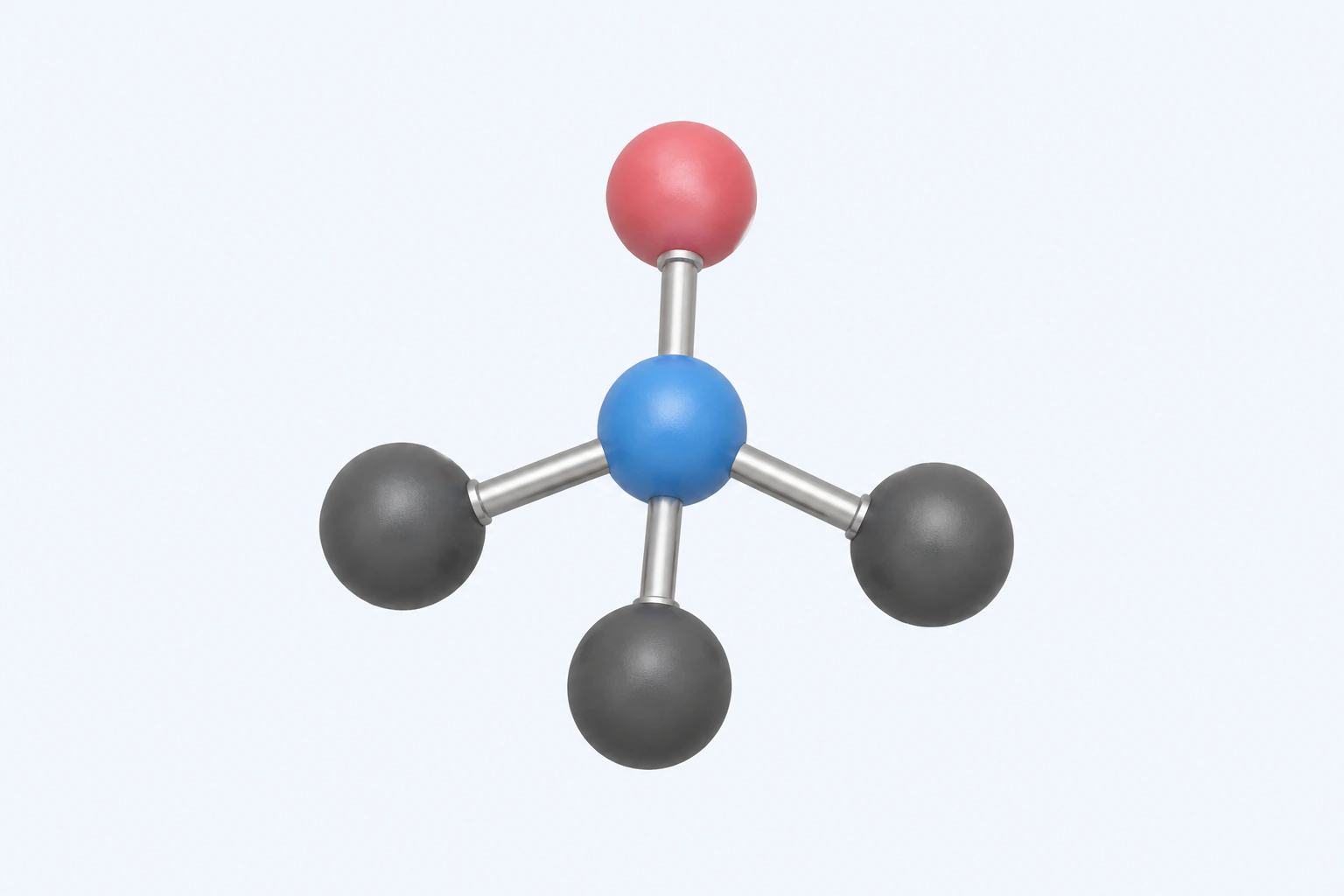
Heavy-atom connectivity orientation for trimethylamine N-oxide. Hydrogens, formal-charge mapping, measured conformation, concentration, pathway, and disease claims are intentionally omitted; this is an educational reconstruction.
Scientific media record4 verified identifiers
- Subject
- Trimethylamine N-Oxidebiological-process
- Review
- Editorial review completeIdentifiers authority-verified · Accessibility validated · · tmao|tmao-mechanism-v1.webp
- Digital source
- Trained-algorithmic mediaCreated with a trained generative algorithm and reviewed by WikiBiome for subject identity, scientific framing, identifiers, provenance, and accessibility.
- Scientific basis
- Trimethylamine N-oxide — PubChemTrimethylamine N-oxide — ChEBITrimethylamine N-Oxide (TMAO)
- License
- CC BY-SA 4.0Created
A Gut Microbiome-derived metabolite that has emerged as one of the strongest microbial biomarkers for Cardiovascular Disease risk. TMAO exemplifies how microbial metabolism of dietary nutrients can generate systemically toxic products—a fundamentally different paradigm from pathogen-driven disease.
Evidence map7 cited passagesInspect provenance +
Betaine: shellfish, beets, spinach.
TMA is absorbed from the gut into portal circulation and transported to the liver, where flavin monooxygenase 3 (FMO3) oxidizes it to TMAO. FMO3 has the highest activity of all FMOs for this reaction. Males have lower FMO3 expression than females, producing sex-specific TMAO level differences. Over 90% of TMAO is excreted in urine, giving it a high turnover
Activates nf kappa b, increasing TNF-alpha, IL-6, and suppressing anti-inflammatory IL-10.
Activates PKC/NF-kB, upregulating VCAM-1 and ICAM-1 adhesion molecules.
Plasma TMAO positively associated with HF risk and severity.
Alzheimer's disease: TMAO traverses the blood-brain barrier; elevated in CSF of cognitively impaired AD patients. May promote neuroinflammation and amyloid-beta aggregation.
IBD-CVD comorbidity: TMAO links gut dysbiosis in inflammatory bowel disease to increased cardiovascular risk.
Contents
1. Biosynthesis Pathway2. Mechanisms of Cardiovascular Harm3. TMAO Beyond CVD4. Metal Connections5. Therapeutic Targets6. ConnectionsBiosynthesis Pathway#
Step 1: Microbial TMA Production#
Gut bacteria metabolize dietary precursors to trimethylamine (TMA) using specific enzyme systems. CutC/CutD (choline TMA-lyase): cleaves choline to TMA. Found in Hungatella, Desulfovibrio, Clostridium, and certain Enterobacteriaceae.
CntA/CntB (carnitine monooxygenase): oxidizes L-carnitine to TMA. Found in Acinetobacter, Serratia, and some Gammaproteobacteria. YeaW/YeaX: converts betaine to TMA.
Dietary Precursors#
Choline: eggs, fish, seafood, liver, dairy products. Phosphatidylcholine (lecithin): eggs, dairy, meat. L-carnitine: red meat, fish.
Betaine: shellfish, beets, spinach.[1]The gut microbial metabolite trimethylamine N-oxide and cardiovascular diseasesJing Zhen, Zhou Zhou, Meng He et al. · 2023Open reference 1 ↓
Step 2: Hepatic Oxidation#
TMA is absorbed from the gut into portal circulation and transported to the liver, where flavin monooxygenase 3 (FMO3) oxidizes it to TMAO. FMO3 has the highest activity of all FMOs for this reaction. Males have lower FMO3 expression than females, producing sex-specific TMAO level differences.
Over 90% of TMAO is excreted in urine, giving it a high turnover rate.[1]The gut microbial metabolite trimethylamine N-oxide and cardiovascular diseasesJing Zhen, Zhou Zhou, Meng He et al. · 2023Open reference 1 ↓
Mechanisms of Cardiovascular Harm#
Atherosclerosis Promotion#
Inhibits reverse cholesterol transport (RCT) by downregulating the ABCG5/ABCG8 heterodimer. Upregulates scavenger receptors CD36 and SR-A1 on macrophages, increasing cholesterol uptake and foam cell formation. Activates NF-kB Signaling Pathway, increasing TNF-alpha, IL-6, and suppressing anti-inflammatory IL-10.[1]The gut microbial metabolite trimethylamine N-oxide and cardiovascular diseasesJing Zhen, Zhou Zhou, Meng He et al. · 2023Open reference 1 ↓
Activates NLRP3 inflammasome via TXNIP (thioredoxin-interacting protein).
Endothelial Dysfunction#
Activates HMGB1/TLR4 signaling, destroying tight junction proteins (ZO-2, occludin, VE-cadherin). Increases endothelial permeability, allowing LDL oxidation in the intima. Activates PKC/NF-kB, upregulating VCAM-1 and ICAM-1 adhesion molecules.[1]The gut microbial metabolite trimethylamine N-oxide and cardiovascular diseasesJing Zhen, Zhou Zhou, Meng He et al. · 2023Open reference 1 ↓
Platelet Hyperreactivity and Thrombosis#
Enhances platelet activation through calcium(II) (Ca2+) release from intracellular stores. Promotes platelet aggregation and adhesion, increasing thrombotic risk.
Heart Failure#
Accelerates myocardial hypertrophy via TGF-beta1/Smad3 signaling. Exacerbates mitochondrial dysfunction in cardiomyocytes. Plasma TMAO positively associated with HF risk and severity.[1]The gut microbial metabolite trimethylamine N-oxide and cardiovascular diseasesJing Zhen, Zhou Zhou, Meng He et al. · 2023Open reference 1 ↓
Hypertension#
Prolonged TMAO elevation activates pro-inflammatory vascular remodeling pathways. Associated with increased Firmicutes/Bacteroidetes ratio characteristic of Hypertension.
TMAO Beyond CVD#
Alzheimer's disease: TMAO traverses the blood-brain barrier; elevated in CSF of cognitively impaired AD patients. May promote Neuroinflammation and amyloid-beta aggregation.[2]Effects of gut microbiota on neurodegenerative diseasesKhatoon S, Kalam N, Rashid S et al. · 2023Open reference 2 ↓
Chronic kidney disease: Impaired renal clearance elevates TMAO; creates a feed-forward loop with CKD progression. IBD-CVD comorbidity: TMAO links gut Dysbiosis in Inflammatory Bowel Disease (IBD) to increased cardiovascular risk.[3]Inflammatory Bowel Disease and Cardiovascular Disease: An Integrative Review With a Focus on the Gut MicrobiomeCamila Sanchez Cruz, Anahi Rojas Huerta, Jesus Lima Barrientos et al. · 2024Open reference 3 ↓
Metal Connections#
Metal-induced dysbiosis enriches TMA-producing Gammaproteobacteria (Enterobacteriaceae) while depleting protective SCFA producers, potentially shifting the metabolite balance toward TMAO. Hungatella hathewayi, a major TMA producer, is metal-tolerant and enriched in dysbiotic states.
TMAO and Short-Chain Fatty Acids (SCFAs) represent opposing arms of microbiome metabolite output: metals push the balance from protective SCFAs toward harmful TMAO.
Therapeutic Targets#
DMB (3,3-dimethyl-1-butanol): Inhibits microbial TMA lyases; reduces TMAO without killing bacteria. Dietary modification: Reducing red meat/egg intake lowers TMAO; Mediterranean diet associated with lower TMAO. Resveratrol: Remodels gut microbiota to reduce TMA-producing taxa.
FMT: Potential to restore SCFA/TMAO balance by reintroducing beneficial communities.
Connections#
- Cardiovascular Disease—TMAO is a key driver of atherosclerosis, thrombosis, and heart failure
- Short-Chain Fatty Acids (SCFAs)—opposing metabolite arm; metal-driven dysbiosis shifts balance toward TMAO
- Hungatella—major TMA-producing genus
- Metal-Driven Inflammation—TMAO activates NF-kB and NLRP3 inflammasome
- dysbiosis—TMAO production reflects dysbiotic community composition
- Hypertension—TMAO contributes to vascular remodeling and BP elevation
- Alzheimer's Disease—TMAO crosses BBB and is elevated in AD CSF
References 7
Numbered by first appearance in the article, then reconciled with its declared source list.
- 1
Jing Zhen, Zhou Zhou, Meng He et al. (2023). The gut microbial metabolite trimethylamine N-oxide and cardiovascular diseases. Frontiers in Endocrinology.
- 2
Khatoon S, Kalam N, Rashid S et al. (2023). Effects of gut microbiota on neurodegenerative diseases. Frontiers in Aging Neuroscience.
- 3
Camila Sanchez Cruz, Anahi Rojas Huerta, Jesus Lima Barrientos et al. (2024). Inflammatory Bowel Disease and Cardiovascular Disease: An Integrative Review With a Focus on the Gut Microbiome. Cureus.
- 4
Dorothea Katharina Hoffelner, Tim Hendrikx (2025). Emerging therapy targets to modulate microbiome-mediated effects evident in cardiovascular disease. Frontiers in Cardiovascular Medicine.
- 5
Hilde Herrema, Max Nieuwdorp, Albert K. Groen (2020). Microbiome and Cardiovascular Disease. Handbook of Experimental Pharmacology (Prevention and Treatment of Atherosclerosis).
- 6
Naushad M. Mansuri, Neelam K. Mann, Shariqa Rizwan et al. (2022). Role of Gut Microbiome in Cardiovascular Events: A Systematic Review. Cureus.
- 7
Jing Gao, Kun-Tao Yan, Ji-Xiang Wang et al. (2020). Gut microbial taxa as potential predictive biomarkers for acute coronary syndrome and post-STEMI cardiovascular events. Scientific Reports.
Article network
Mentioned here 13
Pages linking here 20
Connect the evidence
Publicly readable discussion by ORCID-authenticated researchers. Questions, interpretation, methods, corrections, and new evidence stay attached to this record.
No discussion yet. Start with a precise question or a source-backed observation.
Activity and accepted changes
Accepted researcher context, editorial status, public discussion, and upstream Git revisions are shown together. Pending, declined, and withdrawn proposals remain private.
- published revision
Backfill gut microbiome concept links
Karen Pendergrass · +1 −1
Inspect exact Git diff ↗ - published revision
Complete corpus-wide Dysbiosis linking
Karen Pendergrass · +2 −2
Inspect exact Git diff ↗ - published revision
Complete Tight junctions contextual coverage
Karen Pendergrass · +1 −1
Inspect exact Git diff ↗ - published revision
Add NLRP3 inflammasome concept and link batch
Karen Pendergrass · +3 −3
Inspect exact Git diff ↗ - published revision
massive wiki expansion: 149 stubs fixed, 100+ new pages, Rule 15 scan, keystone papers
WikiBiome Deploy Bot · +14 −14
Inspect exact Git diff ↗ - published revision
nightly maintenance: 94 stub demotions, 181 source_count fixes, 22 auto-discovered stubs, 5 adversarial audits, 3 boundary fixes, 3 evidence-level corrections
WikiBiome Deploy Bot · +1 −0
Inspect exact Git diff ↗ - published revision
pre-overnight checkpoint 2026-04-18
WikiBiome Deploy Bot · +3 −1
Inspect exact Git diff ↗ - published revision
WikiBiome update — 2026-04-15 17:23
WikiBiome Deploy Bot · +0 −1
Inspect exact Git diff ↗ - published revision
WikiBiome update — integrity fixes, metallomic diet pages, cross-condition analyses
WikiBiome Deploy Bot · +18 −8
Inspect exact Git diff ↗ - published revision
WikiBiome update — 2026-04-10 15:45
WikiBiome Deploy Bot · +84 −0
Inspect exact Git diff ↗