
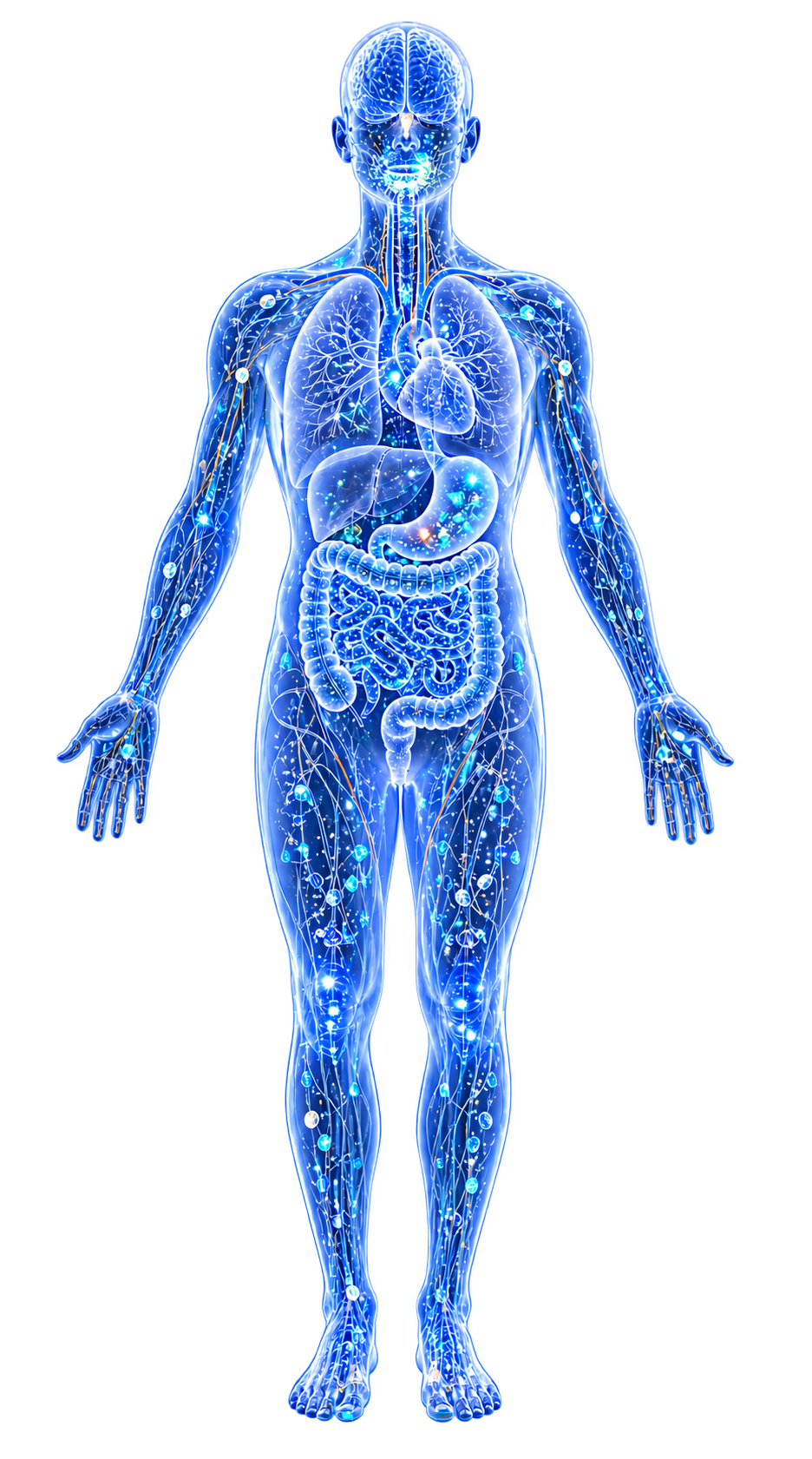
The kynurenine pathway (KP) is the dominant route of Tryptophan catabolism, accounting for approximately 95% of dietary tryptophan degradation. It produces a cascade of neuroactive, immunomodulatory, and potentially neurotoxic metabolites whose balance determines whether the net effect is neuroprotective or neurodegenerative.
The pathway is controlled by iron-dependent rate-limiting enzymes, placing it squarely at the intersection of metal biology and brain health—a connection that conventional neuroscience frequently overlooks.
Evidence map7 cited passagesInspect provenance +
Kynurenic acid (KA): Produced by kynurenine aminotransferases (KATs). An NMDA receptor antagonist and alpha-7 nicotinic receptor antagonist. Neuroprotective at physiological concentrations; anti-excitotoxic. Depleted in ASD fecal samples.
This mechanism explains why anti-inflammatory strategies can improve depressive symptoms even without directly targeting serotonin—by reducing IDO induction, they restore the tryptophan balance.
IDO-mediated tryptophan depletion is well-documented in inflammatory depression. Patients treated with IFN-alpha (for hepatitis C or cancer) develop depressive symptoms that correlate with kynurenine/tryptophan ratios, not with serotonin depletion per se.
Elevated kynurenic acid in cerebrospinal fluid is a consistent finding. As an NMDA antagonist, KA may contribute to the glutamatergic hypofunction underlying cognitive deficits and negative symptoms. This has led to the "kynurenine hypothesis" of schizophrenia.
QUIN accumulation around amyloid plaques is documented in alzheimers disease. QUIN promotes tau-phosphorylation and amyloid beta aggregation. In parkinsons disease, kynurenine pathway metabolites contribute to dopaminergic neuron vulnerability.
Tryptophan-kynurenine pathway remodeling occurs in cerebral palsy with comorbid epilepsy, reflecting the convergence of neuroinflammation and metabolic disruption.
Kynurenine pathway alterations are implicated in the neuroinflammatory component of premenstrual dysphoric disorder, where cyclical hormonal changes modulate IDO activity.
Contents
1. The Iron Gate2. The Metabolite Cascade3. The Tryptophan Steal4. Disease Involvement5. The Metal Connection6. Cross-ReferencesThe Iron Gate#
The pathway begins with the oxidative cleavage of tryptophan's indole ring, catalyzed by two heme-iron-dependent enzymes.
IDO1/IDO2 (indoleamine 2,3-dioxygenase): Expressed in immune cells (macrophages, dendritic cells) and gut epithelium. Powerfully induced by IFN-gamma during Metal-Driven Inflammation. IDO1 is the primary extrahepatic enzyme and the critical link between immune activation and tryptophan depletion.
TDO (tryptophan 2,3-dioxygenase): Constitutively expressed in the liver; responsible for homeostatic tryptophan regulation. Induced by glucocorticoids and tryptophan itself.
Both enzymes absolutely require heme iron as a prosthetic group. This means that Iron availability directly controls pathway flux. In iron-overloaded inflammatory states—precisely the conditions created by metal-driven Dysbiosis—IDO activity increases, amplifying the diversion of tryptophan away from serotonin and toward kynurenine metabolites.
The Metabolite Cascade#
From kynurenine, the pathway branches into neuroprotective and neurotoxic arms:
Neuroprotective Branch#
- Kynurenic acid (KA): Produced by kynurenine aminotransferases (KATs). An NMDA receptor antagonist and alpha-7 nicotinic receptor antagonist. Neuroprotective at physiological concentrations; anti-excitotoxic. Depleted in ASD fecal samples.[1]Aziz-Zadeh 2025 — Relationships Between Brain Activity, Tryptophan-Related Gut Metabolites, and Autism SymptomatologyLisa Aziz-Zadeh, Sofronia M. Ringold, Aditya Jayashankar et al. · 2025Open reference 1 ↓
Neurotoxic Branch#
3-Hydroxykynurenine (3-HK): Produced by kynurenine 3-monooxygenase (KMO). Generates free radicals through auto-oxidation; directly neurotoxic. 3-Hydroxyanthranilic acid (3-HAA): Downstream of 3-HK; both pro-oxidant and immunosuppressive.
Quinolinic acid (QUIN): Produced by 3-hydroxyanthranilic acid dioxygenase (3-HAAO) in macrophages and microglia. A potent NMDA receptor agonist and excitotoxin. Also generates ROS through lipid peroxidation, chelates iron to form redox-active complexes, and promotes tau phosphorylation.
Elevated in neuroinflammatory conditions including Alzheimer's, Parkinson's, and depression.
Picolinic acid: An endogenous metal chelator (binds iron, zinc, copper) with variable neuroprotective/neurotoxic effects depending on context.
The KA/QUIN Ratio#
The ratio of kynurenic acid to quinolinic acid serves as a functional readout of the pathway's net effect. In health, this ratio favors neuroprotection. Inflammation shifts it toward neurotoxicity by.
Upregulating IDO (increasing total pathway flux). Activating KMO in macrophages/microglia (directing flux toward the 3-HK/QUIN branch). Reducing KAT activity in astrocytes (diminishing the protective KA branch).
The Tryptophan Steal#
When IDO is chronically activated by inflammation, it creates a "tryptophan steal"—diverting substrate away from serotonin synthesis and toward kynurenine metabolites. This produces a dual insult. Serotonin depletion: Reduced substrate for TPH1/TPH2, contributing to mood and gastrointestinal dysfunction.
Neurotoxin accumulation: Elevated QUIN and 3-HK in the CNS.
This mechanism explains why anti-inflammatory strategies can improve depressive symptoms even without directly targeting serotonin—by reducing IDO induction, they restore the tryptophan balance.[2]Current Perspectives on Gut Microbiome Dysbiosis and DepressionCapuco A, Urits I, Hasoon J et al. · 2020Open reference 2 ↓
Disease Involvement#
Depression#
IDO-mediated tryptophan depletion is well-documented in inflammatory depression. Patients treated with IFN-alpha (for hepatitis C or cancer) develop depressive symptoms that correlate with kynurenine/tryptophan ratios, not with serotonin depletion per se.[2]Current Perspectives on Gut Microbiome Dysbiosis and DepressionCapuco A, Urits I, Hasoon J et al. · 2020Open reference 2 ↓
Schizophrenia#
Elevated kynurenic acid in cerebrospinal fluid is a consistent finding. As an NMDA antagonist, KA may contribute to the glutamatergic hypofunction underlying cognitive deficits and negative symptoms. This has led to the "kynurenine hypothesis" of schizophrenia.[3]The Gut Microbiome and Schizophrenia: The Current State of the Field and Clinical ApplicationsSzeligowski T, Yun AL, Lennox BR et al. · 2020Open reference 3 ↓[4]Ahmed 2024 — The Role of Infections and Inflammation in Schizophrenia: Review of the EvidenceGellan K Ahmed, Haidi Karam-Allah Ramadan, Khaled Elbeh et al. · 2024Open reference 4 ↓
Neurodegenerative Diseases#
QUIN accumulation around amyloid plaques is documented in Alzheimer's Disease. QUIN promotes tau-phosphorylation and Amyloid-Beta aggregation. In Parkinson's Disease, kynurenine pathway metabolites contribute to dopaminergic neuron vulnerability.[5]Effects of gut microbiota on neurodegenerative diseasesKhatoon S, Kalam N, Rashid S et al. · 2023Open reference 5 ↓[6]Microbial Metallomics and Parkinson's Disease: A Unified Metal-Driven Framework Linking Ferroptosis, Dysbiosis, and alpha-Synuclein PathologyKaren Pendergrass · 2025Open reference 6 ↓
Cerebral Palsy and Epilepsy#
Tryptophan-kynurenine pathway remodeling occurs in cerebral palsy with comorbid epilepsy, reflecting the convergence of neuroinflammation and metabolic disruption.[7]Peng 2023 — Gut Microbiome and Brain Metabolic Remodeling in CP with EpilepsyPeng A, et al. · 2023Open reference 7 ↓
PMDD#
Kynurenine pathway alterations are implicated in the neuroinflammatory component of premenstrual dysphoric disorder, where cyclical hormonal changes modulate IDO activity.[8]Cheng 2025 — Neuroinflammation in PMS and PMDD (Review)Cheng et al. · 2025Open reference 8 ↓
The Metal Connection#
The kynurenine pathway is metal-dependent at multiple nodes.
Iron: IDO and TDO require heme-iron; KMO requires FAD (which depends on riboflavin and iron-sulfur clusters). Zinc: KATs use pyridoxal phosphate (vitamin B6-dependent), and zinc modulates B6 metabolism. QUIN as iron chelator: Quinolinic acid forms redox-active iron complexes that generate hydroxyl radicals via Fenton chemistry, amplifying Oxidative Stress.
Picolinic acid: An endogenous chelator that binds iron, zinc, and copper at the pathway terminus.
This metal dependency means that the kynurenine pathway does not merely respond to inflammation—it responds to the specific metal landscape of the inflammatory environment.
Metal-driven dysbiosis that elevates iron and drives inflammation simultaneously provides the substrate (heme-iron for IDO) and the signal (IFN-gamma) to maximally activate the neurotoxic arm of the pathway.
Cross-References#
- Tryptophan—the pathway's substrate
- Tryptophan Metabolism—comprehensive overview of all three tryptophan routes
- Iron—cofactor for IDO/TDO
- Neuroinflammation—the driver and consequence of pathway activation
- oxidative stress—QUIN and 3-HK generate ROS
- tau-phosphorylation—QUIN promotes tau pathology
- Amyloid-Beta—QUIN promotes aggregation
- Gut-Brain Axis—the route by which peripheral IDO activity affects the brain
- inflammation—the master activator of IDO
References 10
Numbered by first appearance in the article, then reconciled with its declared source list.
- 1
Lisa Aziz-Zadeh, Sofronia M. Ringold, Aditya Jayashankar et al. (2025). Aziz-Zadeh 2025 — Relationships Between Brain Activity, Tryptophan-Related Gut Metabolites, and Autism Symptomatology. Nature Communications.
- 2
Capuco A, Urits I, Hasoon J et al. (2020). Current Perspectives on Gut Microbiome Dysbiosis and Depression. Advances in Therapy.
- 3
Szeligowski T, Yun AL, Lennox BR et al. (2020). The Gut Microbiome and Schizophrenia: The Current State of the Field and Clinical Applications. Frontiers in Psychiatry.
- 4
Gellan K Ahmed, Haidi Karam-Allah Ramadan, Khaled Elbeh et al. (2024). Ahmed 2024 — The Role of Infections and Inflammation in Schizophrenia: Review of the Evidence. Middle East Current Psychiatry.
- 5
Khatoon S, Kalam N, Rashid S et al. (2023). Effects of gut microbiota on neurodegenerative diseases. Frontiers in Aging Neuroscience.
- 6
★Karen Pendergrass (2025). Microbial Metallomics and Parkinson's Disease: A Unified Metal-Driven Framework Linking Ferroptosis, Dysbiosis, and alpha-Synuclein Pathology. Conference Presentation.
- 7
Peng A, et al. (2023). Peng 2023 — Gut Microbiome and Brain Metabolic Remodeling in CP with Epilepsy. Frontiers in Neurology.
- 8
Cheng et al. (2025). Cheng 2025 — Neuroinflammation in PMS and PMDD (Review). Frontiers in Endocrinology.
- 9
Agnieszka Krawczyk, Tomasz Kasperski, Tomasz Gosiewski et al. (2025). Krawczyk 2025 — Effects of Fecal Microbiota Transplantation on the Abundance and Diversity of Selected Fungal and Archaeal Species in the Gut Microbiota in the Rat Model of Schizophrenia. Pharmacological Reports.
- 10
V. Martinelli, M. Albanese, M. Altieri et al. (2022). Gut-oriented interventions in patients with multiple sclerosis: fact or fiction?. European Review for Medical and Pharmacological Sciences.
Article network
Mentioned here 12
Pages linking here 8
Connect the evidence
Publicly readable discussion by ORCID-authenticated researchers. Questions, interpretation, methods, corrections, and new evidence stay attached to this record.
No discussion yet. Start with a precise question or a source-backed observation.
Activity and accepted changes
Accepted researcher context, editorial status, public discussion, and upstream Git revisions are shown together. Pending, declined, and withdrawn proposals remain private.
- published revision
Backfill oxidative stress concept links
Karen Pendergrass · +1 −1
Inspect exact Git diff ↗ - published revision
Backfill inflammation concept links
Karen Pendergrass · +2 −2
Inspect exact Git diff ↗ - published revision
Complete corpus-wide Dysbiosis linking
Karen Pendergrass · +2 −2
Inspect exact Git diff ↗ - published revision
massive wiki expansion: 149 stubs fixed, 100+ new pages, Rule 15 scan, keystone papers
WikiBiome Deploy Bot · +15 −15
Inspect exact Git diff ↗ - published revision
pre-overnight checkpoint 2026-04-18
WikiBiome Deploy Bot · +93 −0
Inspect exact Git diff ↗