
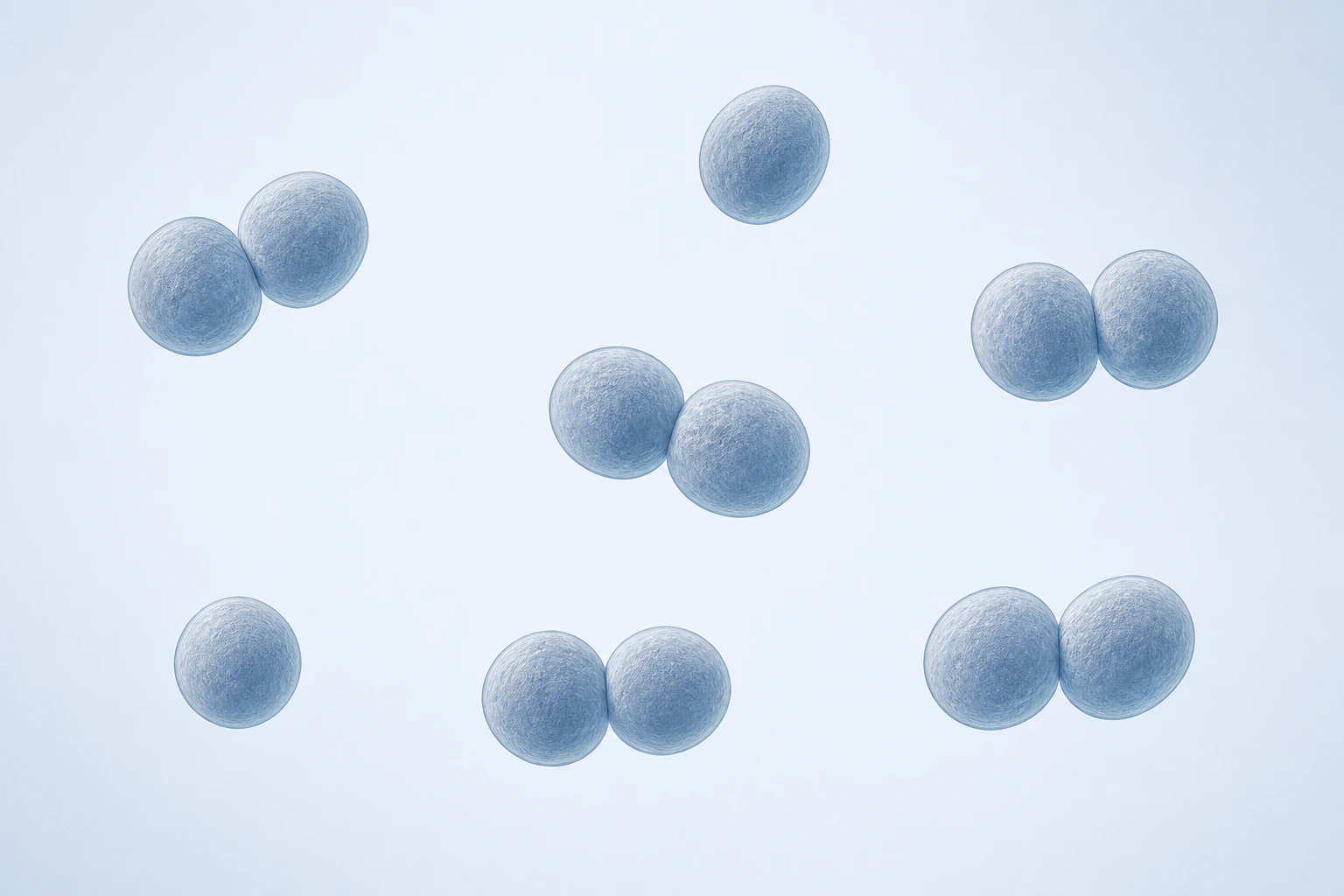
Representative Enterococcus faecium spherical-to-ovoid forms, shown as twelve bodies in two single and five paired groupings. This reconstruction is non-diagnostic, does not visually distinguish the species from E. faecalis, and is not a micrograph.
Scientific media record1 verified identifier
- Subject
- Enterococcus faeciumtaxon · species
- Identifiers
- NCBITaxon:1352
- Review
- Editorial review completeIdentifiers authority-verified · Accessibility validated · · enterococcus-faecium|enterococcus-faecium-morphology-v1.webp
- Digital source
- Trained-algorithmic mediaCreated with a trained generative algorithm and reviewed by WikiBiome for subject identity, scientific framing, identifiers, provenance, and accessibility.
- Scientific basis
- Enterococcus faecium — NCBI TaxonomyEnterococcus faecium — LPSNEnterococcus gen. nov. primary proposalEnterococcus faecium type strain — BacDiveEnterococcus authoritative review
- License
- CC BY-SA 4.0Created
Enterococcus faecium is a Gram-positive, facultatively anaerobic bacterium that epitomizes the metal-antibiotic Co-Selection problem in modern medicine. As one of the six ESKAPE pathogens (the group responsible for the majority of hospital-acquired infections that fail conventional treatment), E. faecium is a leading cause of vancomycin-resistant enterococcal (VRE) infections.
Its story in the WikiBiome framework is not one of metal-dependent virulence enzymes, but of resistance and co-selection—where metal exposure drives antibiotic resistance through shared mobile genetic elements.
Evidence map2 cited passagesInspect provenance +
E. faecium CX 2-6 responds to cadmium stress with massive transcriptional reprogramming: 1,152 differentially expressed genes—fully 47% of its genome—are activated under Cd exposure. The response includes:
Copper exposure alone—such as from hospital copper surfaces intended to reduce infection—selects for this entire resistance cassette
Contents
1. Metal Dependencies2. Metal Resistance and Co-Selection3. Ecological Role4. Conditions Associated5. Interkingdom Relationships6. Cross-ReferencesMetal Dependencies#
E. faecium relies on manganese rather than iron for its superoxide dismutase and core metabolic enzymes, giving it intrinsic resistance to host iron-restriction strategies. This manganese preference contributes to its survival in hospital environments where iron-chelating nutritional immunity is an ineffective defense.
Metal Resistance and Co-Selection#
Cadmium Response#
E. faecium CX 2-6 responds to cadmium stress with massive transcriptional reprogramming: 1,152 differentially expressed genes—fully 47% of its genome—are activated under cadmium (Cd) exposure.[1]Cadmium stress triggers significant metabolic reprogramming in Enterococcus faecium CX 2-6Cheng X, Yang B, Zheng J et al. · 2021Open reference 1 ↓ The response includes:
- Upregulation of cadA (P-type ATPase cadmium efflux pump)
- Massive EPS (exopolysaccharide) production increase—biofilm matrix that sequesters metals
- Stress response pathway activation
- Metabolic restructuring to compensate for metal-enzyme interference
Copper-Vancomycin Co-Selection#
The most clinically alarming feature of E. faecium is the physical co-location of metal and antibiotic resistance on transferable plasmids. tcrB (copper resistance) is linked to vanA (vancomycin resistance) and ermB (macrolide resistance) on a single mobile element.
Copper exposure alone—such as from hospital copper surfaces intended to reduce infection—selects for this entire resistance cassette.[2]Baker-Austin 2006 — Co-selection of Antibiotic and Metal ResistanceBaker-Austin C, Wright MS, Stepanauskas R et al. · 2006Open reference 2 ↓
This means that environmental metal contamination in hospital water, surfaces, or soil can drive the emergence of multi-drug resistant Enterococcus without any antibiotic exposure.
Ecological Role#
In the healthy gut, E. faecium is a minor community member. Its ecological significance emerges under disrupted conditions. Post-antibiotic expansion—Inherent resistance to many antibiotics allows rapid colonization of the depleted niche.
Hospital environment adaptation—Survives on dry surfaces for weeks; tolerates alcohol-based disinfectants; persists through cleaning protocols.
Biofilm formation—EPS production under metal stress creates protective communities that resist both antimicrobials and host immune clearance.
Conditions Associated#
| Context | Role |
|---|---|
| Hospital-acquired infections | VRE bloodstream infections; urinary tract infections |
| Post-antibiotic Dysbiosis | Opportunistic expansion after broad-spectrum antibiotic use |
| Type 2 Diabetes metformin response | Enriched in metformin responders (along with Odoribacter and Lactococcus) |
Interkingdom Relationships#
E. faecium forms mixed biofilms with Candida species in hospital settings, where fungal EPS provides additional structural protection. These interkingdom biofilms on medical devices (catheters, implants) are particularly recalcitrant to treatment.
Cross-References#
- Enterococcus—genus overview with full co-selection framework
- Co-Selection—metal-antibiotic resistance co-location mechanism
- Antimicrobial Resistance—ESKAPE pathogen context
- Cadmium—drives massive transcriptional reprogramming
- Copper—hospital surfaces may paradoxically select for VRE
- Metal Resistance Genes—cadA, tcrB as canonical examples
References 3
Numbered by first appearance in the article, then reconciled with its declared source list.
- 1
Cheng X, Yang B, Zheng J et al. (2021). Cadmium stress triggers significant metabolic reprogramming in Enterococcus faecium CX 2-6. Computational and Structural Biotechnology Journal.
- 2
Baker-Austin C, Wright MS, Stepanauskas R et al. (2006). Baker-Austin 2006 — Co-selection of Antibiotic and Metal Resistance. Trends in Microbiology.
- 3
Rebelo A, Mourao J, Freitas AR et al. (2021). Diversity of metal and antibiotic resistance genes in Enterococcus spp. from the last century reflects multiple pollution and genetic exchange among phyla from overlapping ecosystems. Science of the Total Environment.
Article network
Connect the evidence
Publicly readable discussion by ORCID-authenticated researchers. Questions, interpretation, methods, corrections, and new evidence stay attached to this record.
No discussion yet. Start with a precise question or a source-backed observation.
Published page changes
This record shows only material changes published on this page, including changes to its content, evidence, conclusions, or author context. Internal processes and discussion activity are excluded. Pending, declined, and withdrawn proposals remain private.
- published revision
Created “Enterococcus faecium”: Enterococcus faecium is a Gram-positive, facultatively anaerobic bacterium that epitomizes the metal-antibiotic co selection problem in modern medicine. As one of the six ESKAPE pathogens (the group…
Created “Enterococcus faecium”: Enterococcus faecium is a Gram-positive, facultatively anaerobic bacterium that epitomizes the metal-antibiotic co selection problem in modern medicine. As one of the six ESKAPE pathogens (the group… Published sections: Overview; Metal Dependencies; Cadmium Response; Copper-Vancomycin Co-Selection; Ecological Role; Conditions Associated; Interkingdom Relationships; Cross-References. · WikiBiome Deploy Bot · +79 −0
Inspect exact Git diff ↗