

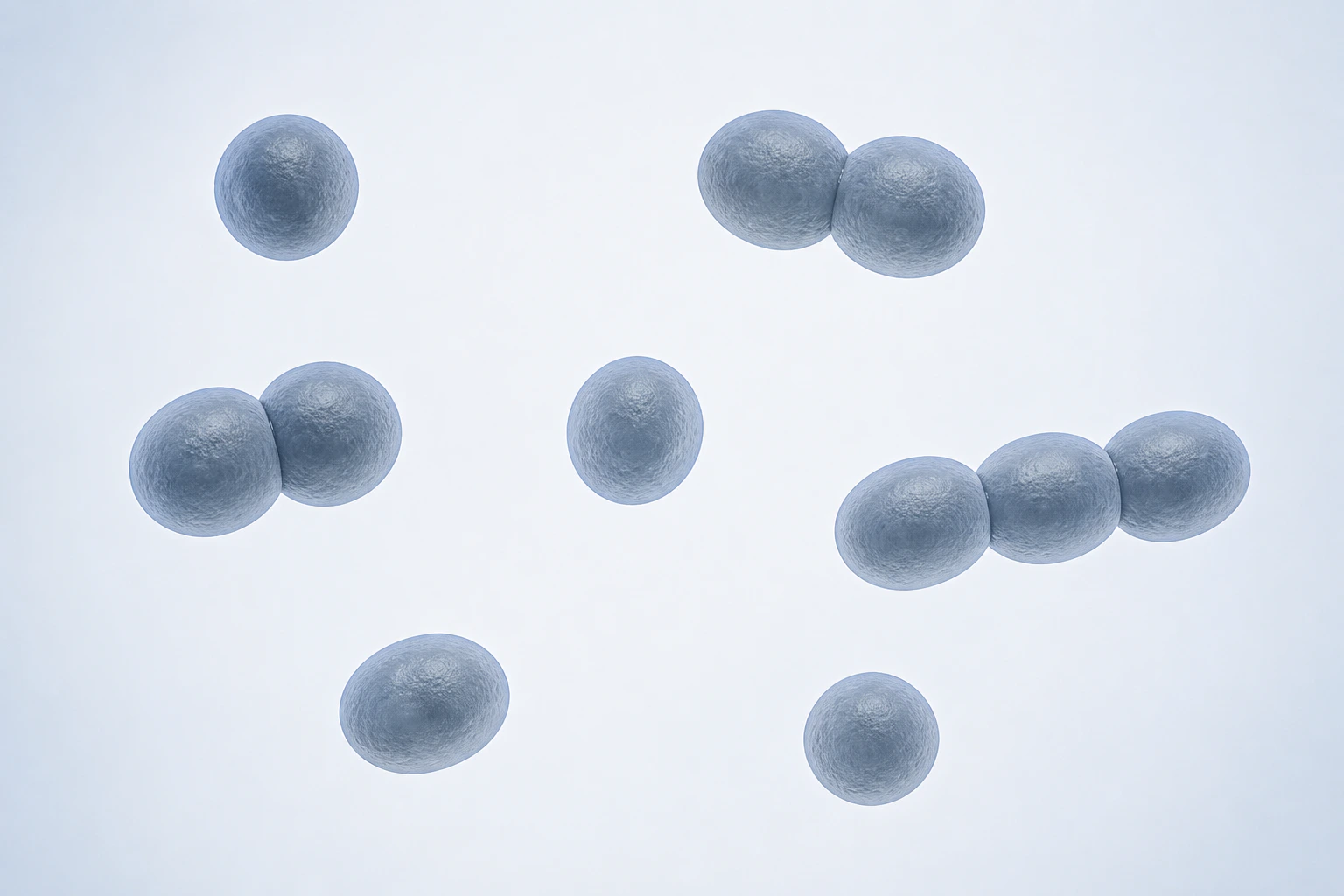
Selected type-species-anchored Enterococcus spherical-to-ovoid forms, shown as eleven bodies in four single, two paired, and one short-chain grouping. This reconstruction is representative, non-diagnostic, and not a micrograph.
Scientific media record1 verified identifier
- Subject
- Enterococcustaxon · genus
- Identifiers
- NCBITaxon:1350
- Review
- Editorial review completeIdentifiers authority-verified · Accessibility validated · · enterococcus|enterococcus-morphology-v1.webp
- Digital source
- Trained-algorithmic mediaCreated with a trained generative algorithm and reviewed by WikiBiome for subject identity, scientific framing, identifiers, provenance, and accessibility.
- Scientific basis
- Enterococcus — NCBI TaxonomyEnterococcus — LPSNEnterococcus gen. nov. primary proposalEnterococcus faecalis type strain — BacDiveEnterococcus authoritative review
- License
- CC BY-SA 4.0Created
A genus of Gram-positive bacteria (primarily E. faecalis and E. faecium) that exemplifies the metal-antibiotic resistance co-selection crisis.
Enterococci carry diverse metal tolerance genes for mercury, arsenic, copper, and cadmium on the same mobile genetic elements as antibiotic resistance genes—meaning environmental metal pollution directly drives the evolution of antibiotic-resistant hospital pathogens. A 120-year survey reveals accelerating co-evolution of metal and drug resistance since the 1990s.
Evidence map9 cited passagesInspect provenance +
Cadmium stress causes massive transcriptional reorganization in E. faecium:
These efflux systems are shared with related genera: parallels the CzcD system in streptococcus pneumoniae.
A landmark study of 381 isolates spanning 1900-2019 reveals the co-evolution of metal and antibiotic resistance:
Metal tolerance and antibiotic resistance genes systematically co-occur on conjugative plasmids: - vanA (vancomycin resistance) near mercury/arsenic tolerance regions. - tet(M) (tetracycline), erm(B) (macrolide), aac6'-Ie-aph2''-Ia (aminoglycoside) co-located with MeT genes. - Flanked by IS elements (IS110, IS256, IS200/605) enabling mobilization. - Associat
Metal resistance gene variants are shared between Enterococcus and distant taxa including Lactobacillus malefermentans, Streptococcus, and Staphylococcus.
Vancomycin-resistant Enterococcus (VRE): a top hospital-acquired infection threat; vanA on same mobile elements as metal resistance.
Agricultural metal use: copper and zinc as growth promoters in livestock feed; arsenic historically used in poultry production. These directly select for metal-tolerant Enterococci carrying antibiotic resistance genes.
Enterococcus is proposed as a bioindicator for metal pollution across diverse environments.
Not all Enterococci are pathogenic. Enterococcus hirae was significantly increased by berberine supplementation in Graves' disease patients alongside clinical improvement in thyroid function. This highlights the genus-level complexity: while E. faecalis and E. faecium are major nosocomial pathogens, other species may play beneficial roles in gut ecosystem mo
Contents
1. Metal-Dependent Biology2. Metal-Antibiotic Resistance Co-Selection3. Nutritional Immunity Context4. Disease Associations5. Connection to Environmental Metal Exposure6. Connections7. Beneficial RolesMetal-Dependent Biology#
Cadmium-Triggered Metabolic Reprogramming#
Cadmium stress causes massive transcriptional reorganization in E. faecium.[1]Cadmium stress triggers significant metabolic reprogramming in Enterococcus faecium CX 2-6Cheng X, Yang B, Zheng J et al. · 2021Open reference 1 ↓ 1,152 differentially expressed genes (47% of the genome) under cadmium exposure.
G1 (310 genes): Downregulated—nucleotide metabolism and DNA replication inhibited (growth arrest). G2 (658 genes): Upregulated at low cadmium (Cd)—ribosome and protein translation increased (stress response machinery). G3 (184 genes): Highly upregulated at high cadmium—carbohydrate transport, anion transport, and exopolysaccharide (EPS) production.
EPS production under cadmium stress is a key defense: the extracellular polysaccharide matrix sequesters cadmium ions before they can enter the cell, analogous to siderophore-based metal chelation in Pseudomonas aeruginosa.
P-type ATPase transporters highly upregulated for active cadmium efflux.
Metal Efflux Systems#
P-type ATPases: primary cadmium and copper efflux pumps. CDF (cation diffusion facilitator) family: zinc and cadmium export. These efflux systems are shared with related genera: parallels the CzcD system in Streptococcus pneumoniae.[2]Metal Homeostasis in Pathogenic StreptococciAkbari MS, Doran KS, Burcham LR · 2022Open reference 2 ↓
Metal-Antibiotic Resistance Co-Selection#
The 120-Year Survey#
A landmark study of 381 isolates spanning 1900-2019 reveals the co-evolution of metal and antibiotic resistance.[3]Diversity of metal and antibiotic resistance genes in Enterococcus spp. from the last century reflects multiple pollution and genetic exchange among phyla from overlapping ecosystemsRebelo A, Mourao J, Freitas AR et al. · 2021Open reference 3 ↓
Metal tolerance genes surveyed: arsA (arsenic), merA (mercury), tcrB (copper). Prevalence: arsA most frequent (82% of MeT-carrying isolates); merA 97% prevalence; tcrB less common. 13 phylogenetic variants of ArsA protein and 6 variants of MerA distributed across diverse ecological contexts (human clinical, animal, food, aquatic).
Temporal acceleration: co-occurrence of metal tolerance and antibiotic resistance genes increased dramatically since the 1990s, correlating with increased antimicrobial and metal use in agriculture and medicine.
Co-Occurrence on Mobile Elements#
Metal tolerance and antibiotic resistance genes systematically co-occur on conjugative plasmids.[3]Diversity of metal and antibiotic resistance genes in Enterococcus spp. from the last century reflects multiple pollution and genetic exchange among phyla from overlapping ecosystemsRebelo A, Mourao J, Freitas AR et al. · 2021Open reference 3 ↓ vanA (vancomycin resistance) near mercury/arsenic tolerance regions. tet(M) (tetracycline), erm(B) (macrolide), aac6'-Ie-aph2''-Ia (aminoglycoside) co-located with MeT genes.
Flanked by IS elements (IS110, IS256, IS200/605) enabling mobilization. Associated with conjugation genes (TraC, TraE, TraG) for horizontal transfer. This means: selecting for metal resistance automatically selects for antibiotic resistance and vice versa.
Cross-Phylum Gene Exchange#
Metal resistance gene variants are shared between Enterococcus and distant taxa including Lactobacillus malefermentans, Streptococcus, and Staphylococcus.[3]Diversity of metal and antibiotic resistance genes in Enterococcus spp. from the last century reflects multiple pollution and genetic exchange among phyla from overlapping ecosystemsRebelo A, Mourao J, Freitas AR et al. · 2021Open reference 3 ↓ Overlapping ecosystems (gut, food production, hospital, agricultural) enable gene flow across bacterial phyla.
This has implications for Staphylococcus aureus MRSA co-resistance evolution and even for probiotic safety (probiotic Lactobacillus may acquire resistance determinants from Enterococcus).
Nutritional Immunity Context#
Enterococci are not classic "metal-dependent virulence" pathogens like Urease-producers—their metal story is about resistance and co-selection rather than metal-dependent enzymes. However, metal homeostasis is still critical: manganese is required for superoxide dismutase, and zinc for multiple metalloenzymes.
Host nutritional immunity (calprotectin-mediated zinc (Zn)/manganese (Mn) sequestration) affects Enterococcal survival at infection sites. The cadmium metabolic reprogramming demonstrates that Enterococci have sophisticated metal stress responses that likely also engage during host-imposed metal challenges.
Disease Associations#
Vancomycin-resistant Enterococcus (VRE): a top hospital-acquired infection threat; vanA on same mobile elements as metal resistance.[3]Diversity of metal and antibiotic resistance genes in Enterococcus spp. from the last century reflects multiple pollution and genetic exchange among phyla from overlapping ecosystemsRebelo A, Mourao J, Freitas AR et al. · 2021Open reference 3 ↓ Endocarditis: E. faecalis is a leading cause of infective endocarditis. Urinary tract infections: common hospital-acquired UTI pathogen.
Bacteremia: especially in ICU patients, post-surgical, immunocompromised. Intra-abdominal/pelvic infections: as part of polymicrobial infections. Wound infections: surgical site infections.
Connection to Environmental Metal Exposure#
Agricultural metal use: copper and zinc as growth promoters in livestock feed; arsenic historically used in poultry production. These directly select for metal-tolerant Enterococci carrying antibiotic resistance genes.[3]Diversity of metal and antibiotic resistance genes in Enterococcus spp. from the last century reflects multiple pollution and genetic exchange among phyla from overlapping ecosystemsRebelo A, Mourao J, Freitas AR et al. · 2021Open reference 3 ↓
Hospital environments: copper-surfaced fittings intended to reduce hospital infections may paradoxically select for copper-tolerant (and therefore antibiotic-resistant) Enterococci. Food chain: metal-resistant Enterococci from animal production enter the human food chain, transferring resistance genes to human gut flora.
Wastewater/sewage: convergence point for antibiotic and metal residues, driving co-selection in environmental Enterococcus populations. Enterococcus is proposed as a bioindicator for metal pollution across diverse environments.[3]Diversity of metal and antibiotic resistance genes in Enterococcus spp. from the last century reflects multiple pollution and genetic exchange among phyla from overlapping ecosystemsRebelo A, Mourao J, Freitas AR et al. · 2021Open reference 3 ↓
Connections#
- Metal-Dependent Virulence—metal-antibiotic co-resistance on shared mobile elements; manganese (Mn)-SOD for oxidative defense
- Cadmium—triggers massive metabolic reprogramming; cadmium resistance genes co-selected with antibiotic resistance
- Mercury—merA mercury resistance genes on same plasmids as vanA
- Arsenic—arsA arsenic resistance is the most prevalent metal tolerance gene
- Copper—tcrB copper resistance; hospital copper surfaces may drive co-selection
- Staphylococcus aureus—parallel metal-antibiotic co-resistance in MRSA; shared gene exchange network
- Streptococcus pneumoniae—related metal homeostasis machinery; shared CDF pump family
- Pseudomonas aeruginosa—EPS-mediated extracellular metal sequestration parallels siderophore strategy
- Nutritional Immunity (Metal Sequestration)—host metal restriction affects Enterococcal infection dynamics
- Co-Selection—metal resistance genes co-located with vancomycin and aminoglycoside resistance on mobile elements
- Antimicrobial Resistance—VRE (vancomycin-resistant Enterococcus) is a paradigmatic AMR threat in hospitals
Beneficial Roles#
Not all Enterococci are pathogenic. Enterococcus hirae was significantly increased by berberine supplementation in Graves' disease patients alongside clinical improvement in thyroid function.[4]Han et al. 2022 — The Potential Prebiotic Berberine Combined With Methimazole Improved the Therapeutic Effect of Graves' Disease Patients Through Regulating the Intestinal MicrobiomeHan Z, Cen C, Ou Q et al. · 2022Open reference 4 ↓
This highlights the genus-level complexity: while E. faecalis and E. faecium are major nosocomial pathogens, other species may play beneficial roles in gut ecosystem modulation under specific therapeutic contexts.
References 4
Numbered by first appearance in the article, then reconciled with its declared source list.
- 1
Cheng X, Yang B, Zheng J et al. (2021). Cadmium stress triggers significant metabolic reprogramming in Enterococcus faecium CX 2-6. Computational and Structural Biotechnology Journal.
- 2
Akbari MS, Doran KS, Burcham LR (2022). Metal Homeostasis in Pathogenic Streptococci. Microorganisms.
- 3
Rebelo A, Mourao J, Freitas AR et al. (2021). Diversity of metal and antibiotic resistance genes in Enterococcus spp. from the last century reflects multiple pollution and genetic exchange among phyla from overlapping ecosystems. Science of the Total Environment.
- 4
Han Z, Cen C, Ou Q et al. (2022). Han et al. 2022 — The Potential Prebiotic Berberine Combined With Methimazole Improved the Therapeutic Effect of Graves' Disease Patients Through Regulating the Intestinal Microbiome. Frontiers in Immunology.
Article network
Mentioned here 12
Pages linking here 21
Connect the evidence
Publicly readable discussion by ORCID-authenticated researchers. Questions, interpretation, methods, corrections, and new evidence stay attached to this record.
No discussion yet. Start with a precise question or a source-backed observation.
Activity and accepted changes
Accepted researcher context, editorial status, public discussion, and upstream Git revisions are shown together. Pending, declined, and withdrawn proposals remain private.
- published revision
Complete reviewed Urease contextual coverage
Karen Pendergrass · +1 −1
Inspect exact Git diff ↗ - published revision
massive wiki expansion: 149 stubs fixed, 100+ new pages, Rule 15 scan, keystone papers
WikiBiome Deploy Bot · +30 −30
Inspect exact Git diff ↗ - published revision
Fix duplicate YAML frontmatter keys and deploy updated content
WikiBiome Deploy Bot · +8 −6
Inspect exact Git diff ↗ - published revision
nightly maintenance: 94 stub demotions, 181 source_count fixes, 22 auto-discovered stubs, 5 adversarial audits, 3 boundary fixes, 3 evidence-level corrections
WikiBiome Deploy Bot · +3 −0
Inspect exact Git diff ↗ - published revision
18 foundational sources + 10 microbe entities deepened
WikiBiome Deploy Bot · +2 −2
Inspect exact Git diff ↗ - published revision
WikiBiome update — 2026-04-15 17:23
WikiBiome Deploy Bot · +8 −8
Inspect exact Git diff ↗ - published revision
wiki: bulk entity upgrades, new article pages, and site regeneration
WikiBiome Deploy Bot · +6 −0
Inspect exact Git diff ↗ - published revision
WikiBiome v2 migration: signature pages + safety fixes + gap analysis
WikiBiome Deploy Bot · +3 −0
Inspect exact Git diff ↗ - published revision
WikiBiome update — integrity fixes, metallomic diet pages, cross-condition analyses
WikiBiome Deploy Bot · +8 −6
Inspect exact Git diff ↗ - published revision
WikiBiome v7 — interactive microbiome metallomics encyclopedia
Karen Pendergrass · +89 −0
Inspect exact Git diff ↗