

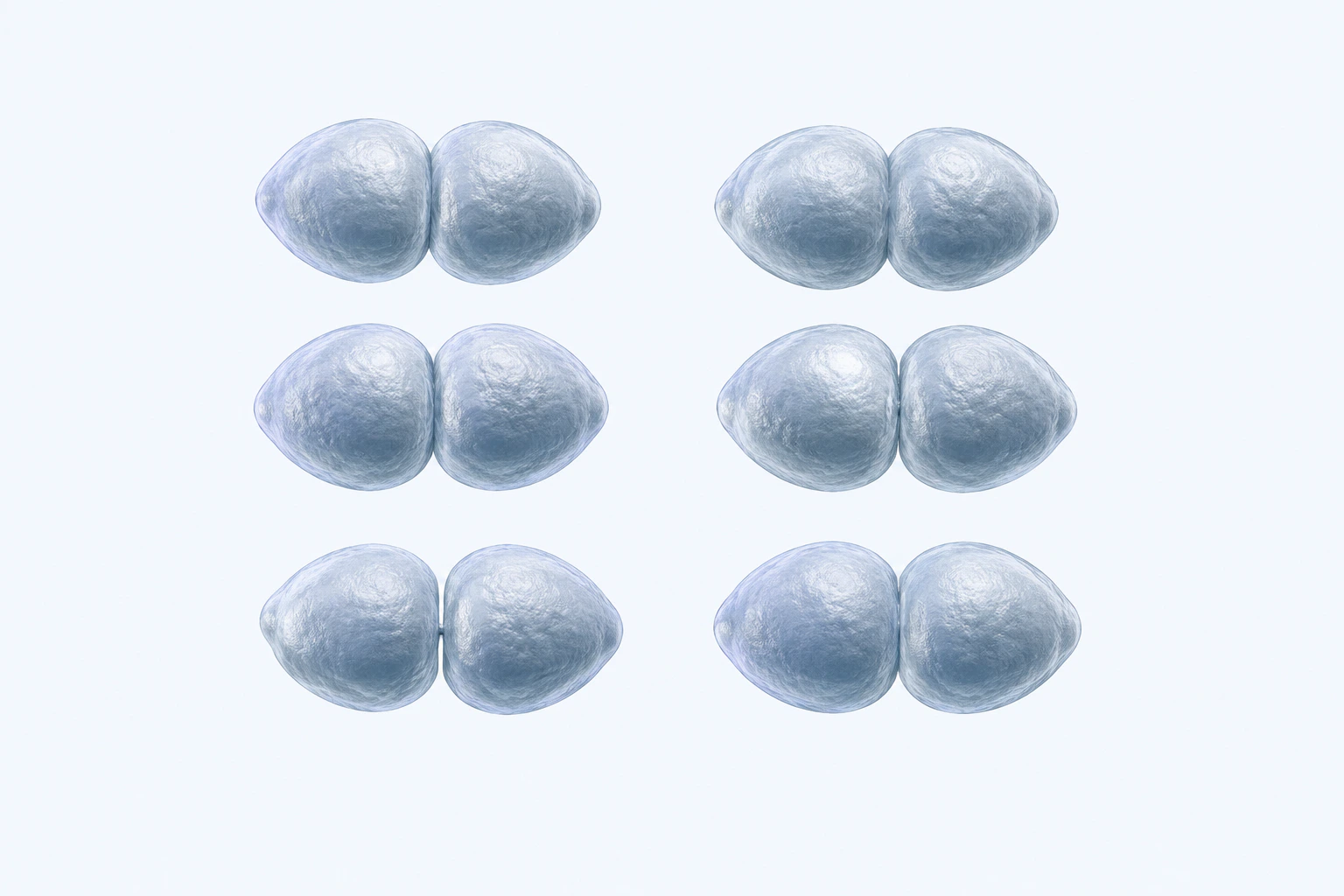
Type-strain-anchored Streptococcus pneumoniae reconstruction with twelve ovoid cocci in six pairs. Representative, non-diagnostic, and not a micrograph; capsule is not depicted.
Scientific media record1 verified identifier
- Subject
- Streptococcus pneumoniaetaxon · species
- Identifiers
- NCBITaxon:1313
- Review
- Editorial review completeIdentifiers authority-verified · Accessibility validated · · streptococcus-pneumoniae|streptococcus-pneumoniae-morphology-v1.webp
- Digital source
- Trained-algorithmic mediaCreated with a trained generative algorithm and reviewed by WikiBiome for subject identity, scientific framing, identifiers, provenance, and accessibility.
- Scientific basis
- Streptococcus pneumoniae — NCBI TaxonomyStreptococcus pneumoniae — LPSNStreptococcus — Medical Microbiology
- License
- CC BY-SA 4.0Created
A Gram-positive pathogen (the "pneumococcus") that depends on iron, manganese, and zinc for virulence and has evolved dedicated transport systems for each.
Iron is required for viability itself, manganese powers the superoxide dismutase needed to survive the oxidative burst, and zinc homeostasis (import via AdcABC, export via CzcD) is critical for colonization.
The pneumococcus faces aggressive host nutritional immunity at every infection site—meninges, lungs, middle ear, blood—and its metal transporters are among its most important virulence factors.
Evidence map13 cited passagesInspect provenance +
S. pneumoniae requires iron for growth and viability.
SodA: Mn-dependent superoxide dismutase, the primary defense against reactive oxygen species.
Essential for surviving the neutrophil oxidative burst during pneumonia and bacteremia.
Mn acquisition via PsaA/MtsABC is therefore directly linked to oxidative stress survival.
Cadmium can disrupt Mn uptake/efflux, indirectly increasing oxidative stress susceptibility—a vulnerability that could be exploited therapeutically.
PiaA/PiuA: ABC-type iron uptake lipoproteins. - PiaA and PiuA are independently important for virulence; double mutants are severely attenuated. - Part of iron-regulated operons induced under iron limitation.
22 kDa and 37 kDa membrane proteins: the first characterized hemoglobin/heme-binding proteins in S. pneumoniae. - Both bind hemoglobin AND free heme. - Compete for the tetrapyrrole ring (shared binding with vitamin B12). - Contain the KVAFDH motif essential for heme binding, conserved with the Shr protein of S. pyogenes.
PsaA/PsaBCA (MtsABC/SloABC): the primary Mn ABC transporter. - PsaA is a surface-exposed lipoprotein and vaccine candidate. - PsaA mutants are severely attenuated in colonization, pneumonia, and bacteremia models. - Also transports Zn at lower affinity.
MntE: CDF-family Mn exporter to prevent manganese toxicity.
AdcABC/AdcAII: ABC-type zinc import system. - AdcA and AdcAII are two distinct solute-binding proteins with different zinc affinities. - Pht (polyhistidine triad) proteins: surface-exposed zinc-binding/storage proteins that feed zinc to AdcAII. - Adc mutants show attenuated nasopharyngeal colonization and meningitis.
CopA: P-type ATPase for copper efflux.
Largely uncharacterized in S. pneumoniae.
Calprotectin (S100A8/A9): sequesters Zn and Mn at infection sites. Released by neutrophils infiltrating the lung, meninges, and middle ear. Directly inhibits pneumococcal growth by starving PsaA and AdcABC of their substrates.
Contents
1. Metal-Dependent Virulence Factors2. Metal Acquisition Systems3. Nutritional Immunity Evasion4. Disease Associations5. Connection to Environmental Metal Exposure6. ConnectionsMetal-Dependent Virulence Factors#
Iron—Required for Viability#
S. pneumoniae requires iron for growth and viability.[1]Streptococcus pneumoniae Requires Iron for Its Viability and Expresses Two Membrane Proteins That Bind Haemoglobin and HaemMaria Elena Romero-Espejel, Marco A. Gonzalez-Lopez, Jose de Jesus Olivares-Trejo · 2013Open reference 1 ↓ Iron starvation arrested growth and reduced viability to ~50% within 5 hours. Supplementation with hemoglobin restored viability to ~90% within 5 hours.
Can use hemoglobin and heme as sole iron sources, but not holo-transferrin or holo-lactoferrin—indicating it has evolved to scavenge iron from damaged red blood cells rather than competing for host iron-binding proteins.
Mn-Dependent Superoxide Dismutase (Mn-SOD)#
SodA: manganese (Mn)-dependent superoxide dismutase, the primary defense against reactive oxygen species.[2]Metal Homeostasis in Pathogenic StreptococciAkbari MS, Doran KS, Burcham LR · 2022Open reference 2 ↓[3]Eijkelkamp et al. 2014 — Extracellular Zinc Competitively Inhibits Manganese Uptake in Streptococcus pneumoniaeBart A. Eijkelkamp, Jacqueline R. Morey, Stephanie L. Neville et al. · 2014Open reference 3 ↓ Essential for surviving the neutrophil oxidative burst during pneumonia and bacteremia.[4]Neville et al. 2020 — Cadmium Stress Dictates Central Carbon Flux and Alters Membrane Composition in Streptococcus pneumoniaeStephanie L. Neville, Jacqueline R. Morey, Erin B. Gillen et al. · 2020Open reference 4 ↓
manganese acquisition via PsaA/MtsABC is therefore directly linked to Oxidative Stress survival.[3]Eijkelkamp et al. 2014 — Extracellular Zinc Competitively Inhibits Manganese Uptake in Streptococcus pneumoniaeBart A. Eijkelkamp, Jacqueline R. Morey, Stephanie L. Neville et al. · 2014Open reference 3 ↓
Cadmium can disrupt manganese uptake/efflux, indirectly increasing oxidative stress susceptibility—a vulnerability that could be exploited therapeutically.[5]Begg et al. 2015 — Dysregulation of Transition Metal Ion Homeostasis Is the Molecular Basis for Cadmium Toxicity in Streptococcus pneumoniaeStephanie L. Begg, Bart A. Eijkelkamp, Zhenyao Luo et al. · 2015Open reference 5 ↓[4]Neville et al. 2020 — Cadmium Stress Dictates Central Carbon Flux and Alters Membrane Composition in Streptococcus pneumoniaeStephanie L. Neville, Jacqueline R. Morey, Erin B. Gillen et al. · 2020Open reference 4 ↓
Zn-Dependent Metalloenzymes#
Zinc is cofactor for numerous metabolic enzymes. Zinc homeostasis is tightly regulated because both deficiency and excess are lethal.
Metal Acquisition Systems#
Iron Acquisition#
PiaA/PiuA: ABC-type iron uptake lipoproteins.[2]Metal Homeostasis in Pathogenic StreptococciAkbari MS, Doran KS, Burcham LR · 2022Open reference 2 ↓ PiaA and PiuA are independently important for virulence; double mutants are severely attenuated. Part of iron-regulated operons induced under iron limitation.
22 kDa and 37 kDa membrane proteins: the first characterized hemoglobin/heme-binding proteins in S. pneumoniae.[1]Streptococcus pneumoniae Requires Iron for Its Viability and Expresses Two Membrane Proteins That Bind Haemoglobin and HaemMaria Elena Romero-Espejel, Marco A. Gonzalez-Lopez, Jose de Jesus Olivares-Trejo · 2013Open reference 1 ↓ Both bind hemoglobin AND free heme. Compete for the tetrapyrrole ring (shared binding with vitamin B12).
Contain the KVAFDH motif essential for heme binding, conserved with the Shr protein of S. pyogenes. FeoABC: ferrous iron transporter for anaerobic/low-oxygen environments. Notably, S. pneumoniae does not produce classical siderophores—it relies on direct heme/hemoglobin binding and ABC transporters.
Manganese Acquisition#
PsaA/PsaBCA (MtsABC/SloABC): the primary manganese (Mn) ABC transporter.[2]Metal Homeostasis in Pathogenic StreptococciAkbari MS, Doran KS, Burcham LR · 2022Open reference 2 ↓ PsaA is a surface-exposed lipoprotein and vaccine candidate. PsaA mutants are severely attenuated in colonization, pneumonia, and bacteremia models.
Also transports zinc (Zn) at lower affinity. MntH (NRAMP family): secondary manganese importer.
Manganese Export#
MntE: CDF-family manganese (Mn) exporter to prevent manganese toxicity.[2]Metal Homeostasis in Pathogenic StreptococciAkbari MS, Doran KS, Burcham LR · 2022Open reference 2 ↓ Balances manganese import via PsaA; mntE mutants accumulate toxic manganese levels.
Zinc Homeostasis#
AdcABC/AdcAII: ABC-type zinc import system.[2]Metal Homeostasis in Pathogenic StreptococciAkbari MS, Doran KS, Burcham LR · 2022Open reference 2 ↓ AdcA and AdcAII are two distinct solute-binding proteins with different zinc affinities. Pht (polyhistidine triad) proteins: surface-exposed zinc-binding/storage proteins that feed zinc to AdcAII.
Adc mutants show attenuated nasopharyngeal colonization and meningitis. CzcD: CDF-family zinc exporter. Exports zinc (and possibly cadmium) to prevent intracellular toxicity.
Essential when host neutrophils pump zinc into phagosomes as an antimicrobial strategy.
Copper Homeostasis#
CopA: P-type ATPase for copper efflux.[2]Metal Homeostasis in Pathogenic StreptococciAkbari MS, Doran KS, Burcham LR · 2022Open reference 2 ↓ CopY: copper-responsive repressor regulating copA expression. Copper intoxication by macrophages is a key host defense; CopA enables survival.
Nickel#
Largely uncharacterized in S. pneumoniae.[2]Metal Homeostasis in Pathogenic StreptococciAkbari MS, Doran KS, Burcham LR · 2022Open reference 2 ↓ A LarA homolog (nickel (Ni)-dependent lactate racemase) is present in the genome, suggesting some nickel utilization. No characterized nickel transporter; the UreMQO system known in S. salivarius has not been identified in pneumococcus.
Nutritional Immunity Evasion#
S. pneumoniae encounters metal restriction at every infection site. Calprotectin (S100A8/A9): sequesters zinc (Zn) and manganese (Mn) at infection sites. Released by neutrophils infiltrating the lung, meninges, and middle ear.
Directly inhibits pneumococcal growth by starving PsaA and AdcABC of their substrates.[3]Eijkelkamp et al. 2014 — Extracellular Zinc Competitively Inhibits Manganese Uptake in Streptococcus pneumoniaeBart A. Eijkelkamp, Jacqueline R. Morey, Stephanie L. Neville et al. · 2014Open reference 3 ↓
Lactoferrin: sequesters iron in mucosal secretions. Notably, S. pneumoniae cannot use lactoferrin-bound iron, making lactoferrin an effective barrier. Transferrin: sequesters iron in blood.
Again, pneumococcus cannot access transferrin-bound iron—it must wait for red blood cell lysis to access hemoglobin.
Zinc intoxication: neutrophils pump zinc into phagosomes to toxic levels; CzcD exports excess zinc as a countermeasure. Copper intoxication: macrophage copper pumps target engulfed pneumococci; CopA provides defense.
The pneumococcus is therefore caught in a dual bind: metal starvation in extracellular spaces (calprotectin, lactoferrin) and metal intoxication inside phagocytes (zinc, copper (Cu) poisoning).
Disease Associations#
Community-acquired pneumonia: the most common bacterial cause worldwide. Bacterial meningitis: leading cause in children and adults; iron acquisition is critical in CSF. Otitis media: the most common cause of middle ear infection in children.
Bacteremia/sepsis: especially in asplenic patients and young children. Sinusitis: common upper respiratory infection.
Connection to Environmental Metal Exposure#
Host iron status directly affects pneumococcal disease severity: iron supplementation in iron-deficient populations has been associated with increased infection rates.
Zinc supplementation is used therapeutically to reduce pneumonia incidence in children—partly by enhancing host immunity but potentially also by altering metal availability dynamics.
Cadmium disruption of manganese (Mn) homeostasis (via competition for PsaA and disruption of MntE) suggests that environmental cadmium exposure could paradoxically increase pneumococcal oxidative stress susceptibility—or select for cadmium-tolerant variants.
Manganese-rich diets or supplements may support both host SOD function and, inadvertently, pneumococcal manganese-SOD.
Connections#
- Metal-Dependent Virulence—iron (Fe) required for viability; manganese (Mn)-SOD for oxidative defense; PsaA as vaccine target
- Iron—absolutely required for viability; acquired via hemoglobin/heme binding (not siderophores)
- Manganese—powers SOD for oxidative defense; PsaA is a vaccine candidate
- Zinc—AdcABC import and CzcD export; Pht surface proteins for zinc scavenging
- Copper—CopA efflux defends against macrophage copper intoxication
- Nickel—largely uncharacterized; LarA homolog suggests some utilization
- Nutritional Immunity (Metal Sequestration)—faces both metal starvation and metal intoxication by the host
- Staphylococcus aureus—both face calprotectin-mediated metal restriction at infection sites
- Enterococcus—shared CDF pump family for zinc/cadmium export
- Helicobacter pylori—contrasting metal strategies: pneumococcus needs iron/manganese/zinc (Zn), H. pylori needs nickel (Ni)
References 8
Numbered by first appearance in the article, then reconciled with its declared source list.
- 1
Maria Elena Romero-Espejel, Marco A. Gonzalez-Lopez, Jose de Jesus Olivares-Trejo (2013). Streptococcus pneumoniae Requires Iron for Its Viability and Expresses Two Membrane Proteins That Bind Haemoglobin and Haem. Metallomics.
- 2
Akbari MS, Doran KS, Burcham LR (2022). Metal Homeostasis in Pathogenic Streptococci. Microorganisms.
- 3
Bart A. Eijkelkamp, Jacqueline R. Morey, Stephanie L. Neville et al. (2014). Eijkelkamp et al. 2014 — Extracellular Zinc Competitively Inhibits Manganese Uptake in Streptococcus pneumoniae. PLoS ONE.
- 4
Stephanie L. Neville, Jacqueline R. Morey, Erin B. Gillen et al. (2020). Neville et al. 2020 — Cadmium Stress Dictates Central Carbon Flux and Alters Membrane Composition in Streptococcus pneumoniae. Communications Biology.
- 5
Stephanie L. Begg, Bart A. Eijkelkamp, Zhenyao Luo et al. (2015). Begg et al. 2015 — Dysregulation of Transition Metal Ion Homeostasis Is the Molecular Basis for Cadmium Toxicity in Streptococcus pneumoniae. Nature Communications.
- 6
Reuben Opoku, Edgar Carrasco, Nicholas R De Lay et al. (2024). Opoku 2024 — Calcium Rescues Streptococcus pneumoniae D39 delta-mntE Manganese-Sensitive Growth Phenotype. Microorganisms.
- 7
Nicholas R De Lay, Nidhi Verma, Dhriti Sinha et al. (2024). De Lay 2024 — The Five Homologous CiaR-Controlled Ccn sRNAs of Streptococcus pneumoniae Modulate Zn-Resistance. PLOS Pathogens.
- 8
Julia E. Martin, Lauren S. Waters (2022). Martin & Waters 2022 — Manganese Homeostasis, Stress, and Pathogenesis in Bacteria. Frontiers in Molecular Biosciences.
Article network
Mentioned here 11
Pages linking here 13
Connect the evidence
Publicly readable discussion by ORCID-authenticated researchers. Questions, interpretation, methods, corrections, and new evidence stay attached to this record.
No discussion yet. Start with a precise question or a source-backed observation.
Activity and accepted changes
Accepted researcher context, editorial status, public discussion, and upstream Git revisions are shown together. Pending, declined, and withdrawn proposals remain private.
- published revision
Backfill oxidative stress concept links
Karen Pendergrass · +1 −1
Inspect exact Git diff ↗ - published revision
massive wiki expansion: 149 stubs fixed, 100+ new pages, Rule 15 scan, keystone papers
WikiBiome Deploy Bot · +40 −35
Inspect exact Git diff ↗ - published revision
nightly maintenance: 94 stub demotions, 181 source_count fixes, 22 auto-discovered stubs, 5 adversarial audits, 3 boundary fixes, 3 evidence-level corrections
WikiBiome Deploy Bot · +3 −0
Inspect exact Git diff ↗ - published revision
18 foundational sources + 10 microbe entities deepened
WikiBiome Deploy Bot · +5 −5
Inspect exact Git diff ↗ - published revision
WikiBiome update — 2026-04-15 17:23
WikiBiome Deploy Bot · +13 −13
Inspect exact Git diff ↗ - published revision
v2 migration Priority 3: 17 metal + 82 microbe entities upgraded with seo_target, wikipedia_differentiation, conditions data
WikiBiome Deploy Bot · +6 −0
Inspect exact Git diff ↗ - published revision
WikiBiome update — integrity fixes, metallomic diet pages, cross-condition analyses
WikiBiome Deploy Bot · +15 −10
Inspect exact Git diff ↗ - published revision
WikiBiome v7 — interactive microbiome metallomics encyclopedia
Karen Pendergrass · +113 −0
Inspect exact Git diff ↗