

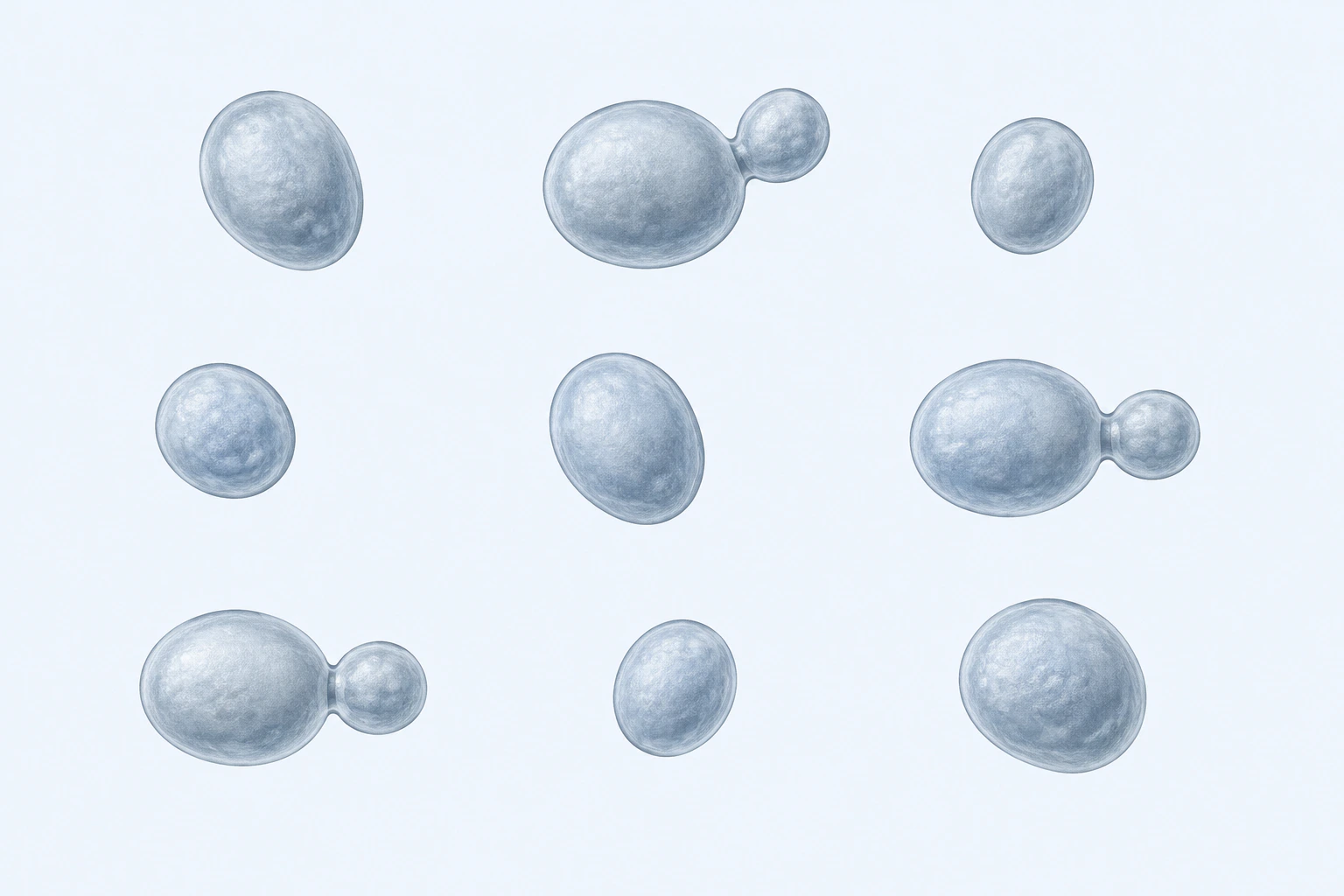
Current-name, type-strain-anchored Nakaseomyces glabratus reconstruction showing twelve subglobose-to-ovoid bodies in six single and three budding-pair groupings. This scientific reconstruction is representative, non-diagnostic, and not a micrograph.
Scientific media record3 verified identifiers
- Subject
- Nakaseomyces glabratustaxon · species
- Review
- Editorial review completeIdentifiers authority-verified · Accessibility validated · · nakaseomyces-glabratus|nakaseomyces-glabratus-morphology-v1.webp
- Digital source
- Trained-algorithmic mediaCreated with a trained generative algorithm and reviewed by WikiBiome for subject identity, scientific framing, identifiers, provenance, and accessibility.
- Scientific basis
- Nakaseomyces glabratus — NCBI TaxonomyNakaseomyces glabratus — Index FungorumNakaseomyces glabratus — MycoBankNakaseomyces glabratus current combinationNakaseomyces glabratus ATCC 2001
- License
- CC BY-SA 4.0Created
Nakaseomyces glabratus is the current name for NCBITaxon:5478. Takashima and Sugita established the current combination in 2022 as MycoBank MB 843854; Candida glabrata is a homotypic synonym and former combination, while Cryptococcus glabratus H.tungsten (W).
Anderson 1917 is the basionym.[1]NCBI Taxonomy — Nakaseomyces glabratus (NCBITaxon:5478)Author information pendingOpen reference 1 ↓[2]Index Fungorum — Nakaseomyces glabratusAuthor information pendingOpen reference 2 ↓[3]Takashima and Sugita 2022 — Transfer of Candida glabrata to Nakaseomyces glabratusMasako Takashima, Takashi Sugita · 2022Open reference 3 ↓
Anderson's original description introduced the organism from the human intestinal tract, and the nomenclatural records connect its type material to current strain deposits including CBS 138 and ATCC 2001.[4]Anderson 1917 — Yeast-Like Fungi of the Human Intestinal TractHarry Warren Anderson · 1917Open reference 4 ↓
The clinical and experimental sources summarized below mostly use Candida glabrata or C. glabrata. WikiBiome preserves those historical study labels rather than silently rewriting them. They refer to this same nomenclatural species unless a source identifies a different organism; they do not establish a second canonical taxon.
Evidence map9 cited passagesInspect provenance +
Nakaseomyces glabratus is the current name for NCBITaxon:5478. Takashima and Sugita established the current combination in 2022 as MycoBank MB 843854; Candida glabrata is a homotypic synonym and former combination, while Cryptococcus glabratus H.W. Anderson 1917 is the basionym. Anderson's original description introduced the organism from the human intestina
Iron is essential for C. glabrata mitochondrial function, iron-sulfur cluster assembly, and heme biosynthesis. Selective iron chelation by NR-6226C (a collismycin A analog derived from Streptomyces) potently inhibits both wild-type and drug-resistant C. glabrata with a favorable therapeutic window: EC50 of approximately 3 uM against Candida versus 37-29 uM a
A remarkable finding: copper and zinc ions ameliorate iron chelation effects on C. glabrata despite not being bound by the chelating compound (, in-vitro). The proposed mechanism is mis metallation—Cu2+ and Zn2+ bind to iron-dependent proteins, triggering a compensatory iron uptake response that partially overcomes chelation. This provides direct evidence
Like C. albicans, C. glabrata modulates its visibility to the immune system based on the metabolic environment. Lactate triggers beta-glucan masking (hiding from immune detection), while short-chain fatty acids (butyrate, acetate) cause unmasking (, expert-opinion). This means the metabolic balance of the gut environment directly determines whether C. glabra
C. glabrata is detectable in the gut mycobiome of both healthy controls and type 2 diabetes patients (, case-control, n=41). A key finding from this study: in T2DM, the mycobiome explains most of the microbiome variance (12.5%) while bacteria explain only 10.4%—a reversal of the normal pattern where bacteria dominate (64.2%). This suggests fungi including
NR-6226C synergizes strongly with fluconazole against C. albicans and related species, providing a potential combination therapy that may prevent azole resistance (, in-vitro). In a Galleria mellonella infection model, NR-6226C significantly increased survival of Candida-infected larvae.
(in-vitro)—Demonstrates selective iron chelation as potent antifungal strategy against C. glabrata; reveals Cu2+/Zn2+ mis-metallation compensation; documents fluconazole synergy and transcriptomic iron starvation response.
(expert-opinion)—Reviews lactate/butyrate masking-unmasking immune evasion and metabolic adaptation across Candida species including C. glabrata.
(case-control, n=41)—Multi-omics study documenting C. glabrata in T2DM mycobiome and the reversal of bacteria-fungi variance dominance in diabetes.
Contents
1. Metal Dependencies2. Key Enzymes and Virulence Factors3. Ecological Role4. Conditions Associated5. Key Studies6. Cross-ReferencesMetal Dependencies#
Iron: The Central Vulnerability#
Iron is essential for C. glabrata mitochondrial function, iron-sulfur cluster assembly, and heme biosynthesis.
Selective iron chelation by NR-6226C (a collismycin A analog derived from Streptomyces) potently inhibits both wild-type and drug-resistant C. glabrata with a favorable therapeutic window: EC50 of approximately 3 uM against Candida versus 37-29 uM against human cell lines (,[5]Corrales 2024 — Characterization of a Selective, Iron-Chelating Antifungal Compound That Disrupts Fungal Metabolism and Synergizes with FluconazoleJeanne Corrales, Lucia Ramos-Alonso, Javier Gonzalez-Sabin et al. · 2024Open reference 5 ↓ in-vitro).
Transcriptomic analysis of C. glabrata treated with NR-6226C revealed an iron starvation response: 224 genes upregulated and 220 downregulated within one hour. Upregulated genes included TRR1 (thioredoxin), HMX1 (heme oxygenase), and iron import genes.
Critically, iron-sulfur cluster enzyme genes were downregulated—SDH2 (succinate dehydrogenase), ACO1/2 (aconitase), and ISA1 (iron (Fe)-S assembly)—indicating severe mitochondrial iron depletion.
Copper and Zinc: Mis-metallation Compensation#
A remarkable finding: Copper and Zinc ions ameliorate iron chelation effects on C. glabrata despite not being bound by the chelating compound (,[5]Corrales 2024 — Characterization of a Selective, Iron-Chelating Antifungal Compound That Disrupts Fungal Metabolism and Synergizes with FluconazoleJeanne Corrales, Lucia Ramos-Alonso, Javier Gonzalez-Sabin et al. · 2024Open reference 5 ↓ in-vitro).
The proposed mechanism is Mis-Metallation—copper(II) (Cu2+) and zinc(II) (Zn2+) bind to iron-dependent proteins, triggering a compensatory iron uptake response that partially overcomes chelation. This provides direct evidence that metal competition at protein binding sites has functional consequences for fungal survival.
Key Enzymes and Virulence Factors#
| System | Metal | Function |
|---|---|---|
| Aft1 transcription factor | Iron sensor | Master regulator of iron starvation response |
| Iron-sulfur cluster enzymes (SDH2, ACO1/2) | Iron | Mitochondrial respiration and TCA cycle |
| HMX1 (heme oxygenase) | Iron | Heme degradation for iron recycling |
| TRR1 (thioredoxin) | — | Oxidative Stress defense under iron starvation |
| ISA1 (iron (Fe)-S assembly) | Iron | Iron-sulfur cluster biogenesis |
Ecological Role#
Immune Evasion Through Metabolite Sensing#
Like C. albicans, C. glabrata modulates its visibility to the immune system based on the metabolic environment. Lactate triggers beta-glucan masking (hiding from immune detection), while short-chain fatty acids (Butyrate, acetate) cause unmasking (,[6]Alves et al. 2020 — Adapting to Survive: How Candida Overcomes Host-Imposed ConstraintsAlves R, et al. · 2020Open reference 6 ↓ expert-opinion).
This means the metabolic balance of the gut environment directly determines whether C. glabrata is visible to immune surveillance—a dysbiotic, lactate-rich, butyrate-poor environment favors fungal stealth.
In the Mycobiome of Type 2 Diabetes#
C. glabrata is detectable in the gut mycobiome of both healthy controls and type 2 diabetes patients (,[7]Al Bataineh 2023 — Multi-Omics Analysis of Gut Microbial Dysbiosis, Metabolomics, and Dietary Intake in Type 2 DiabetesMohammad Tahseen Al Bataineh, Axel Kunstner, Nihar Ranjan Dash et al. · 2023Open reference 7 ↓ case-control, n=41).
A key finding from this study: in T2DM, the mycobiome explains most of the microbiome variance (12.5%) while bacteria explain only 10.4%—a reversal of the normal pattern where bacteria dominate (64.2%). This suggests fungi including C. glabrata become primary ecological drivers in diabetic Dysbiosis.
Fluconazole Synergy#
NR-6226C synergizes strongly with fluconazole against C. albicans and related species, providing a potential combination therapy that may prevent azole resistance (,[5]Corrales 2024 — Characterization of a Selective, Iron-Chelating Antifungal Compound That Disrupts Fungal Metabolism and Synergizes with FluconazoleJeanne Corrales, Lucia Ramos-Alonso, Javier Gonzalez-Sabin et al. · 2024Open reference 5 ↓ in-vitro). In a Galleria mellonella infection model, NR-6226C significantly increased survival of Candida-infected larvae.
Conditions Associated#
Candidemia—Second most common cause after C. albicans; increasing in nosocomial settings. Vulvovaginal candidiasis—Common cause, particularly of azole-resistant recurrent infections. Type 2 diabetes—Part of the disease-associated mycobiome; mycobiome variance dominance in T2DM.
Immunocompromised infections—Increasing prevalence in transplant recipients, ICU patients, and elderly populations. Urinary tract infections—Growing cause of catheter-associated fungal UTIs.
Key Studies#
[5]Corrales 2024 — Characterization of a Selective, Iron-Chelating Antifungal Compound That Disrupts Fungal Metabolism and Synergizes with FluconazoleJeanne Corrales, Lucia Ramos-Alonso, Javier Gonzalez-Sabin et al. · 2024Open reference 5 ↓ (in-vitro)—Demonstrates selective iron chelation as potent antifungal strategy against C. glabrata; reveals copper(II) (Cu2+)/zinc(II) (Zn2+) mis-metallation compensation; documents fluconazole synergy and transcriptomic iron starvation response.
[6]Alves et al. 2020 — Adapting to Survive: How Candida Overcomes Host-Imposed ConstraintsAlves R, et al. · 2020Open reference 6 ↓ (expert-opinion)—Reviews lactate/butyrate masking-unmasking immune evasion and metabolic adaptation across Candida species including C. glabrata.
[7]Al Bataineh 2023 — Multi-Omics Analysis of Gut Microbial Dysbiosis, Metabolomics, and Dietary Intake in Type 2 DiabetesMohammad Tahseen Al Bataineh, Axel Kunstner, Nihar Ranjan Dash et al. · 2023Open reference 7 ↓ (case-control, n=41)—Multi-omics study documenting C. glabrata in T2DM mycobiome and the reversal of bacteria-fungi variance dominance in diabetes.
Cross-References#
- Candida albicans—Primary Candida pathogen; shares iron dependency and immune evasion strategies
- Candidozyma auris—Current-name record for the historically named Candida auris
- Iron—Central metabolic dependency; iron chelation as therapeutic strategy
- Mis-Metallation—copper(II) (Cu2+)/zinc(II) (Zn2+) compensation for iron chelation via protein mis-metallation
- butyrate—Triggers immune unmasking of Candida; ecological lever for anti-fungal defense
- Antimicrobial Resistance—Intrinsic fluconazole resistance; iron chelation as alternative strategy
- Type 2 Diabetes—Mycobiome-dominant variance signature in T2DM
References 7
Numbered by first appearance in the article, then reconciled with its declared source list.
- 1
Author information pending. NCBI Taxonomy — Nakaseomyces glabratus (NCBITaxon:5478). NCBI Taxonomy.
- 2
Author information pending. Index Fungorum — Nakaseomyces glabratus. Index Fungorum.
- 3
Masako Takashima, Takashi Sugita (2022). Takashima and Sugita 2022 — Transfer of Candida glabrata to Nakaseomyces glabratus. Medical Mycology Journal.
- 4
Harry Warren Anderson (1917). Anderson 1917 — Yeast-Like Fungi of the Human Intestinal Tract. The Journal of Infectious Diseases.
- 5
Jeanne Corrales, Lucia Ramos-Alonso, Javier Gonzalez-Sabin et al. (2024). Corrales 2024 — Characterization of a Selective, Iron-Chelating Antifungal Compound That Disrupts Fungal Metabolism and Synergizes with Fluconazole. Microbiology Spectrum.
- 6
Alves R, et al. (2020). Alves et al. 2020 — Adapting to Survive: How Candida Overcomes Host-Imposed Constraints. PLoS Pathogens.
- 7
Mohammad Tahseen Al Bataineh, Axel Kunstner, Nihar Ranjan Dash et al. (2023). Al Bataineh 2023 — Multi-Omics Analysis of Gut Microbial Dysbiosis, Metabolomics, and Dietary Intake in Type 2 Diabetes. Scientific Reports.
Article network
Connect the evidence
Publicly readable discussion by ORCID-authenticated researchers. Questions, interpretation, methods, corrections, and new evidence stay attached to this record.
No discussion yet. Start with a precise question or a source-backed observation.
Published page changes
This record shows only material changes published on this page, including changes to its content, evidence, conclusions, or author context. Internal processes and discussion activity are excluded. Pending, declined, and withdrawn proposals remain private.
- published revision
Revised “Key Enzymes and Virulence Factors”: now reads “| TRR1 (thioredoxin) | -- | oxidative stress defense under iron starvation |”.
Revised “Key Enzymes and Virulence Factors”: changed “| TRR1 (thioredoxin) | -- | Oxidative stress defense under iron starvation |” to “| TRR1 (thioredoxin) | -- | oxidative stress defense under iron starvation |”. · Karen Pendergrass · +1 −1
Inspect exact Git diff ↗ - published revision
Added “Nakaseomyces glabratus”: Nakaseomyces glabratus is the current name for NCBITaxon:5478. Takashima and Sugita established the current combination in 2022 as MycoBank MB 843854; Candida glabrata is a homotypic synonym and…
Added “Nakaseomyces glabratus”: Nakaseomyces glabratus is the current name for NCBITaxon:5478. Takashima and Sugita established the current combination in 2022 as MycoBank MB 843854; Candida glabrata is a homotypic synonym and… Revised “Cross-References”: changed “dependency and immune evasion strategies - candida auris -- Emerging drug-resistant Candida; related immune evasion mechanisms - iron -- Central metabolic dependency;” to “dependency and immune evasion strategies - candidozyma auris -- Current-name record for the historically named Candida auris - iron -- Central metabolic dependency;”. Removed “Candida glabrata”: A haploid, asexual yeast and the second most common cause of invasive candidiasis after Candida albicans. Recently reclassified into the genus Nakaseomyces (as N. glabratus), though the name C.… Added citations to “Nakaseomyces glabratus”: ncbi taxonomy nakaseomyces glabratus; index fungorum nakaseomyces glabratus; takashima sugita 2022 nakaseomyces glabratus transfer; anderson 1917 cryptococcus glabratus original description. Title changed from “Candida glabrata” to “Nakaseomyces glabratus”. Added references: ncbi-taxonomy-nakaseomyces-glabratus; index-fungorum-nakaseomyces-glabratus; takashima-sugita-2022-nakaseomyces-glabratus-transfer; anderson-1917-cryptococcus-glabratus-original-description. · Karen Pendergrass · +17 −11
Inspect exact Git diff ↗