
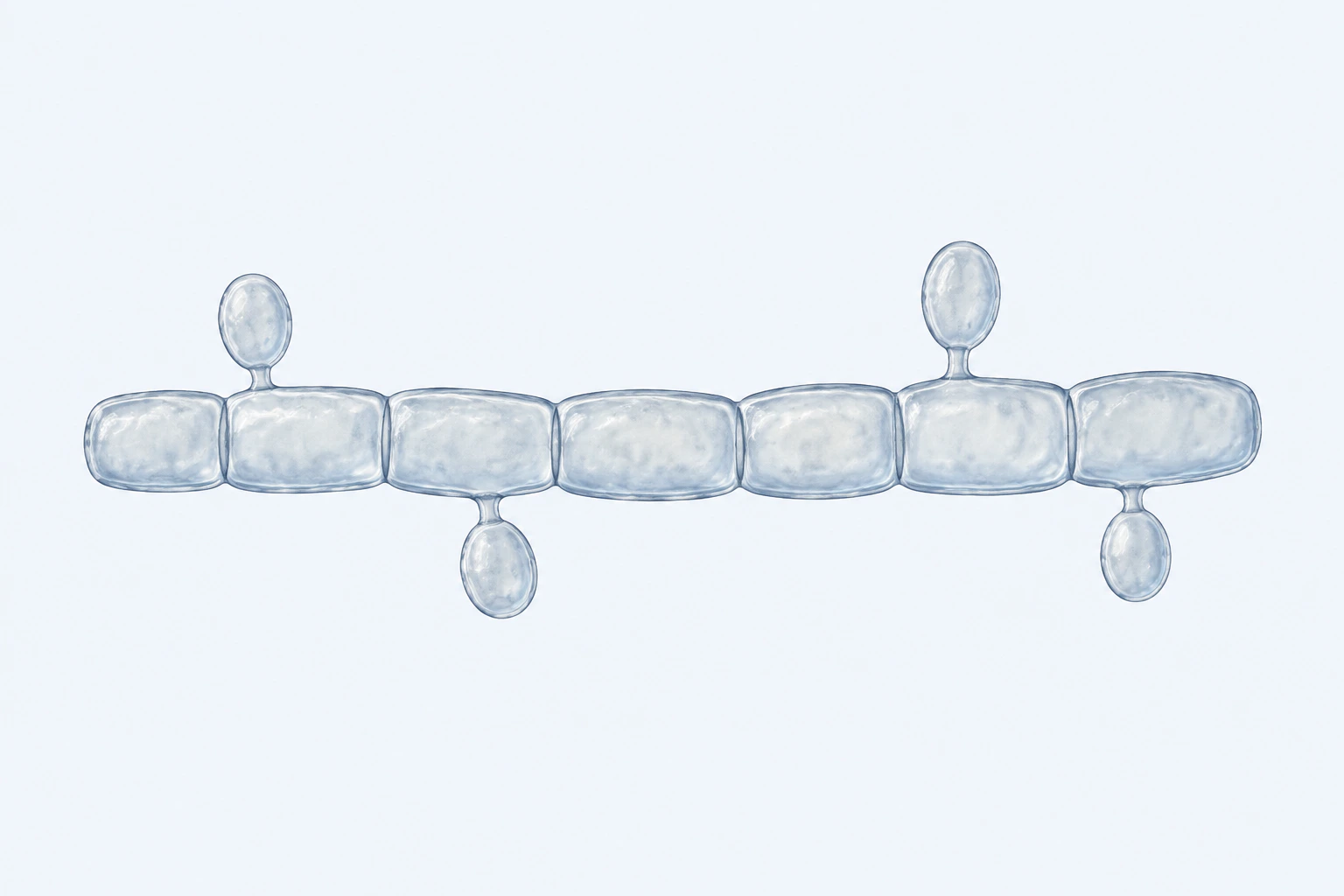
Type-material-anchored Trichosporon asahii reconstruction with seven barrel-like compartments and four blastoconidia. Representative, non-diagnostic, and not a micrograph.
Scientific media record1 verified identifier
- Subject
- Trichosporon asahiitaxon · species
- Identifiers
- NCBITaxon:82508
- Review
- Editorial review completeIdentifiers authority-verified · Accessibility validated · · trichosporon-asahii|trichosporon-asahii-morphology-v1.webp
- Digital source
- Trained-algorithmic mediaCreated with a trained generative algorithm and reviewed by WikiBiome for subject identity, scientific framing, identifiers, provenance, and accessibility.
- License
- CC BY-SA 4.0Created
Trichosporon asahii is a basidiomycetous yeast found in soil, water, and on human skin. It is the primary cause of invasive trichosporonosis in immunocompromised patients, particularly those with neutropenia or hematologic malignancies. It is inherently resistant to echinocandins and shows variable susceptibility to amphotericin B.
Metal Dependencies#
T. asahii requires iron for growth and produces siderophore-like molecules for iron acquisition. Its zinc-dependent proteases and manganese-dependent superoxide dismutase contribute to tissue invasion and Oxidative Stress resistance. Metal availability in the host—particularly during neutropenia when Nutritional Immunity (Metal Sequestration) is compromised—facilitates its expansion.
Ecological Role#
T. asahii forms robust Biofilm on medical devices and mucosal surfaces. These biofilms confer up to 1000-fold increased resistance to antifungal agents compared to planktonic cells. Within the gut mycobiome, T. asahii can engage in interkingdom interactions with bacteria, potentially participating in mixed-species biofilm communities that enhance mutual persistence.
Conditions Associated#
Invasive trichosporonosis carries mortality rates exceeding 50% in immunocompromised hosts. T. asahii has also been detected at elevated abundance in the gut mycobiome of Inflammatory Bowel Disease (IBD) patients. Its intrinsic echinocandin resistance limits treatment options to azoles and amphotericin B formulations.
Cross-References#
- Iron—siderophore-mediated acquisition
- Biofilm—antifungal resistance mechanism
- Candida albicans—differential antifungal susceptibility comparison
- Nutritional Immunity (Metal Sequestration)—host defense evasion
References 5
Numbered by first appearance in the article, then reconciled with its declared source list.
- 1
Ling Z, Cheng Y, Lan Z et al. (2025). Gut Mycobiota Dysbiosis and Systemic Immune Dysfunction in Chinese Schizophrenia Patients with Metabolic Syndrome. Frontiers in Immunology.
- 2
Youran Li, Pei Xiao, Rong Cao et al. (2024). Li 2024 — Oral Lyophilized FMT Effects and Microbiota Changes in ASD Children. Frontiers in Pediatrics.
- 3
Ping Yang, Xiaoshan Zhang, Rui Xu et al. (2022). Fungal microbiota dysbiosis and ecological alterations in gastric cancer. Frontiers in Microbiology.
- 4
Mohammad Tahseen Al Bataineh, Axel Kunstner, Nihar Ranjan Dash et al. (2023). Al Bataineh 2023 — Multi-Omics Analysis of Gut Microbial Dysbiosis, Metabolomics, and Dietary Intake in Type 2 Diabetes. Scientific Reports.
- 5
Zongxin Ling, Yiwen Cheng, Zhiyong Lan et al. (2025). Ling 2025 — Gut Mycobiota Dysbiosis and Systemic Immune Dysfunction in Chinese Schizophrenia Patients with Metabolic Syndrome. Frontiers in Immunology.
Article network
Connect the evidence
Publicly readable discussion by ORCID-authenticated researchers. Questions, interpretation, methods, corrections, and new evidence stay attached to this record.
No discussion yet. Start with a precise question or a source-backed observation.
Published page changes
This record shows only material changes published on this page, including changes to its content, evidence, conclusions, or author context. Internal processes and discussion activity are excluded. Pending, declined, and withdrawn proposals remain private.
- published revision
Added references: ling-2025-gut-mycobiota-dysbiosis-immune-dysfunction-schizophrenia-metabolic-syndrome; li-2024-oral-lyophilized-fmt-asd-children; yang-2022-fungal-microbiota-dysbiosis-gastric-cancer; al-bataineh-2023-multi-omics-microbiome-metabolome-t2d-fiber;…
Added references: ling-2025-gut-mycobiota-dysbiosis-immune-dysfunction-schizophrenia-metabolic-syndrome; li-2024-oral-lyophilized-fmt-asd-children; yang-2022-fungal-microbiota-dysbiosis-gastric-cancer; al-bataineh-2023-multi-omics-microbiome-metabolome-t2d-fiber; ling-2025-gut-mycobiota-schizophrenia-metabolic-syndrome-trichosporon. · WikiBiome Deploy Bot · +10 −7
Inspect exact Git diff ↗ - published revision
Created “Trichosporon asahii”: Trichosporon asahii is a basidiomycetous yeast found in soil, water, and on human skin. It is the primary cause of invasive trichosporonosis in immunocompromised patients, particularly those with…
Created “Trichosporon asahii”: Trichosporon asahii is a basidiomycetous yeast found in soil, water, and on human skin. It is the primary cause of invasive trichosporonosis in immunocompromised patients, particularly those with… Published sections: Overview; Metal Dependencies; Ecological Role; Conditions Associated; Cross-References. · WikiBiome Deploy Bot · +61 −0
Inspect exact Git diff ↗