

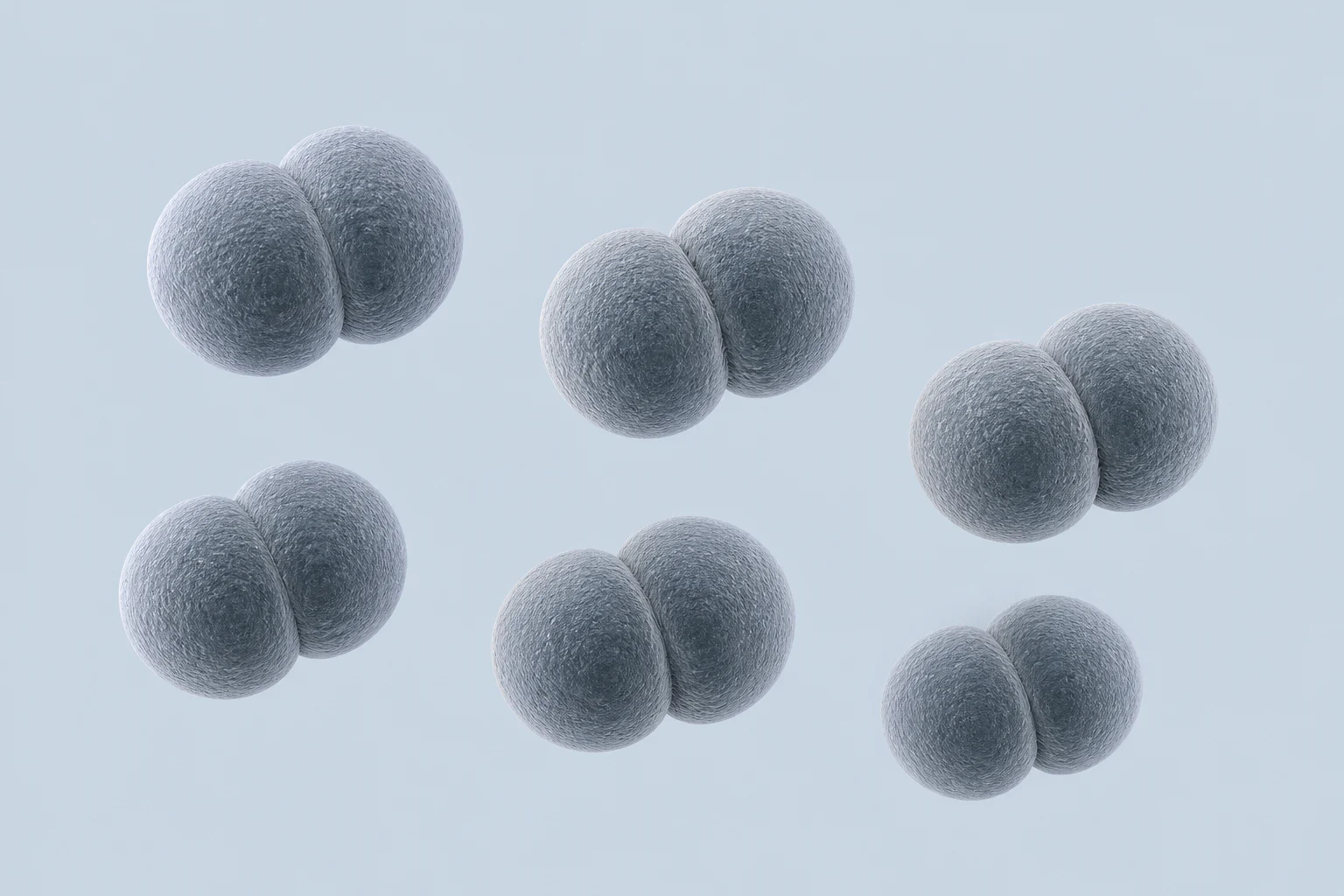
Representative Acidaminococcus diplococci. Members of this genus are Gram-negative, obligately anaerobic cocci that commonly occur in pairs; this is an educational reconstruction, not a micrograph.
Scientific media record1 verified identifier
- Subject
- Acidaminococcustaxon · genus
- Identifiers
- NCBITaxon:904
- Review
- Editorial review completeIdentifiers authority-verified · Accessibility validated · · acidaminococcus|acidaminococcus-morphology-v1.webp
- Digital source
- Trained-algorithmic mediaCreated with a trained generative algorithm and reviewed by WikiBiome for subject identity, scientific framing, identifiers, provenance, and accessibility.
- License
- CC BY-SA 4.0Created
A Gram-negative, obligate anaerobic genus within the family Veillonellaceae (class Negativicutes, phylum Firmicutes) defined by its specialized amino acid fermentation—the genus name literally means "acid from amino acids."
Acidaminococcus ferments glutamate as its primary energy source, a metabolic strategy that links it to protein-rich diets and conditions characterized by altered amino acid metabolism.
The genus has emerged as a consistently enriched taxon across breast cancer, schizophrenia, and type 2 diabetes, suggesting a pattern of pathobiont expansion in metabolic and inflammatory diseases.
Evidence map8 cited passagesInspect provenance +
Acidaminococcus is enriched in breast cancer patients (24% prevalence vs. 9% in controls), alongside hungatella and tyzzerella. Notably, Acidaminococcus-positive participants had significantly lower whole fruit intake (HEI-2015 scores, p = 0.005), connecting dietary patterns to pathobiont expansion.
Consistently up-regulated in schizophrenia across multiple studies in a systematic vote-counting meta-analysis, alongside prevotella, Succinivibrio, and other taxa.
Identified as a key disease-discriminating taxon (absolute R-value 0.6) in a multi-omics study of the gut microbiome-metabolome axis in T2D patients.
Acidaminococcus massiliensis was a key predictive feature in a random forest model distinguishing COVID-19 recovery status (AUC 0.99). Dynamic cycling was observed: enriched at baseline and 6 months but absent at 3 months, suggesting fluctuating dominance during immune reconstitution.
(case-control, n=50)—Identified Acidaminococcus enrichment in breast cancer with dietary correlation.
(systematic review/meta-analysis)—Consistently up-regulated in schizophrenia across studies.
(prospective cohort)—A. massiliensis as predictive feature in COVID-19 recovery.
(cross-sectional)—Disease-discriminating taxon in T2D.
Contents
1. Taxonomy2. Metal Dependencies3. Key Enzymes and Metabolic Features4. Ecological Role5. Conditions Associated6. Key Studies7. Cross-ReferencesTaxonomy#
Acidaminococcus fermentans—the type species; A. massiliensis is a more recently described species relevant to COVID-19 recovery studies. Family Veillonellaceae, order Veillonellales, class Negativicutes, phylum Firmicutes. Like other Negativicutes, Acidaminococcus is Gram-negative despite belonging to the predominantly Gram-positive Firmicutes.
Metal Dependencies#
Iron. Iron-sulfur cluster proteins are essential for the glutamate fermentation pathway, particularly in the electron transfer steps of glutaconyl-CoA decarboxylase. Ferredoxin-dependent oxidoreductases support the anaerobic energy metabolism characteristic of amino acid-fermenting bacteria.
Iron availability in inflammatory environments may favor Acidaminococcus expansion alongside other iron-dependent pathobionts.
Key Enzymes and Metabolic Features#
Glutamate dehydrogenase: Initiates glutamate catabolism, converting glutamate to 2-oxoglutarate. This enzyme's activity determines how effectively Acidaminococcus can exploit glutamate as an energy source.
Glutaconyl-CoA decarboxylase: A biotin-dependent sodium pump that couples glutamate fermentation to ATP synthesis via a sodium gradient. This energy-conserving strategy is the metabolic hallmark of the genus and explains its specificity for glutamate-rich environments.
Acetate and Butyrate production: End products of glutamate fermentation include acetate and butyrate, though the overall metabolic impact may differ from fiber-derived SCFA production.
Ecological Role#
In the Healthy Gut#
Acidaminococcus is a minor member of the healthy gut microbiota, typically present at low abundance. Its niche—glutamate fermentation—is relatively specialized and does not compete directly with the dominant fiber-fermenting bacteria.
In Dysbiosis#
Acidaminococcus expands in conditions characterized by. Increased luminal amino acid availability (protein maldigestion, mucosal damage releasing tissue-derived amino acids). Reduced competition from fiber fermenters (low-fiber Western diets eliminate the dominant SCFA-producing competitors).
Inflammatory environments where iron release from damaged tissue supports iron-dependent metabolism.
Conditions Associated#
Breast Cancer#
Acidaminococcus is enriched in breast cancer patients (24% prevalence vs. 9% in controls), alongside Hungatella and Tyzzerella. Notably, Acidaminococcus-positive participants had significantly lower whole fruit intake (HEI-2015 scores, p = 0.005),[1]Association between Gut Microbiota and Breast Cancer: Diet as a Potential Modulating FactorAltinok Dindar D, Chun B, Palma A et al. · 2023Open reference 1 ↓ connecting dietary patterns to pathobiont expansion.
Schizophrenia#
Consistently up-regulated in schizophrenia across multiple studies in a systematic vote-counting meta-analysis, alongside Prevotella, Succinivibrio, and other taxa.[2]Alterations of the Gut Microbiota in Patients with SchizophreniaLi Z, Tao X, Wang D et al. · 2024Open reference 2 ↓
Type 2 Diabetes#
Identified as a key disease-discriminating taxon (absolute R-value > 0.6) in a multi-omics study of the Gut Microbiome-metabolome axis in T2D patients.[3]Al Bataineh 2023 — Multi-Omics Analysis of Gut Microbial Dysbiosis, Metabolomics, and Dietary Intake in Type 2 DiabetesMohammad Tahseen Al Bataineh, Axel Kunstner, Nihar Ranjan Dash et al. · 2023Open reference 3 ↓
COVID-19 Recovery#
Acidaminococcus massiliensis was a key predictive feature in a random forest model distinguishing COVID-19 recovery status (AUC 0.99). Dynamic cycling was observed: enriched at baseline and 6 months but absent at 3 months, suggesting fluctuating dominance during immune reconstitution.[4]Li et al. 2025 — Long-term Alterations in Gut Microbiota Following Mild COVID-19 RecoveryDa Li, Da-Ya Zhang, Shi-Ju Chen et al. · 2025Open reference 4 ↓
Key Studies#
[1]Association between Gut Microbiota and Breast Cancer: Diet as a Potential Modulating FactorAltinok Dindar D, Chun B, Palma A et al. · 2023Open reference 1 ↓ (case-control, n=50)—Identified Acidaminococcus enrichment in breast cancer with dietary correlation.[2]Alterations of the Gut Microbiota in Patients with SchizophreniaLi Z, Tao X, Wang D et al. · 2024Open reference 2 ↓ (systematic review/meta-analysis)—Consistently up-regulated in schizophrenia across studies.
[4]Li et al. 2025 — Long-term Alterations in Gut Microbiota Following Mild COVID-19 RecoveryDa Li, Da-Ya Zhang, Shi-Ju Chen et al. · 2025Open reference 4 ↓ (prospective cohort)—A. massiliensis as predictive feature in COVID-19 recovery.[3]Al Bataineh 2023 — Multi-Omics Analysis of Gut Microbial Dysbiosis, Metabolomics, and Dietary Intake in Type 2 DiabetesMohammad Tahseen Al Bataineh, Axel Kunstner, Nihar Ranjan Dash et al. · 2023Open reference 3 ↓ (cross-sectional)—Disease-discriminating taxon in T2D.
Cross-References#
- Veillonellaceae—parent family; shared Negativicutes classification
- Breast Cancer—enriched alongside Hungatella and Tyzzerella
- Schizophrenia—consistently up-regulated across studies
- Type 2 Diabetes—disease-discriminating taxon
- Hungatella—co-enriched in breast cancer
- Tyzzerella—co-enriched in breast cancer
- Iron—iron-dependent amino acid fermentation pathway
References 4
Numbered by first appearance in the article, then reconciled with its declared source list.
- 1
Altinok Dindar D, Chun B, Palma A et al. (2023). Association between Gut Microbiota and Breast Cancer: Diet as a Potential Modulating Factor. Nutrients.
- 2
Li Z, Tao X, Wang D et al. (2024). Alterations of the Gut Microbiota in Patients with Schizophrenia. Frontiers in Psychiatry.
- 3
Mohammad Tahseen Al Bataineh, Axel Kunstner, Nihar Ranjan Dash et al. (2023). Al Bataineh 2023 — Multi-Omics Analysis of Gut Microbial Dysbiosis, Metabolomics, and Dietary Intake in Type 2 Diabetes. Scientific Reports.
- 4
Da Li, Da-Ya Zhang, Shi-Ju Chen et al. (2025). Li et al. 2025 — Long-term Alterations in Gut Microbiota Following Mild COVID-19 Recovery. Frontiers in Cellular and Infection Microbiology.
Article network
Mentioned here 10
Pages linking here 1
Connect the evidence
Publicly readable discussion by ORCID-authenticated researchers. Questions, interpretation, methods, corrections, and new evidence stay attached to this record.
No discussion yet. Start with a precise question or a source-backed observation.
Activity and accepted changes
Accepted researcher context, editorial status, public discussion, and upstream Git revisions are shown together. Pending, declined, and withdrawn proposals remain private.
- published revision
Backfill gut microbiome concept links
Karen Pendergrass · +1 −1
Inspect exact Git diff ↗ - published revision
massive wiki expansion: 149 stubs fixed, 100+ new pages, Rule 15 scan, keystone papers
WikiBiome Deploy Bot · +9 −9
Inspect exact Git diff ↗ - published revision
pre-overnight checkpoint 2026-04-18
WikiBiome Deploy Bot · +88 −0
Inspect exact Git diff ↗