

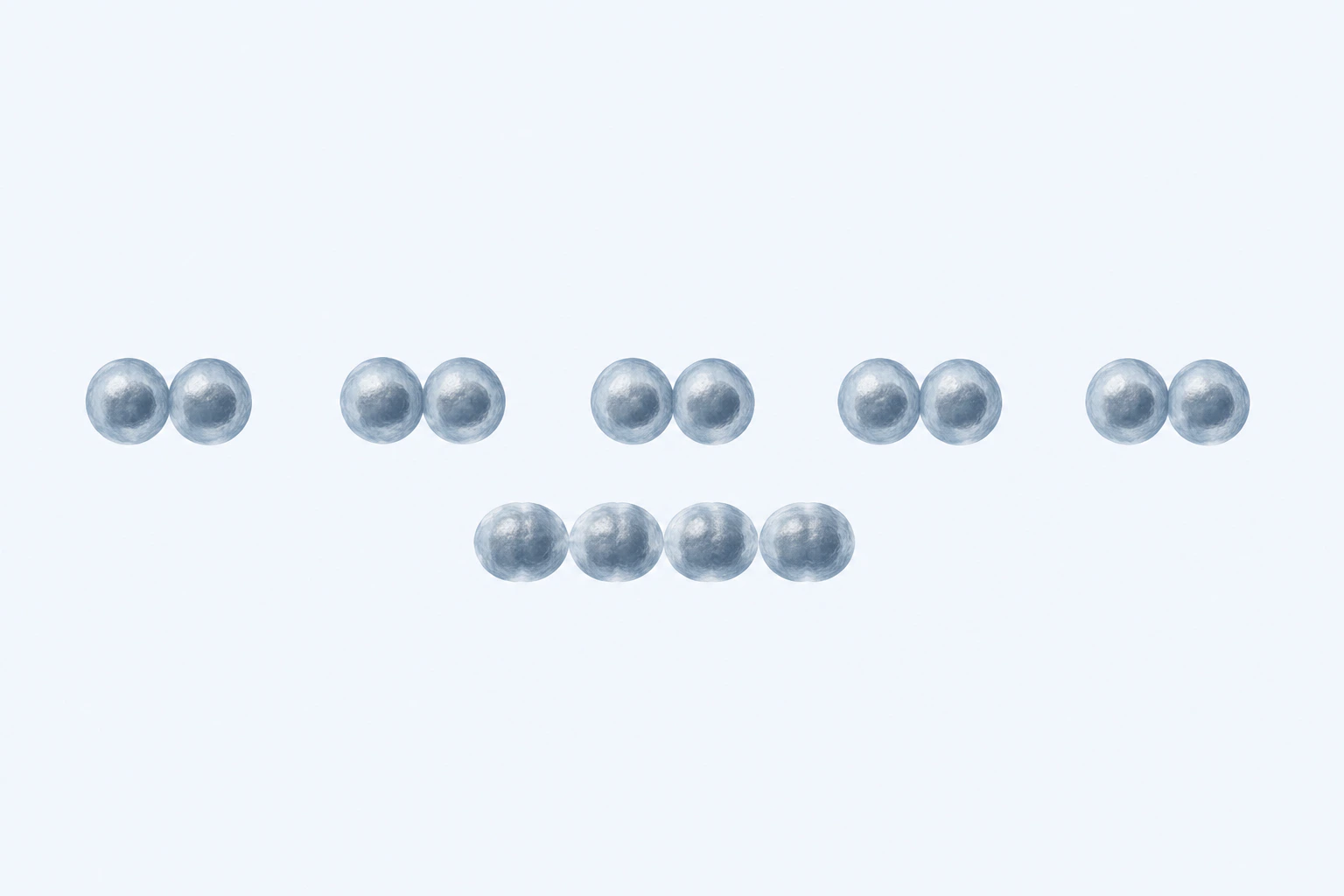
Type-genus-anchored Veillonellaceae reconstruction with fourteen cocci in paired and short-chain arrangements. Representative, non-diagnostic, and not a micrograph.
Scientific media record1 verified identifier
- Subject
- Veillonellaceaetaxon · family
- Identifiers
- NCBITaxon:31977
- Review
- Editorial review completeIdentifiers authority-verified · Accessibility validated · · veillonellaceae|veillonellaceae-morphology-v1.webp
- Digital source
- Trained-algorithmic mediaCreated with a trained generative algorithm and reviewed by WikiBiome for subject identity, scientific framing, identifiers, provenance, and accessibility.
- Scientific basis
- Veillonellaceae — NCBI TaxonomyVeillonellaceae — LPSN
- License
- CC BY-SA 4.0Created
A family of Gram-negative, obligate anaerobic bacteria within the Firmicutes phylum (class Negativicutes) that occupies a unique metabolic niche as specialized lactate utilizers. Veillonellaceae cannot ferment sugars directly—instead, they cross-feed on lactate produced by other bacteria, particularly Streptococcus and Lactobacillus.
This metabolic dependency creates ecological partnerships that link oral health, gut metabolism, and neuropsychiatric outcomes. Mendelian randomization has identified Veillonellaceae as causally protective against schizophrenia, while depletion of the family appears in thyroid autoimmunity.
Evidence map6 cited passagesInspect provenance +
Veillonellaceae is causally protective against schizophrenia (OR = 0.93, p = 0.033), specifically in patients with violent behaviors. The protective effect may operate through propionate production: propionate modulates microglial activation and neuroinflammation via free fatty acid receptors (FFAR2/FFAR3) in the brain. Effective schizophrenia intervention r
Veillonellaceae levels are decreased in HT patients alongside prevotellaceae, suggesting the family's immunomodulatory SCFA production may contribute to thyroid immune tolerance.
Paradoxically, some studies report Veillonellaceae enrichment in schizophrenia alongside Proteobacteria and Lactobacillaceae. This apparent contradiction likely reflects the heterogeneity of schizophrenia subtypes, treatment effects, and the difference between genus-level (Veillonella vs. Dialister) and family-level analyses.
(Mendelian randomization, n=148,984)—Established Veillonellaceae as causally protective against schizophrenia; part of the two-sided ecological engineering framework.
(review)—Documented Veillonellaceae among taxa with inconsistent directionality across schizophrenia studies.
(review)—Reported Veillonellaceae depletion in Hashimoto's thyroiditis patients.
Contents
1. Taxonomy2. Metal Dependencies3. Key Enzymes and Metabolic Features4. Ecological Role5. Conditions Associated6. Key Studies7. Cross-ReferencesTaxonomy#
Family Veillonellaceae, order Veillonellales (sometimes Selenomonadales), class Negativicutes, phylum Firmicutes. Key genera: Veillonella, Dialister, Megasphaera, Selenomonas, Acidaminococcus. The Negativicutes are unusual Firmicutes: they are Gram-negative despite belonging to a predominantly Gram-positive phylum, possessing an outer membrane-like structure with lipopolysaccharide.
Metal Dependencies#
Iron. Iron-sulfur cluster proteins support the electron transport chain in Veillonellaceae's anaerobic lactate metabolism. Methylmalonyl-CoA decarboxylase, a key enzyme in propionate production from lactate, requires iron as part of its electron-carrying cofactors.
The relatively modest iron requirements of Veillonellaceae compared to siderophore-producing pathogens may explain their competitive disadvantage in iron-replete inflammatory environments.
Key Enzymes and Metabolic Features#
Lactate dehydrogenase: Converts lactate (produced by Streptococcus, Lactobacillus) into pyruvate, initiating the cross-feeding metabolism that defines the family.
Methylmalonyl-CoA decarboxylase: A sodium-pumping decarboxylase that converts methylmalonyl-CoA to propionyl-CoA, generating a sodium gradient that drives ATP synthesis—an energy-conserving strategy unique to this metabolic niche.
Propionate kinase: Terminal enzyme in propionate production; Veillonellaceae are significant propionate producers in both the oral cavity and gut.
Ecological Role#
In the Healthy Gut and Oral Cavity#
Veillonellaceae occupy a secondary fermenter niche: they consume lactate that would otherwise accumulate and acidify the environment. This cross-feeding relationship with lactate producers.
Prevents local acidification that could disrupt microbial community structure. Converts lactate into propionate and acetate—short-chain fatty acids with anti-inflammatory and immunomodulatory properties. Creates metabolic partnerships where lactate producers (Streptococcus) and lactate consumers (Veillonella, Dialister) form stable ecological units.
In Dysbiosis#
Depletion of Veillonellaceae disrupts the lactate-propionate conversion pathway, potentially leading to lactate accumulation and loss of propionate-mediated immunomodulation. This depletion pattern appears in. Schizophrenia—patients with violent behaviors show reduced Veillonellaceae.
Hashimoto's thyroiditis—Veillonellaceae decreased alongside Prevotellaceae.
Conditions Associated#
Schizophrenia (Protective)#
Veillonellaceae is causally protective against schizophrenia (OR = 0.93, p = 0.033), specifically in patients with violent behaviors.[1]Zhou 2024 — Gut Microbiome and Schizophrenia: Insights from Two-Sample Mendelian RandomizationKeer Zhou, Ancha Baranova, Hongbao Cao et al. · 2024Open reference 1 ↓ The protective effect may operate through propionate production: propionate modulates microglial activation and neuroinflammation via free fatty acid receptors (FFAR2/FFAR3) in the brain.
Effective schizophrenia intervention requires restoring causally protective taxa like Veillonellaceae AND suppressing risk-increasing taxa like Clostridia and Betaproteobacteria—neither side alone is sufficient.
Hashimoto's Thyroiditis#
Veillonellaceae levels are decreased in HT patients alongside Prevotellaceae,[2]Docimo et al. 2020 — The Human Microbiota in Endocrinology: Implications for Pathophysiology, Treatment, and Prognosis in Thyroid DiseasesDocimo G, Cangiano A, Romano RM et al. · 2020Open reference 2 ↓ suggesting the family's immunomodulatory SCFA production may contribute to thyroid immune tolerance.
Schizophrenia (Also Enriched in Some Studies)#
Paradoxically, some studies report Veillonellaceae enrichment in schizophrenia alongside Proteobacteria and Lactobacillaceae.[3]The Gut Microbiome and Schizophrenia: The Current State of the Field and Clinical ApplicationsSzeligowski T, Yun AL, Lennox BR et al. · 2020Open reference 3 ↓ This apparent contradiction likely reflects the heterogeneity of schizophrenia subtypes, treatment effects, and the difference between genus-level (Veillonella vs. Dialister) and family-level analyses.
Key Studies#
[1]Zhou 2024 — Gut Microbiome and Schizophrenia: Insights from Two-Sample Mendelian RandomizationKeer Zhou, Ancha Baranova, Hongbao Cao et al. · 2024Open reference 1 ↓ (Mendelian randomization, n=148,984)—Established Veillonellaceae as causally protective against schizophrenia; part of the two-sided ecological engineering framework.
[3]The Gut Microbiome and Schizophrenia: The Current State of the Field and Clinical ApplicationsSzeligowski T, Yun AL, Lennox BR et al. · 2020Open reference 3 ↓ (review)—Documented Veillonellaceae among taxa with inconsistent directionality across schizophrenia studies.[2]Docimo et al. 2020 — The Human Microbiota in Endocrinology: Implications for Pathophysiology, Treatment, and Prognosis in Thyroid DiseasesDocimo G, Cangiano A, Romano RM et al. · 2020Open reference 2 ↓ (review)—Reported Veillonellaceae depletion in Hashimoto's thyroiditis patients.
Cross-References#
- Veillonella—the best-characterized genus; oral-gut lactate utilizer
- Dialister—another key genus; strongest protective association in depression
- Schizophrenia—Veillonellaceae causally protective via MR
- Hashimoto's Thyroiditis—Veillonellaceae depleted in HT patients
- Butyrate—Veillonellaceae produce propionate rather than butyrate, but both are immunomodulatory SCFAs
- Clostridia—the causal risk counterpart in schizophrenia ecology
- Betaproteobacteria—co-identified as schizophrenia risk taxon in the same MR study
References 3
Numbered by first appearance in the article, then reconciled with its declared source list.
- 1
Keer Zhou, Ancha Baranova, Hongbao Cao et al. (2024). Zhou 2024 — Gut Microbiome and Schizophrenia: Insights from Two-Sample Mendelian Randomization. Schizophrenia (Nature Partner Journal).
- 2
Docimo G, Cangiano A, Romano RM et al. (2020). Docimo et al. 2020 — The Human Microbiota in Endocrinology: Implications for Pathophysiology, Treatment, and Prognosis in Thyroid Diseases. Frontiers in Endocrinology.
- 3
Szeligowski T, Yun AL, Lennox BR et al. (2020). The Gut Microbiome and Schizophrenia: The Current State of the Field and Clinical Applications. Frontiers in Psychiatry.
Article network
Connect the evidence
Publicly readable discussion by ORCID-authenticated researchers. Questions, interpretation, methods, corrections, and new evidence stay attached to this record.
No discussion yet. Start with a precise question or a source-backed observation.
Published page changes
This record shows only material changes published on this page, including changes to its content, evidence, conclusions, or author context. Internal processes and discussion activity are excluded. Pending, declined, and withdrawn proposals remain private.
- published revision
Created “Veillonellaceae”: A family of Gram-negative, obligate anaerobic bacteria within the Firmicutes phylum (class Negativicutes) that occupies a unique metabolic niche as specialized lactate utilizers. Veillonellaceae…
Created “Veillonellaceae”: A family of Gram-negative, obligate anaerobic bacteria within the Firmicutes phylum (class Negativicutes) that occupies a unique metabolic niche as specialized lactate utilizers. Veillonellaceae… Published sections: Veillonellaceae; Taxonomy; Metal Dependencies; Key Enzymes and Metabolic Features; In the Healthy Gut and Oral Cavity; In Dysbiosis; Schizophrenia (Protective); Hashimoto's Thyroiditis; Schizophrenia (Also Enriched in Some Studies); Key Studies; Cross-References. · WikiBiome Deploy Bot · +86 −0
Inspect exact Git diff ↗