

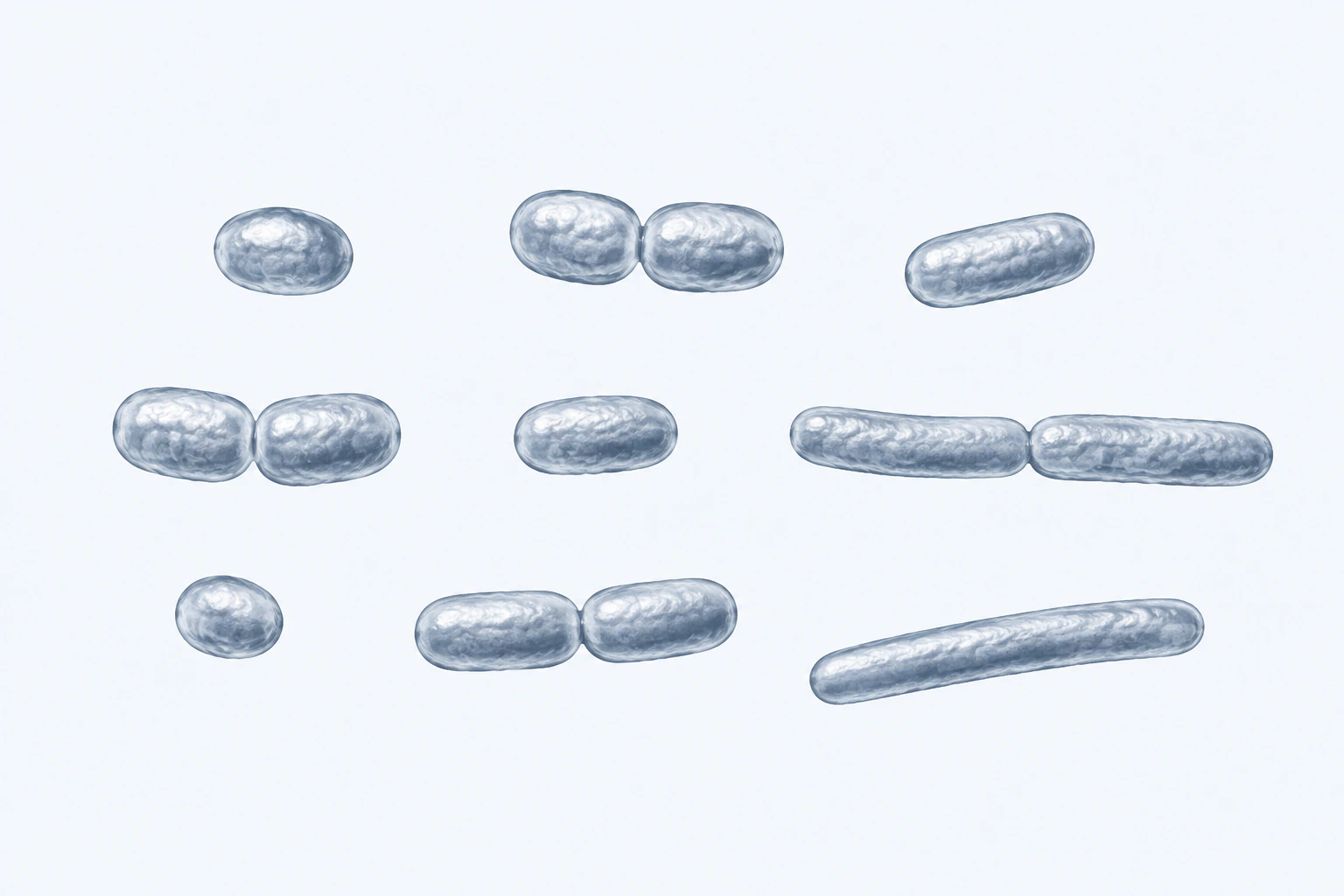
Selected-descendant Prevotellaceae reconstruction with thirteen cellular bodies in five single and four paired groupings. This family plate is representative, non-exhaustive, non-universal, non-diagnostic, and not a micrograph; relative scale is illustrative.
Scientific media record1 verified identifier
- Subject
- Prevotellaceaetaxon · family
- Identifiers
- NCBITaxon:171552
- Review
- Editorial review completeIdentifiers authority-verified · Accessibility validated · · prevotellaceae|prevotellaceae-microbial-community-v1.webp
- Digital source
- Trained-algorithmic mediaCreated with a trained generative algorithm and reviewed by WikiBiome for subject identity, scientific framing, identifiers, provenance, and accessibility.
- Scientific basis
- Prevotellaceae — NCBI TaxonomyPrevotellaceae — LPSNPrevotella, a new genus to include Bacteroides melaninogenicus and related speciesParaprevotella clara gen. nov., sp. nov. and Paraprevotella xylaniphila sp. nov.
- License
- CC BY-SA 4.0Created
A family of Gram-negative, obligate anaerobic bacteria within the phylum Bacteroidota (formerly Bacteroidetes) that includes the genus Prevotella and the recently described Alloprevotella.
Prevotellaceae are specialist fiber fermenters producing short-chain fatty acids, yet their relationship with human disease is strikingly paradoxical: they are the most consistently depleted family in Parkinson's disease but a causal risk factor for autism spectrum disorder via Mendelian randomization.
This duality makes Prevotellaceae one of the most instructive examples of context-dependent host-microbe interactions in the gut.
Evidence map6 cited passagesInspect provenance +
Harmful: When Prevotellaceae infiltrate the mucosal layer, they can trigger T-cell and antibody responses, promoting inflammation
Reduced Prevotellaceae is the most consistent PD microbiome finding across multiple meta-analyses. Depletion correlates with reduced SCFA production and increased gut permeability, potentially facilitating alpha synuclein propagation from gut to brain via the vagus nerve. Loss of Prevotellaceae alongside lachnospiraceae and faecalibacterium represents the co
Prevotellaceae causally increases ASD risk (IVW OR = 1.24, 95% CI: 1.09-1.40, p = 9.2 x 10^-4), surviving FDR correction. The mechanism may involve mucosal infiltration by Prevotellaceae, triggering T-cell and antibody responses that exacerbate neuroinflammation via the gut-brain axis.
(Mendelian randomization)—Established Prevotellaceae as a causal ASD risk factor (OR 1.24); FDR-significant.
(review)—Documented Prevotellaceae as the most consistently depleted family in PD.
(meta-analysis)—Confirmed Prevotellaceae depletion across PD cohorts.
Contents
1. Taxonomy2. Metal Dependencies3. Key Enzymes and Metabolic Features4. Ecological Role5. Conditions Associated6. Key Studies7. Open Questions8. Cross-ReferencesTaxonomy#
Family Prevotellaceae, order Bacteroidales, class Bacteroidia, phylum Bacteroidota. Key genera: Prevotella (including P. copri, P. melaninogenica), Alloprevotella, Paraprevotella, Hallella. Prevotella copri is the dominant species in non-Western, fiber-rich diets and is a primary driver of the "Prevotella enterotype."
Metal Dependencies#
Iron. Iron-dependent succinate dehydrogenase participates in the fumarate respiration pathway, a key anaerobic energy-generating strategy in Bacteroidales. Prevotellaceae encode iron uptake systems including TonB-dependent receptors for iron-siderophore complexes, though they are generally less aggressive iron competitors than Enterobacteriaceae.
In iron-depleted environments (host nutritional immunity), Prevotellaceae may lose competitive advantage to siderophore-producing pathobionts, contributing to their depletion in inflammatory conditions.
Key Enzymes and Metabolic Features#
Glycoside hydrolases: Prevotellaceae encode extensive polysaccharide utilization loci (PUL) for degrading plant-derived complex carbohydrates—xylan, arabinoxylan, pectin. This makes them indicators of fiber-rich diets.
Peptidases: Prevotella species also degrade host-derived glycoproteins, including mucin, which can trigger inflammatory responses when Prevotellaceae infiltrate the mucosal layer. Succinate dehydrogenase: Iron-dependent enzyme in fumarate respiration.
Ecological Role#
In the Healthy Gut#
Prevotellaceae thrive in individuals consuming plant-rich, fiber-heavy diets. They are dominant in non-Western populations and relatively depleted in individuals consuming high-fat, high-protein Western diets. Their SCFA production (primarily succinate and propionate) contributes to.
Colonic epithelial energy supply. Anti-inflammatory signaling via FFAR2/FFAR3. Gut barrier maintenance.
The Prevotellaceae Paradox#
The family's dual role as both beneficial (SCFA production, fiber fermentation) and potentially harmful (mucosal invasion, T-cell activation) depends on context.
Beneficial: In the gut lumen, Prevotellaceae ferment dietary fiber into SCFAs and maintain community diversity. Harmful: When Prevotellaceae infiltrate the mucosal layer, they can trigger T-cell and antibody responses, promoting Metal-Driven Inflammation.[1]Li 2023 — Gut Microbiota and Autism Spectrum Disorders: A Bidirectional Mendelian Randomization StudyZhi Li, Shuai Liu, Fang Liu et al. · 2023Open reference 1 ↓
Conditions Associated#
Parkinson's Disease (Depleted)#
Reduced Prevotellaceae is the most consistent PD microbiome finding across multiple meta-analyses.[2]Microbial Metallomics and Parkinson's Disease: A Unified Metal-Driven Framework Linking Ferroptosis, Dysbiosis, and alpha-Synuclein PathologyKaren Pendergrass · 2025Open reference 2 ↓[3]Romano 2021 -- Meta-analysis of the Parkinson's Disease Gut Microbiome Suggests Alterations Linked to Intestinal InflammationStefano Romano, George M Savva, Janis R Bedarf et al. · 2021Open reference 3 ↓ Depletion correlates with reduced SCFA production and increased gut permeability, potentially facilitating Alpha-Synuclein propagation from gut to brain via the vagus nerve.
Loss of Prevotellaceae alongside Lachnospiraceae and faecalibacterium represents the core PD Dysbiosis signature.
Autism Spectrum Disorder (Risk Factor)#
Prevotellaceae causally increases ASD risk (IVW OR = 1.24, 95% CI: 1.09-1.40, p = 9.2 x 10^-4), surviving FDR correction.[1]Li 2023 — Gut Microbiota and Autism Spectrum Disorders: A Bidirectional Mendelian Randomization StudyZhi Li, Shuai Liu, Fang Liu et al. · 2023Open reference 1 ↓ The mechanism may involve mucosal infiltration by Prevotellaceae, triggering T-cell and antibody responses that exacerbate neuroinflammation via the gut-brain axis.
Schizophrenia (Enriched)#
Prevotellaceae is enriched in schizophrenia patients with violent behaviors (OR = 1.11, 95% CI 1.03-1.20, p = 1.4 x 10^-3) by MR, contrasting with its depletion in PD and depression.
Depression (Depleted)#
Prevotellaceae show the most pronounced reduction in depressed patients, with decreased richness (p = 0.005), total observed species (p = 0.002), and phylogenetic diversity (p = 0.001).
Key Studies#
[1]Li 2023 — Gut Microbiota and Autism Spectrum Disorders: A Bidirectional Mendelian Randomization StudyZhi Li, Shuai Liu, Fang Liu et al. · 2023Open reference 1 ↓ (Mendelian randomization)—Established Prevotellaceae as a causal ASD risk factor (OR 1.24); FDR-significant.[2]Microbial Metallomics and Parkinson's Disease: A Unified Metal-Driven Framework Linking Ferroptosis, Dysbiosis, and alpha-Synuclein PathologyKaren Pendergrass · 2025Open reference 2 ↓ (review)—Documented Prevotellaceae as the most consistently depleted family in PD.
[3]Romano 2021 -- Meta-analysis of the Parkinson's Disease Gut Microbiome Suggests Alterations Linked to Intestinal InflammationStefano Romano, George M Savva, Janis R Bedarf et al. · 2021Open reference 3 ↓ (meta-analysis)—Confirmed Prevotellaceae depletion across PD cohorts.
Open Questions#
Unresolved questions identified by the current evidence record.
01Why is Prevotellaceae protective in PD but a risk factor in ASD?+
The opposing directionality across neurological conditions is unexplained. Species-level differences (P. copri vs. P. melaninogenica), mucosal vs. luminal location, and immune context may resolve this paradox.
02Does dietary fiber supplementation restore Prevotellaceae in PD patients?+
Prebiotic intervention targeting Prevotellaceae expansion is an untested therapeutic hypothesis for PD.
Cross-References#
- Prevotella—the primary genus; Prevotella copri drives the "Prevotella enterotype"
- Alloprevotella—a recently described genus within the family
- Parkinson's Disease—Prevotellaceae depletion is the hallmark PD microbiome signature
- Autism Spectrum Disorder—Prevotellaceae causally increases ASD risk
- Schizophrenia—enriched in violent behavior phenotype
- Depression—most pronounced family-level reduction in depressed patients
- Lachnospiraceae—co-depleted with Prevotellaceae in PD
- Alpha-Synuclein—gut permeability from Prevotellaceae loss facilitates alpha-synuclein propagation
References 3
Numbered by first appearance in the article, then reconciled with its declared source list.
- 1
Zhi Li, Shuai Liu, Fang Liu et al. (2023). Li 2023 — Gut Microbiota and Autism Spectrum Disorders: A Bidirectional Mendelian Randomization Study. Frontiers in Cellular and Infection Microbiology.
- 2
★Karen Pendergrass (2025). Microbial Metallomics and Parkinson's Disease: A Unified Metal-Driven Framework Linking Ferroptosis, Dysbiosis, and alpha-Synuclein Pathology. Conference Presentation.
- 3
Stefano Romano, George M Savva, Janis R Bedarf et al. (2021). Romano 2021 -- Meta-analysis of the Parkinson's Disease Gut Microbiome Suggests Alterations Linked to Intestinal Inflammation. npj Parkinson's Disease.
Article network
Connect the evidence
Publicly readable discussion by ORCID-authenticated researchers. Questions, interpretation, methods, corrections, and new evidence stay attached to this record.
No discussion yet. Start with a precise question or a source-backed observation.
Published page changes
This record shows only material changes published on this page, including changes to its content, evidence, conclusions, or author context. Internal processes and discussion activity are excluded. Pending, declined, and withdrawn proposals remain private.
- published revision
Created “Prevotellaceae”: A family of Gram-negative, obligate anaerobic bacteria within the phylum Bacteroidota (formerly Bacteroidetes) that includes the genus prevotella and the recently described alloprevotella.…
Created “Prevotellaceae”: A family of Gram-negative, obligate anaerobic bacteria within the phylum Bacteroidota (formerly Bacteroidetes) that includes the genus prevotella and the recently described alloprevotella.… Published sections: Prevotellaceae; Taxonomy; Metal Dependencies; Key Enzymes and Metabolic Features; In the Healthy Gut; The Prevotellaceae Paradox; Parkinson's Disease (Depleted); Autism Spectrum Disorder (Risk Factor); Schizophrenia (Enriched); Depression (Depleted); Key Studies; Open Questions; Cross-References. · WikiBiome Deploy Bot · +95 −0
Inspect exact Git diff ↗