
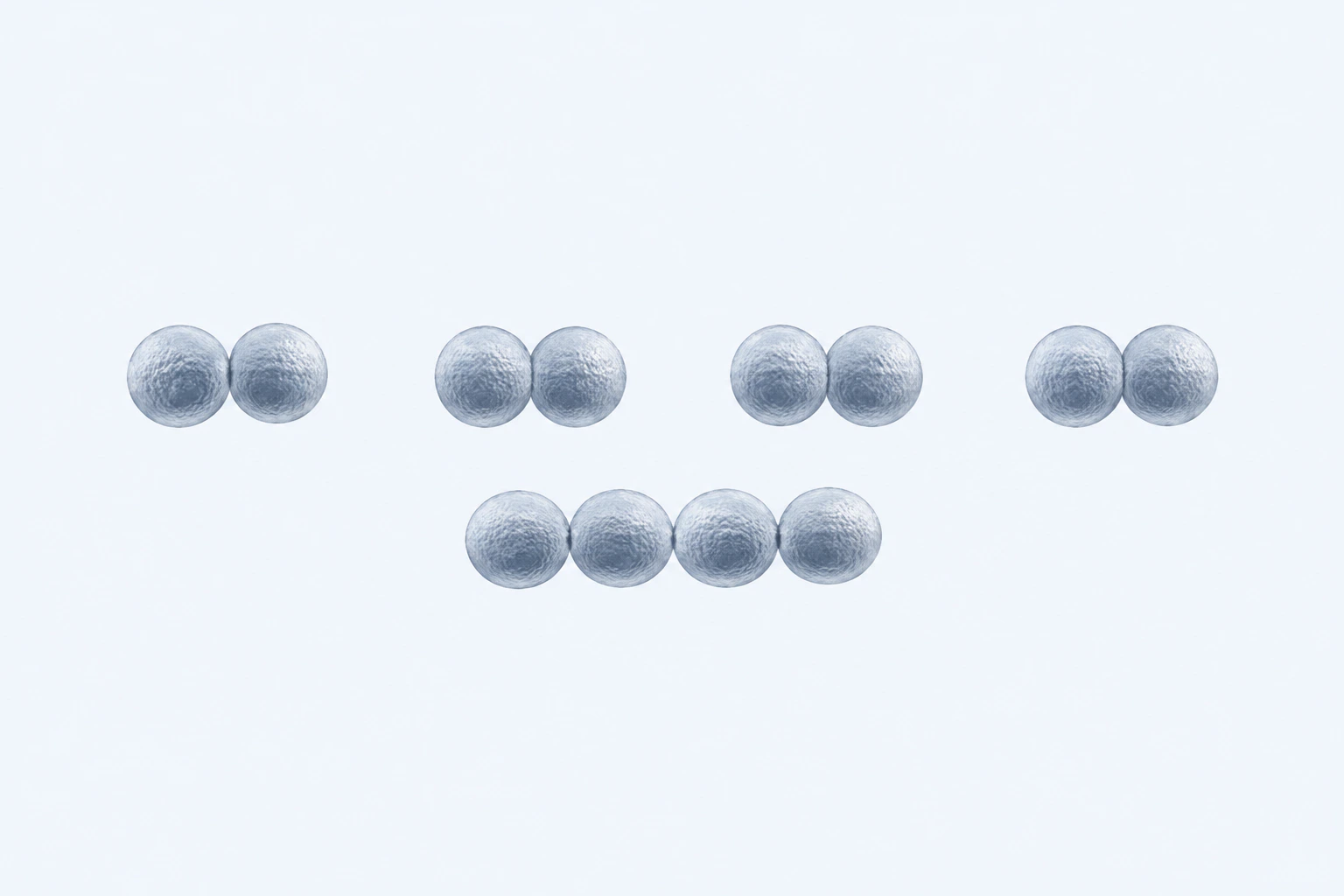
Type-species-anchored Veillonella reconstruction with twelve cocci in paired and short-chain arrangements. Representative, non-diagnostic, and not a micrograph.
Scientific media record1 verified identifier
- Subject
- Veillonellataxon · genus
- Identifiers
- NCBITaxon:29465
- Review
- Editorial review completeIdentifiers authority-verified · Accessibility validated · · veillonella|veillonella-morphology-v1.webp
- Digital source
- Trained-algorithmic mediaCreated with a trained generative algorithm and reviewed by WikiBiome for subject identity, scientific framing, identifiers, provenance, and accessibility.
- Scientific basis
- Veillonella — NCBI TaxonomyVeillonella — LPSNComplete genome sequence of Veillonella parvula type strain
- License
- CC BY-SA 4.0Created
A Gram-negative, obligate anaerobic genus within the Firmicutes phylum (class Negativicutes, family Veillonellaceae). The primary species vanadium (V). parvula is a specialized lactate utilizer that occupies a unique metabolic niche by cross-feeding with lactate-producing bacteria, particularly Streptococcus.
Veillonella is abundant in both the oral cavity and gut, making it a central player in the oral-gut translocation story that connects oral Dysbiosis to systemic disease.
Evidence map3 cited passagesInspect provenance +
Enriched in MS patients in multiple studies. Found exclusively in the MS patient group (absent in controls) in the oral microbiome study by Zangeneh 2021.
Enriched in graves disease patients, alongside Prevotella and Megasphaera, contributing to the pro-inflammatory gut signature that characterizes thyroid autoimmunity.
Decreased in ASD youth in the Romano 2023 umbrella review, contrasting with its enrichment in autoimmune conditions.
Contents
1. Role in Gut Ecosystem2. Oral-Gut Translocation3. Disease Associations4. Key Metabolites5. Mechanistic Considerations6. ConnectionsRole in Gut Ecosystem#
Cannot ferment sugars or complex carbohydrates directly; instead specializes in lactate utilization, converting lactate into propionate, acetate, CO2, and H2 via the methylmalonyl-CoA pathway.
Forms a tightly coupled cross-feeding partnership with Streptococcus: Streptococcus produces lactate from sugar fermentation, and Veillonella consumes it, preventing lactate accumulation that would acidify the environment and inhibit both organisms.
This partnership operates in both the oral cavity (dental plaque) and the gut, representing one of the best-characterized syntrophic relationships in the human microbiome.
H2 production from lactate fermentation feeds hydrogenotrophic organisms including Methanobrevibacter and sulfate-reducing bacteria.
Oral-Gut Translocation#
Veillonella is one of the most abundant genera in the oral microbiome, particularly in dental plaque and the tongue dorsum. Oral Veillonella can survive gastric transit and colonize the gut, contributing to the oral-gut axis increasingly recognized in autoimmune and inflammatory disease.
Oral-to-gut translocation of Veillonella is enhanced by conditions that reduce gastric acid barrier function (PPI use, achlorhydria) or increase gut permeability.
Disease Associations#
Multiple Sclerosis#
Enriched in MS patients in multiple studies. Found exclusively in the MS patient group (absent in controls) in the oral microbiome study by Zangeneh 2021.[1]Bacterial Variation in the Oral Microbiota in Multiple Sclerosis PatientsZangeneh Z, Abdi-Ali A, Khamooshian K et al. · 2021Open reference 1 ↓
Elevated in both oral and gut compartments of MS patients, consistent with increased oral-gut translocation under inflammatory conditions. Part of the Negativicutes expansion seen in MS alongside other propionate-producing genera.
Graves' Disease#
- Enriched in Graves' Disease patients, alongside Prevotella and Megasphaera, contributing to the pro-inflammatory gut signature that characterizes thyroid autoimmunity.[2]Alteration in gut microbiota is associated with immune imbalance in Graves' diseaseSu X, Yin X, Liu Y et al. · 2020Open reference 2 ↓
Autism Spectrum Disorder#
- Decreased in ASD youth in the Romano 2023 umbrella review, contrasting with its enrichment in autoimmune conditions.[3]Romano 2023 — Gut Microbiome in Children with Mood, Anxiety, and NDDs: Umbrella ReviewKaitlin Romano, Ashka N. Shah, Anett Schumacher et al. · 2023Open reference 3 ↓
Key Metabolites#
- Propionate—primary product from lactate fermentation; immunomodulatory SCFA
- Acetate—secondary product
- H2—feeds hydrogenotrophic methanogens and sulfate reducers
- CO2—byproduct of lactate metabolism
Mechanistic Considerations#
The enrichment of Veillonella in autoimmune disease may reflect increased oral-gut translocation rather than gut-specific expansion. Compromised gut barrier function in MS and Graves' disease allows oral bacteria to establish colonic populations.
Lactate utilization could be beneficial (preventing lactate accumulation) or detrimental (removing substrate from beneficial lactate-utilizing Butyrate producers like Anaerostipes). The H2 produced by Veillonella could support the expansion of Methanobrevibacter, which is also elevated in MS, suggesting a metabolic cascade.
Connections#
- Multiple Sclerosis—enriched in MS oral and Gut Microbiome; oral-gut translocation marker
- Graves' Disease—enriched in GD; part of pro-inflammatory gut signature
- Methanobrevibacter—H2 cross-feeding; both elevated in MS
- Dorea—both enriched in MS; potential metabolic network via H2 production
- Short-Chain Fatty Acids (SCFAs)—propionate and acetate producer from lactate
- Autism Spectrum Disorder—decreased in ASD (opposite to autoimmune pattern)
- Porphyromonas—co-member of oral-gut translocation consortium
- Metal-Driven Inflammation—enrichment in autoimmune disease suggests pro-inflammatory context
- dysbiosis—oral-gut translocation as a mechanism of gut dysbiosis
References 6
Numbered by first appearance in the article, then reconciled with its declared source list.
- 1
Zangeneh Z, Abdi-Ali A, Khamooshian K et al. (2021). Bacterial Variation in the Oral Microbiota in Multiple Sclerosis Patients. PLoS ONE.
- 2
Su X, Yin X, Liu Y et al. (2020). Alteration in gut microbiota is associated with immune imbalance in Graves' disease. EBioMedicine.
- 3
Kaitlin Romano, Ashka N. Shah, Anett Schumacher et al. (2023). Romano 2023 — Gut Microbiome in Children with Mood, Anxiety, and NDDs: Umbrella Review. Gut Microbiome.
- 4
Aurea Simon-Soro, Dongyeop Kim, Yong Li et al. (2021). Impact of the Repurposed Drug Thonzonium Bromide on Host Oral-Gut Microbiomes. npj Biofilms and Microbiomes.
- 5
Rachel L. Fitzjerrells, Leeann Aguilar Meza, Meeta Yadav et al. (2025). Multiple Sclerosis Patients Exhibit Oral Dysbiosis with Decreased Early Colonizers and Lower Hypotaurine Level. npj Biofilms and Microbiomes.
- 6
Thirion F, Sellebjerg F, Fan Y et al. (2023). The Gut Microbiota in Multiple Sclerosis Varies with Disease Activity. Genome Medicine.
Article network
Mentioned here 12
Pages linking here 23
Connect the evidence
Publicly readable discussion by ORCID-authenticated researchers. Questions, interpretation, methods, corrections, and new evidence stay attached to this record.
No discussion yet. Start with a precise question or a source-backed observation.
Activity and accepted changes
Accepted researcher context, editorial status, public discussion, and upstream Git revisions are shown together. Pending, declined, and withdrawn proposals remain private.
- published revision
Backfill gut microbiome concept links
Karen Pendergrass · +1 −1
Inspect exact Git diff ↗ - published revision
Complete corpus-wide Dysbiosis linking
Karen Pendergrass · +2 −2
Inspect exact Git diff ↗ - published revision
massive wiki expansion: 149 stubs fixed, 100+ new pages, Rule 15 scan, keystone papers
WikiBiome Deploy Bot · +10 −10
Inspect exact Git diff ↗ - published revision
nightly maintenance: 94 stub demotions, 181 source_count fixes, 22 auto-discovered stubs, 5 adversarial audits, 3 boundary fixes, 3 evidence-level corrections
WikiBiome Deploy Bot · +1 −0
Inspect exact Git diff ↗ - published revision
WikiBiome update — 2026-04-15 17:23
WikiBiome Deploy Bot · +0 −1
Inspect exact Git diff ↗ - published revision
v2 migration Priority 3: 17 metal + 82 microbe entities upgraded with seo_target, wikipedia_differentiation, conditions data
WikiBiome Deploy Bot · +6 −0
Inspect exact Git diff ↗ - published revision
WikiBiome update — integrity fixes, metallomic diet pages, cross-condition analyses
WikiBiome Deploy Bot · +14 −5
Inspect exact Git diff ↗ - published revision
WikiBiome update — 2026-04-10 13:49
WikiBiome Deploy Bot · +65 −0
Inspect exact Git diff ↗