

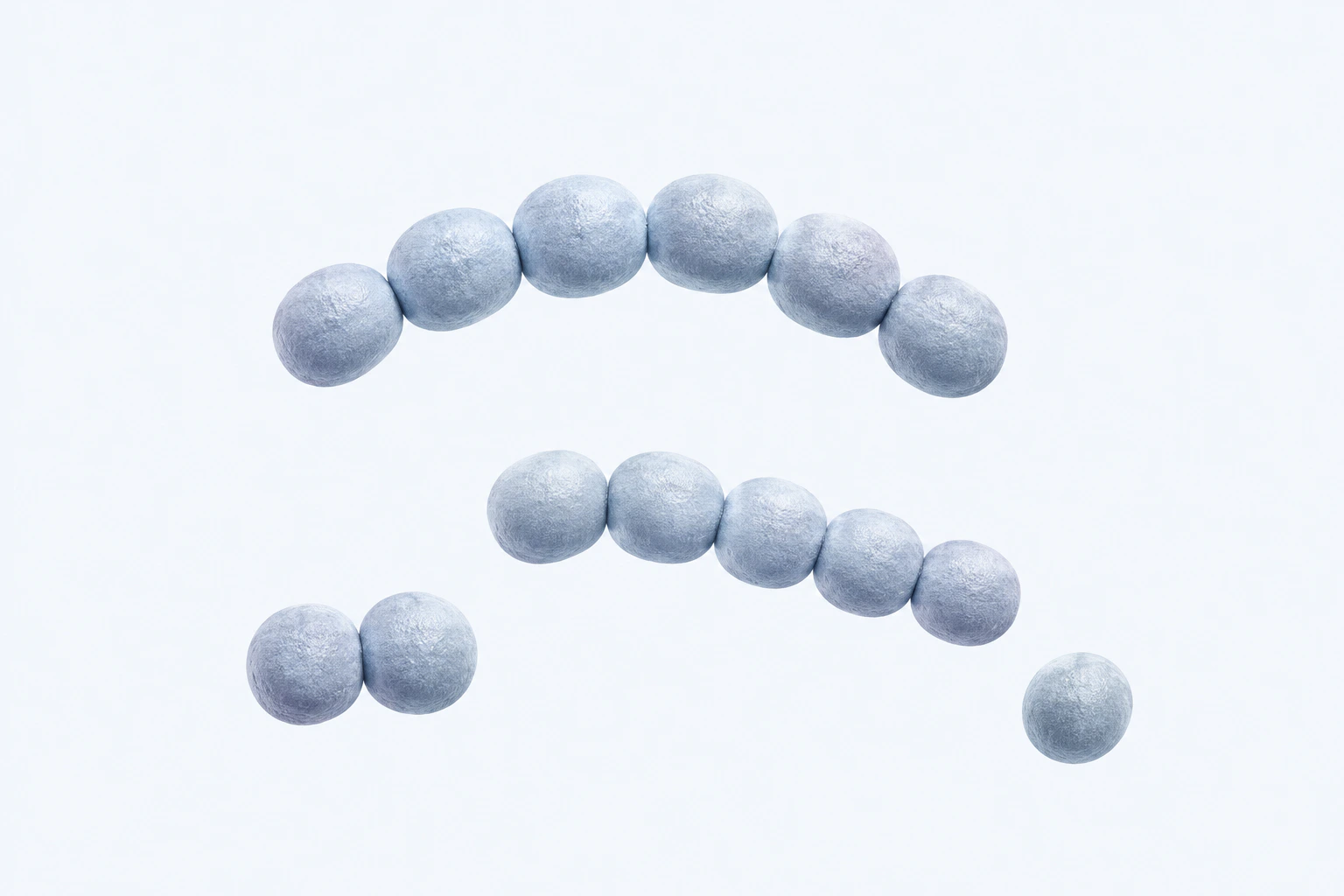
Type-species-anchored Streptococcus reconstruction with fourteen cocci in chains, a pair, and a single. Representative, non-universal, non-diagnostic, and not a micrograph.
Scientific media record1 verified identifier
- Subject
- Streptococcustaxon · genus
- Identifiers
- NCBITaxon:1301
- Review
- Editorial review completeIdentifiers authority-verified · Accessibility validated · · streptococcus|streptococcus-morphology-v1.webp
- Digital source
- Trained-algorithmic mediaCreated with a trained generative algorithm and reviewed by WikiBiome for subject identity, scientific framing, identifiers, provenance, and accessibility.
- Scientific basis
- Streptococcus — NCBI TaxonomyStreptococcus — LPSNStreptococcus — Medical Microbiology
- License
- CC BY-SA 4.0Created
A genus of Gram-positive facultative anaerobes that occupy niches ranging from benign commensals (dental plaque, skin) to acute pathogens (pharyngitis, impetigo, invasive disease).
Streptococci are uniquely manganese-dependent for catalytic scavenging of reactive oxygen species,[1]Metal Homeostasis in Pathogenic StreptococciAkbari MS, Doran KS, Burcham LR · 2022Open reference 1 ↓ a trait that distinguishes them from many other pathogenic bacteria and provides both metabolic advantage and therapeutic vulnerability.
Evidence map8 cited passagesInspect provenance +
A genus of Gram-positive facultative anaerobes that occupy niches ranging from benign commensals (dental plaque, skin) to acute pathogens (pharyngitis, impetigo, invasive disease). Streptococci are uniquely manganese-dependent for catalytic scavenging of reactive oxygen species, a trait that distinguishes them from many other pathogenic bacteria and provides
Streptococci rely on MnSOD (a cambialistic SOD in many species, able to use either Mn or Fe but preferring Mn in vivo) as their primary defense against oxidative stress.
Manganese is imported primarily through the PsaABC / PsaA ABC-type permease, which is essential for virulence in S. pneumoniae and related species.
Elevated luminal zinc competes with manganese at PsaA, and excess Zn relative to Mn is directly toxic to pneumococci by preventing Mn uptake—a natural host antimicrobial strategy. Calcium can partially rescue streptococci from manganese excess toxicity.
This manganese preference represents an evolutionary adaptation to environments where iron is sequestered by host nutritional immunity mechanisms like lactoferrin and transferrin.
Manganese availability modulates streptococcal virulence: MnSOD-deficient mutants show reduced survival in macrophages and attenuated pathogenicity in murine models.
Calprotectin at inflammation sites sequesters manganese and zinc (and to some extent iron), and mis-metallation under combined Mn/Zn stress drives ROS damage in group B Streptococcus.
Experimental approaches: Manganese chelators or dietary manganese restriction may synergize with antibiotics against streptococcal infections by blocking MnSOD-dependent stress survival.
Contents
1. Taxonomy and Major Groups2. Manganese Dependency—A Unique Metabolic Strategy3. Major Virulence Factors4. Disease Associations5. Role in the Microbiome6. Ecological Context7. Manganese Sequestration as Therapeutic Strategy8. ConnectionsTaxonomy and Major Groups#
Group A Streptococcus (GAS / S. pyogenes)—causes pharyngitis, scarlet fever, rheumatic fever, and acute postinfectious glomerulonephritis (APIGN). Leads to ~111,500 deaths annually worldwide (Carapetis et al. 2005, global disease burden review); post-infectious sequelae are the primary long-term public health burden.
Group B Streptococcus (GBS / S. agalactiae)—vaginal colonizer; causes neonatal meningitis and sepsis (leading cause of bacterial meningitis in infants <3 months), chorioamnionitis, and preterm birth complications.
Streptococcus pneumoniae—causes community-acquired pneumonia, otitis media, meningitis. Encapsulated, invasive in immunocompromised hosts. Streptococcus mutans—dental caries pathogen.
Acidogenic biofilm former; produces lactic acid from sucrose fermentation, driving enamel demineralization. Streptococcus thermophilus—GRAS (Generally Recognized as Safe) organism; probiotic strain used in yogurt and dairy fermentation.
Manganese Dependency—A Unique Metabolic Strategy#
Manganese-Dependent Superoxide Dismutase (MnSOD) and the PsaA Permease#
Streptococci rely on MnSOD (a cambialistic SOD in many species, able to use either manganese (Mn) or iron (Fe) but preferring manganese in vivo) as their primary defense against Oxidative Stress.[1]Metal Homeostasis in Pathogenic StreptococciAkbari MS, Doran KS, Burcham LR · 2022Open reference 1 ↓
MnSOD catalyzes the dismutation of superoxide radical (O2·−) to hydrogen peroxide and molecular oxygen, protecting intracellular proteins from oxidative damage.
Manganese is imported primarily through the PsaABC / PsaA ABC-type permease, which is essential for virulence in S. pneumoniae and related species.[1]Metal Homeostasis in Pathogenic StreptococciAkbari MS, Doran KS, Burcham LR · 2022Open reference 1 ↓[2]Eijkelkamp et al. 2014 — Extracellular Zinc Competitively Inhibits Manganese Uptake in Streptococcus pneumoniaeBart A. Eijkelkamp, Jacqueline R. Morey, Stephanie L. Neville et al. · 2014Open reference 2 ↓
Elevated luminal zinc competes with manganese at PsaA, and excess zinc (Zn) relative to manganese is directly toxic to pneumococci by preventing manganese uptake—a natural host antimicrobial strategy.[2]Eijkelkamp et al. 2014 — Extracellular Zinc Competitively Inhibits Manganese Uptake in Streptococcus pneumoniaeBart A. Eijkelkamp, Jacqueline R. Morey, Stephanie L. Neville et al. · 2014Open reference 2 ↓
Calcium can partially rescue streptococci from manganese excess toxicity.[3]Opoku 2024 — Calcium Rescues Streptococcus pneumoniae D39 delta-mntE Manganese-Sensitive Growth PhenotypeReuben Opoku, Edgar Carrasco, Nicholas R De Lay et al. · 2024Open reference 3 ↓
This manganese preference represents an evolutionary adaptation to environments where iron is sequestered by host Nutritional Immunity (Metal Sequestration) mechanisms like Lactoferrin and transferrin.[1]Metal Homeostasis in Pathogenic StreptococciAkbari MS, Doran KS, Burcham LR · 2022Open reference 1 ↓
Virulence and Manganese Availability#
Manganese availability modulates streptococcal virulence: MnSOD-deficient mutants show reduced survival in macrophages and attenuated pathogenicity in murine models.[1]Metal Homeostasis in Pathogenic StreptococciAkbari MS, Doran KS, Burcham LR · 2022Open reference 1 ↓[4]Martin & Waters 2022 — Manganese Homeostasis, Stress, and Pathogenesis in BacteriaJulia E. Martin, Lauren S. Waters · 2022Open reference 4 ↓
In the throat and tonsil environment during acute infection, local manganese availability (vs. iron sequestration) may favor GAS expansion and persistence.
Calprotectin at Metal-Driven Inflammation sites sequesters manganese and zinc (and to some extent iron), and mis-metallation under combined manganese (Mn)/zinc (Zn) stress drives ROS damage in group B Streptococcus.[5]Goh 2024 — An Opportunistic Pathogen Under Stress: How Group B Streptococcus Responds to Cytotoxic Reactive Species and Conditions of Metal Ion Imbalance to SurviveKelvin G K Goh, Devika Desai, Ruby Thapa et al. · 2024Open reference 5 ↓
Major Virulence Factors#
Group A Streptococcus (GAS) Virulence Arsenal#
M protein—antiphagocytic, cross-reactive with myosin (molecular mimicry; triggering post-streptococcal sequelae). Hyaluronidase—cleaves hyaluronic acid in connective tissue; enhances invasiveness and tissue spread. Streptokinase—plasminogen activator; converts plasminogen to plasmin for fibrin degradation and dissemination.
Streptolysins O and S—pore-forming toxins that lyse red blood cells and immune cells; drive inflammation and necrotic tissue damage. Streptopain (cysteine protease)—cleaves complement and immunoglobulin, subverting adaptive immunity.
Group B Streptococcus (GBS) Virulence#
Capsule (polysialic acid)—mimics host neural tissue, evading immune recognition; prevents phagocytosis. Beta-hemolysin/cytolysin—pore-forming toxin; damages epithelial and immune cells. Serine protease SpeCE—cleaves IgA, fibrinogen, and complement factors.
Streptococcus mutans#
Glucosyltransferases (GTFs)—synthesize insoluble dextran polysaccharide from dietary sucrose; primary biofilm matrix. Acidogenic metabolism—lactate fermentation drives pH <5, creating aciduric niche. Acid tolerance—ATP-dependent H+ pumping allows survival at pH 4.0 in biofilm microenvironments.
Disease Associations#
Acute Infection#
Pharyngitis: GAS causes 10-20% of bacterial pharyngitis cases; diagnosis guides antibiotic intervention to prevent rheumatic sequelae. Necrotizing fasciitis: Rapidly progressive streptococcal cellulitis with high mortality; requires surgical debridement. Neonatal sepsis: GBS acquisition from maternal vaginal microbiota during delivery; 1-2 per 1,000 live births; preventable via intrapartum antibiotic prophylaxis.
Post-Infectious Sequelae#
Acute Rheumatic Fever (ARF)—develops 2-4 weeks after untreated GAS pharyngitis; affects 1-3% of infected children in developed countries, 5-10% in low-income settings. Cardiac involvement (rheumatic heart disease) is a leading cause of preventable mortality in children globally.
Molecular mimicry between GAS M protein and cardiac myosin, tropomyosin, and keratin triggers autoimmune heart inflammation. Autoantibodies cross-react with cardiac valve proteins, driving valve fibrosis and stenosis. Post-Infectious Glomerulonephritis (PIGN)—immune complex deposition in kidney glomeruli; develops in 1-5% of GAS-infected individuals; can progress to ESRD if untreated.
PANDAS (Pediatric Autoimmune Neuropsychiatric Disorders Associated with Streptococcal infection)—controversial post-infectious OCD/tics; molecular mechanism remains unproven; antibody-mediated striatal dysfunction proposed but not yet established.
Chronic Biofilm States#
Dental caries—S. mutans initiates plaque biofilm; cavity incidence correlates with dietary sucrose and bacterial load. Chronic tonsillitis—persistent GAS carriage in tonsillar crypts; recurrent infections and occasional abscesses.
Role in the Microbiome#
Oral biofilm: Streptococci are primary pioneers of dental plaque; establish pH microenvironments that enable secondary colonizers (Actinomyces, Veillonella). Throat microbiota: Transient in healthy individuals; persists during acute infection; clearance typically occurs with antibiotic or immune control. Gut: Not a primary resident; occasional detection reflects oropharyngeal aspiration rather than stable colonization.
Ecological Context#
Streptococci thrive in anaerobic biofilms (dental, tonsillar) where manganese availability exceeds iron. M protein and capsular polymers enable coexistence with host tissues through anti-phagocytic camouflage. Biofilm matrix (hyaluronate-cross-linked, carbohydrate-rich) sequesters antimicrobial peptides and antibodies, enabling persistence despite active immune response.
Manganese Sequestration as Therapeutic Strategy#
Calprotectin elevation (during inflammation or in IBD/infection) sequesters zinc and iron but may allow manganese to remain available.
Experimental approaches: Manganese chelators or dietary manganese restriction may synergize with antibiotics against streptococcal infections by blocking MnSOD-dependent stress survival.[4]Martin & Waters 2022 — Manganese Homeostasis, Stress, and Pathogenesis in BacteriaJulia E. Martin, Lauren S. Waters · 2022Open reference 4 ↓
Probiotics with alternative superoxide defenses (e.g., FeSOD-dependent organisms) may competitively exclude streptococci in biofilms.
Connections#
- Manganese—essential cofactor for MnSOD; manganese (Mn) availability modulates virulence
- Zinc—competing metal in calprotectin; possible bioavailability interactions
- Iron—sequestered by host as defense; streptococci bypass via manganese-dependent metabolism
- MnSOD is critical virulence-enabling enzyme
- Nutritional Immunity (Metal Sequestration)—host metal sequestration selects for manganese-dependent pathogens
- Biofilm—carbohydrate matrix protects against antimicrobials and immune attack
- M protein cross-reactivity with cardiac myosin (ARF pathogenesis)
- post-streptococcal sequela with global disease burden
- plaque pioneer; acidogenic niche developer
References 10
Numbered by first appearance in the article, then reconciled with its declared source list.
- 1
Akbari MS, Doran KS, Burcham LR (2022). Metal Homeostasis in Pathogenic Streptococci. Microorganisms.
- 2
Bart A. Eijkelkamp, Jacqueline R. Morey, Stephanie L. Neville et al. (2014). Eijkelkamp et al. 2014 — Extracellular Zinc Competitively Inhibits Manganese Uptake in Streptococcus pneumoniae. PLoS ONE.
- 3
Reuben Opoku, Edgar Carrasco, Nicholas R De Lay et al. (2024). Opoku 2024 — Calcium Rescues Streptococcus pneumoniae D39 delta-mntE Manganese-Sensitive Growth Phenotype. Microorganisms.
- 4
Julia E. Martin, Lauren S. Waters (2022). Martin & Waters 2022 — Manganese Homeostasis, Stress, and Pathogenesis in Bacteria. Frontiers in Molecular Biosciences.
- 5
Kelvin G K Goh, Devika Desai, Ruby Thapa et al. (2024). Goh 2024 — An Opportunistic Pathogen Under Stress: How Group B Streptococcus Responds to Cytotoxic Reactive Species and Conditions of Metal Ion Imbalance to Survive. FEMS Microbiology Reviews.
- 6
Benjamin W. Bauer, Sheeana Gangadoo, Yadav Sharma Bajagai et al. (2019). Bauer 2019 — Oregano Powder Reduces Streptococcus and Increases SCFA in Mixed Bacterial Culture. PLOS ONE.
- 7
Zhuye Jie, Huihua Xia, Shi-Long Zhong et al. (2017). The gut microbiome in atherosclerotic cardiovascular disease. Nature Communications.
- 8
Rebelo A, Mourao J, Freitas AR et al. (2021). Diversity of metal and antibiotic resistance genes in Enterococcus spp. from the last century reflects multiple pollution and genetic exchange among phyla from overlapping ecosystems. Science of the Total Environment.
- 9
Ramezani M, Reisian M, Sajadi Hezaveh Z (2023). The Effect of Synbiotic Supplementation on Hypothyroidism: A Randomized Double-Blind Placebo Controlled Clinical Trial. PLoS ONE.
- 10
Yuanzhao Xu, Lingyue An, Jiling Xie et al. (2026). Xu 2026 — The Gut-Prostate Axis in Benign Prostatic Hyperplasia: Systematic Review of Microbial Dysbiosis and Pathogenic Mechanisms. BMC Urology.
Article network
Mentioned here 8
Pages linking here 34
Connect the evidence
Publicly readable discussion by ORCID-authenticated researchers. Questions, interpretation, methods, corrections, and new evidence stay attached to this record.
No discussion yet. Start with a precise question or a source-backed observation.
Activity and accepted changes
Accepted researcher context, editorial status, public discussion, and upstream Git revisions are shown together. Pending, declined, and withdrawn proposals remain private.
- published revision
Backfill oxidative stress concept links
Karen Pendergrass · +1 −1
Inspect exact Git diff ↗ - published revision
Backfill inflammation concept links
Karen Pendergrass · +1 −1
Inspect exact Git diff ↗ - published revision
massive wiki expansion: 149 stubs fixed, 100+ new pages, Rule 15 scan, keystone papers
WikiBiome Deploy Bot · +40 −36
Inspect exact Git diff ↗ - published revision
nightly maintenance: 94 stub demotions, 181 source_count fixes, 22 auto-discovered stubs, 5 adversarial audits, 3 boundary fixes, 3 evidence-level corrections
WikiBiome Deploy Bot · +3 −0
Inspect exact Git diff ↗ - published revision
Deep citation pass: 25 new sources + major entity citations
WikiBiome Deploy Bot · +10 −8
Inspect exact Git diff ↗ - published revision
WikiBiome update — 2026-04-15 17:23
WikiBiome Deploy Bot · +6 −6
Inspect exact Git diff ↗ - published revision
v2 migration Priority 3: 17 metal + 82 microbe entities upgraded with seo_target, wikipedia_differentiation, conditions data
WikiBiome Deploy Bot · +6 −0
Inspect exact Git diff ↗ - published revision
WikiBiome update — integrity fixes, metallomic diet pages, cross-condition analyses
WikiBiome Deploy Bot · +2 −0
Inspect exact Git diff ↗ - published revision
WikiBiome update — 2026-04-10 17:16
WikiBiome Deploy Bot · +109 −0
Inspect exact Git diff ↗