

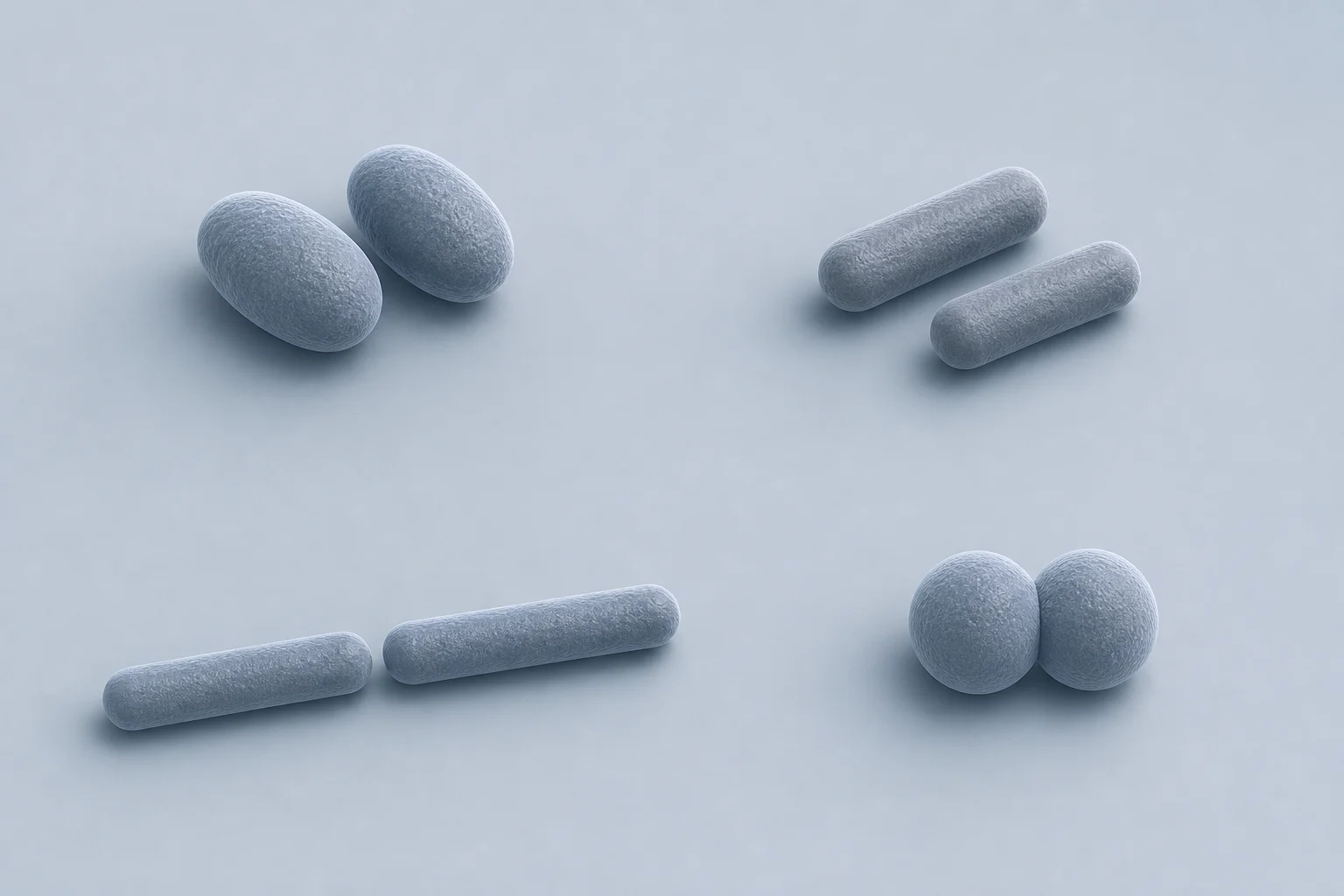
Selected cellular-form breadth within Betaproteobacteria, shown as eight cells in four groupings. The class-level plate is non-exhaustive, non-diagnostic, and not a micrograph.
Scientific media record1 verified identifier
- Subject
- Betaproteobacteriataxon · class
- Identifiers
- NCBITaxon:28216
- Review
- Editorial review completeIdentifiers authority-verified · Accessibility validated · · betaproteobacteria|betaproteobacteria-microbial-community-v1.webp
- Digital source
- Trained-algorithmic mediaCreated with a trained generative algorithm and reviewed by WikiBiome for subject identity, scientific framing, identifiers, provenance, and accessibility.
- Scientific basis
- Betaproteobacteria — NCBI TaxonomyParasutterella secunda type strainOxalobacter formigenes gen. nov., sp. nov.Neisseria gonorrhoeae type strain
- License
- CC BY-SA 4.0Created
A class of Gram-negative bacteria within the phylum Proteobacteria that has emerged as a causal risk factor for schizophrenia and bipolar disorder through Mendelian randomization studies.
Betaproteobacteria includes genera with notable metal tolerance—particularly within the order Burkholderiales—explaining their enrichment in heavy-metal-contaminated environments and potentially connecting environmental metal exposure to neuropsychiatric disease via the gut-brain axis.
Evidence map4 cited passagesInspect provenance +
Class Betaproteobacteria is causally linked to schizophrenia (OR = 1.13, 95% CI 1.01-1.27, p = 0.027). Betaproteobacteria has been previously associated with cognitive impairment in schizophrenia patients, suggesting a specific neurological pathway. Effective intervention requires suppressing both Betaproteobacteria and clostridia (OR 1.16) while restoring d
Class Betaproteobacteria is causally linked to bipolar disorder via a separate Mendelian randomization study, suggesting a shared gut-brain mechanism across psychotic spectrum disorders.
(Mendelian randomization, n=148,984)—Established Betaproteobacteria as a causal schizophrenia risk factor; bidirectional MR confirmed directionality.
(Mendelian randomization)—Causally linked Betaproteobacteria to bipolar disorder.
Contents
1. Taxonomy2. Metal Dependencies and Tolerance3. Ecological Role4. Conditions Associated5. Key Studies6. Open Questions7. Cross-ReferencesTaxonomy#
Class Betaproteobacteria, phylum Proteobacteria. Key gut-relevant orders: Burkholderiales (includes Oxalobacter, Parasutterella, Sutterella), Neisseriales (includes Neisseria Meningitidis).
Taxonomic note: some classification schemes have reclassified Betaproteobacteria as a subclass within Gammaproteobacteria based on phylogenomics; the traditional class-level designation is retained here for consistency with MR studies that used this taxonomy.
Metal Dependencies and Tolerance#
Iron. Betaproteobacteria encode diverse iron acquisition systems including siderophore receptors and TonB-dependent transporters. The class includes both iron-dependent commensals and aggressive iron competitors that thrive in iron-replete inflammatory environments.
Nickel and Heavy Metal Tolerance. Burkholderiales, the largest gut-relevant order within Betaproteobacteria, includes species that thrive in heavy-metal-contaminated soils and environments. Metal efflux pumps (CzcCBA for cadmium (Cd)/zinc (Zn)/cobalt (Co), NccCBA for nickel (Ni)/cobalt/cadmium) are widespread in Betaproteobacteria, providing survival advantages in metal-stressed environments.
This metal tolerance creates a potential pathway: environmental heavy metal exposure → selective enrichment of metal-tolerant Betaproteobacteria in the gut → neuropsychiatric effects via the gut-brain axis.
Ecological Role#
In the Healthy Gut#
Betaproteobacteria are minor members of the healthy gut microbiota, typically comprising <5% of the total community. Parasutterella and Oxalobacter are the best-characterized gut-resident genera.
In Dysbiosis#
Betaproteobacteria expansion is observed in neuropsychiatric conditions and in individuals with elevated heavy metal exposure. The class's metal tolerance mechanisms provide a competitive advantage when dietary or environmental metals create selection pressure against metal-sensitive commensals.
Conditions Associated#
Schizophrenia (Causal Risk Factor)#
Class Betaproteobacteria is causally linked to schizophrenia (OR = 1.13, 95% CI 1.01-1.27, p = 0.027).[1]Zhou 2024 — Gut Microbiome and Schizophrenia: Insights from Two-Sample Mendelian RandomizationKeer Zhou, Ancha Baranova, Hongbao Cao et al. · 2024Open reference 1 ↓ Betaproteobacteria has been previously associated with cognitive impairment in schizophrenia patients, suggesting a specific neurological pathway.
Effective intervention requires suppressing both Betaproteobacteria and Clostridia (OR 1.16) while restoring Desulfovibrio and Veillonellaceae—the two-sided ecological engineering principle.
Bipolar Disorder#
Class Betaproteobacteria is causally linked to bipolar disorder via a separate Mendelian randomization study,[2]Ni 2022 — Gut Microbiota and Psychiatric Disorders: A Two-Sample Mendelian Randomization StudyJing-Jing Ni, Qian Xu, Shan-Shan Yan et al. · 2022Open reference 2 ↓ suggesting a shared gut-brain mechanism across psychotic spectrum disorders.
Epilepsy#
Betaproteobacteria (class) and Burkholderiales (order) are MR risk factors for epilepsy (OR = 1.357 and 1.336 respectively), further supporting the class's role in neurological disease via the gut-brain axis.
Key Studies#
[1]Zhou 2024 — Gut Microbiome and Schizophrenia: Insights from Two-Sample Mendelian RandomizationKeer Zhou, Ancha Baranova, Hongbao Cao et al. · 2024Open reference 1 ↓ (Mendelian randomization, n=148,984)—Established Betaproteobacteria as a causal schizophrenia risk factor; bidirectional MR confirmed directionality.[2]Ni 2022 — Gut Microbiota and Psychiatric Disorders: A Two-Sample Mendelian Randomization StudyJing-Jing Ni, Qian Xu, Shan-Shan Yan et al. · 2022Open reference 2 ↓ (Mendelian randomization)—Causally linked Betaproteobacteria to bipolar disorder.
Open Questions#
Unresolved questions identified by the current evidence record.
01Does environmental heavy metal exposure drive Betaproteobacteria enrichment in neuropsychiatric patients?+
The metal tolerance of Burkholderiales provides a mechanistic hypothesis, but no study has measured both metal exposure and Betaproteobacteria abundance in psychiatric cohorts.
02Which Betaproteobacteria genera mediate the schizophrenia signal?+
Class-level MR data cannot distinguish between Parasutterella, Sutterella, Oxalobacter, and other gut-resident genera.
03Does Betaproteobacteria suppression improve cognitive outcomes in schizophrenia?+
The association with cognitive impairment suggests a specific intervention target, but no RCT has tested this.
Cross-References#
- Schizophrenia—causal risk factor via MR
- Clostridia—co-identified as schizophrenia risk taxon in the same MR study
- Veillonellaceae—causally protective counterpart in schizophrenia ecology
- Desulfovibrio—causally protective counterpart in schizophrenia ecology
- Parasutterella—a key gut-resident genus within Betaproteobacteria
- Oxalobacter—another gut-relevant genus; Burkholderiales order
- Neisseria Meningitidis—a pathogenic Betaproteobacteria outside the gut niche
- Epilepsy—Betaproteobacteria and Burkholderiales as MR risk factors
References 8
Numbered by first appearance in the article, then reconciled with its declared source list.
- 1
Keer Zhou, Ancha Baranova, Hongbao Cao et al. (2024). Zhou 2024 — Gut Microbiome and Schizophrenia: Insights from Two-Sample Mendelian Randomization. Schizophrenia (Nature Partner Journal).
- 2
Jing-Jing Ni, Qian Xu, Shan-Shan Yan et al. (2022). Ni 2022 — Gut Microbiota and Psychiatric Disorders: A Two-Sample Mendelian Randomization Study. Frontiers in Microbiology.
- 3
Ming Yuan, Dong Li, Zhe Zhang et al. (2018). Yuan 2018 — Endometriosis Induces Gut Microbiota Alterations in Mice. Human Reproduction.
- 4
Tung Hoang, Minjung Kim, Ji Won Park et al. (2023). Dysbiotic microbiome variation in colorectal cancer patients is linked to lifestyles and metabolic diseases. BMC Microbiology.
- 5
Fang L, Ning J (2024). Fang & Ning 2024 — Recent Advances in Gut Microbiota and Thyroid Disease: Pathogenesis and Therapeutics. Frontiers in Cellular and Infection Microbiology.
- 6
Wang M, Zhu Y (2025). Wang & Zhu 2025 — Gut Microbiome Versus Thyroid Cancer: Association and Clinical Implications (Review). Oncology Letters.
- 7
Ni JJ, Xu Q, Yan SS et al. (2022). Gut Microbiota and Psychiatric Disorders: A Two-Sample Mendelian Randomization Study. Frontiers in Microbiology.
- 8
Youjie Zeng, Si Cao, Heng Yang (2023). Roles of gut microbiome in epilepsy risk: a Mendelian randomization study. Frontiers in Microbiology.
Article network
Mentioned here 8
Pages linking here 3
Connect the evidence
Publicly readable discussion by ORCID-authenticated researchers. Questions, interpretation, methods, corrections, and new evidence stay attached to this record.
No discussion yet. Start with a precise question or a source-backed observation.
Published page changes
This record shows only material changes published on this page, including changes to its content, evidence, conclusions, or author context. Internal processes and discussion activity are excluded. Pending, declined, and withdrawn proposals remain private.
- published revision
Added references: yuan-2018-endometriosis-induces-gut-microbiota-alterations-mice; hoang-2023-dysbiotic-microbiome-crc-lifestyles-metabolic; fang-2024-gut-microbiota-thyroid-disease-advances; wang-2025-gut-microbiome-thyroid-cancer-review;…
Added references: yuan-2018-endometriosis-induces-gut-microbiota-alterations-mice; hoang-2023-dysbiotic-microbiome-crc-lifestyles-metabolic; fang-2024-gut-microbiota-thyroid-disease-advances; wang-2025-gut-microbiome-thyroid-cancer-review; ni-2022-gut-microbiota-psychiatric-disorders-mendelian-randomization; zeng-2023-gut-microbiome-epilepsy-mendelian-randomization. · WikiBiome Deploy Bot · +19 −13
Inspect exact Git diff ↗ - published revision
Created “Betaproteobacteria”: A class of Gram-negative bacteria within the phylum Proteobacteria that has emerged as a causal risk factor for schizophrenia and bipolar disorder through Mendelian randomization studies.…
Created “Betaproteobacteria”: A class of Gram-negative bacteria within the phylum Proteobacteria that has emerged as a causal risk factor for schizophrenia and bipolar disorder through Mendelian randomization studies.… Published sections: Betaproteobacteria; Taxonomy; Metal Dependencies and Tolerance; In the Healthy Gut; In Dysbiosis; Schizophrenia (Causal Risk Factor); Bipolar Disorder; Epilepsy; Key Studies; Open Questions; Cross-References. · WikiBiome Deploy Bot · +85 −0
Inspect exact Git diff ↗