

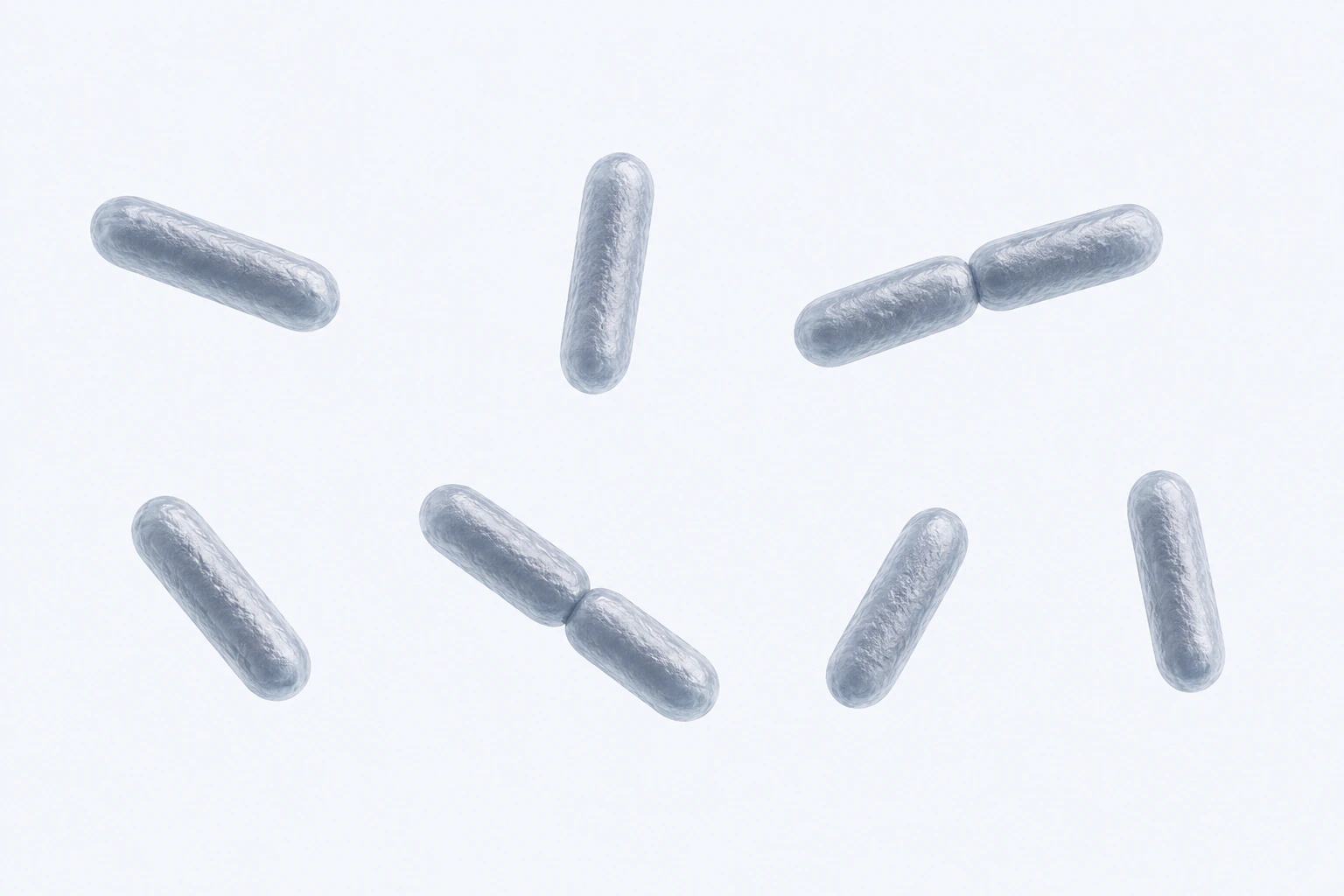
Type-strain-anchored Serratia marcescens reconstruction with nine straight rods. Representative, non-diagnostic, and not a micrograph; colony pigment is not depicted.
Scientific media record1 verified identifier
- Subject
- Serratia marcescenstaxon · species
- Identifiers
- NCBITaxon:615
- Review
- Editorial review completeIdentifiers authority-verified · Accessibility validated · · serratia-marcescens|serratia-marcescens-morphology-v1.webp
- Digital source
- Trained-algorithmic mediaCreated with a trained generative algorithm and reviewed by WikiBiome for subject identity, scientific framing, identifiers, provenance, and accessibility.
- Scientific basis
- Serratia marcescens — NCBI TaxonomySerratia marcescens — LPSNSerratia marcescens — MeSHSerratia marcescens type strain — BacDive
- License
- CC BY-SA 4.0Created
Serratia marcescens is a Gram-negative, facultatively anaerobic member of the Enterobacteriaceae, historically recognized by its distinctive red pigment prodigiosin.
Once considered a harmless environmental saprophyte, S. marcescens is now recognized as a significant opportunistic pathogen in hospital settings and a participant in the polymicrobial biofilm communities implicated in inflammatory bowel disease.
In the WikiBiome framework, its significance lies in its metal tolerance systems, its role in interkingdom biofilms, and the anticancer properties of its signature pigment.
Contents
1. Metal Dependencies and Tolerance2. Key Enzymes and Virulence Factors3. Ecological Role4. Conditions Associated5. Cross-ReferencesMetal Dependencies and Tolerance#
S. marcescens possesses robust iron acquisition systems including siderophores that compete with host Lactoferrin and Transferrin for environmental iron. Its metal story extends beyond iron dependency.
Mercury resistance—The mer operon (merA, merB) in S. marcescens encodes mercuric reductase that converts toxic mercury(II) (Hg2+) to volatile Hg0, providing resistance to mercury contamination. This operon is frequently carried on mobile genetic elements alongside antibiotic resistance genes, making S. marcescens a paradigm organism for Co-Selection.
Multi-metal tolerance—Environmental isolates show tolerance to cadmium, zinc, copper, and chromium, reflecting the genus's adaptation to contaminated soils and water systems. Prodigiosin and metals—Prodigiosin biosynthesis is regulated by metal availability; iron and copper modulate pigment production through transcriptional regulators.
Key Enzymes and Virulence Factors#
Prodigiosin—A tripyrrole red pigment with remarkable biological activities: anticancer (induces apoptosis in tumor cells), immunomodulatory, antifungal, and antibacterial. Its anticancer potential has attracted pharmaceutical interest.
Serralysin (metalloprotease)—A zinc-dependent extracellular protease that degrades host immune proteins including immunoglobulins, complement components, and extracellular matrix. A canonical Zinc-Metalloprotease virulence factor.
Siderophores—Iron acquisition systems enabling competition in iron-limited environments. Chitinase—Degrades chitin, potentially relevant to interkingdom interactions with fungi.
Ecological Role#
Triple-Species Biofilm in Crohn's Disease#
The most distinctive ecological feature of S. marcescens in the WikiBiome context is its participation in a triple-species biofilm with Escherichia coli and Candida tropicalis documented in the Crohn's disease mucosa.
In this partnership, the three organisms cooperate metabolically and provide mutual protection against host defenses and antimicrobials—a canonical example of Inter-Kingdom Metal Shielding and Functional Shielding.
Nosocomial Ecology#
In hospital environments, S. marcescens colonizes water systems, respiratory equipment, and catheter surfaces. Its biofilm-forming capacity and intrinsic resistance to many disinfectants make it a persistent environmental contaminant.
Conditions Associated#
| Condition | Role |
|---|---|
| Crohn's Disease | Triple-species biofilm participant with E. coli and C. tropicalis |
| Nosocomial infections | Catheter-associated UTI, pneumonia, wound infections |
| Neonatal infections | Outbreaks in neonatal ICUs, particularly from contaminated parenteral nutrition |
Cross-References#
- Candida tropicalis—biofilm partner in Crohn's disease
- Escherichia coli—biofilm partner in Crohn's disease
- Functional Shielding—triple-species biofilm as canonical example
- Co-Selection—mercury resistance operon co-located with antibiotic resistance
- Zinc-Metalloprotease—serralysin as virulence factor
- Iron—siderophore-mediated iron competition
References 3
Numbered by first appearance in the article, then reconciled with its declared source list.
- 1
Apurva Virmani Johri, Pranav Johri, Naomi Hoyle et al. (2023). Johri 2023 — Successful Treatment of Recurrent E. coli Infection with Bacteriophage Therapy for Chronic Bacterial Prostatitis. Frontiers in Pharmacology.
- 2
Shaun Trecarten, Michael A. Liss, Jill Hamilton-Reeves et al. (2025). Trecarten 2025 — Obesity, Dietary Interventions and Microbiome Alterations in Prostate Cancer. Frontiers in Immunology.
- 3
Khan F, Rizvi M, Shukla I et al. (2011). A Novel Approach for Identification of Members of Enterobacteriaceae Isolated from Clinical Samples. Biology and Medicine.
Article network
Connect the evidence
Publicly readable discussion by ORCID-authenticated researchers. Questions, interpretation, methods, corrections, and new evidence stay attached to this record.
No discussion yet. Start with a precise question or a source-backed observation.
Published page changes
This record shows only material changes published on this page, including changes to its content, evidence, conclusions, or author context. Internal processes and discussion activity are excluded. Pending, declined, and withdrawn proposals remain private.
- published revision
Added references: johri-2023-phage-therapy-ecoli-chronic-prostatitis-case; trecarten-2025-obesity-diet-microbiome-prostate-cancer; khan-2011-novel-approach-enterobacteriaceae-identification-clinical.
WikiBiome Deploy Bot · +15 −14
Inspect exact Git diff ↗ - published revision
Created “Serratia marcescens”: Serratia marcescens is a Gram-negative, facultatively anaerobic member of the Enterobacteriaceae, historically recognized by its distinctive red pigment prodigiosin. Once considered a harmless…
Created “Serratia marcescens”: Serratia marcescens is a Gram-negative, facultatively anaerobic member of the Enterobacteriaceae, historically recognized by its distinctive red pigment prodigiosin. Once considered a harmless… Published sections: Overview; Metal Dependencies and Tolerance; Key Enzymes and Virulence Factors; Triple-Species Biofilm in Crohn's Disease; Nosocomial Ecology; Conditions Associated; Cross-References. · WikiBiome Deploy Bot · +89 −0
Inspect exact Git diff ↗