

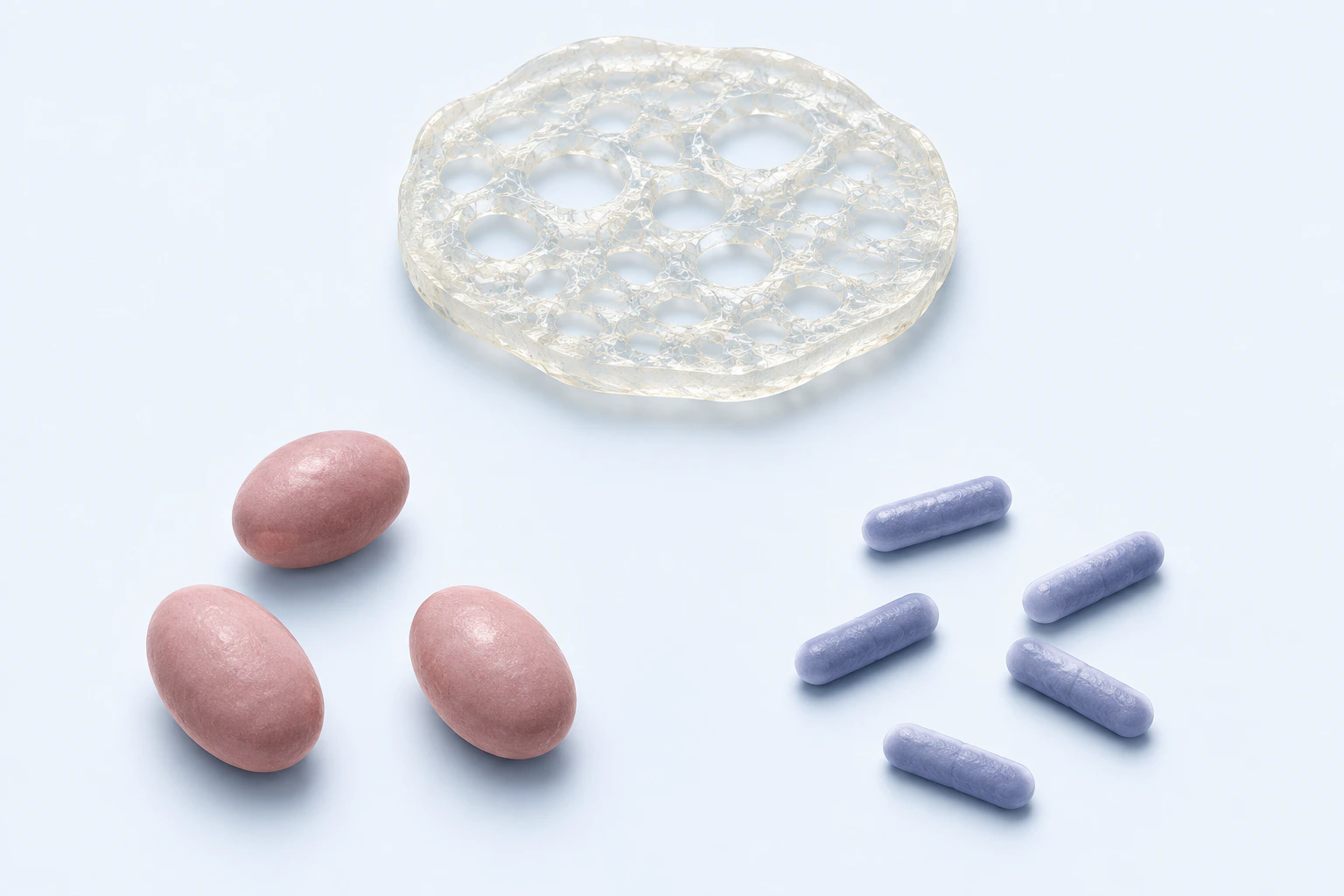
Separate matrix, generic fungal-context, and generic bacterial-context teaching models orient the literature-derived functional-shielding concept. They do not show a mixed biofilm, physical shielding, resistance, immune evasion, persistence, clinical outcome, or treatment effect.
Scientific media record3 verified identifiers
- Subject
- Functional Shieldingbiological-process
- Review
- Editorial review completeIdentifiers authority-verified · Accessibility validated · · functional-shielding|functional-shielding-mechanism-v1.webp
- Digital source
- Trained-algorithmic mediaCreated with a trained generative algorithm and reviewed by WikiBiome for subject identity, scientific framing, identifiers, provenance, and accessibility.
- Scientific basis
- Functional ShieldingBiofilms — Medical Subject HeadingsMicrobial Interactions — Medical Subject HeadingsCandida albicans biofilm matrix protects Streptococcus mutansPolymicrobial biofilm matrix interaction studyCross-kingdom biofilm interaction context
- License
- CC BY-SA 4.0Created
Functional shielding is the phenomenon in which one microorganism—typically a fungus—physically and immunologically protects a co-resident pathogen from host immune attack, antimicrobial agents, and Oxidative Stress. The shielding organism's biofilm matrix acts as a permeability barrier while cross-kingdom signaling enhances virulence and suppresses host immune alertness.
This is not passive co-occurrence—it is active, bidirectional immune subversion where both partners benefit from the partnership.
This concept exemplifies Karen's Brain Primitive 6 (Interkingdom Relationships and Functional Shielding): understanding disease requires examining the entire ecological network pathogens inhabit, not just individual organisms in isolation.
Evidence map19 cited passagesInspect provenance +
The most mechanistically detailed demonstration of functional shielding comes from the Bartnicka et al. (2020) study—the definitive paper showing how C. albicans shields the periodontal keystone pathogen P. gingivalis from immune recognition.
Immune recognition suppressed: THP-1 macrophages exposed to mixed-species (C. albicans + P. gingivalis) biofilm supernatants showed attenuated cytokine and chemokine production compared to bacterial mono-infection. TNF-alpha was reduced, IL-8 was nearly eliminated, and neutrophil elastase activity remained at baseline—the host could not detect the bacteria
Bacterial virulence amplified: Gingipain (Rgp) activity—the zinc-dependent protease that is P. gingivalis's master virulence factor—increased up to 130% under anoxia and up to 10-fold under normoxic conditions in fungal co-culture. The biofilm doesn't just hide the bacterium—it makes it more dangerous.
Chronic persistence over acute invasion: In vivo (mouse subcutaneous chamber model), pre-infection with C. albicans reduced P. gingivalis mortality from 21% to 7% while bacterial persistence at 96 hours rose from 24% to 85%. The mixed infection favors chronic local persistence rather than acute systemic invasion—the "chronic disease" phenotype.
Als3-RgpA binding: The fungal adhesin Als3 (agglutinin-like sequence protein 3) binds the hemagglutinin domain of the bacterial gingipain RgpA, creating direct physical contact.
PPAD citrullination: The bacterial enzyme peptidylarginine deiminase (PPAD) converts arginine residues on C. albicans surface proteins to citrulline, facilitating adhesion. PPAD-deficient P. gingivalis mutants show reduced binding to fungal cells.
Reciprocal virulence enhancement: Co-culture promoted secretion of 7 cytolytic and 11 proteolytic virulence factors—both organisms become more virulent together than alone.
Simultaneous hypha formation AND beta-glucan masking: The bacterial partner drives Candida toward its most invasive hyphal form while simultaneously triggering beta-glucan masking—hiding the fungus from Dectin-1-mediated immune recognition. This is the most direct evidence that interkingdom cooperation includes active immune evasion as a shared benefit.
Masking pathways: Multiple signaling cascades (cAMP-PKA, MAPK, cell wall integrity) regulate the balance between glucan exposure and masking.
Bacterial enhancement of masking: S. aureus co-culture enhances beta-glucan masking beyond what C. albicans achieves alone.
Drug-sensitive unmasking: Caspofungin and other echinocandin antifungals disrupt glucan synthesis, exposing beta-glucan to immune recognition—effectively "unmasking" the fungus.
Magnesium modulation: Magnesium availability affects C. albicans immune evasion mechanisms.
Zinc: porphyromonas gingivalis gingipains are zinc metallopeptidases. The 10-fold amplification of gingipain activity in fungal co-culture means the zinc-dependent virulence axis is enhanced by interkingdom cooperation. Host calprotectin-mediated zinc sequestration may paradoxically reduce gingipain activity while simultaneously strengthening the biofilm's m
Iron: P. gingivalis is a heme specialist; gingival bleeding provides iron/heme substrate. C. albicans possesses its own iron acquisition systems. Within biofilms, fungi can monopolize Fe3+ uptake then transfer iron to bacterial partners—cross-feeding that strengthens the partnership. Cortisol-stimulated P. gingivalis migration requires metabolic substrates
Magnesium: Mg2+ affects C. albicans morphogenesis and immune evasion capacity.
| Condition | Fungal partner | Bacterial partner | Shielding effect | Source | |-----------|---------------|-------------------|------------------|--------| | Periodontitis | C. albicans | P. gingivalis | Immune evasion + gingipain amplification + chronic persistence | | | Wound infections | C. albicans / C. auris | S. aureus | Reciprocal virulence + beta-gl
C. albicans Als3—P. gingivalis RgpA: Direct adhesin-protease binding.
Beta-glucan unmasking: Caspofungin and other echinocandins expose beta-glucan to Dectin-1, triggering immune recognition.
Stress reduction: Cortisol promotes P. gingivalis surface translocation and virulence gene expression; stress management becomes a non-antibiotic ecological intervention for periodontitis.
Contents
1. The Paradigm Case: Candida albicans + Porphyromonas gingivalis2. Candida albicans + Staphylococcus aureus3. Beta-Glucan Masking—The Fungal Cloak4. Metal Connections5. Role in Disease6. Co-Aggregation as the Entry Point7. Intervention Implications8. Cross-ReferencesThe Paradigm Case: Candida albicans + Porphyromonas gingivalis#
The most mechanistically detailed demonstration of functional shielding comes from the Bartnicka et al. (2020) study—the definitive paper showing how C. albicans shields the periodontal keystone pathogen P. gingivalis from immune recognition.[1]Bartnicka et al. 2020 — Candida albicans Shields the Periodontal Killer Porphyromonas gingivalis from Recognition by the Host Immune System and Supports the Bacterial Infection of Gingival TissueDominika Bartnicka, Miriam Gonzalez-Gonzalez, Joanna Sykut et al. · 2020Open reference 1 ↓
Three-Layer Protection#
- Immune recognition suppressed: THP-1 macrophages exposed to mixed-species (C. albicans + P. gingivalis) biofilm supernatants showed attenuated cytokine and chemokine production compared to bacterial mono-infection. TNF-alpha was reduced, IL-8 was nearly eliminated, and neutrophil elastase activity remained at baseline—the host could not detect the bacterial invader within the fungal biofilm.[1]Bartnicka et al. 2020 — Candida albicans Shields the Periodontal Killer Porphyromonas gingivalis from Recognition by the Host Immune System and Supports the Bacterial Infection of Gingival TissueDominika Bartnicka, Miriam Gonzalez-Gonzalez, Joanna Sykut et al. · 2020Open reference 1 ↓
- Bacterial virulence amplified: Gingipain (Rgp) activity—the zinc-dependent protease that is P. gingivalis's master virulence factor—increased up to 130% under anoxia and up to 10-fold under normoxic conditions in fungal co-culture. The biofilm doesn't just hide the bacterium—it makes it more dangerous.[1]Bartnicka et al. 2020 — Candida albicans Shields the Periodontal Killer Porphyromonas gingivalis from Recognition by the Host Immune System and Supports the Bacterial Infection of Gingival TissueDominika Bartnicka, Miriam Gonzalez-Gonzalez, Joanna Sykut et al. · 2020Open reference 1 ↓
- Chronic persistence over acute invasion: In vivo (mouse subcutaneous chamber model), pre-infection with C. albicans reduced P. gingivalis mortality from 21% to 7% while bacterial persistence at 96 hours rose from 24% to 85%. The mixed infection favors chronic local persistence rather than acute systemic invasion—the "chronic disease" phenotype.[1]Bartnicka et al. 2020 — Candida albicans Shields the Periodontal Killer Porphyromonas gingivalis from Recognition by the Host Immune System and Supports the Bacterial Infection of Gingival TissueDominika Bartnicka, Miriam Gonzalez-Gonzalez, Joanna Sykut et al. · 2020Open reference 1 ↓
Co-Aggregation Mechanism#
The C. albicans + P. gingivalis partnership is stabilized by specific molecular interactions. Als3-RgpA binding: The fungal adhesin Als3 (agglutinin-like sequence protein 3) binds the hemagglutinin domain of the bacterial gingipain RgpA, creating direct physical contact.[1]Bartnicka et al. 2020 — Candida albicans Shields the Periodontal Killer Porphyromonas gingivalis from Recognition by the Host Immune System and Supports the Bacterial Infection of Gingival TissueDominika Bartnicka, Miriam Gonzalez-Gonzalez, Joanna Sykut et al. · 2020Open reference 1 ↓
PPAD citrullination: The bacterial enzyme peptidylarginine deiminase (PPAD) converts arginine residues on C. albicans surface proteins to citrulline, facilitating adhesion. PPAD-deficient P. gingivalis mutants show reduced binding to fungal cells.[1]Bartnicka et al. 2020 — Candida albicans Shields the Periodontal Killer Porphyromonas gingivalis from Recognition by the Host Immune System and Supports the Bacterial Infection of Gingival TissueDominika Bartnicka, Miriam Gonzalez-Gonzalez, Joanna Sykut et al. · 2020Open reference 1 ↓
Bidirectional morphogenesis: P. gingivalis enhances C. albicans germ tube formation and upregulates fungal adhesins (Als3, Hwp1), while the hyphal form of C. albicans provides the structural scaffold for bacterial colonization.
These specific binding interactions mean co-aggregation is not random—the organisms have co-evolved molecular recognition systems for partnership.
Candida albicans + Staphylococcus aureus#
The second major functional shielding partnership involves C. albicans and S. aureus. Reciprocal virulence enhancement: cobalt (Co)-culture promoted secretion of 7 cytolytic and 11 proteolytic virulence factors—both organisms become more virulent together than alone.[2]Pasman et al. 2025 — Candida-Staphylococcus Reciprocal Virulence and Masking in Co-culturePasman ME, et al. · 2025Open reference 2 ↓
Simultaneous hypha formation AND beta-glucan masking: The bacterial partner drives Candida toward its most invasive hyphal form while simultaneously triggering beta-glucan masking—hiding the fungus from Dectin-1-mediated immune recognition.
This is the most direct evidence that interkingdom cooperation includes active immune evasion as a shared benefit.[2]Pasman et al. 2025 — Candida-Staphylococcus Reciprocal Virulence and Masking in Co-culturePasman ME, et al. · 2025Open reference 2 ↓
Clinical relevance: C. albicans + S. aureus co-infection is common in diabetic wounds, surgical site infections, catheter-associated bloodstream infections, and ventilator-associated pneumonia. The mixed biofilm is 100–1,000-fold more antibiotic-resistant than planktonic cells.
Beta-Glucan Masking—The Fungal Cloak#
Beta-1,3-glucan is a major component of the Candida cell wall and the primary PAMP recognized by host Dectin-1 receptors. C. albicans actively masks beta-glucan exposure by covering it with a mannoprotein outer layer.
Masking pathways: Multiple signaling cascades (cAMP-PKA, MAPK, cell wall integrity) regulate the balance between glucan exposure and masking.[3]Chen, Wagner & Reynolds 2022 — Beta-Glucan Masking Signaling Pathways in CandidaChen T, Wagner AS, Reynolds TB · 2022Open reference 3 ↓
Bacterial enhancement of masking: S. aureus co-culture enhances beta-glucan masking beyond what C. albicans achieves alone.[2]Pasman et al. 2025 — Candida-Staphylococcus Reciprocal Virulence and Masking in Co-culturePasman ME, et al. · 2025Open reference 2 ↓
Drug-sensitive unmasking: Caspofungin and other echinocandin antifungals disrupt glucan synthesis, exposing beta-glucan to immune recognition—effectively "unmasking" the fungus.[4]Wheeler & Fink 2006 — A Drug-Sensitive Genetic Network Masks Fungi from the Immune SystemWheeler RT, Fink GR · 2006Open reference 4 ↓
Magnesium modulation: Magnesium availability affects C. albicans immune evasion mechanisms.[5]Hans et al. 2022 — Magnesium Deprivation Causes Candida Beta-Glucan Unmasking and Immune Evasion ChangesHans S, et al. · 2022Open reference 5 ↓
Metal Connections#
Zinc, iron, and magnesium are central to functional shielding.
Zinc: Porphyromonas gingivalis gingipains are zinc metallopeptidases. The 10-fold amplification of gingipain activity in fungal co-culture means the zinc-dependent virulence axis is enhanced by interkingdom cooperation.[1]Bartnicka et al. 2020 — Candida albicans Shields the Periodontal Killer Porphyromonas gingivalis from Recognition by the Host Immune System and Supports the Bacterial Infection of Gingival TissueDominika Bartnicka, Miriam Gonzalez-Gonzalez, Joanna Sykut et al. · 2020Open reference 1 ↓ Host Calprotectin (S100A8/A9)-mediated zinc sequestration may paradoxically reduce gingipain activity while simultaneously strengthening the biofilm's metabolic integration.
Iron: P. gingivalis is a heme specialist; gingival bleeding provides iron/heme substrate. C. albicans possesses its own iron acquisition systems. Within biofilms, fungi can monopolize iron(III) (Fe3+) uptake then transfer iron to bacterial partners—cross-feeding that strengthens the partnership.
Cortisol-stimulated P. gingivalis migration requires metabolic substrates from erythrocyte lysis (heme + lactate/pyruvate).[6]Kim et al. 2022 — Cortisol Promotes Surface Translocation of Porphyromonas gingivalisHey-Min Kim, Christina Magda Rothenberger, Mary Ellen Davey · 2022Open reference 6 ↓
Magnesium: magnesium(II) (Mg2+) affects C. albicans morphogenesis and immune evasion capacity.[5]Hans et al. 2022 — Magnesium Deprivation Causes Candida Beta-Glucan Unmasking and Immune Evasion ChangesHans S, et al. · 2022Open reference 5 ↓
Nutritional immunity paradox: Host elevation of Hepcidin and Calprotectin (S100A8/A9) to restrict microbial metals may paradoxically strengthen fungal-bacterial biofilms by forcing tighter metabolic integration and cross-feeding.
Role in Disease#
Functional shielding is documented across multiple conditions:
| Condition | Fungal partner | Bacterial partner | Shielding effect | Source |
|---|---|---|---|---|
| Periodontitis | C. albicans | P. gingivalis | Immune evasion + gingipain amplification + chronic persistence | [1]Bartnicka et al. 2020 — Candida albicans Shields the Periodontal Killer Porphyromonas gingivalis from Recognition by the Host Immune System and Supports the Bacterial Infection of Gingival TissueDominika Bartnicka, Miriam Gonzalez-Gonzalez, Joanna Sykut et al. · 2020Open reference 1 ↓ |
| Wound infections | C. albicans / C. auris | S. aureus | Reciprocal virulence + beta-glucan masking | [2]Pasman et al. 2025 — Candida-Staphylococcus Reciprocal Virulence and Masking in Co-culturePasman ME, et al. · 2025Open reference 2 ↓ |
| Endometriosis | C. albicans | E. coli, Enterobacteriaceae | Biofilm protection in endometrial lesions | |
| IBD | C. tropicalis | Bacteroides, E. coli | Mucosal biofilm perpetuating Dysbiosis | |
| GERD | Candida spp. | Esophageal pathogens | PPI-induced fungal overgrowth shields bacteria | [7]Shi 2023 — PPI-Induced Fungal Dysbiosis in Patients with Gastroesophageal Reflux DiseaseYichao Shi, Jianfeng Li, Shuntian Cai et al. · 2023Open reference 7 ↓ |
Co-Aggregation as the Entry Point#
cobalt (Co)-aggregation—the specific cell-to-cell binding between genetically distinct organisms—is the prerequisite for functional shielding. Without co-aggregation, organisms cannot form the mixed biofilms that enable shielding.
Key co-aggregation partnerships in the oral cavity.
Fusobacterium nucleatum as the "bridge organism"—co-aggregates with both early (Streptococcus) and late (P. gingivalis, Treponema) colonizers. C. albicans Als3—P. gingivalis RgpA: Direct adhesin-protease binding.[1]Bartnicka et al. 2020 — Candida albicans Shields the Periodontal Killer Porphyromonas gingivalis from Recognition by the Host Immune System and Supports the Bacterial Infection of Gingival TissueDominika Bartnicka, Miriam Gonzalez-Gonzalez, Joanna Sykut et al. · 2020Open reference 1 ↓ C. albicans—S. aureus: Attachment to hyphal surfaces.
cobalt-aggregation is distinct from biofilm formation—it describes the initial specific binding that nucleates mixed-species communities. Once co-aggregated, the organisms transition into biofilm architecture where functional shielding emerges.
Intervention Implications#
Sequential therapy: Antifungal → antibiotic is mechanistically justified. Disrupting the fungal scaffold first (echinocandins targeting beta-glucan synthesis) exposes bacterial partners to both immune recognition and antibiotic penetration.
cobalt (Co)-aggregation disruption: Targeting Als3-RgpA binding with peptide mimetics could prevent the initial partnership formation. Beta-glucan unmasking: Caspofungin and other echinocandins expose beta-glucan to Dectin-1, triggering immune recognition.[4]Wheeler & Fink 2006 — A Drug-Sensitive Genetic Network Masks Fungi from the Immune SystemWheeler RT, Fink GR · 2006Open reference 4 ↓ Zinc supplementation: May inhibit C. albicans hyphal morphogenesis at non-toxic doses, collapsing the structural scaffold.
Stress reduction: Cortisol promotes P. gingivalis surface translocation and virulence gene expression;[6]Kim et al. 2022 — Cortisol Promotes Surface Translocation of Porphyromonas gingivalisHey-Min Kim, Christina Magda Rothenberger, Mary Ellen Davey · 2022Open reference 6 ↓ stress management becomes a non-antibiotic ecological intervention for periodontitis.
Cross-References#
- Inter-Kingdom Metal Shielding—Metal-mediated cooperative defense in polymicrobial biofilms
- Biofilm—The structural context enabling shielding
- Candida albicans—Primary fungal shielder; hyphal form provides scaffold
- Porphyromonas gingivalis—Paradigm case of bacterial beneficiary
- Staphylococcus aureus—Second major bacterial partner; reciprocal virulence masking
- Candida tropicalis, Candidozyma auris—Alternative fungal partners
- Fusobacterium nucleatum—Bridge organism enabling co-aggregation networks
- Calprotectin (S100A8/A9)—Host zinc/manganese (Mn) sequestration may paradoxically strengthen biofilms
- Nutritional Immunity (Metal Sequestration)—Metal restriction as failed antimicrobial strategy in polymicrobial context
- Gingipains—Zinc-dependent virulence proteases amplified by fungal shielding
References 11
Numbered by first appearance in the article, then reconciled with its declared source list.
- 1
★Dominika Bartnicka, Miriam Gonzalez-Gonzalez, Joanna Sykut et al. (2020). Bartnicka et al. 2020 — Candida albicans Shields the Periodontal Killer Porphyromonas gingivalis from Recognition by the Host Immune System and Supports the Bacterial Infection of Gingival Tissue. International Journal of Molecular Sciences.
- 2
Pasman ME, et al. (2025). Pasman et al. 2025 — Candida-Staphylococcus Reciprocal Virulence and Masking in Co-culture. Frontiers in Cellular and Infection Microbiology.
- 3
Chen T, Wagner AS, Reynolds TB (2022). Chen, Wagner & Reynolds 2022 — Beta-Glucan Masking Signaling Pathways in Candida. Frontiers in Fungal Biology.
- 4
Wheeler RT, Fink GR (2006). Wheeler & Fink 2006 — A Drug-Sensitive Genetic Network Masks Fungi from the Immune System. PLoS Pathogens.
- 5
Hans S, et al. (2022). Hans et al. 2022 — Magnesium Deprivation Causes Candida Beta-Glucan Unmasking and Immune Evasion Changes. PLoS ONE.
- 6
Hey-Min Kim, Christina Magda Rothenberger, Mary Ellen Davey (2022). Kim et al. 2022 — Cortisol Promotes Surface Translocation of Porphyromonas gingivalis. Pathogens.
- 7
Yichao Shi, Jianfeng Li, Shuntian Cai et al. (2023). Shi 2023 — PPI-Induced Fungal Dysbiosis in Patients with Gastroesophageal Reflux Disease. Frontiers in Cellular and Infection Microbiology.
- 8
Li XV, et al. (2022). Li et al. 2022 — Candida albicans and Resident Microbiota Interactions. Frontiers in Microbiology.
- 9
Yiyuan Pan, Zhaoling Shi, Yadong Wang et al. (2024). Pan et al. 2024 — Baicalin Promotes β-1,3-Glucan Exposure in Candida albicans and Enhances Macrophage Response. Frontiers in Cellular and Infection Microbiology.
- 10
XiaoHui Sem, Giang T. T. Le, Alrina S. M. Tan et al. (2016). Sem et al. 2016 — β-Glucan Exposure on the Fungal Cell Wall Tightly Correlates with Competitive Fitness of Candida Species in the Mouse Gastrointestinal Tract. Frontiers in Cellular and Infection Microbiology.
- 11
Andrew S. Wagner, Stephen W. Lumsdaine, Mikayla M. Mangrum et al. (2022). Wagner et al. 2022 — Cek1 Regulates ß(1,3)-Glucan Exposure Through Calcineurin Effectors in Candida albicans. PLOS Genetics.
Article network
Mentioned here 14
Pages linking here 19
Connect the evidence
Publicly readable discussion by ORCID-authenticated researchers. Questions, interpretation, methods, corrections, and new evidence stay attached to this record.
No discussion yet. Start with a precise question or a source-backed observation.
Activity and accepted changes
Accepted researcher context, editorial status, public discussion, and upstream Git revisions are shown together. Pending, declined, and withdrawn proposals remain private.
- published revision
Backfill oxidative stress concept links
Karen Pendergrass · +1 −1
Inspect exact Git diff ↗ - published revision
Complete corpus-wide Dysbiosis linking
Karen Pendergrass · +1 −1
Inspect exact Git diff ↗ - published revision
Canonicalize Candida fungal names
Karen Pendergrass · +1 −1
Inspect exact Git diff ↗ - published revision
massive wiki expansion: 149 stubs fixed, 100+ new pages, Rule 15 scan, keystone papers
WikiBiome Deploy Bot · +96 −50
Inspect exact Git diff ↗ - published revision
ingest: 87 papers (17 endometriosis, 67 erectile dysfunction, 3 cross-condition)
WikiBiome Deploy Bot · +4 −4
Inspect exact Git diff ↗ - published revision
nightly maintenance: 94 stub demotions, 181 source_count fixes, 22 auto-discovered stubs, 5 adversarial audits, 3 boundary fixes, 3 evidence-level corrections
WikiBiome Deploy Bot · +3 −0
Inspect exact Git diff ↗ - published revision
pre-overnight checkpoint 2026-04-18
WikiBiome Deploy Bot · +3 −1
Inspect exact Git diff ↗ - published revision
WikiBiome update — 2026-04-15 17:23
WikiBiome Deploy Bot · +5 −5
Inspect exact Git diff ↗ - published revision
WikiBiome update — integrity fixes, metallomic diet pages, cross-condition analyses
WikiBiome Deploy Bot · +22 −20
Inspect exact Git diff ↗ - published revision
WikiBiome update — 2026-04-10 17:16
WikiBiome Deploy Bot · +71 −0
Inspect exact Git diff ↗