

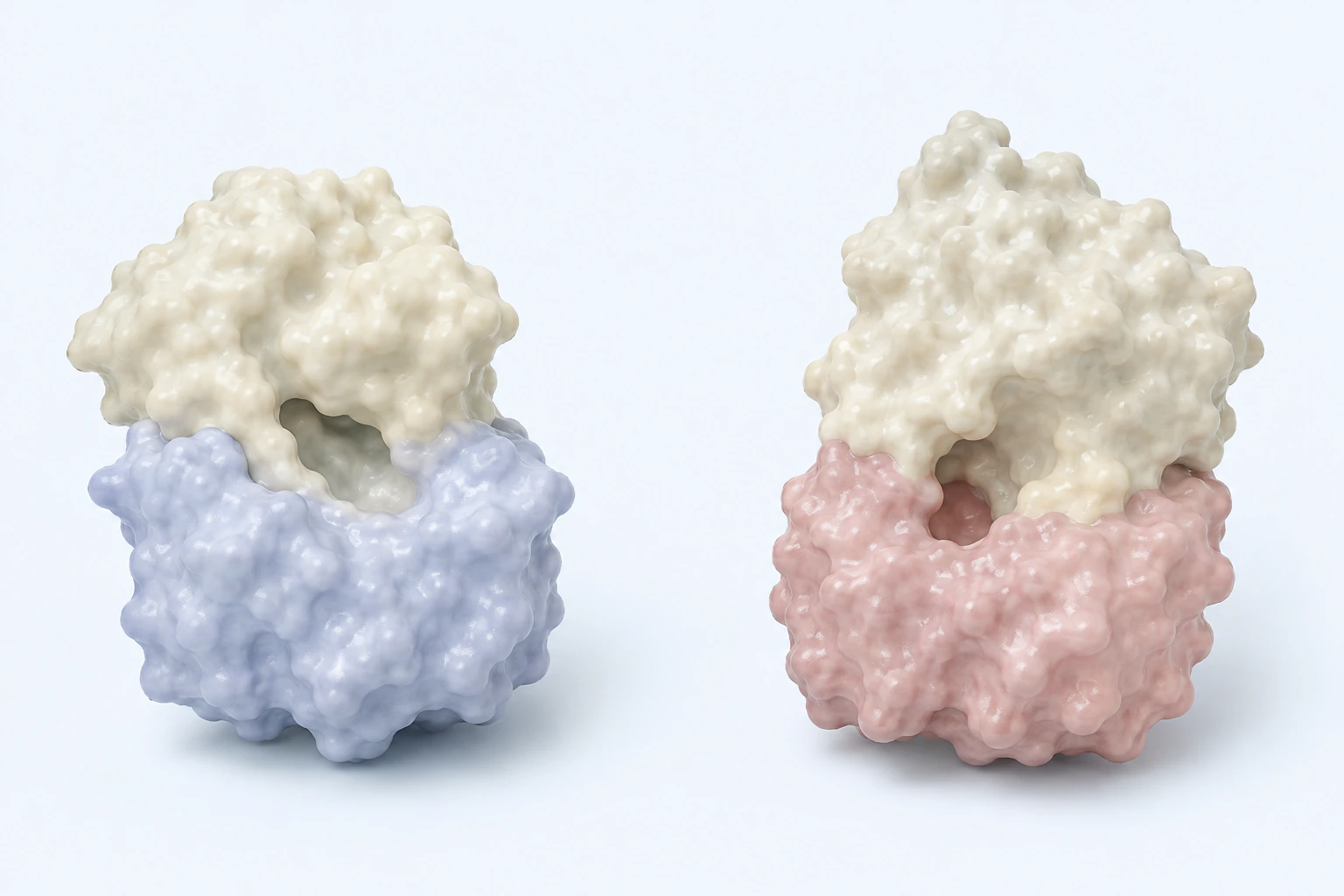
Representative resolved-fragment context for the Arg-specific RgpB and Lys-specific Kgp gingipain classes. These non-atomic models do not show full-length proteins, RgpA, a catalytic event, metal dependence, virulence, disease, or treatment.
Scientific media record9 verified identifiers
- Subject
- Gingipainsbiological-process
- Identifiers
- WikiBiome:gingipainsMeSH:D000080867MEROPS:C25EC:3.4.22.37EC:3.4.22.47UniProt:P95493UniProt:Q51817PDB:1CVRPDB:4RBM
- Review
- Editorial review completeIdentifiers authority-verified · Accessibility validated · · gingipains|gingipains-mechanism-v1.webp
- Digital source
- Trained-algorithmic mediaCreated with a trained generative algorithm and reviewed by WikiBiome for subject identity, scientific framing, identifiers, provenance, and accessibility.
- Scientific basis
- Gingipains — Medical Subject HeadingsPeptidase family C25 — MEROPSEC 3.4.22.37EC 3.4.22.47UniProtKB P95493UniProtKB Q51817PDB 1CVRPDB 4RBMGingipains
- License
- CC BY-SA 4.0Created
Gingipains are the zinc-dependent cysteine proteases that serve as the master virulence factors of Porphyromonas gingivalis. Three gingipains exist: RgpA and RgpB (arginine-specific) and Kgp (lysine-specific).
They require zinc as a catalytic cofactor, making gingipain activity directly modulated by local zinc availability—a metal-dependent Achilles' heel (Karen's Brain Primitive 4).
Evidence map6 cited passagesInspect provenance +
Immune evasion: Cleave IgG, complement C3/C4, and IL-8 (preventing neutrophil recruitment).
Amyloid generation: Cleave amyloid precursor protein (APP) and tau, generating amyloidogenic fragments that aggregate in the brain → Alzheimer's pathogenesis.
Co-aggregation: RgpA hemagglutinin domain binds fungal adhesin Als3, mediating C. albicans-P. gingivalis functional shielding partnership.
CVD: Gingipain-mediated endothelial damage and platelet aggregation disruption.
Gingipain (Rgp) activity increases up to 10-fold in the presence of C. albicans under normoxic conditions—the fungal biofilm both protects P. gingivalis from immune detection AND amplifies its virulence enzyme output.
cortisol upregulates T9SS genes that secrete gingipains but does not directly upregulate gingipain transcription (kgp, rgpA, rgpB unchanged)—the increased gingipain activity in stress may result from increased bacterial numbers rather than per-cell enzyme induction.
Functions#
Tissue destruction: Degrade collagen, fibronectin, laminin in periodontal ligament. Immune evasion: Cleave IgG, complement C3/C4, and IL-8 (preventing neutrophil recruitment).[1]Bartnicka et al. 2020 — Candida albicans Shields the Periodontal Killer Porphyromonas gingivalis from Recognition by the Host Immune System and Supports the Bacterial Infection of Gingival TissueDominika Bartnicka, Miriam Gonzalez-Gonzalez, Joanna Sykut et al. · 2020Open reference 1 ↓
Amyloid generation: Cleave amyloid precursor protein (APP) and tau, generating amyloidogenic fragments that aggregate in the brain → Alzheimer's pathogenesis.[2]Ibrahim 2023 -- Association Between Oral Dysbiosis and Parkinson's Disease: A Systematic ReviewAsmaa Ibrahim, Saravanan Subramanian, Vijaya Anand et al. · 2023Open reference 2 ↓
cobalt (Co)-aggregation: RgpA hemagglutinin domain binds fungal adhesin Als3, mediating C. albicans-P. gingivalis Functional Shielding partnership.[1]Bartnicka et al. 2020 — Candida albicans Shields the Periodontal Killer Porphyromonas gingivalis from Recognition by the Host Immune System and Supports the Bacterial Infection of Gingival TissueDominika Bartnicka, Miriam Gonzalez-Gonzalez, Joanna Sykut et al. · 2020Open reference 1 ↓ CVD: Gingipain-mediated endothelial damage and platelet aggregation disruption.[3]Gualtero 2023 — Oral Microbiome Mediated Inflammation, a Potential Inductor of Vascular Diseases: A Comprehensive ReviewDiego F. Gualtero, Gloria Ines Lafaurie, Diana Marcela Buitrago et al. · 2023Open reference 3 ↓[4]Periodontal Biomarkers in Cardiovascular Disease: Mechanisms, Diagnostics, and Clinical ImplicationsMax Foroughi, Keykavous Parang · 2026Open reference 4 ↓
Amplification by C. albicans#
Gingipain (Rgp) activity increases up to 10-fold in the presence of C. albicans under normoxic conditions—the fungal biofilm both protects P. gingivalis from immune detection AND amplifies its virulence enzyme output.[1]Bartnicka et al. 2020 — Candida albicans Shields the Periodontal Killer Porphyromonas gingivalis from Recognition by the Host Immune System and Supports the Bacterial Infection of Gingival TissueDominika Bartnicka, Miriam Gonzalez-Gonzalez, Joanna Sykut et al. · 2020Open reference 1 ↓
Cortisol Connection#
Cortisol upregulates T9SS genes that secrete gingipains but does not directly upregulate gingipain transcription (kgp, rgpA, rgpB unchanged)—the increased gingipain activity in stress may result from increased bacterial numbers rather than per-cell enzyme induction.[5]Kim et al. 2022 — Cortisol Promotes Surface Translocation of Porphyromonas gingivalisHey-Min Kim, Christina Magda Rothenberger, Mary Ellen Davey · 2022Open reference 5 ↓
Cross-References#
- Porphyromonas gingivalis—the organism producing gingipains
- Zinc—catalytic cofactor; zinc availability modulates gingipain activity
- Functional Shielding—C. albicans amplifies gingipain activity 10-fold
- Amyloid-Beta—gingipain-generated amyloidogenic fragments
- Alzheimer's Disease—gingipain-Alzheimer's connection
- Periodontitis—gingipain-driven tissue destruction
- IL-8 (Interleukin-8 / CXCL8)—gingipain substrate; degradation prevents neutrophil recruitment
References 6
Numbered by first appearance in the article, then reconciled with its declared source list.
- 1
★Dominika Bartnicka, Miriam Gonzalez-Gonzalez, Joanna Sykut et al. (2020). Bartnicka et al. 2020 — Candida albicans Shields the Periodontal Killer Porphyromonas gingivalis from Recognition by the Host Immune System and Supports the Bacterial Infection of Gingival Tissue. International Journal of Molecular Sciences.
- 2
Asmaa Ibrahim, Saravanan Subramanian, Vijaya Anand et al. (2023). Ibrahim 2023 -- Association Between Oral Dysbiosis and Parkinson's Disease: A Systematic Review. Journal of Oral Microbiology.
- 3
Diego F. Gualtero, Gloria Ines Lafaurie, Diana Marcela Buitrago et al. (2023). Gualtero 2023 — Oral Microbiome Mediated Inflammation, a Potential Inductor of Vascular Diseases: A Comprehensive Review. Frontiers in Cardiovascular Medicine.
- 4
Max Foroughi, Keykavous Parang (2026). Periodontal Biomarkers in Cardiovascular Disease: Mechanisms, Diagnostics, and Clinical Implications. Infection.
- 5
Hey-Min Kim, Christina Magda Rothenberger, Mary Ellen Davey (2022). Kim et al. 2022 — Cortisol Promotes Surface Translocation of Porphyromonas gingivalis. Pathogens.
- 6
Kudra A, Muszynski D, Sobocki BK et al. (2023). Insights into Oral Microbiome and Colorectal Cancer - On the Way of Searching New Perspectives. Frontiers in Cellular and Infection Microbiology.
Article network
Connect the evidence
Publicly readable discussion by ORCID-authenticated researchers. Questions, interpretation, methods, corrections, and new evidence stay attached to this record.
No discussion yet. Start with a precise question or a source-backed observation.
Activity and accepted changes
Accepted researcher context, editorial status, public discussion, and upstream Git revisions are shown together. Pending, declined, and withdrawn proposals remain private.
- published revision
massive wiki expansion: 149 stubs fixed, 100+ new pages, Rule 15 scan, keystone papers
WikiBiome Deploy Bot · +51 −0
Inspect exact Git diff ↗