

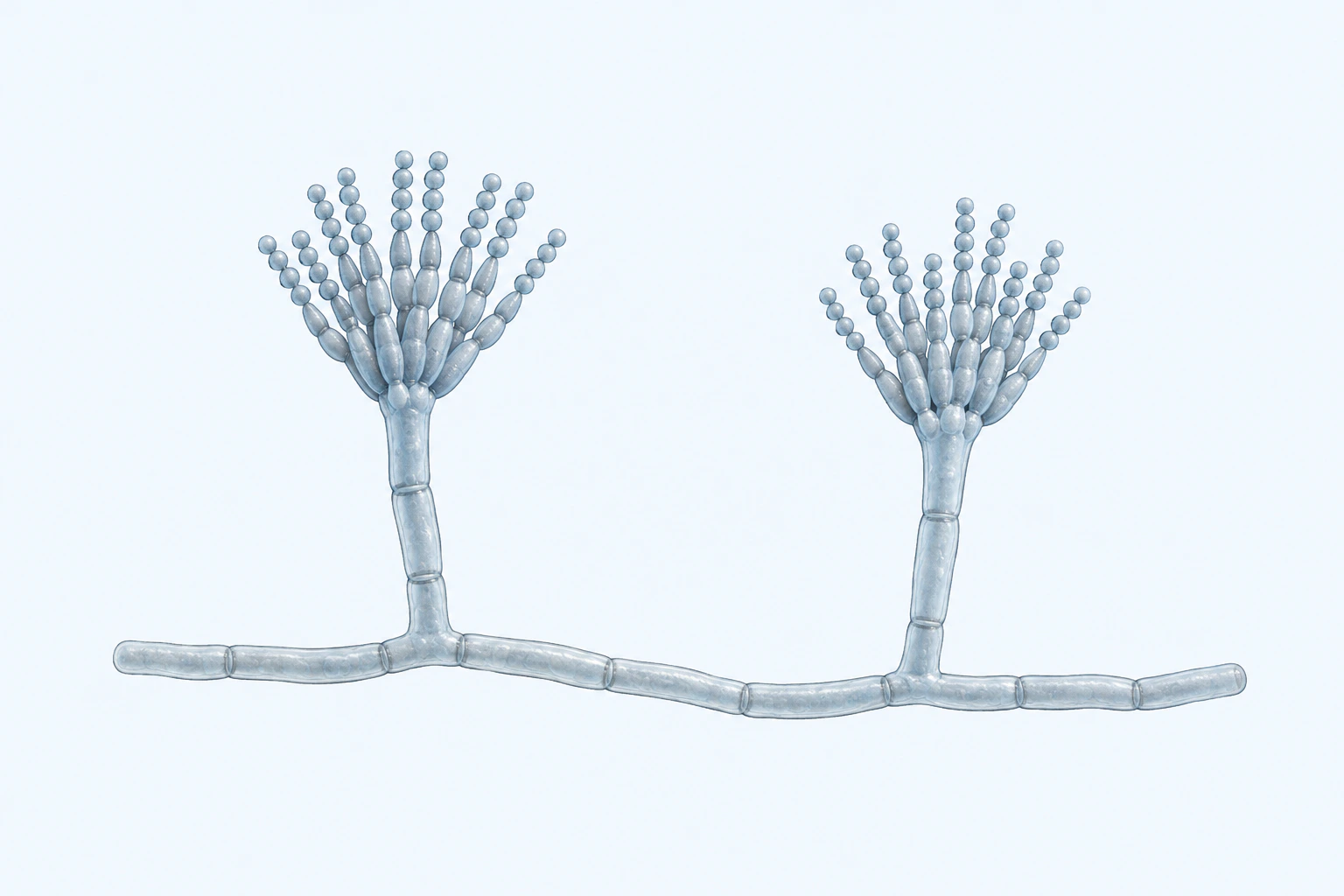
Type-species-anchored Penicillium reconstruction with one connected septate hyphal grouping and two brush-like conidiophores bearing attached conidial chains. This genus plate is representative, non-universal, non-diagnostic, and not a micrograph.
Scientific media record2 verified identifiers
- Subject
- Penicilliumtaxon · genus
- Identifiers
- NCBITaxon:5073IndexFungorum:9257
- Review
- Editorial review completeIdentifiers authority-verified · Accessibility validated · · penicillium|penicillium-morphology-v1.webp
- Digital source
- Trained-algorithmic mediaCreated with a trained generative algorithm and reviewed by WikiBiome for subject identity, scientific framing, identifiers, provenance, and accessibility.
- Scientific basis
- Penicillium — NCBI TaxonomyPenicillium — Index FungorumIdentification and nomenclature of the genus Penicillium
- License
- CC BY-SA 4.0Created
Penicillium is a genus of filamentous fungi best known as the source of penicillin. In the WikiBiome context, Penicillium appears in the gut Mycobiome—the fungal component of the microbiome—with associations across ASD, pancreatitis, and cardiometabolic disease.
Evidence map3 cited passagesInspect provenance +
ASD: Altered Penicillium abundance in gut mycobiome of ASD children.
Pancreatitis: Part of intestinal fungal microbiota shifts in acute pancreatitis.
Cardiometabolic disease: Part of gut mycobiome in cardiometabolic progression.
Disease Associations#
ASD: Altered Penicillium abundance in gut mycobiome of ASD children.[1]Patel 2018 -- Analysis of Yeast and Fungi in Children with ASD vs. Neurotypical ControlsJigar Patel, Dae-Wook Kang, James Adams et al. · 2018Open reference 1 ↓[2]Strati 2017 — New Evidences on the Altered Gut Microbiota in Autism Spectrum DisordersFrancesco Strati, Duccio Cavalieri, Davide Albanese et al. · 2017Open reference 2 ↓ Pancreatitis: Part of intestinal fungal microbiota shifts in acute pancreatitis.[3]Profile of intestinal fungal microbiota in acute pancreatitis patients and healthy individualsMeng-Qi Zhao, Miao-Yan Fan, Meng-Yan Cui et al. · 2025Open reference 3 ↓
Cardiometabolic disease: Part of gut mycobiome in cardiometabolic progression.[4]Gut mycobiome in cardiometabolic disease progression: current evidence and future directionsXiaoyu Wei, Zixin Guo, Jingyang Wang et al. · 2025Open reference 4 ↓
Cross-References#
- Mycobiome—fungal component of microbiome
- Candida albicans—dominant pathogenic gut fungus
- Aspergillus—related filamentous fungal genus
References 5
Numbered by first appearance in the article, then reconciled with its declared source list.
- 1
Jigar Patel, Dae-Wook Kang, James Adams et al. (2018). Patel 2018 -- Analysis of Yeast and Fungi in Children with ASD vs. Neurotypical Controls. Unpublished/Preprint.
- 2
Francesco Strati, Duccio Cavalieri, Davide Albanese et al. (2017). Strati 2017 — New Evidences on the Altered Gut Microbiota in Autism Spectrum Disorders. Microbiome.
- 3
Meng-Qi Zhao, Miao-Yan Fan, Meng-Yan Cui et al. (2025). Profile of intestinal fungal microbiota in acute pancreatitis patients and healthy individuals. Gut Pathogens.
- 4
Xiaoyu Wei, Zixin Guo, Jingyang Wang et al. (2025). Gut mycobiome in cardiometabolic disease progression: current evidence and future directions. Frontiers in Microbiology.
- 5
Anees Ur Rahman, Abdullah Abdullah, Shah Faisal et al. (2024). Rahman 2024 — Nigella sativa extract: phytochemical analysis and antimicrobial/antioxidant activity. BMC Complementary Medicine and Therapies.
Article network
Mentioned here 3
Connect the evidence
Publicly readable discussion by ORCID-authenticated researchers. Questions, interpretation, methods, corrections, and new evidence stay attached to this record.
No discussion yet. Start with a precise question or a source-backed observation.
Published page changes
This record shows only material changes published on this page, including changes to its content, evidence, conclusions, or author context. Internal processes and discussion activity are excluded. Pending, declined, and withdrawn proposals remain private.
- published revision
Created “Penicillium”: Penicillium is a genus of filamentous fungi best known as the source of penicillin. In the WikiBiome context, Penicillium appears in the gut mycobiome — the fungal component of the microbiome — with…
Created “Penicillium”: Penicillium is a genus of filamentous fungi best known as the source of penicillin. In the WikiBiome context, Penicillium appears in the gut mycobiome — the fungal component of the microbiome — with… Published sections: Penicillium; Disease Associations; Cross-References. · WikiBiome Deploy Bot · +42 −0
Inspect exact Git diff ↗