
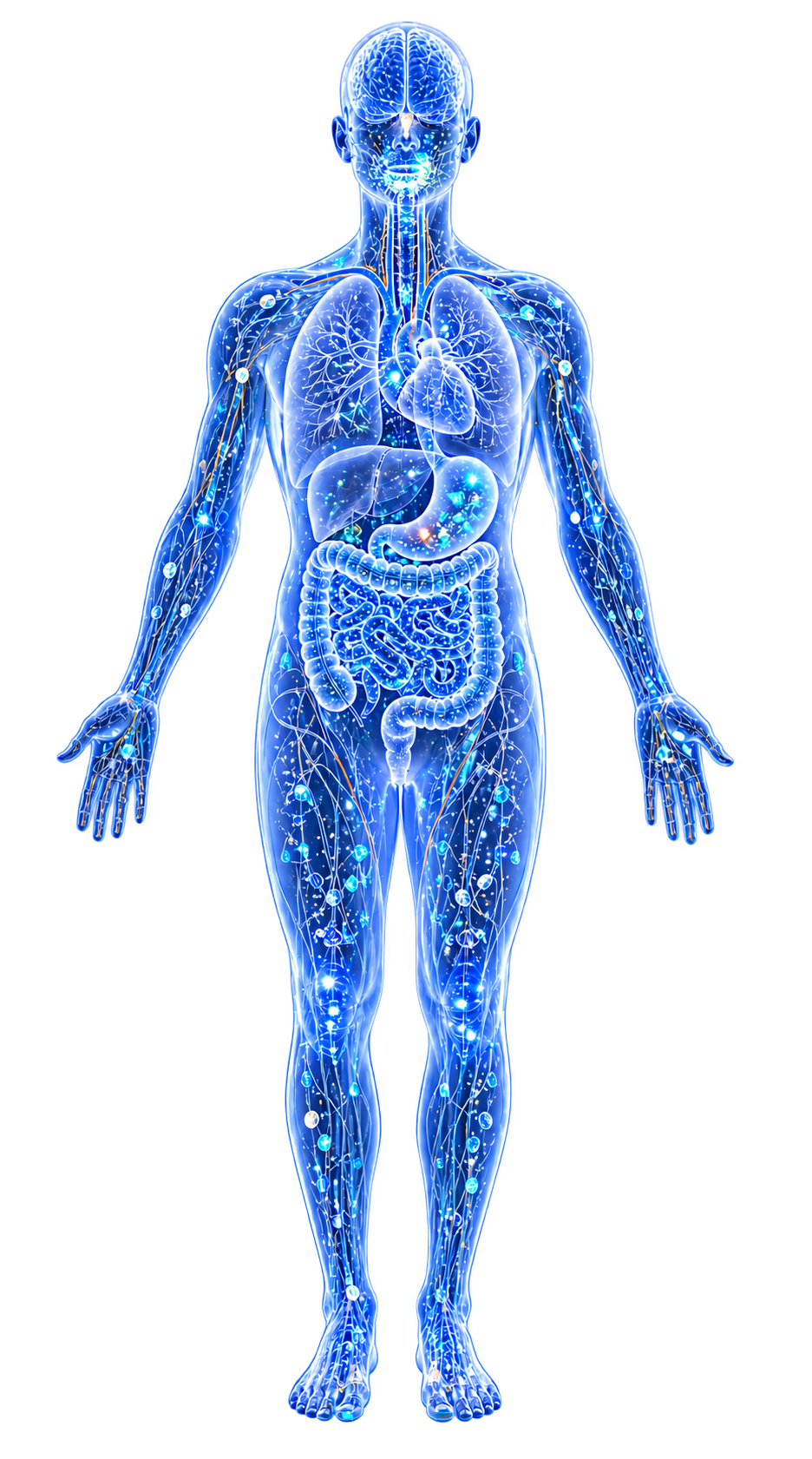
Chelation therapy uses molecules with high affinity for specific metal ions to form stable, excretable complexes, removing toxic metals from the body. The word derives from Greek "chele" (claw)—the chelator grips the metal ion at multiple coordination sites.
While chelation is life-saving in acute poisoning, its application in chronic low-level exposure and complex diseases remains controversial, and the risks of Mis-Metallation and essential metal depletion are non-trivial.
Contents
1. Major Chelating Agents2. When Chelation Is Appropriate3. Risks and Controversies4. Metal-Specific Protocols5. See AlsoMajor Chelating Agents#
EDTA (Ethylenediaminetetraacetic acid)#
- Target metals: Lead, cadmium, zinc, calcium
- Route: IV infusion (CaNa2EDTA to avoid hypocalcemia)
- Clinical use: Acute lead poisoning; the TACT trial showed modest benefit in post-MI diabetic patients with elevated lead
- Limitations: Poor oral bioavailability; non-selective (depletes zinc (Zn), copper (Cu), manganese (Mn))
DMSA (Succimer / Dimercaptosuccinic acid)#
- Target metals: Lead, Mercury, Arsenic
- Route: Oral
- Clinical use: FDA-approved for lead poisoning in children (blood lead (Pb) >45 mcg/dL). First-line pediatric chelator due to oral administration and relative safety.
- Limitations: Does not cross blood-brain barrier effectively; may redistribute metals if given before source removal
DMPS (2,3-Dimercapto-1-propanesulfonic acid / Unithiol)#
- Target metals: Mercury (especially inorganic), Arsenic, Lead
- Route: Oral or IV
- Clinical use: Mercury poisoning (preferred over DMSA for inorganic mercury (Hg)); arsenic poisoning. Not FDA-approved in the US but used widely in Europe.
- Limitations: Can mobilize mercury from tissue stores; renal excretion requires adequate kidney function
D-Penicillamine#
- Target metals: Copper, Lead, mercury
- Route: Oral
- Clinical use: Wilson's disease (Copper overload)—historical first-line agent. Also used in lead and mercury poisoning when DMSA/DMPS unavailable.
- Limitations: Significant side effects (nephrotoxicity, bone marrow suppression, autoimmune reactions); largely supplanted by trientine for Wilson's disease
Deferoxamine (Desferal)#
- Target metals: Iron
- Route: SC or IV infusion (poorly absorbed orally)
- Clinical use: Acute iron poisoning; chronic iron overload from transfusion-dependent thalassemia. The siderophore-derived chelator with highest iron specificity.
- Limitations: Requires prolonged infusion (8-12 hrs SC); ototoxicity, retinal toxicity with chronic use
Deferasirox (Exjade/Jadenu)#
- Target metals: Iron
- Route: Oral (once daily)
- Clinical use: Chronic transfusional iron overload. Revolutionized iron chelation by replacing deferoxamine infusions with oral dosing.
- Limitations: Hepatotoxicity, nephrotoxicity; GI side effects; expensive
Disulfiram / Diethyldithiocarbamate (DDC)#
- Target metals: Nickel, copper
- Route: Oral
- Clinical use: Nickel carbonyl poisoning (the specific antidote). DDC, the active metabolite of disulfiram (Antabuse), chelates nickel (Ni)(II) with high affinity. Also explored for copper chelation in cancer therapy.
- Limitations: Disulfiram-alcohol reaction; hepatotoxicity; limited clinical experience outside nickel carbonyl poisoning
When Chelation Is Appropriate#
Acute poisoning with confirmed toxic metal levels above treatment thresholds. Chronic overload with documented tissue accumulation (e.g., transfusional iron overload, Wilson's disease). Symptomatic exposure where metal levels correlate with clinical findings and source has been removed.
Risks and Controversies#
Essential Metal Depletion#
No chelator is perfectly selective. EDTA depletes zinc and calcium. DMSA can lower zinc and copper.
Deferoxamine given to iron-replete individuals causes iron deficiency. This creates a paradox: chelation of one toxic metal may induce deficiency of another essential metal, potentially worsening disease through Mis-Metallation.
Redistribution#
Chelators can mobilize metals from stable tissue depots into the bloodstream, potentially increasing exposure to vulnerable organs (especially the brain) before the complex is excreted. This is particularly concerning for mercury and lead.
The Autism Controversy#
Chelation therapy has been promoted in alternative medicine for Autism Spectrum Disorder based on the theory that mercury (from thimerosal in vaccines) causes autism. Multiple systematic reviews find no evidence supporting this practice. The FDA has warned against over-the-counter chelation products.
At least one child death has been attributed to inappropriate EDTA chelation.
Chelation vs. Microbiome#
An underexplored dimension: chelation alters luminal metal availability, which directly impacts the Gut-Metal-Microbiome Interactions. Removing iron via chelation could starve iron-dependent pathobionts but also deprive beneficial Lactobacillus species. The microbiome consequences of chelation therapy remain largely unstudied.
Metal-Specific Protocols#
| Metal | First-Line Chelator | Alternative | Key Consideration |
|---|---|---|---|
| Lead (adult) | CaNa2EDTA | DMSA | Remove source first |
| Lead (child) | DMSA (succimer) | CaNa2EDTA | Threshold: blood lead (Pb) >45 mcg/dL |
| Mercury (inorganic) | DMPS | DMSA | Monitor renal function |
| Mercury (organic/methyl) | DMSA | None well-established | Poor CNS penetration limits efficacy |
| Arsenic | DMPS or DMSA | BAL (dimercaprol) | BAL is older, more toxic |
| Iron (acute) | Deferoxamine | — | Vin rose urine confirms chelation |
| Iron (chronic) | Deferasirox | Deferoxamine | Oral vs. infusion trade-off |
| Copper (Wilson's) | Trientine or D-penicillamine | Zinc (maintenance) | Zinc blocks absorption long-term |
| Nickel (nickel (Ni) carbonyl) | Disulfiram/DDC | — | Specific antidote |
See Also#
- Mis-Metallation—the fundamental problem chelation can cause
- Environmental Metal Exposure—source identification before chelation
- Iron / Copper / Lead / Mercury / Arsenic / Nickel—individual metal pages
- Gut-Metal-Microbiome Interactions—unexplored microbiome effects of chelation
References 6
Numbered by first appearance in the article, then reconciled with its declared source list.
- 1
★Balali-Mood M, Naseri K, Tahergorabi Z et al. (2021). Toxic Mechanisms of Five Heavy Metals: Mercury, Lead, Chromium, Cadmium, and Arsenic. Frontiers in Pharmacology.
- 2
Jessica Briffa, Emmanuel Sinagra, Renald Blundell (2020). Heavy Metal Pollution in the Environment and Their Toxicological Effects on Humans. Heliyon.
- 3
★Monisha Jaishankar, Tenzin Tseten, Naresh Anbalagan et al. (2014). Toxicity, Mechanism and Health Effects of Some Heavy Metals. Interdisciplinary Toxicology.
- 4
Passeri E, et al. (2024). Recent Advances in Therapeutics for the Treatment of Alzheimer's Disease. (Brain Sciences / related journal).
- 5
★Manish Mishra, Larry Nichols, Aditi A. Dave et al. (2022). Molecular Mechanisms of Cellular Injury and Role of Toxic Heavy Metals in Chronic Kidney Disease. International Journal of Molecular Sciences.
- 6
★Tizabi Y, Bennani S, El Kouhen N et al. (2023). Interaction of Heavy Metal Lead with Gut Microbiota: Implications for Autism Spectrum Disorder. Biomolecules.
Article network
Mentioned here 11
Pages linking here 11
Connect the evidence
Publicly readable discussion by ORCID-authenticated researchers. Questions, interpretation, methods, corrections, and new evidence stay attached to this record.
No discussion yet. Start with a precise question or a source-backed observation.
Activity and accepted changes
Accepted researcher context, editorial status, public discussion, and upstream Git revisions are shown together. Pending, declined, and withdrawn proposals remain private.
- published revision
massive wiki expansion: 149 stubs fixed, 100+ new pages, Rule 15 scan, keystone papers
WikiBiome Deploy Bot · +31 −31
Inspect exact Git diff ↗ - published revision
nightly maintenance: 94 stub demotions, 181 source_count fixes, 22 auto-discovered stubs, 5 adversarial audits, 3 boundary fixes, 3 evidence-level corrections
WikiBiome Deploy Bot · +1 −0
Inspect exact Git diff ↗ - published revision
pre-overnight checkpoint 2026-04-18
WikiBiome Deploy Bot · +3 −1
Inspect exact Git diff ↗ - published revision
Batch: fix 1025 broken wikilinks, wire 13 STOP pages, deepen PPD/GERD/T1D/8 microbes
WikiBiome Deploy Bot · +15 −15
Inspect exact Git diff ↗ - published revision
WikiBiome update — 2026-04-11 22:49
WikiBiome Deploy Bot · +99 −0
Inspect exact Git diff ↗